Renal & Urinary System
 Call Kai
 Learn
Learn Practice Test
 Spaced Repetition
 Match
Match Flashcards
 Knowt Play
1/90

There's no tags or description
Looks like no tags are added yet.
Name | Mastery | Learn | Test | Matching | Spaced | Call with Kai |
|---|
No analytics yet
Send a link to your students to track their progress
91 Terms
Eliminate waste and regulate volume and composition
-filter blood plasma
-regulate bv
-osmolarity of body fluids
Kidneys fundamental role
Glucose
In times of starvation, the kidneys will make ________
Waste
any substance that is useless to body or in excess of the bodies needs
Nitrogen
Most toxic of our metabolic wastes
Urea
The liver converts ammonia to ________ because its significantly less toxic
Gout
Too much uric acid leads to
BUN
An expression of the level of nitrogenous waste in the blood
Azotemia
INCREASED BUN - indicates renal insufficiency (not filtering waste); may progress to uremia
Uremia
a syndrome of diarrhea, vomiting, dyspnea, and cardiac arrhythmia all due to the toxic effects as wastes accumulate
Cortex
The _______ is the outer area of the kidney
Medulla
The _______ is the inner area of the kidney that surrounds the renal sinus
Major and minor
There are _______ calyx and _______ calyx in the kidenys
Renal pelvis
enlarged chamber formed by 2-3
major calyces
Ureter
tubular continuation of renal pelvis that drains urine to bladder
Artery → Afferent arteriole → Glomerulus → Efferent arteriole → Capillaries/Vasa recta → Vein
Describe circulation through the kidney
Nephron, cortex
The _______ is the functional unit of the kidney, located in the _______
Renal corpuscle
Renal tubule
__________: where blood plasma is filtered
_________: where plasma filtrates into urine
Bowman's capsule, proximal tubule, loop of henle, distal tubule
What are the 4 parts of the nephron
2, parietal and visceral
The bowman's capsule has ____ layers and they are ______ and _______
podocytes
The visceral layer consists of _______
Capsular
The ______ space is found between the parietal and visceral layers in the bowman's capsule
Glomerular filtrate
What collects in the capsular space?
Network of capillaries
-vascular and urinary pole
What is the glomerulus? What are its "poles"?
PCT
longest, most coiled, simple cuboidal with brush border (microvilli)
Ascending and descending
The loop of henle has a ______ portion and ________ portion
Thick segment
part of descending limb and
most of ascending limb, active transport of salts
Very water permeable
Unique feature of thin segment of loop of henle
Renal corpuscle → PCT→ nephron loop →DCT → collecting duct→ papillary duct →minor calyx → major
calyx → renal pelvis →ureter → urinarybladder → urethra
*****What is the flow of glomerular filtrate from start to finish?******
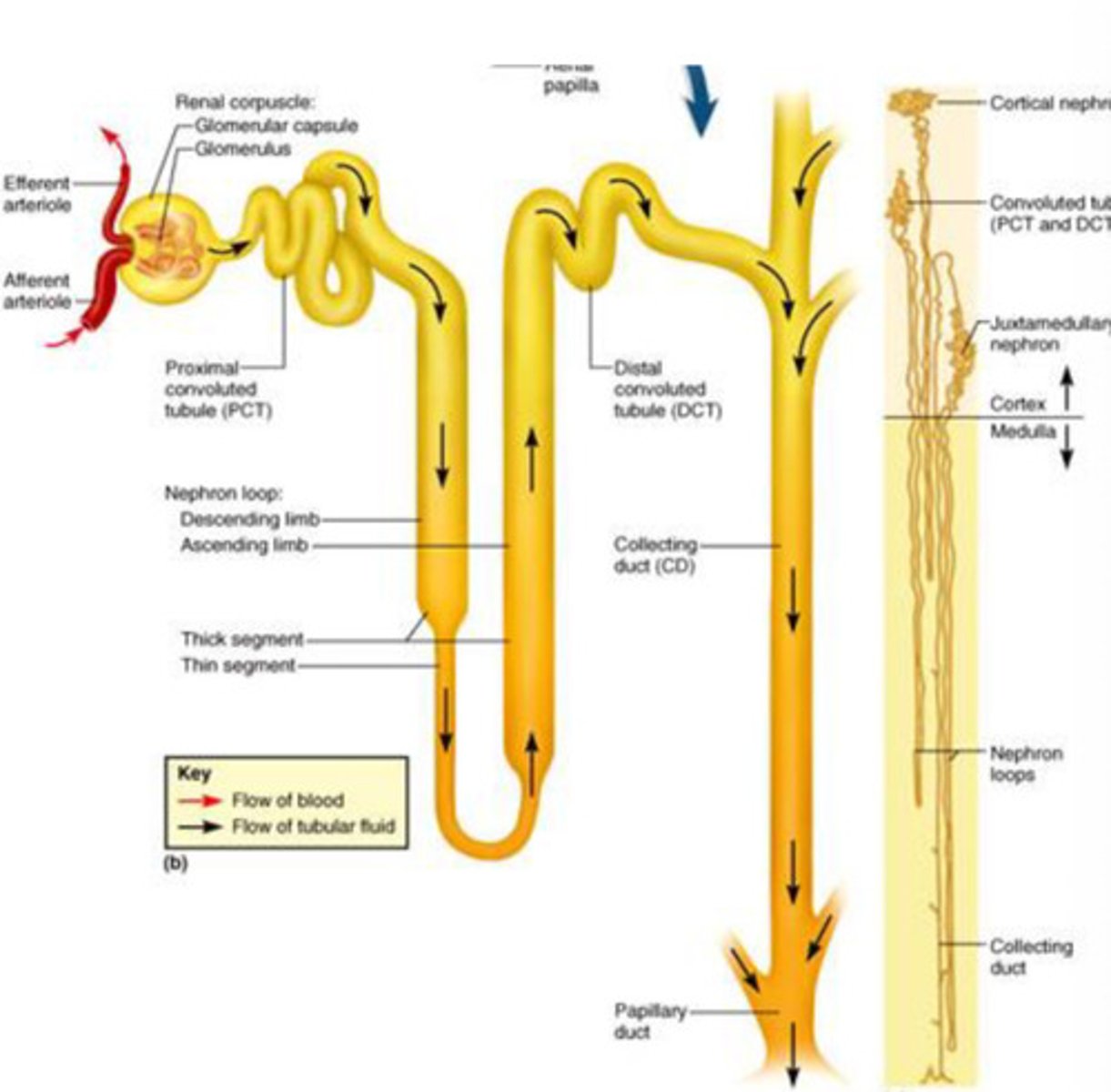
Cortical (95%)
Juxtamedullary
What are the 2 types of nephrons
juxtamedullary nephrons
This neuron helps maintain salt gradients and conserve water
-glomerular filtration
-tubular reabsorption/secretion
-water conservation
The kidney converts blood plasma to urine. How?
fenestarted capillary, basement membrane, filtration slits
The filtration membrane must pass....
Negative, to repel albumin
the basement membrane has a (positive/negative) charge. Why?
Protein and blood are seen in urine
If the filtration membrane is damaged then...
The high pressure causes the vessel walls to thicken and narrow, reducing blood flow to the nephrons.
How can hypertension affect kidney function?
Glomerulus. It has large afferent arterioles and small efferent arterioles
Blood hydrostatic pressure is much higher in the _______ than anywhere else in the body. Why?
High, kidneys
Because the "blood pressure" within the glomerulus is already________, the ______ are particularly vulnerable to systemic hypertension
GFR
Amount of filtrate formed per minute by both kidneys
combined
Dehydration, electrolyte depletion
Increased GFR indicates
Less filtrate is being formed and less water removal
Decreased GFR indicates
Adjusting glomerular bp
Yes, by causing smooth muscle to contract when stretched and tubuloglomerular feedback
How is GFR controlled?
Do neurons adjust their own blood flow? How?
Myogenic
Stretches, constricts, decreases
________ mechanism: smooth muscle will contract when stretched
Systemic increased BP → _______ afferent arteriole → afferent arteriole
________ → (increases/decreases) blood flow
Juxtaglomerular apparatus
a complex of structures
found at very end of loop of Henle. Contains 3 special cell
types
Macula densa, JG cells, mesangial cells
3 cells that make up juxtagomerular apparatus
JG
These cells of the juxtaglomerular apparatus vasodilate/vasoconstrict arterioles
Mesangial
These cells of the juxtaglomerular apparatus can contract glomerular
capillaries to reduce filtration OR relax to increase blood flow & filtration
Macula densa
These cells of the juxtaglomerular apparatus send signals to constrict AFFERENT arteriole to DECREASE GFR
High BP causes a rapid flow of filtrate into renal tubules.
The macular densa senses this and secretes paracrine.
Constriction of afferent arterioles occurs to reduce GFR
How does control of GFR act as a negative feedback system?
JG
______ cells release renin
Stimulates widespread vasoconstriction
Reduces GFR/water loss
Secretes aldosterone and ADH
What are the effects of angiotensin II on the kidney
Reabsorbs 65% of the glomerular filtrate.
Sodium is reabsorbed
Role of PCT
Sodium
Most important ion reabsorbed by PCT
Secondary active transport
Na/K pumps
Paracellualr and transcellular routes
How is chloride reabsorbed by the PCT?
Co-transport with NA using symports called SGLTs then enters capillaries via facilitated diffusion
How is glucose reabsorbed by the PCT?
Paracellular route w water
How are electrolytes (K, MG, P) reabsorbed by the PCT?
Urea diffuses through tubule epithelium with water
How is nitrogenous waste reabsorbed by the PCT?
Increases
As volume of filtrate decreases, concentration of urea (increases/decreases)
Yes
No, too large
Yes
Does the PCT reabsorb uric acid? Creatinine? Water?
peritubular capillaries
Reabsorption of water and solutes occurs at the
High, low
A (low/high) colloid osmotic pressure and (low/high) blood hydorsotatic pressure favors water reabsorption
remaining solute molecules will escape being reabsorbed and spill into urine
If all transporters are occupied, then....
waste removal and acid-base balance
What is tubular secretion of the PCT
Generates solute gradient
Ascending (thick)
Loop of henle primary function?Which segment is impermeable to water?
Ascending (thick)
Descending (thin)
The _______ segment is not permeable to water, the ______ segment is highly permeable to water
Aldosterone, ANP, ADH, PTH
Which hormones regulate DCT and the collecting ducts?
Aldosterone
A drop in BP triggers
The posterior pituitary to secrete ADH to INCREASE waster reabsorption
Dehydration stimulates....
ANH, increases
_______ is released in response to HIGH BP, (increases/decreases GFR)
PTH
________ is released due to LOW blood calcium levels
Loop of henle
Reabsorbs another 25% of filtrate
• Primary role is to aid the function of collecting duct
PCT
Reabsorbs ~ 65% of glomerular filtrate and returns it to the
blood of peritubular capillaries
• reabsorption occurs via osmotic and cotransport linked to active
transport of sodium ions
DCT
Reabsorbs more sodium, chloride, and water
• Rates are subject to control by hormones
• Extract drugs, waste
Collecting duct, cortex
The _______ conserves body water and begins in the ________
High
In order to concentrate urine (and
prevent a large volume of water from being lost), the kidney must maintain a (low/high) concentration of solutes in the medulla
Proximal tubules
Na+ and other substances
removed are removed in _________
• Water follows passively
• Filtrate volume reduced
Descending loop of henle
In the ________ water exits passively, solute enters
Ascending limb
In the ________ Na+, Cl-, K+ transported out of filtrate
• Water remain
Clear to light yellow
Bacterial growth
Urine is normally which color? What does cloudy urine suggest?
Hydration
50 mOsm/L indicates (hydration/dehydration)
Dehydration
1200 mOsm/L indicates (hydration/dehydration)
Oliguria
<500mL/day is
Anuria
>100 mL/day is
Polyuria
>2L/day is
2 L
Normal amount of urine we should expel a day
diabtes
Any metabolic disorder resulting in chronic polyuria
DM
For (DM/DI), the polyuria results
from high concentrations of glucose in renal tubule
DI
For (DM/DI), the polyuria results from insufficient ADH secretion. This means the collecting duct doesn't reabsorb much water
Increase urine volume and lower bp
How do diuretics work?
Internal
External
The (internal/external) urinary sphincter contains smooth muscle
the (internal/external) urinary sphincter contains skeletal muscle
Sacral spinal cord
When voiding urine, stretch receptors send signals to