VTP test 1
 Call Kai
 Learn
Learn Practice Test
 Spaced Repetition
 Match
Match Flashcards
1/83

There's no tags or description
Looks like no tags are added yet.
Name | Mastery | Learn | Test | Matching | Spaced | Call with Kai |
|---|
No analytics yet
Send a link to your students to track their progress
84 Terms
What order do ticks belong to?
Arachnida
What is the family name for hard body ticks?
Ixodidae
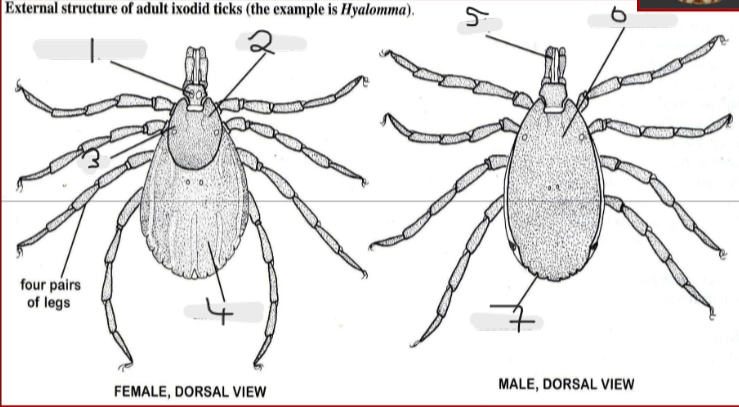
Name 1-7
1) Basis Capituli
2) Scutum
3) Eye
4) Alloscutum
5) Palp
6) Conscutum
7) Festoons
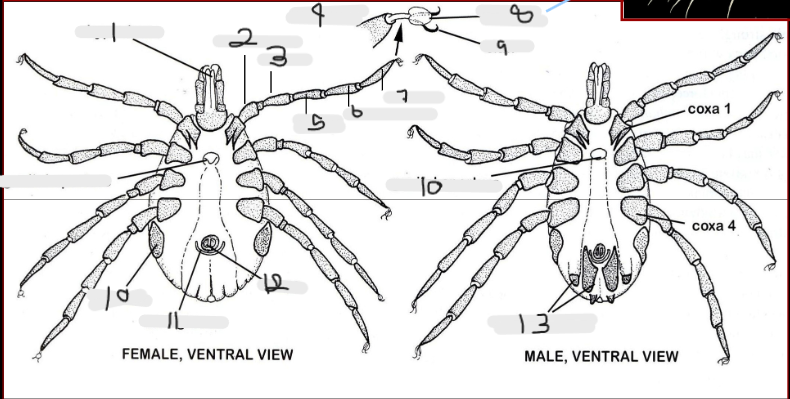
Name 1-13
1) Hypostome
2) Trochanter
3) Femur
4) Pretarsus
5) Tibia
6) Metatarsus
7) Tarsus
8) Pulvillus
9) Claw
10) Genital aperture
11) Anal groove
12) Anus
13) Ventral plates
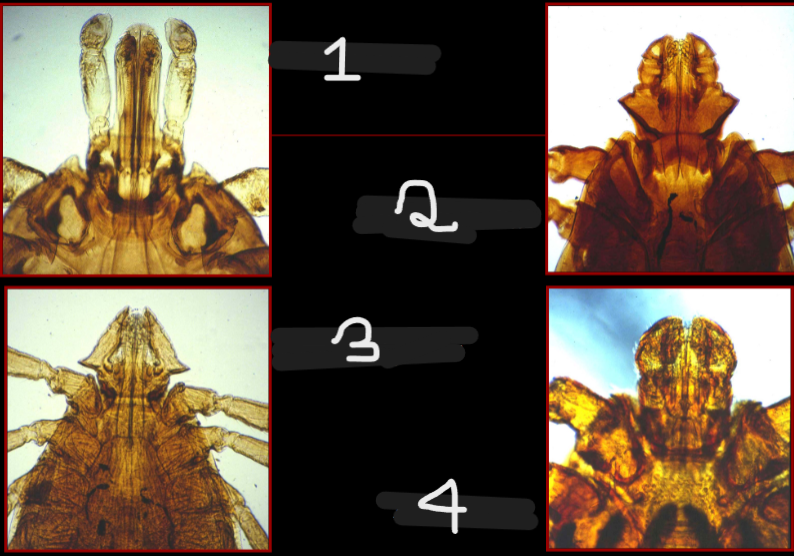
Name 1-4
1) Amblyomma
2) Rhipicephalus
3) Haemaphysalis
4) Hyalomma
What is the famioly name for soft body ticks?
Argasidae
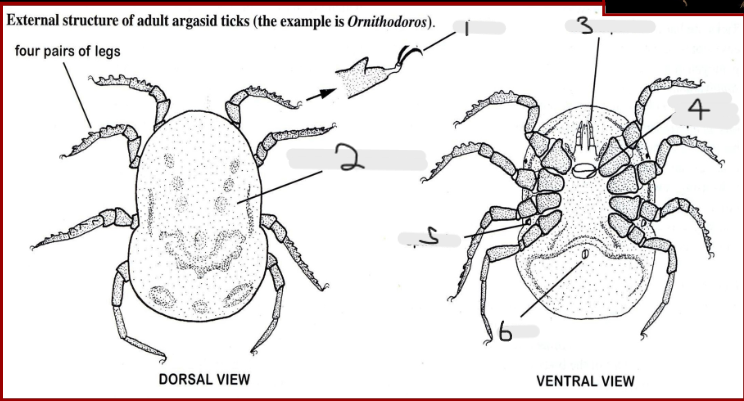
Name 1-6
1) Claw
2) Mammillated texture
3) Mouthparts
4) Gental aperture
5) Spiracle
6) Anus
What are the hosts for Argas spp?
Domestic fowl, waterfowl (ducks and geese), turkeys
What is the common name for Argas spp?
Fowl tick/fowl tampan
What is the life cycle for Argas spp?
The female lays a batch of 20-100 eggs after every blood meal. The eggs hatch in ~3 weeks. The 6 legged larva attached to the host and feed for 5-10 days, usually under the wings. They drop off and moult in cracks and crevices. The nymphs only feed for 5min-1h. There can be 4 nymoh stages, each requiring a blood meal before moulting. Moulting to the adult can occure from the 2nd stage onward. The adult, like the nymphs, usually only feed at night, when the birds are roosting. The adults feed ~once a month. Females may produce 6-7 batches of eggs in their lifetime. The larva can survive 2+ months, the nymphs a year, and the adults up to 3 years without a blood meal.
What are the 2 species in the genus Argas (that we learn of)?
Argas walkerae, Argas persicus
What is the seasonality of Argas spp?
Larva and the first nymphs are in early summer, nymph stages 2-4 in midsommer, and adults in late summer to winter. Over-winter as adults or eggs.
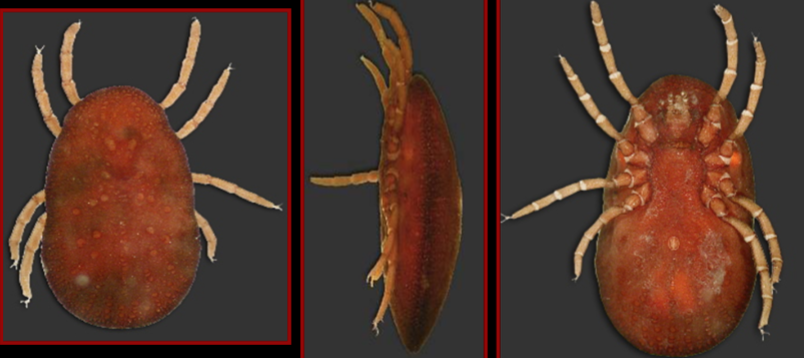
What tick is this?
Argas walkerae
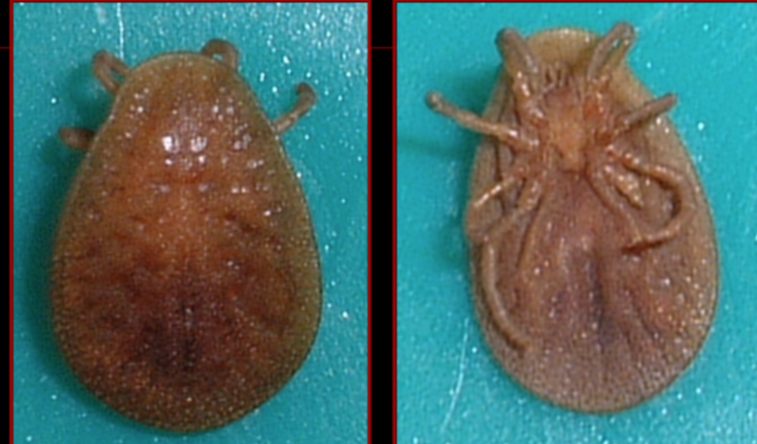
What tick is this?
Argas persicus
What is the clinical importance of Argas spp?
Spread of disease, larva secrete toxin that paralyses ducks and chickens.
How do we control Argas spp?
Through management and acaricides in the poulty housing.
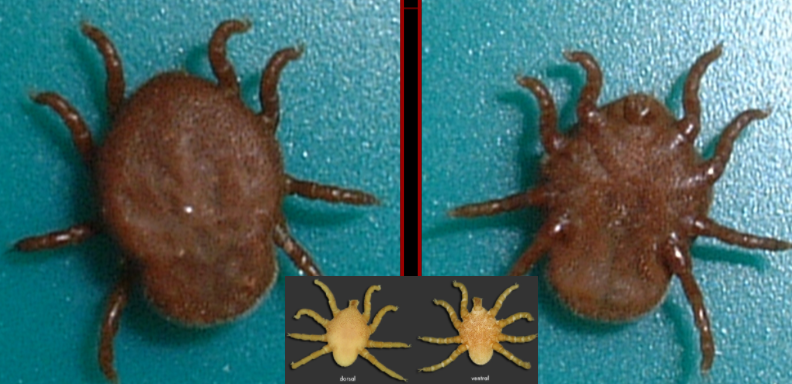
What tick is this?
Otobius megnini (spinose ear tick)
What feature is Otobius megnini missing?
Eyes
Describe what a Otobius megnini larva looks like.
These have six fairly long legs and the capitulum is situated anteriorly. As the
larvae engorge they become pear-shaped. They are white or pink in colour
Describe what a Otobius megnini nymph looks like.
There are a number of nymph stages. The earlier ones are diamond-shaped, and the later ones assume a violin-shape similar to that of the adults. The capitulum is situated antero-ventrally under the body. The nymphs are covered with short, rigid spines from which the tick derives its common name
What are the hosts for Otobius megnini?
Cattle, sheep, goats, horses, donkeys, mules and cats and occasionally humans
What is the life cycle of Otobius megnini?
The tick lays aboyt 300 - 1500 in batches over months. These eggs are laid in cracks and crevices. The eggs hatch in ~3 weeks, the larva then attach to the ear canal of the host. The larval stage is 1-2 weeks, the larva will moult in the ear. The number of nymph stages is unknown, but moulting and attachment happens in the ear. The nymph stayes in the ear for 3-6 months, and after it engorges, it detaches. The nymphs moult, and then mate. 18 months can pass before mating. Adults are non parasitic, and remain in cracks and crevices, they can live up to 2 years.
What is the importance of Otobius megnini?
The feeding and spines in the ear canal causes irritation, so the animal does not feed well.
How do we control Otobius megnini?
Acaracised onto the ear, and sprayed into cracks.
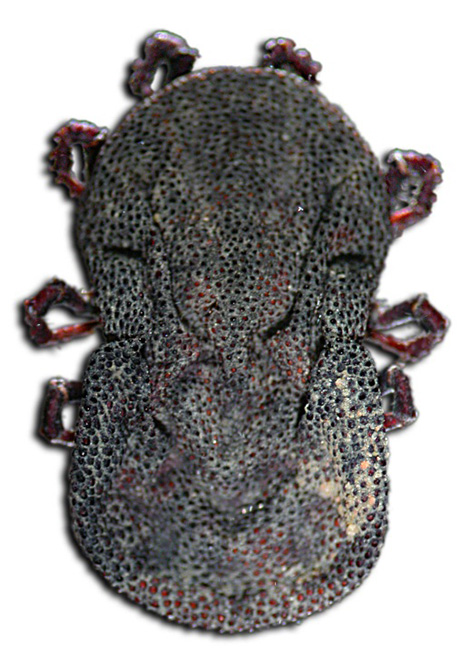
What tick is this?
Ornithodoros moubata (eyeless hut tampan) or Ornithodoros porcinus (warthog tampan)
What are the hosts for Ornithodoros spp?
O. moubata: Humans, poultry. O. porcinus: Warthogs
What is the life cycle of O. moubata and O. porcinus?
After a blood meal (usually at night) and mating, the female will lay about 300 eggs. 6 legged larva emerge, but do not feed, and moult after 1-2 days. The nymph then finds a host, feeds, and moults. This repeats for the 4-5 nymph stages. Each stage may survive up to 2 years with no blood meal. The adults take about 20-30min to feed. While feeding they void large amounts of coxal fluid between coxa 1 and coxa 2. Feeding takes place usually at night, but will feed during the day if the environment is dark enough. After each meal the femal lays a batch of eggs. Adults can survive 4-5 years with no food.
What is the importance of O. moubata and O. porcinus?
The transmission of disease to humans and chickens, as well as causing african swine fever
How do we control O. moubata and O. porcinus?
Keep wathogs and domestic pigs seperate,
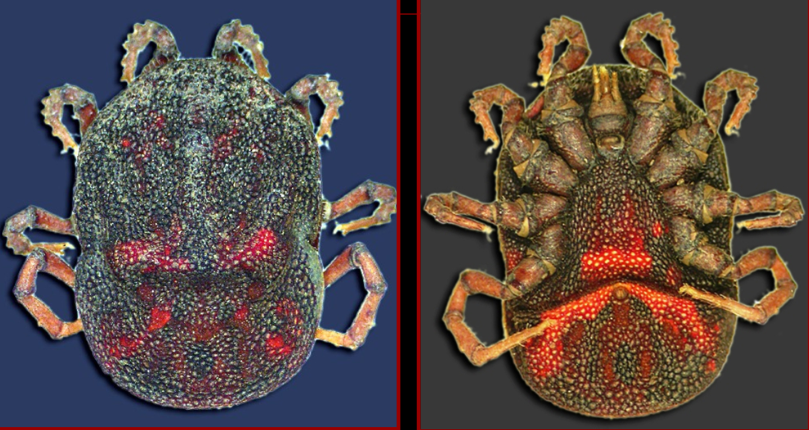
What tick is this?
Ornithodoros savignyi (sand tampan)
What are the hosts for O. savignyi?
Antelope, sheep, goats, man and cattle
What is the life cycle of O. savignyi?
The females leave the sand to feed, which takes about 20-30min, breed on the sand, then digs 7-22cm into the sand to lay a batch of 100-200 eggs. Larva hatch in 10-14 days, do not feed, and then moult. The nymphs take a blood meal, and then moult, this repeats for the 5-6 nymph stages. Each stage can live for 1 year without food. The adults take a blood meal every 3 months, and can live many years, and can survive without food for 8 years. After feeding they excrete fluid from the coxal organs.
What is the importance of O. savignyi?
The tampans release a toxin that can cause the death of the host. Calves are most susceptible as many tampans will attack them before they can stand. Newly introduced cattle also don't avoid tampan infested areas, unlike cows who are used to the farm
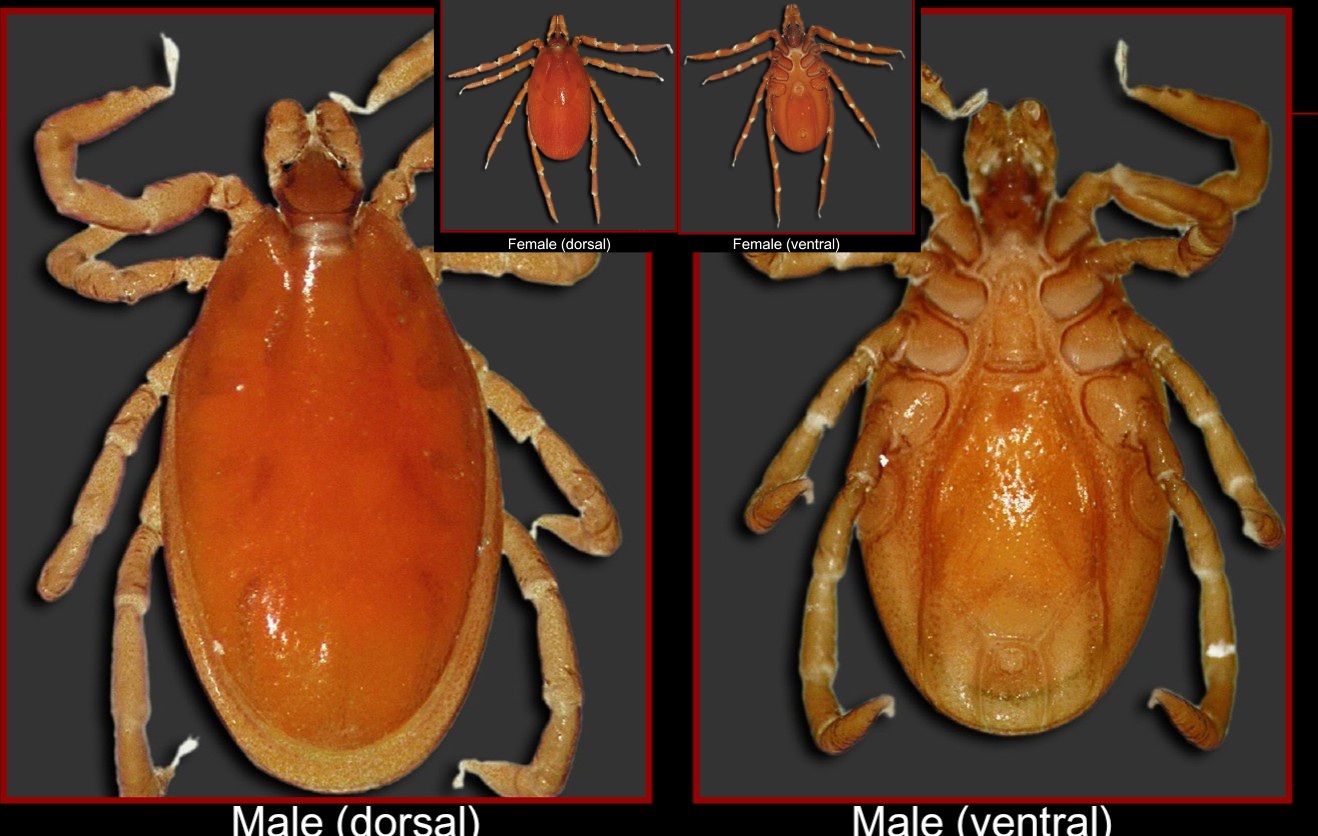
What tick is this?
Ixodes rubicundus (karoo paralysis tick)
What are the hosts of I. rubicundus?
Adults: Sheep, goats, rooikatte (caracals) and mountain reedbuck.
Immatire: Red rock rabbits, rock elephant shrews and rooikatte.
Where does I. rubicundus attach?
Females: on the wool line of belly and limbs
Males rarely attach.
What is the life cycle of I. rubicundus?
3 host tick, females lay 2000-4000 eggs then die. Females remain on the host for 4-7 days. Life cycle takes 2 years to complete.
What is the seasonality of I. rubicundus?
Adults from April to September, the eggs “over-summer" and hatch in autumn. LArva are active in March to May, and nymphs from July to November.
What is the importance of I. rubicundus?
The females make a toxin that can paralyse the host.
How do we control I. rubicundus?
Dipping, pour on formulations, veld management and removal of tick from paralysed sheep.
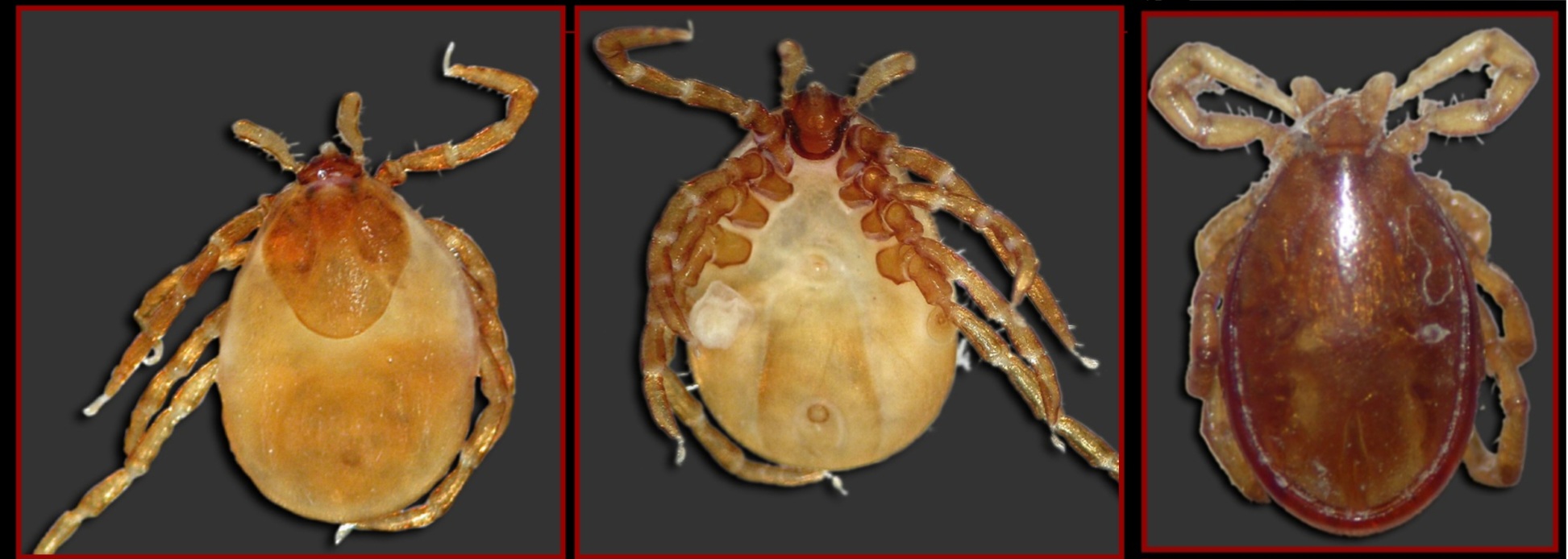
What tick is this?
Ixodes pilosus (Sourveld tick)
What are the hosts for I. pilosus?
Cattle, sheep, dogs, grey rhebok, rooikatte, bushbuck, scrub hares.
What is the life cycle of I. pilosus?
Attach around head, no disease. Adults in summer, larva in autumn and nymphs in spring.
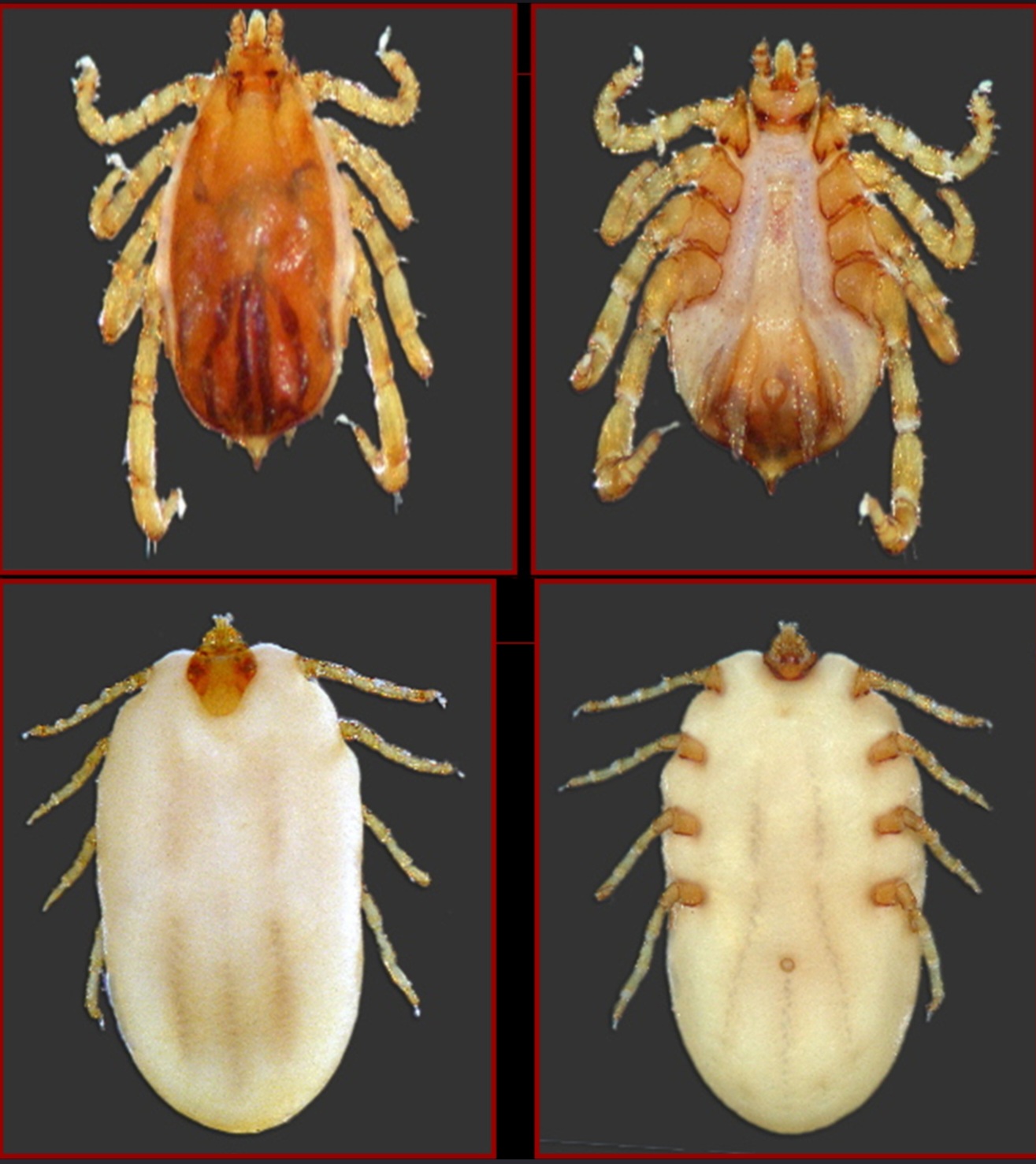
What tick is this?
Rhipicephalus decoloratus (blue tick)
What are the hosts for R. decoloratus?
Kudus, impalas, zebras, horses, and cattle
Where does R. decoloratus attach?
Sides of the body, dewlap, shoulders and neck. The immature phases can be found on the tip of the ear, and upper edges of the legs.
What is the life cycle for R. decoloratus?
It is a one host tick. Engorged females lay 1000-2500 eggs ~1 week after detaching. The larva hatch in 3-6 weeks, and wait in tall grass for a host. They engorge and moult in about a week, and engorge and moult into adults after another week. The females will then drop after a week.
What is the seasonality of R. decoloratus?
They are active during hotter times like spring and late summer and autumn.
What is the importance of R. decoloratus?
Transmission of Babesia bigemina and Anaplasma marginale
How do we control R. decoloratus?
Dipping and spraying
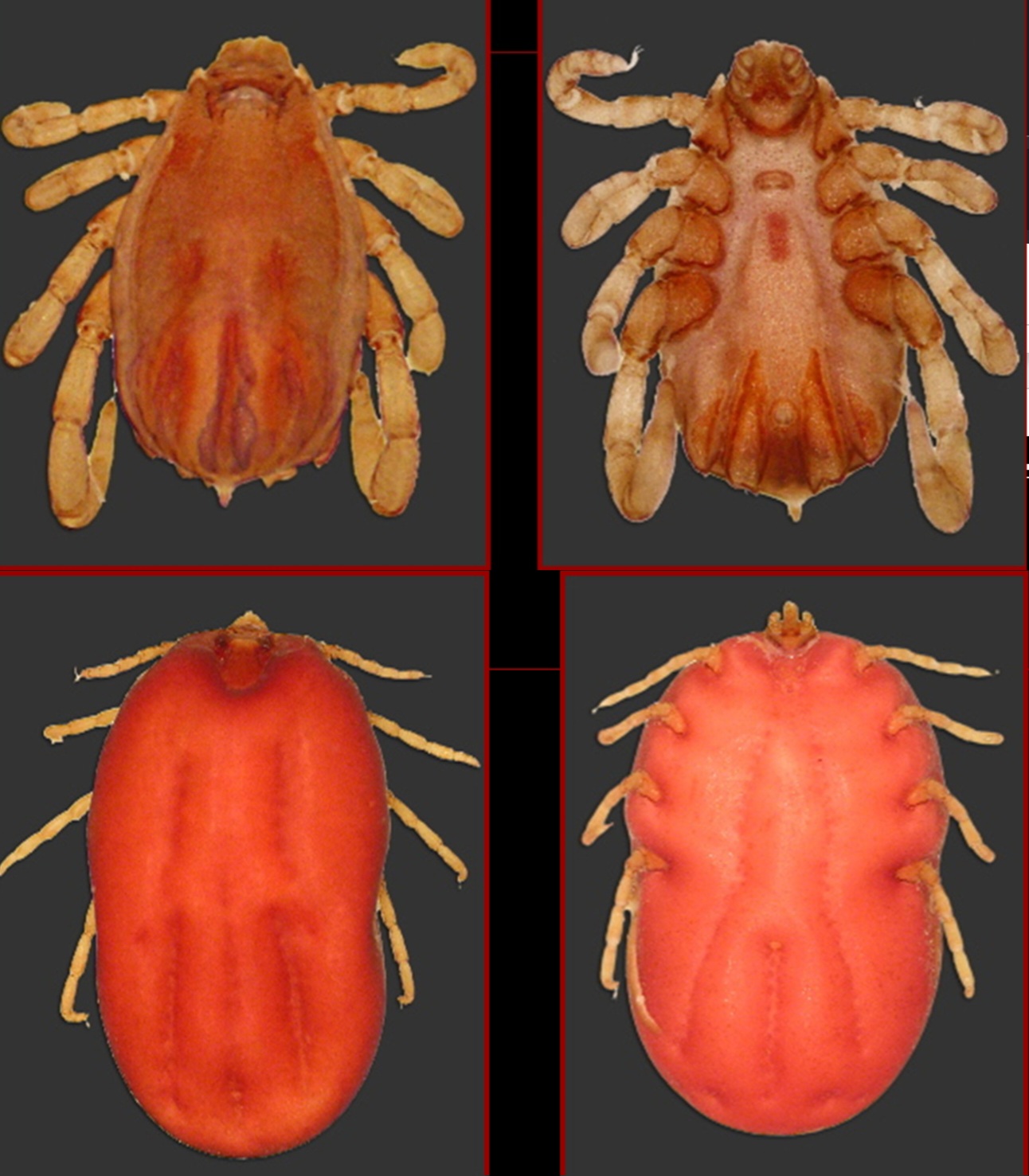
What tick is this?
Rhipicephalus microplus (Asiatic blue tick)
What is the host for R. microplus?
Cattle
What is the life cycle of R. microplus?
1-host tick, females lay 1500-3000 eggs. Whole life cycle can happen in ~2 weeks.
What is the importance of R. microplus?
Transmission of Anaplasma marginale, Babesia bovis, and Babesia bigemina
How do we control R. microplus?
Acaricides.
What tick is this?
Margopus winthemi (Winter horse tick)
What are the hosts for M. winthemi?
Horses, zebras, donkeys, and eland
What is the life cycle of M. winthemi?
1-host tick, attaches on the side of animals
What is the importance of M. winthemi?
It does not transmit diseases but can cause loss of condition if the animal is heavily infested
How do we control M. winthemi?
White winged starlings pluck off the ticks, acaricide spray and dips also work.
What tick is this?
Rhipicephalus appendiculatis
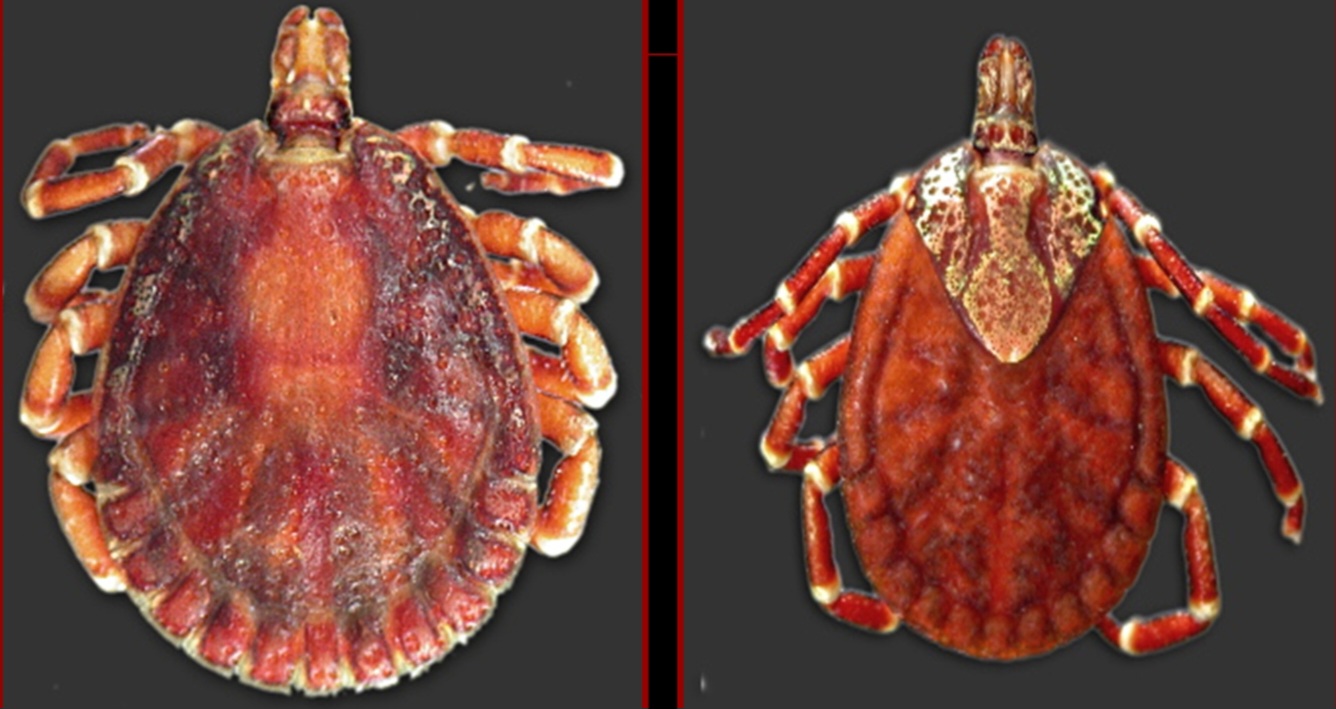
What tick is this?
Amblyomma marmoreum
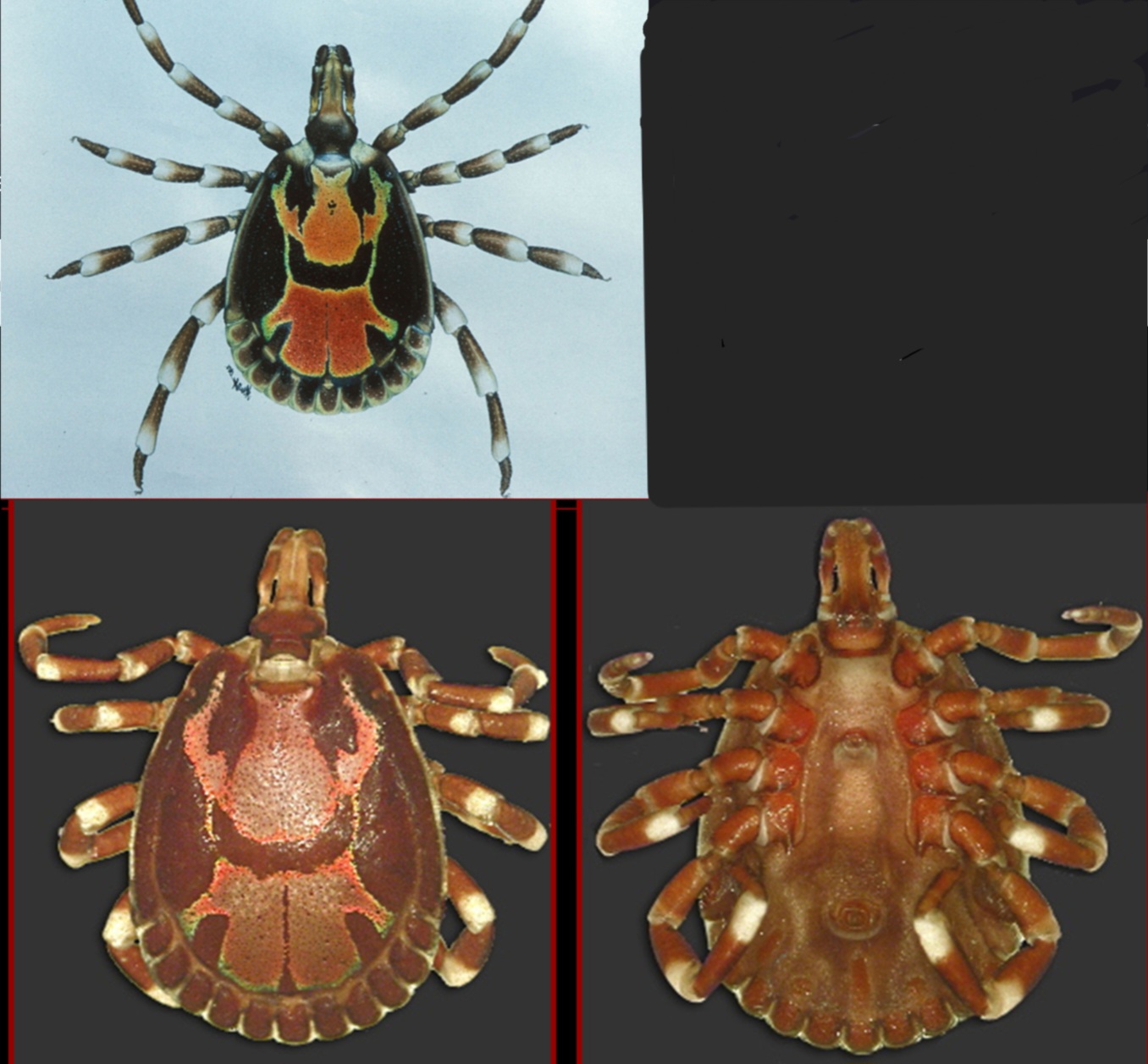
What tick is this?
Amblyomma variegatum (tropiese bont bosluis)
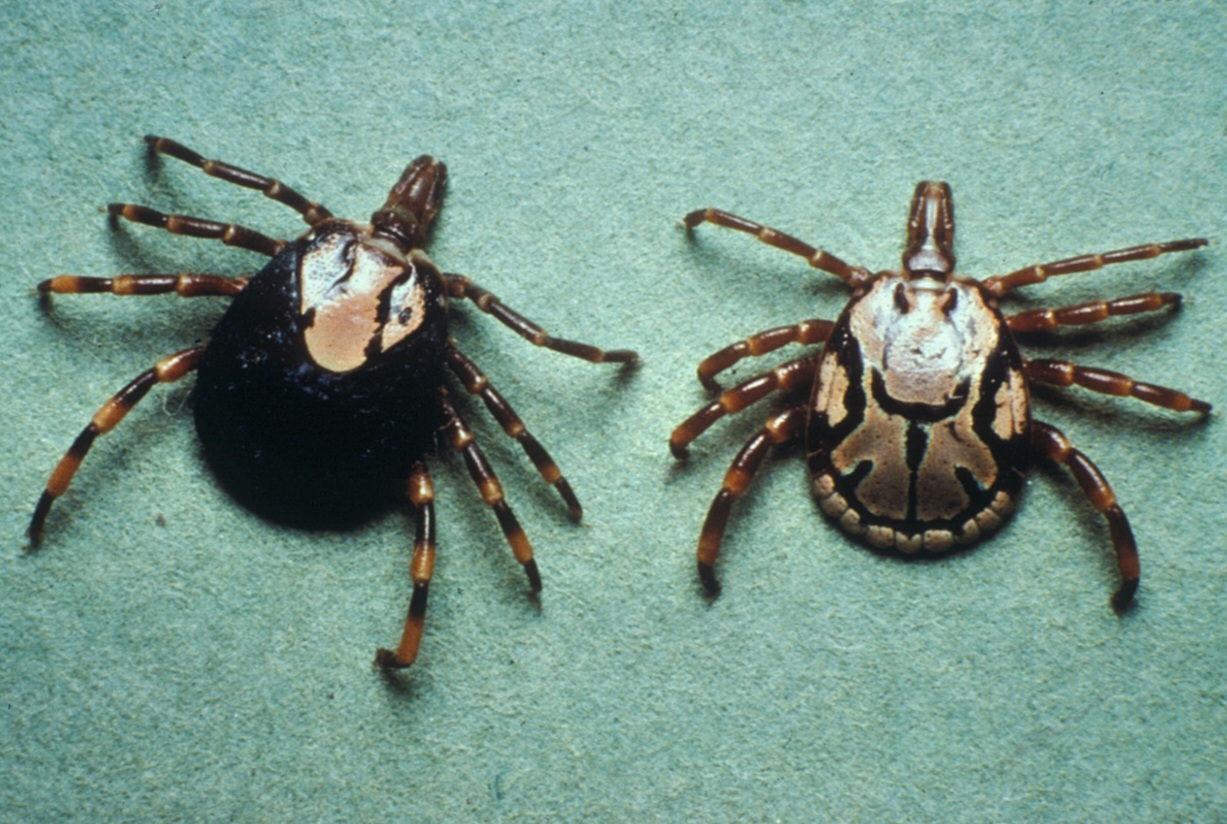
What tick is this?
Amblyomma hebraeum
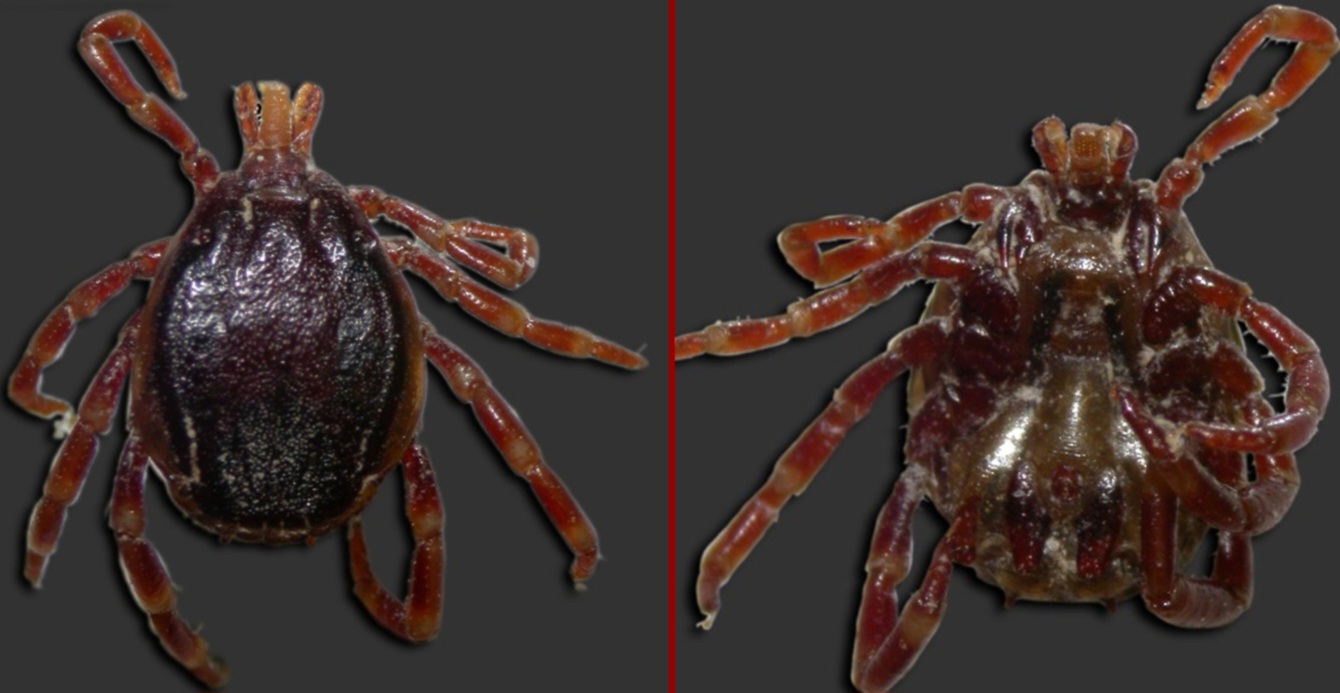
What tick is this?
Hyalomma glabrum (vaal bontpootbosluis)
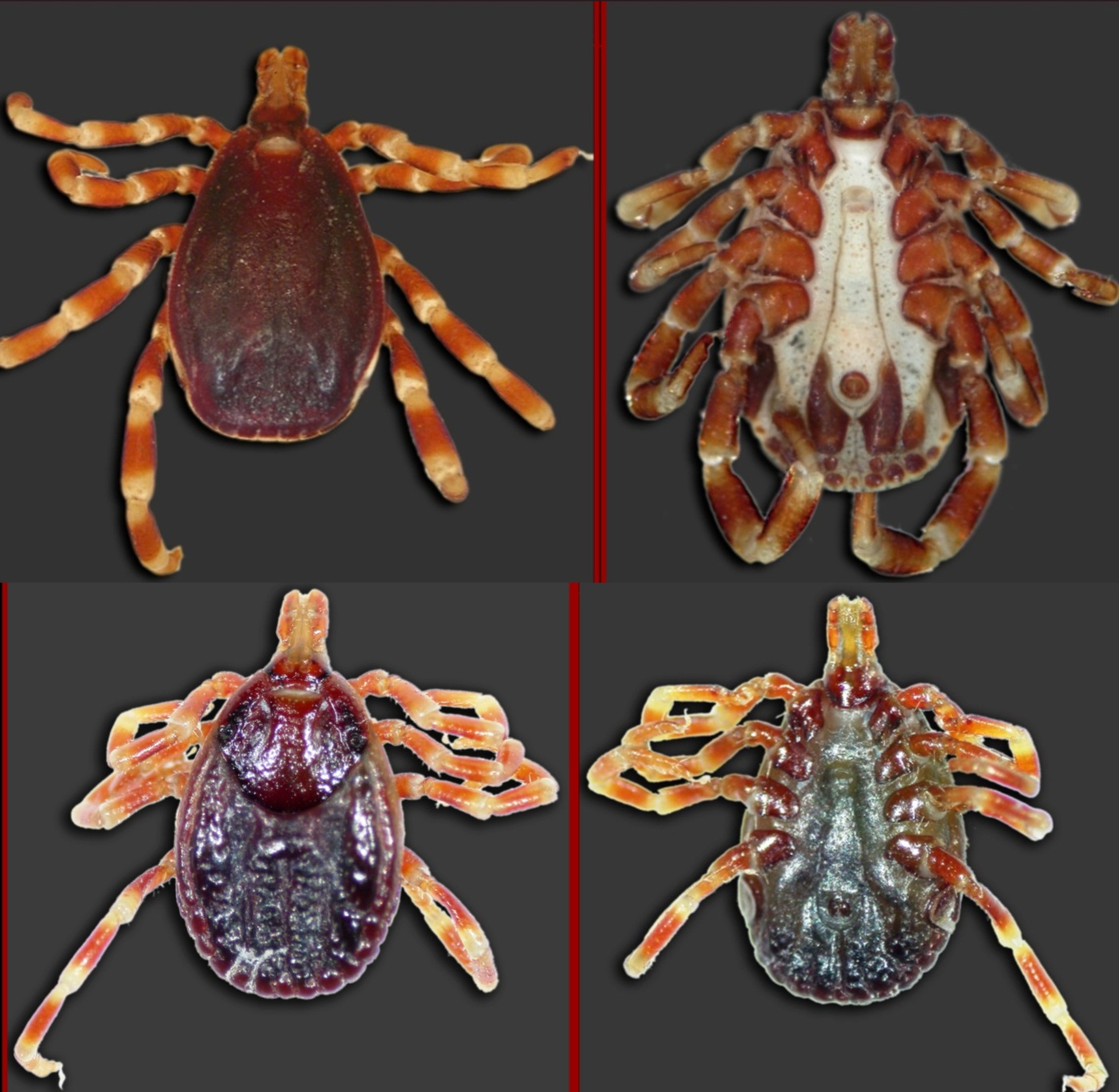
What tick is this?
Hyalomma truncatum (klein gladde bontpootbosluis)
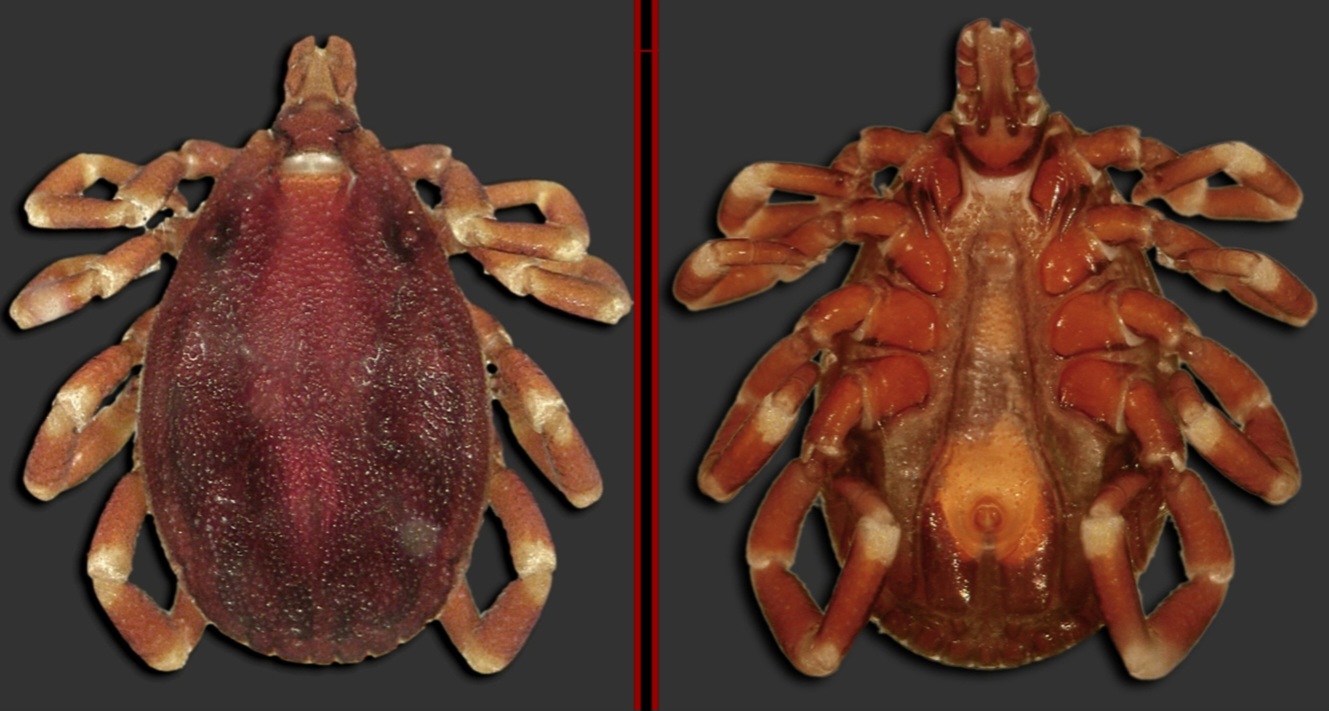
What tick is this?
Hyalomma rufipes (groot growwe bontpootbosluis)
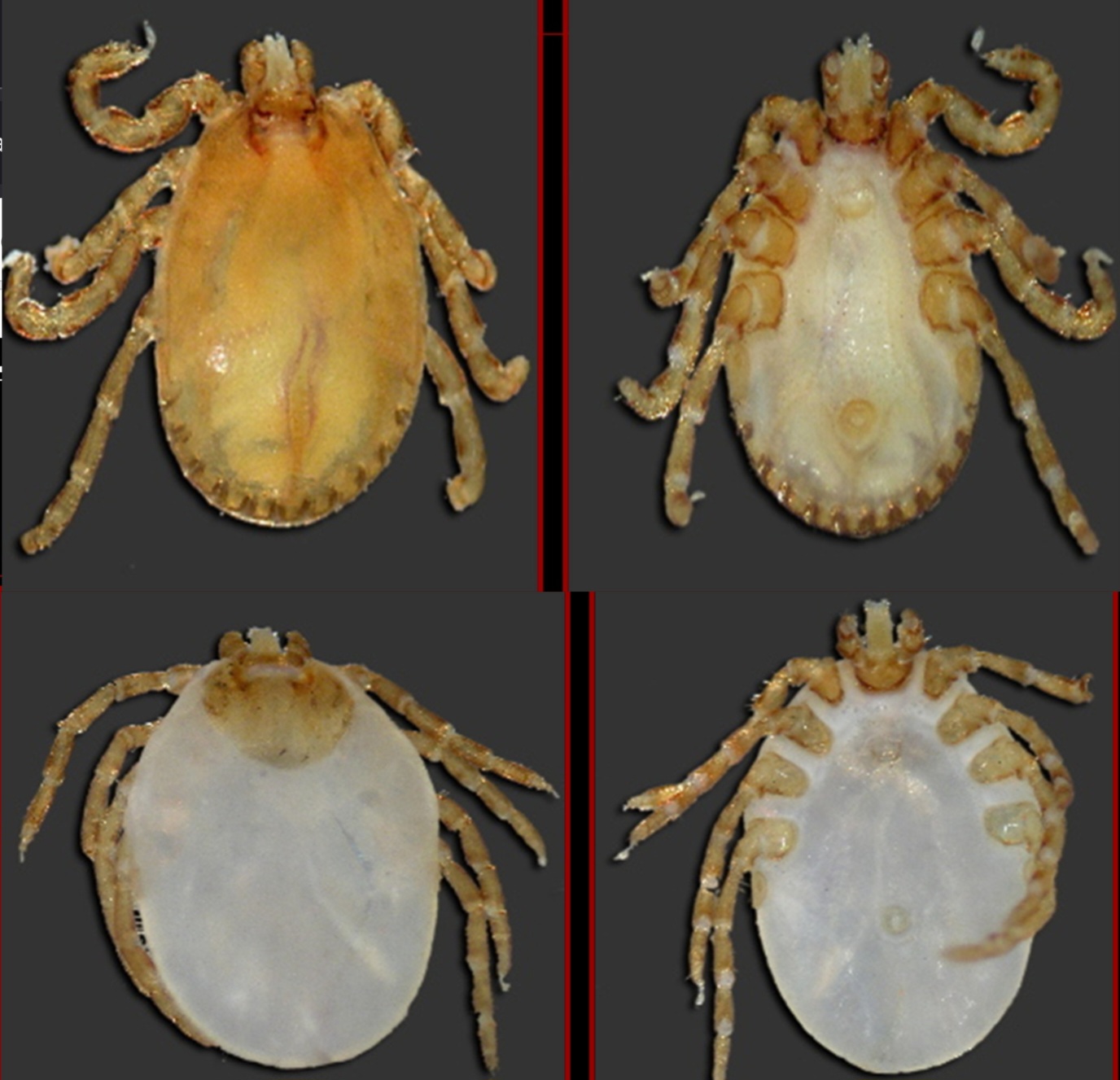
What tick is this?
Haemaphysalis silacea (ciskey tick)
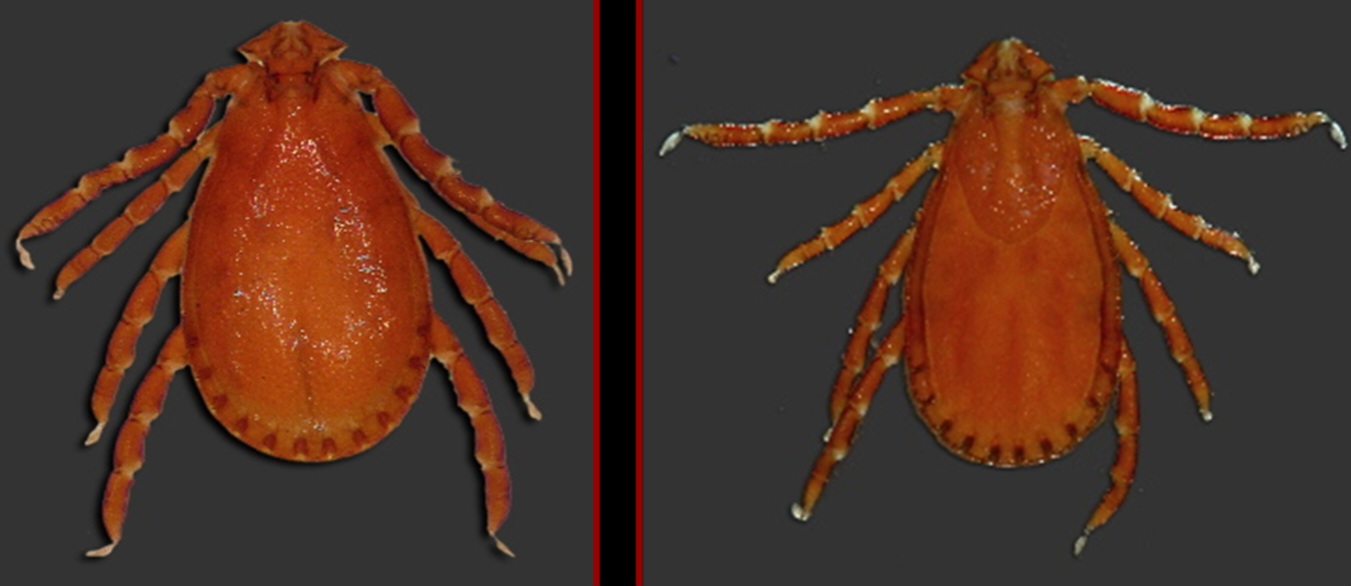
What tick is this?
Haemaphysalis elliptica (yellow dog tick)
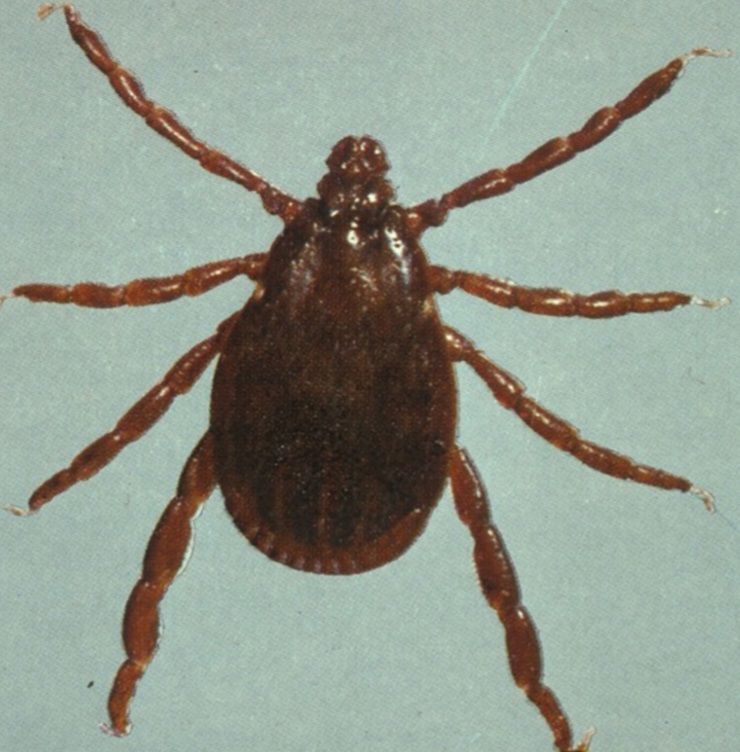
What tick is this?
Rhipicephalus warbutoni (brown paralysis tick)
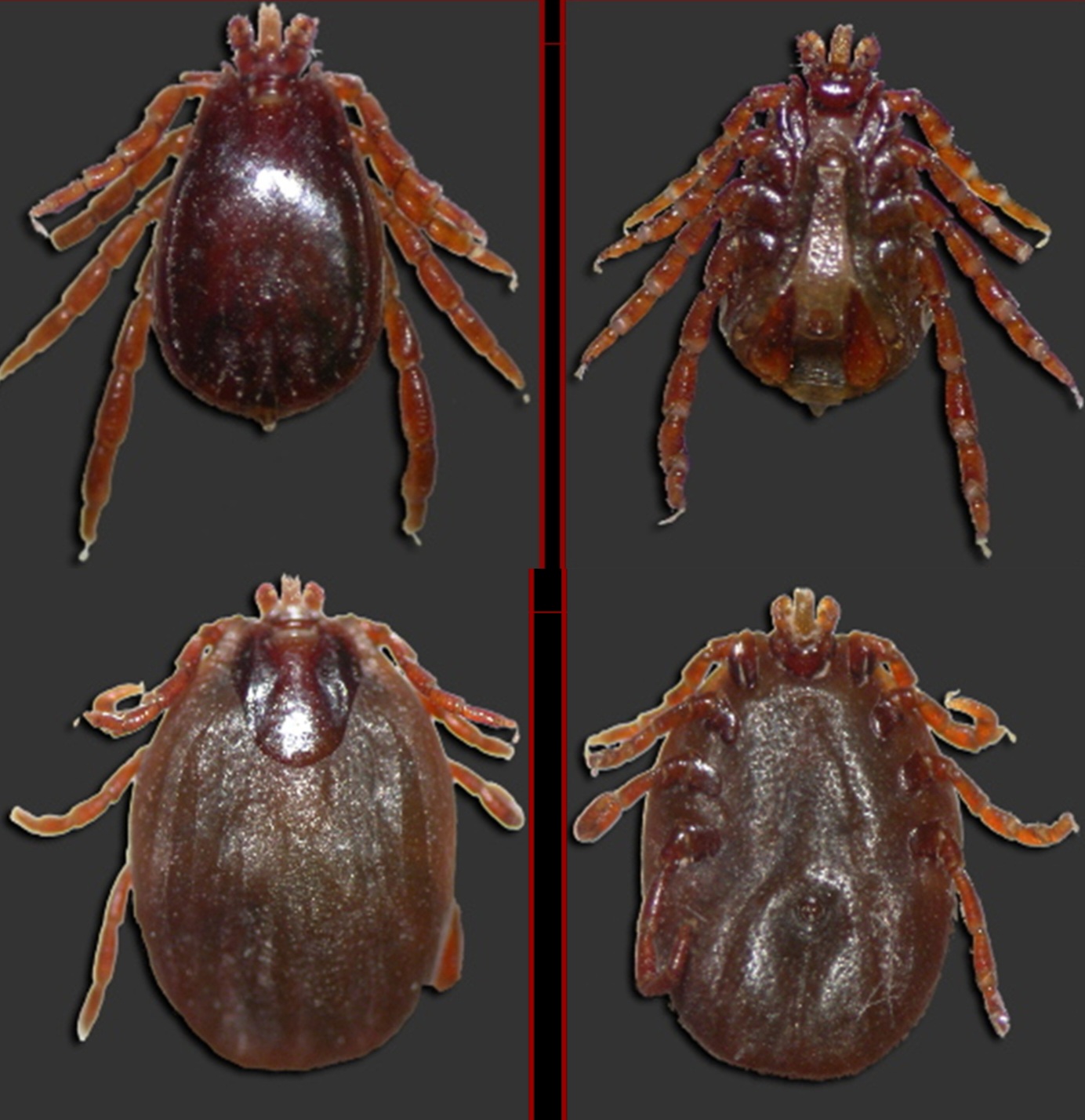
What tick is this?
Rhipicephalus glabroscutanum
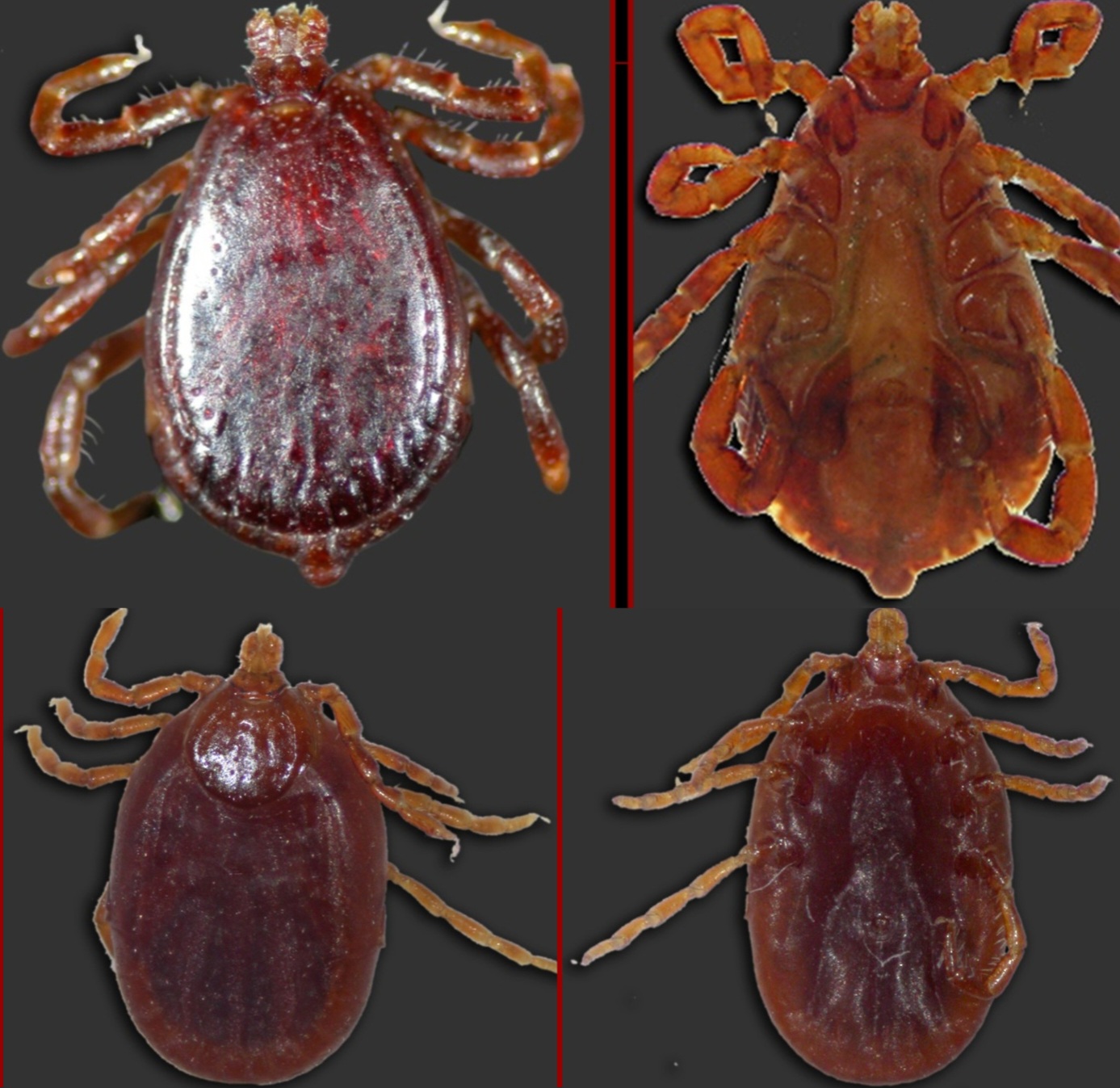
What tick is this?
Rhipicephalus simus (glossy brown tick)
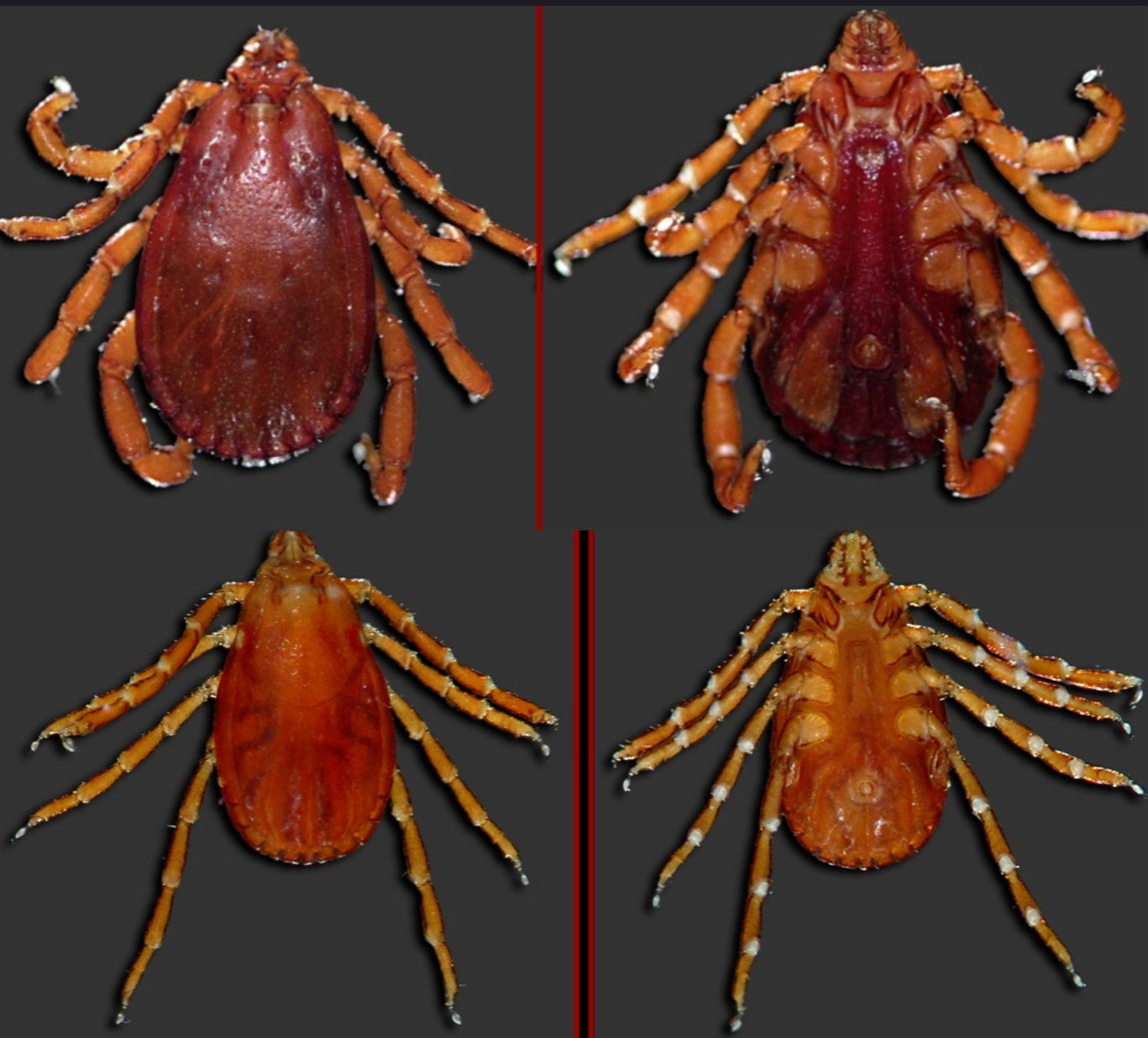
What tick is this?
Rhipicephalus sanquineus (kennel tick)
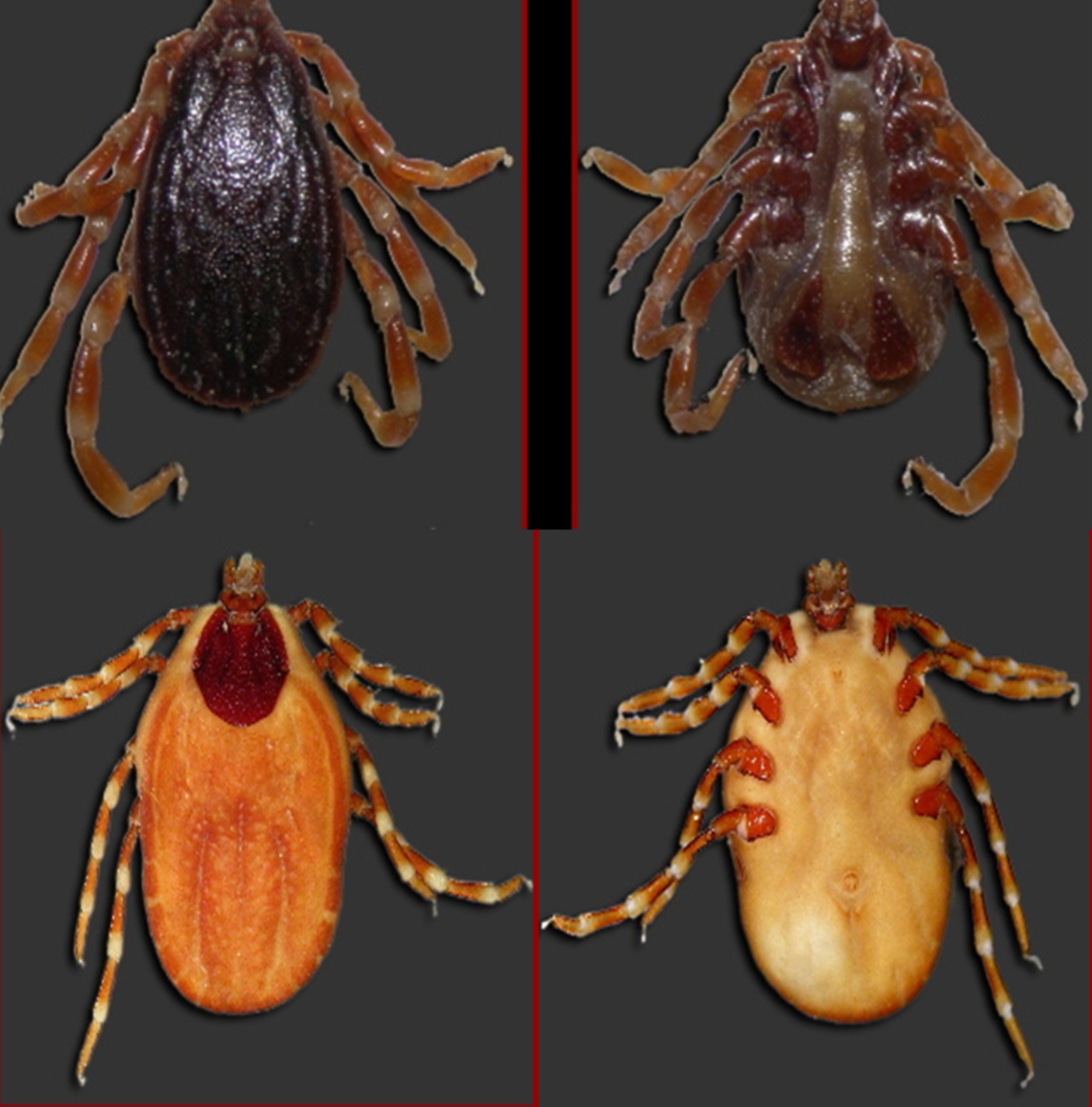
What tick is this?
Rhipicephalus evertsi mimeticus (namibian red legged tick)
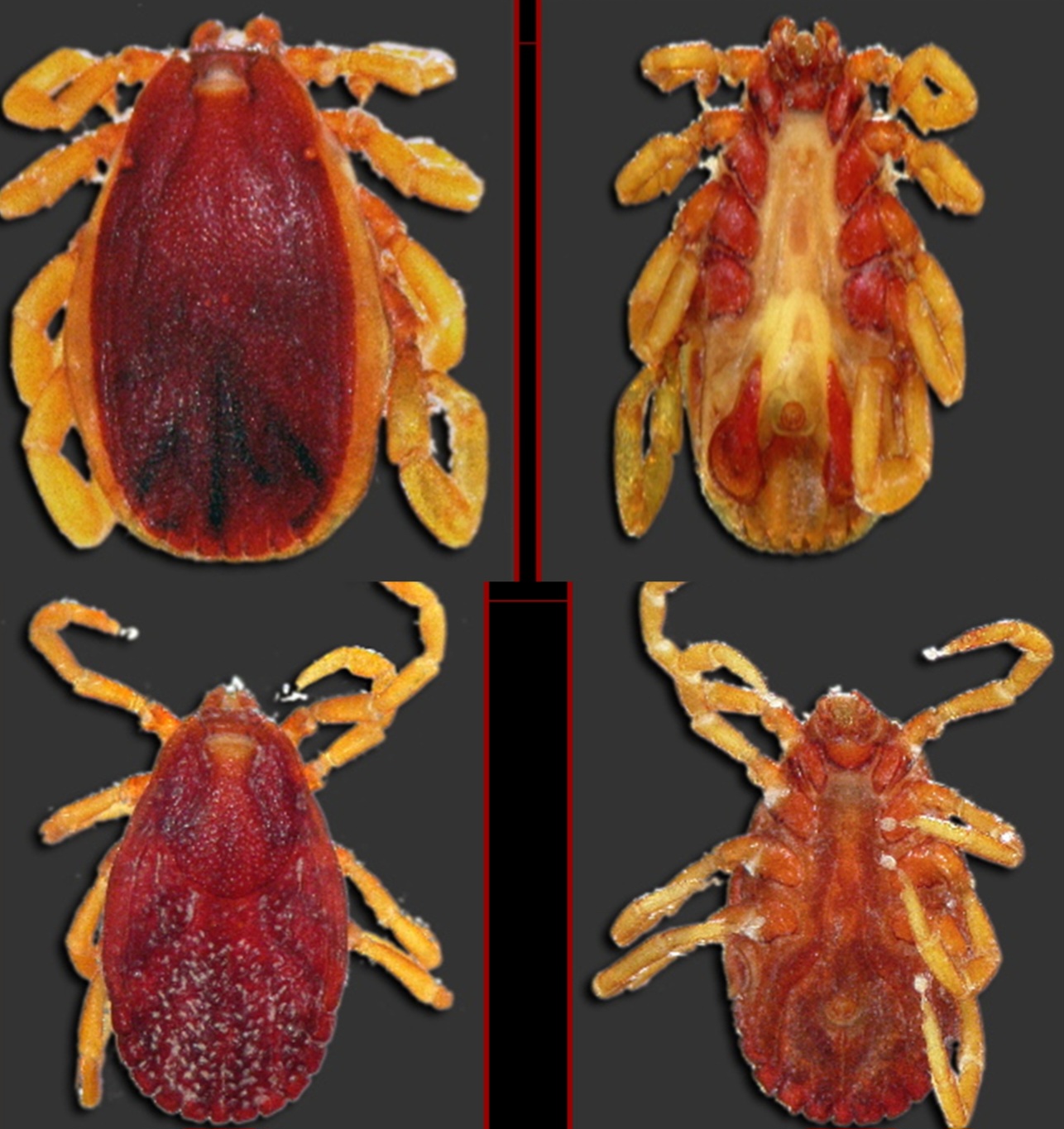
What tick is this?
Rhipincephalus evertsi evertsi (red legged tick)
What tick is this?
Rhipicephalus nitens (fynbos bruinoorbosluis)