CFA Level 2 exam questions with complete verified solutions
 Call Kai
 Learn
Learn Practice Test
 Spaced Repetition
 Match
Match Flashcards
1/67

There's no tags or description
Looks like no tags are added yet.
Name | Mastery | Learn | Test | Matching | Spaced | Call with Kai |
|---|
No analytics yet
Send a link to your students to track their progress
68 Terms
Heteroskedasticity
What/effects?
How to detect?
How to correct?
Non-constant error variance. Standard errors are unreliable, coefficient estimates are NOT effected, t and F tests are not reliable
Detect with Bruesch-Pagan Test (chi^2 = n * R^2(of residuals))
Correct with White-correct standard errors
Autocorrelation
What/effects?
How to detect?
how to correct?
Correlation among error terms. Coefficient standard errors are too small, est. coefficients are NOT effected, t-stat. too large (type 1 error), unreliable F-test.
Detect with Durbin-Watson statistic (DW = 2(1-r))
Correct with Hansen method (adjusting coefficient standard errors) or improve model specification
DW test
DW=2(1-r) for large sample
if DW=2 homoskedastic
DW<2 positive serial correlation
DW>2 negative serial correlation
if DW
Multicollinearity
What/effects?
How to detect?
how to correct?
High correlation among X's. No effect on slope coefficient but is unreliable, standard error of X's is too high (Type II error).
Detect if t-tests indicate none of the slope coefficients are different than 0, but F-test is significant and R^2 is high.
Correct by omitting variables.
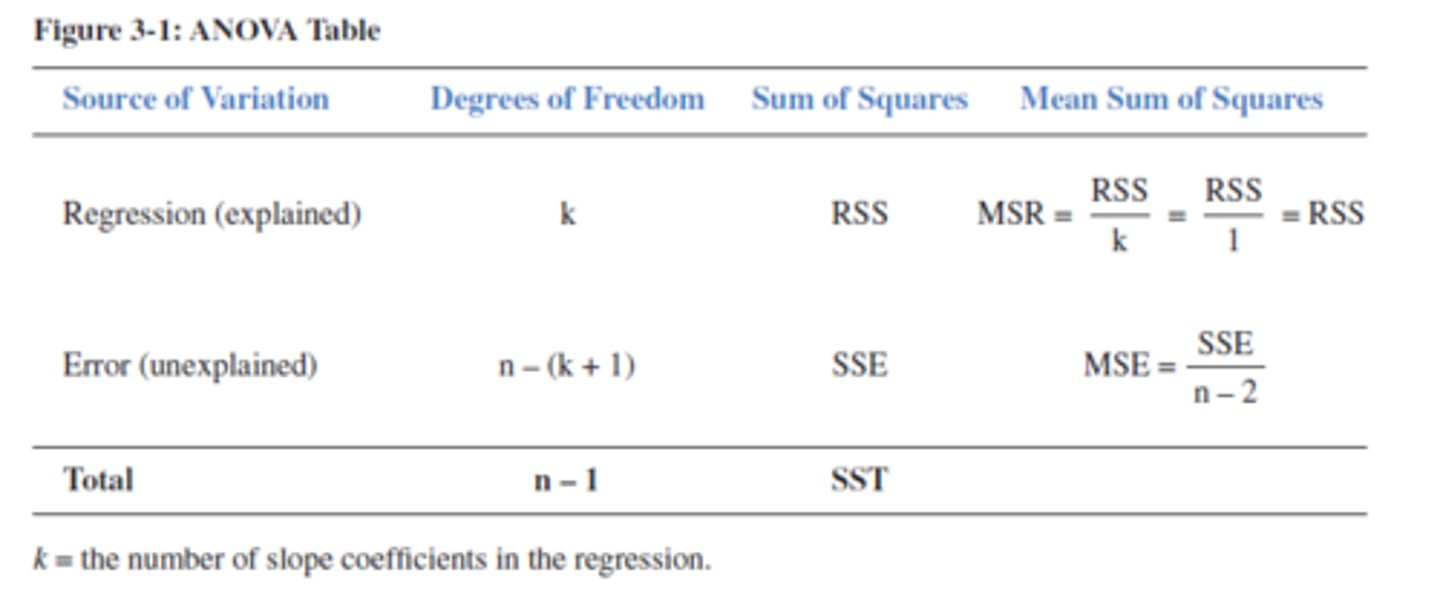
SEE
=sqrt(MSE)
Measures the degree of variability of actual Y to estimated Y
ANOVA table
Adjusted R^2
= 1 - [(n-1)/(n-k-1)](1-R^2)
Mean Reverting Level
= B0/1-b1
Note that this is why Random Walk has unit root where b1 = 1. Therefore Random Walk is NON STATIONARY.
Test for autocorrelation in AR model
t-test where t = correlation of error terms/(1/sqrt(T))
RMSE (root mean squared error)
RMSE is used to compare the accuracy of AR models in forecasting values out-of-sample
Test for unit root for time series model
Run AR model, if residual autocorrelations = 0 at all lags then it is covariance stationary
or
Dicky-Fuller test: Ho: g = b(1) - 1 = 0
if Ho cannot be rejected there is a unit root
First Differencing
This is used to correct AR when it has a unit root. You subtract the previous value from the current value to define NEW DEPENDENT variable. Here you graph the CHANGE in the values which is essential the error term.
ARCH Model
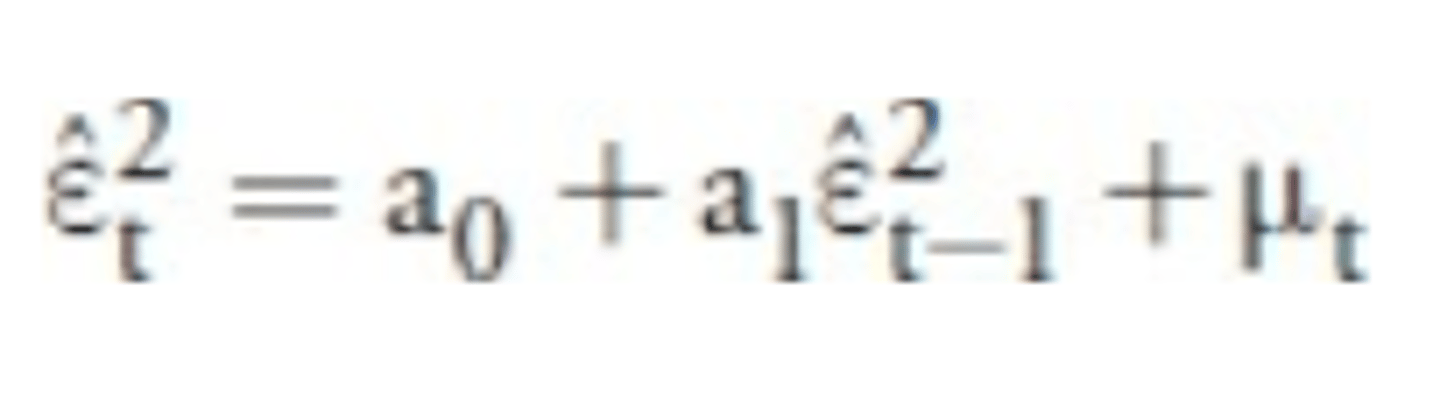
Used to test for autoregressive conditional heteroskedasticity (ARCH) in AR models.
If a(1) is statistically different than 0, time series has ARCH
bias error
in-sample error, model is a poor fit
Variance Error
out-of-sample error, overfitted models
base error
residual errors due to random noise
If model complexity increases, what happens to variance error and bias error?
Variance error increases and bias error decreases with model complexity
Penalized regressions
Supervised ML algorithm
Penalizes for more variables added in model
ex. LASSO
Support Vector Machine
Supervised learning classification tool that separates data into 1 of 2 possible outcomes
ex. buy vs sell
K-nearest neighbor (K-NN)
A supervised ML technique used to discover associations and sequences when the data attributes are numeric; nonparametric estimator of a function
ex. assigning a bond to a rating class
Classification and regression tress (CART)
Supervised ML algorithm used when target variable is categorical and usually binary, with non-linear relationship
Ensamble Forecasting
Supervised ML
combines predictions from multiple models, results in lower average error
Random Forest
An supervised ML algorithm used for regression or classification that uses a collection of tree data structures trees "vote" on the best model
Principal Component Analysis (PCA)
Unsupervised ML algorithm
variable reduction technique, used when variables are highly correlated. Helps you to figure out which variables matter the most. Categorization technique
Clustering
Unsupervised ML algorithm
Grouping observations into categories based on similarities in attributes
ex. k-means clustering
Normalization
puts values between 1 and 0
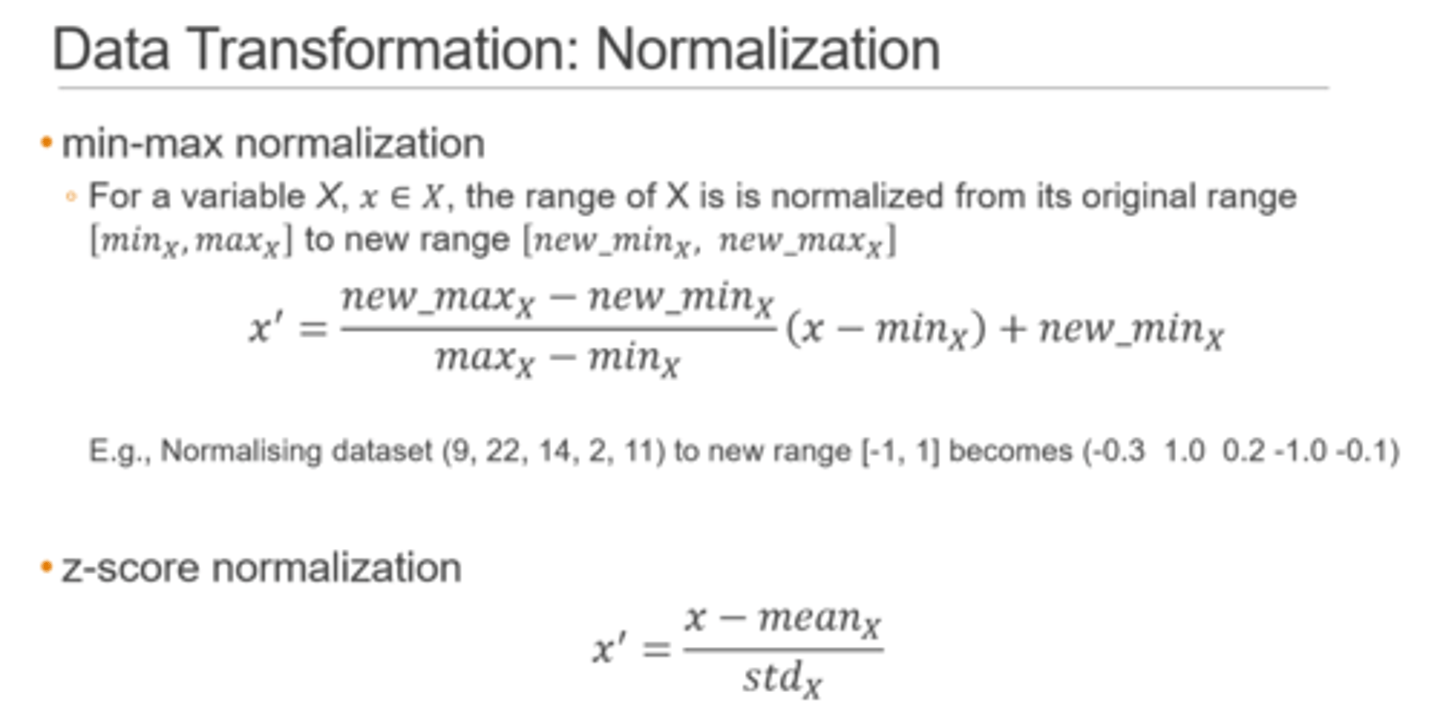
Standardization
Centers variables at 0 and scales them as units of standard deviations from the mean
Assumes data is normally distributed
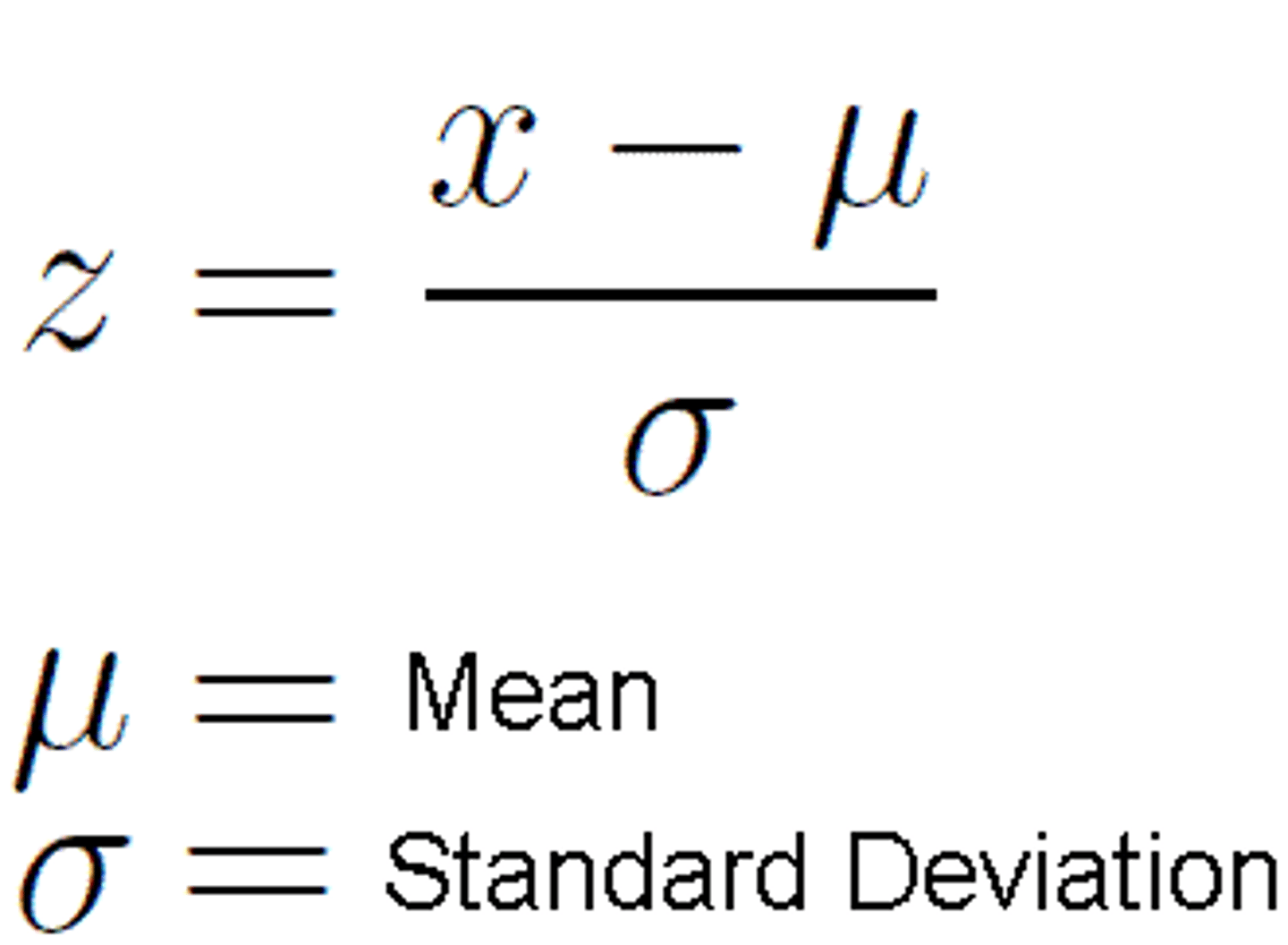
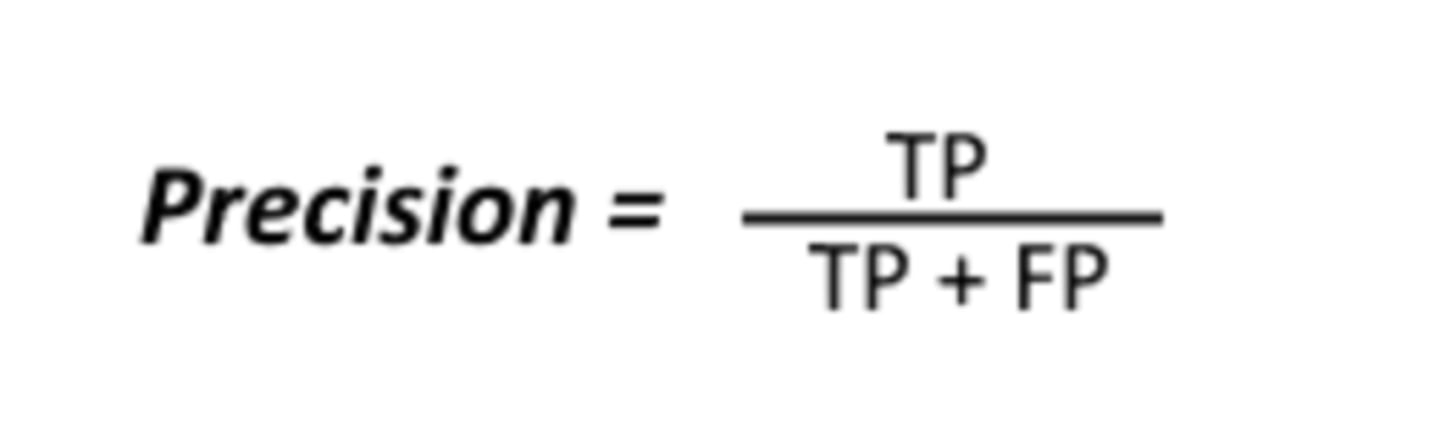
Precision formula
Recall formula
TP/(TP+FN)
Accuracy formula
(TP + TN)/(TP + TN+ FP + FN)
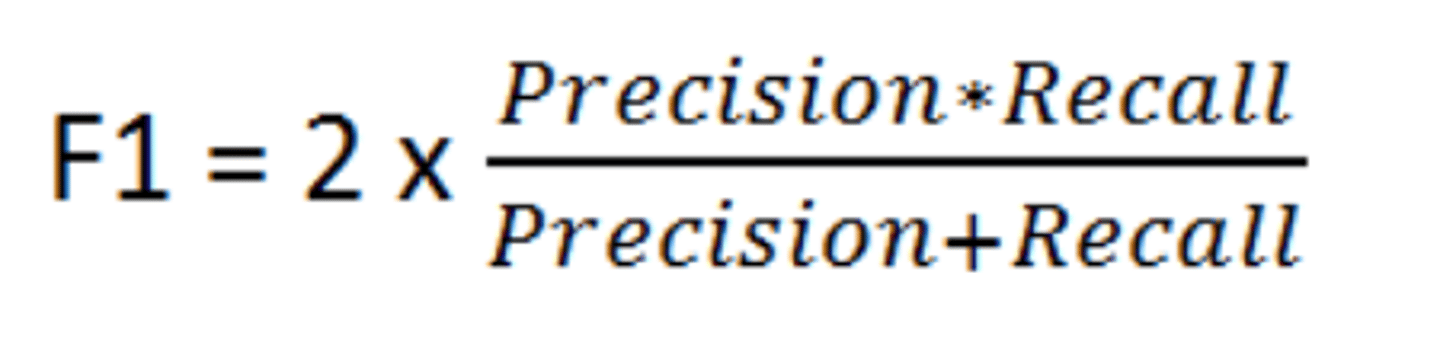
F1 Score
harmonic mean of precision and recall
currency arbitrage rule
Up-the-bid-and-multiply, down-the-ask-and-divide
Given a quote for A/B, if trading at a forward premium, we say currency _______ is trading at a forward premium
B
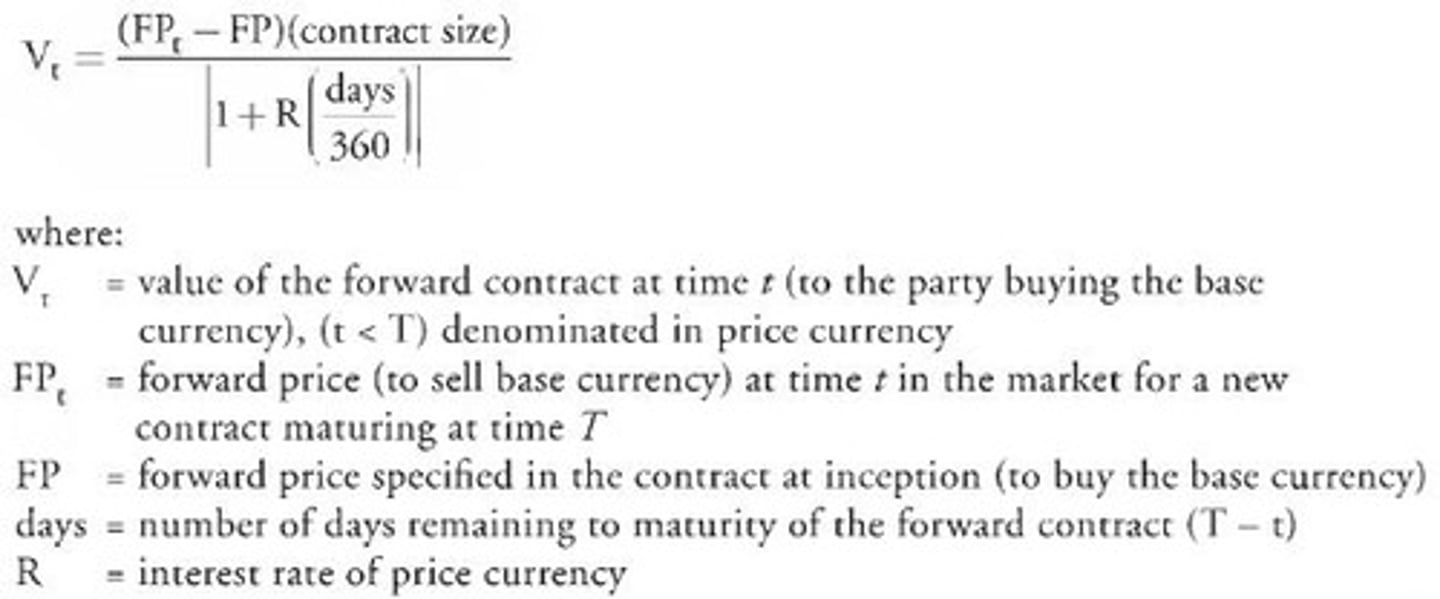
Mark-To-Market Value of Forward Currency Contract
Note FP(t) is calculated based on the need to "unwind" the position
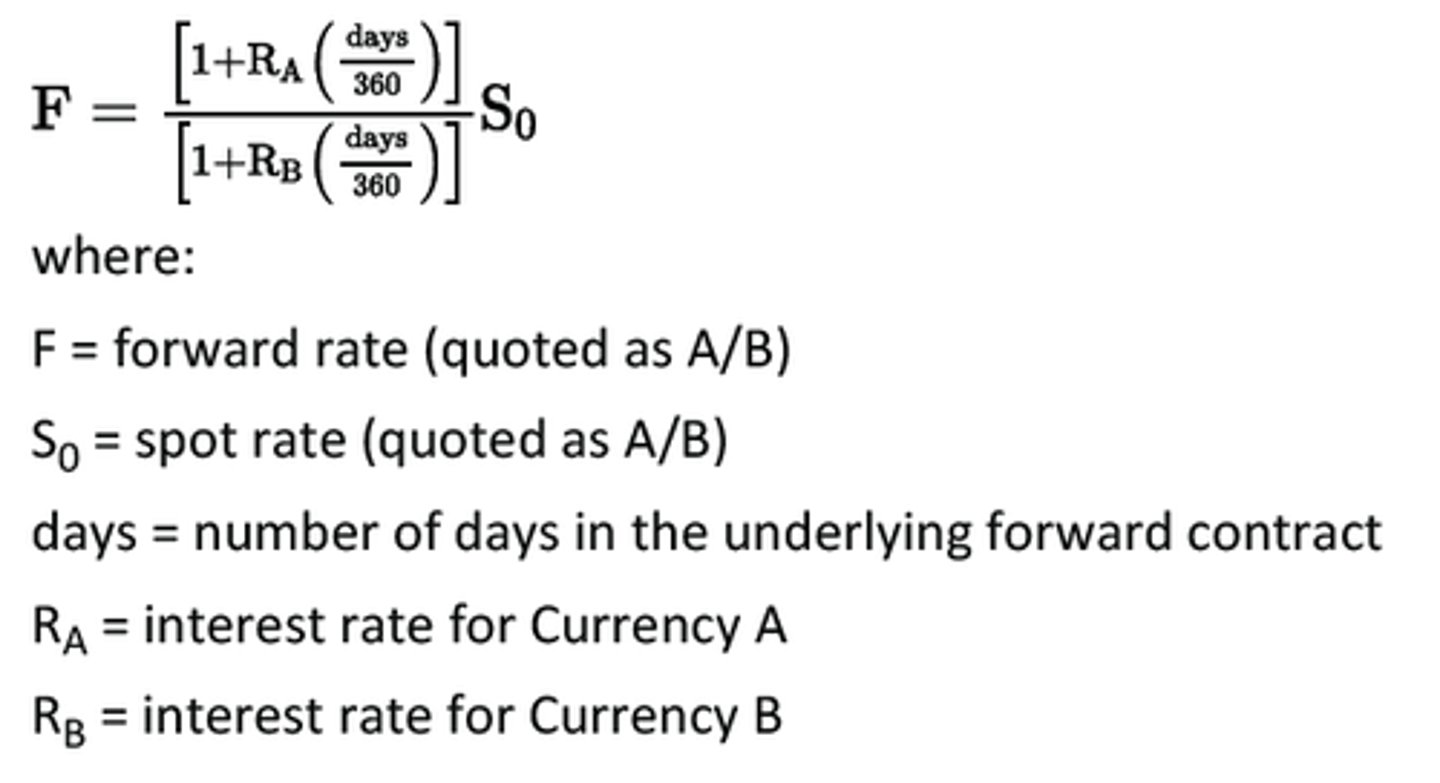
covered interest rate parity
principle implying that forward exchange rates and spot exchange rates set interest rates on bonds in different countries equal to one another
Uncovered Interest Rate Parity
a theory that holds that the forward exchange rate equals the expected future value of the spot rate
assumes investors are risk neutral
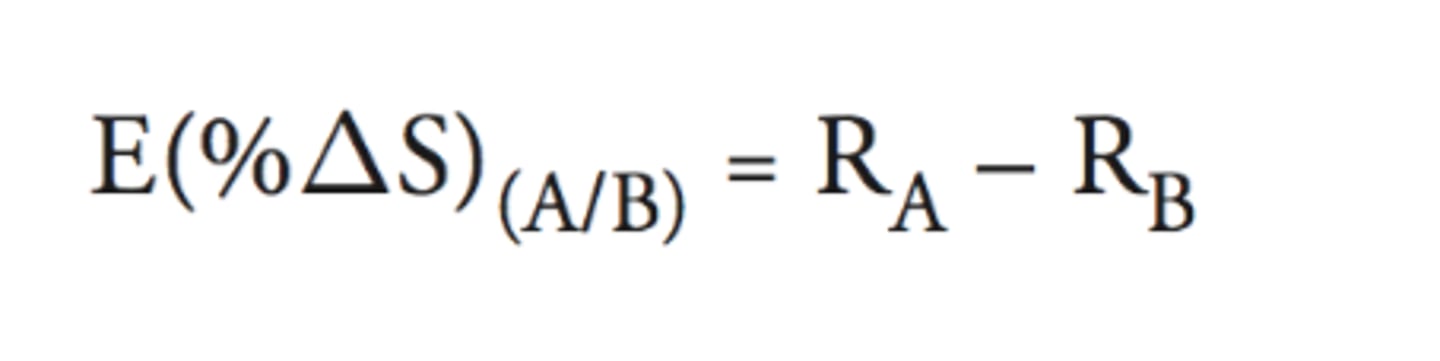
Unbiased Predictor
If the forward rate (under covered interest parity) = expected future spot rate (uncovered interest rate parity) then the forward rate is said to be an unbiased predictor of the future spot rate
Fisher Relation and international Fischer Relation
R(nominal) = R(real) + E(inflation)

Ex ante version of PPP
Hypothesis that expected changes in the spot exchange rate are equal to expected differences in national inflation rates. An extension of relative purchasing power parity to expected future changes in the exchange rate
FX Carry Trade
an investment strategy that involves taking on long positions in high-yield currencies and short positions in low-yield currencies
Flow supply/demand mechanism (current account deficit)
Excess supply of currency in the markets causes domestic currency to depreciate.
Amount of depreciation depends on (1) initial deficit, (2) influence of FX rates on domestic import/export prices, (3) price elasticity of demand of the traded goods
Debt Sustainability Mechanism (current account deficit)
When debt gets too high relative to GDP, foreign investors may pull out of positions causing domestic currency depreciation
Excessive capital inflows into emerging markets causes...
1. excessive appreciation
2. asset bubbles
3. increase in debt
4. excessive consumption fueled by debt
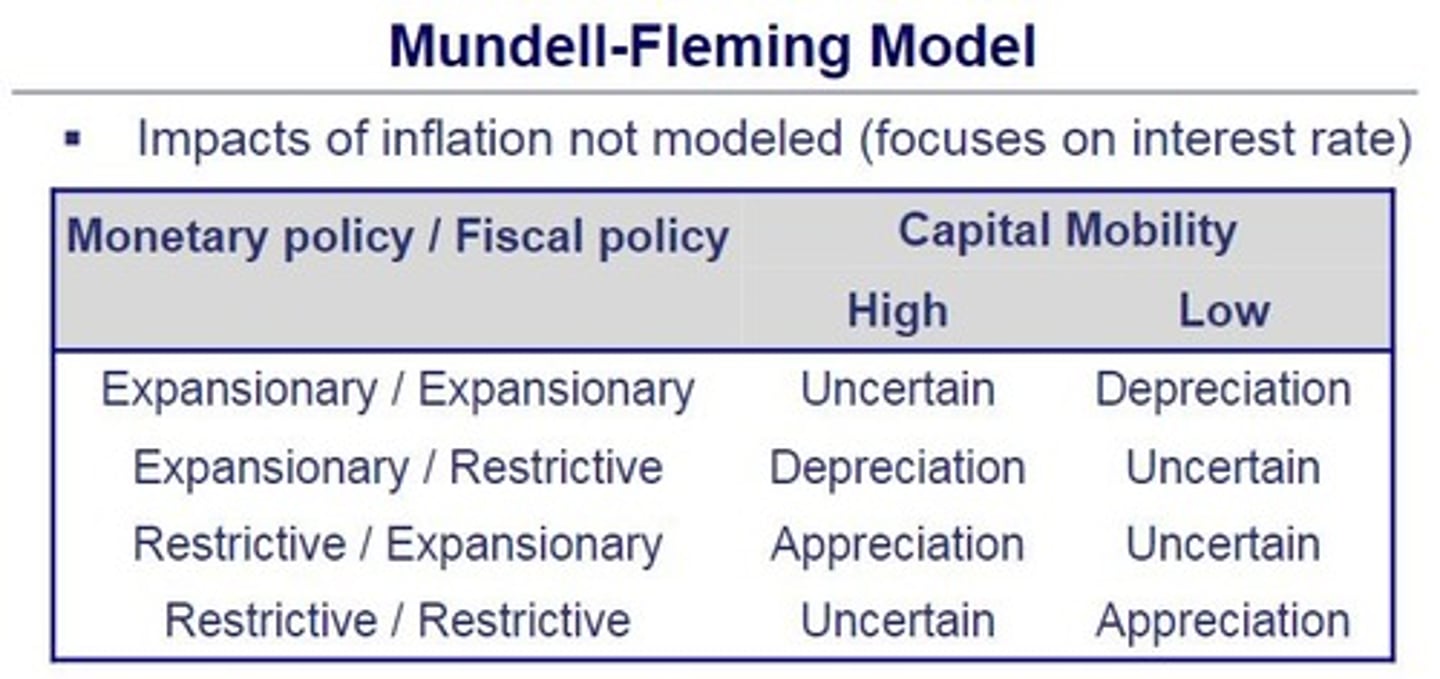
Mundell-Fleming Model
-Evaluates the impact of monetary and fiscal policies on interest rates and exchange rates
-Short-term focus
Potential GDP
the amount that can be produced when all of the economy's resources are used fully and efficiently
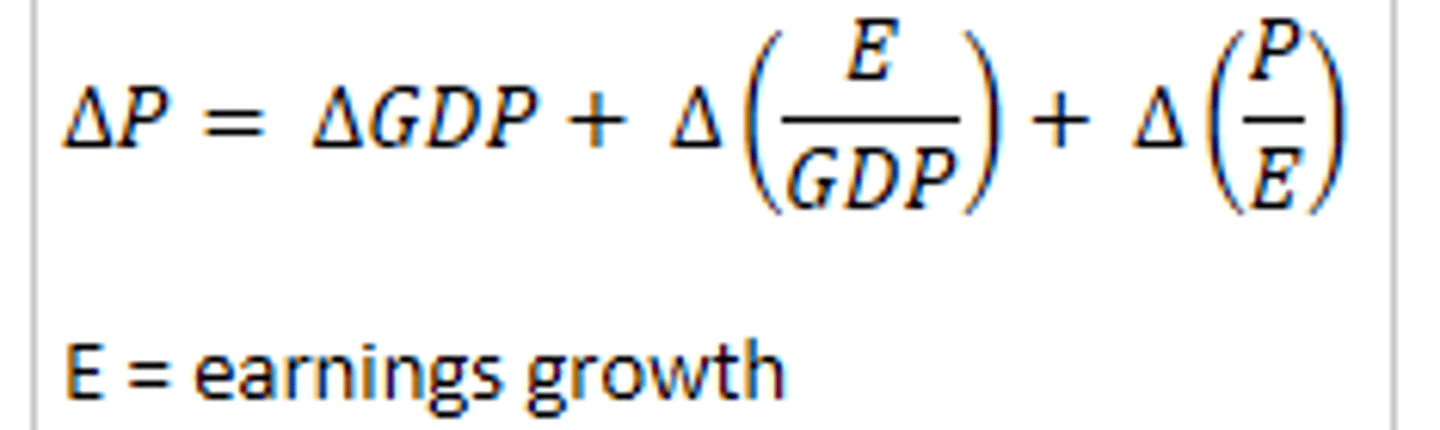
Growth in aggregate stock market equation (as a function of GDP)
In the long term only change in GDP will not be 0
In short-term, what are the effects of actual GPD>potential GDP?
Inflation leading to restrictive monetary policy
Cobb-Douglas production function
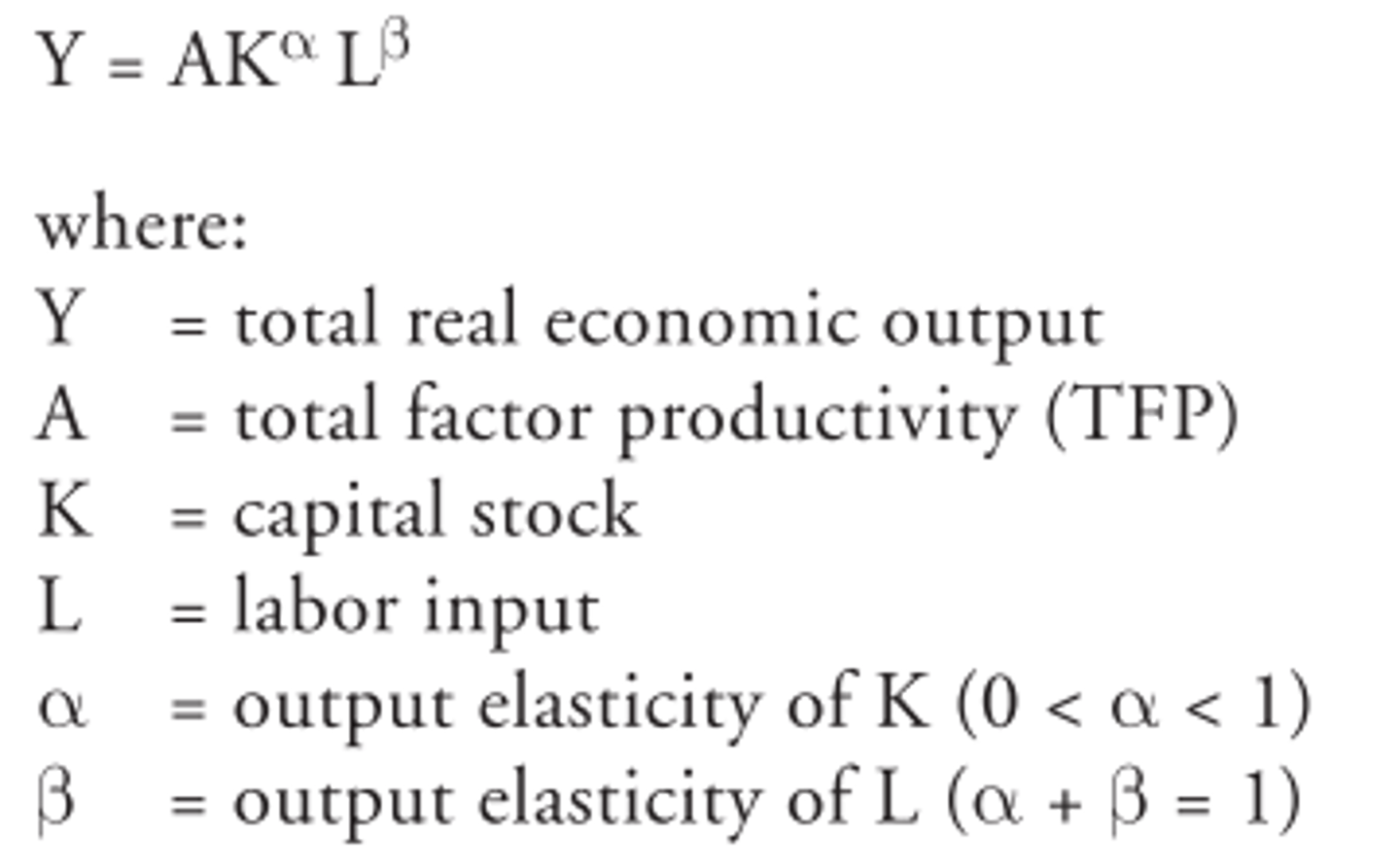
Lower share of output allocated to capital (α) causes the affect of capital deepening to...
decrease
Growth Accounting Equation

Dutch Disease
the negative impact on an economy of anything that gives rise to a sharp inflow of foreign currency, such as the discovery of large oil reserves. The currency inflows lead to currency appreciation, making the country's other products less price competitive on the export market.
Classical Growth Theory
A theory of economic growth based on the view that the growth of real GDP per person is temporary and that when it rises above subsistence level, a population explosion eventually brings it back to subsistence level.
Neoclassical Growth Theory
a theory of economic growth that proposes that real GDP per person grows because technological change. An increase in savings will only temporarily increase economic growth
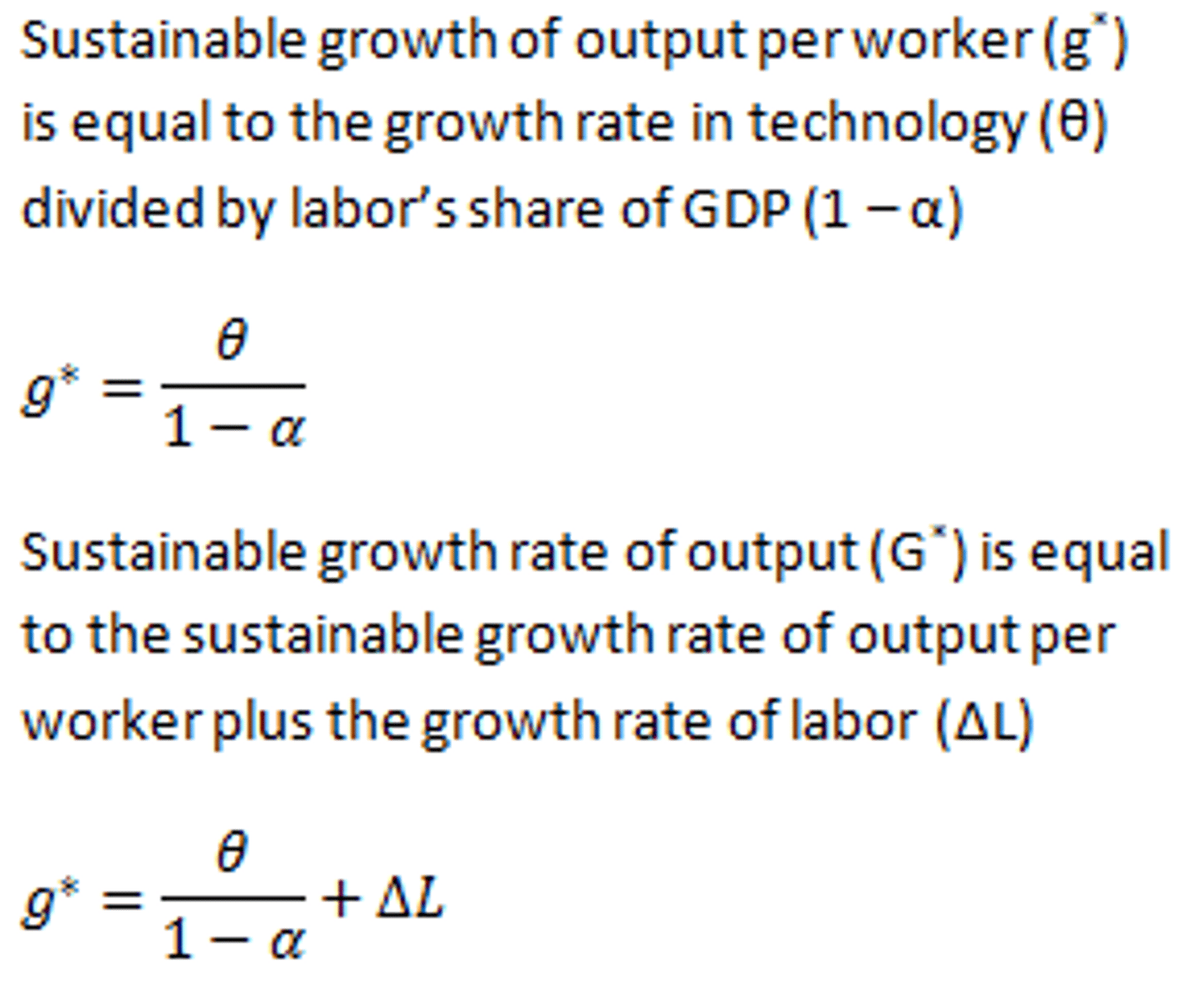
Effect of capital deepening on growth rate at steady state (neoclassical growth theory)
Capital deepening does NOT effect growth rate
Endogenous Growth Theory
-Technological growth emerges as a result of investment in both physical and human capital
-Increased investment can permanently increase rate of growth
-Returns to capital are constant
-An increase in savings will permanently increase the growth rate
-Capital investment may improve total factor productivity
Regulatory Capture Theory
Regulatory body will at some point be influenced or even controlled by the industry being regulated. Regulators often have experience in the industry and this affects their ability to render impartial decisions
Investments in Financial Assets (IFRS 9) Classifications
For investments <20% with no significant controls
- Amortized Cost (debt): On B/S at amortized cost, interest income from coupon pmts on I/S
- Fair value thru P&L: when held for trading, on B/S at FV with G/L on I/S
- Fair value thru OCI: on B/S at FV, unrealized G/L in OCI, realized G/L on I/S
Investments in Associates (20%-50% ownership)
For investments between 20% and 50% with significant influence. Account for investment using equity method:
- record at cost on B/S as a non-current asset
- in subsequent periods, increase B/S with share of investee's net income and decrease with share of dividends
- share of net income is recognized on I/S, dividends are not recognized on I/S
Impairment on equity method investments
GAAP: if fair value > carrying value AND is not temporary, asset is impaired and written down to fair value
IFRS: asset is impaired if there are 1 or more loss events
Acquisition Method
- used for business combinations or investments >50%
- combine A & L, add minority interest in E
- combine revenue and expenses, add minority interest expense
How is minority interest on B/S adjusted for income and dividends?
Increased for portion of net income not owned by parent and decreased for portion of dividends
Full Goodwill
(Fair value of equity of whole subsidiary) - (fair value of net identifiable net assets of the subsidiary)
#Required under U.S. GAAP; allowed under IFRS
Partial Goodwill
Purchase price - (% owned × FV of net identifiable assets of the subsidiary)
#IFRS only
Non-Controlling Interest (NCI)
Full goodwill: NCI = (% not owned by parent) * (subsidiary's fair value)
Partial Goodwill: NCI = (% not owned by parent) * (FV of net identifiable assets)
Goodwill Impairment
Tested ANUALLY
IFRS: single-step, if carrying value of cash generating unit > recoverable amount; IMPAIRED
GAAP: 2-step, if carrying value of reporting unit > FV; IMPAIRED
impairment loss = (carrying value of GW) - (implied FV of GW)
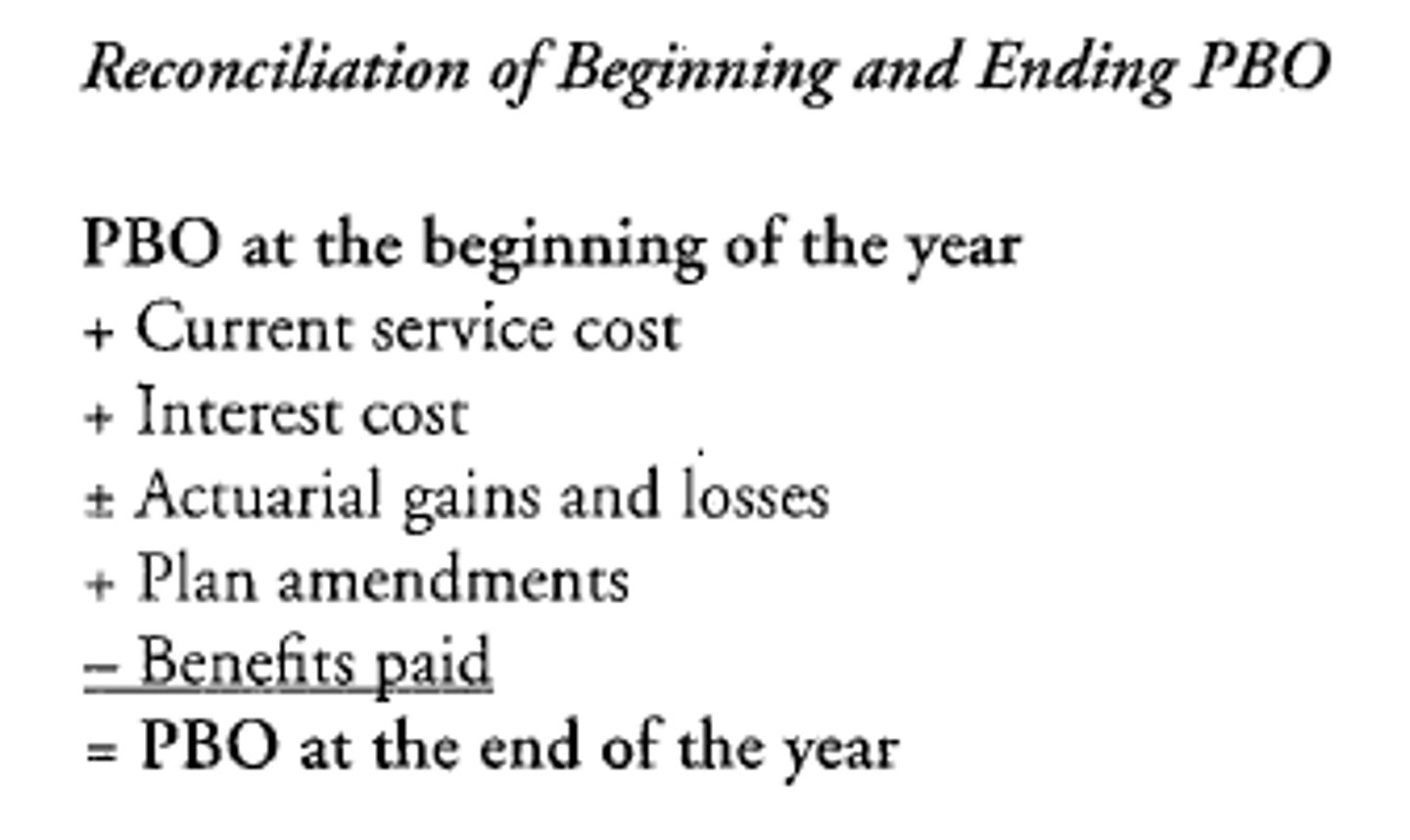
PBO (PVDBO)
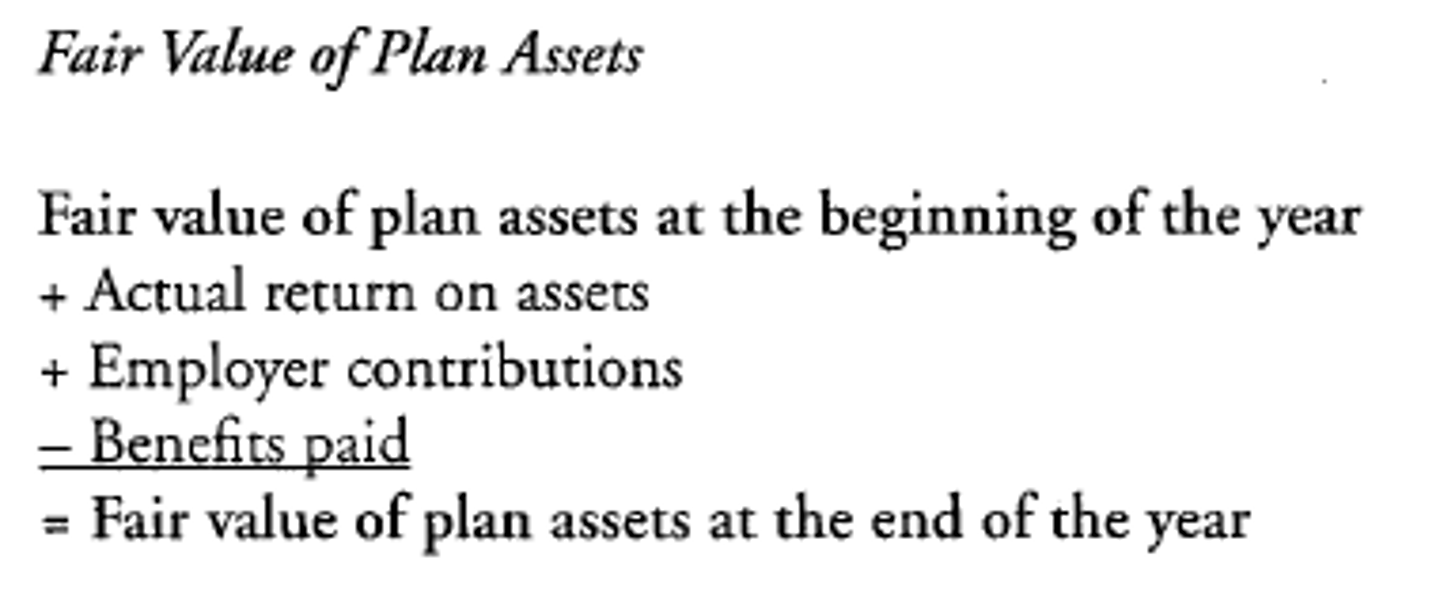
Plan Assets
Total Periodic Pension Cost (TPPC)
Contributions - ∆ funded status
OR
Contributions - (ending funding status - beginning funded status)
OR
Current service cost
+ Prior Service Cost
+ Interest Cost
- Actual return on plan assets
+/- Actuarial losses/gains due to changes in assumptions affecting PBO
OR
(Ending PBO - Beginning PBO)
+ Benefits Paid
- Actual Return on Plan Assets