Lin Alg Midterm #2
 Call Kai
 Learn
Learn Practice Test
 Spaced Repetition
 Match
Match Flashcards
 Knowt Play
1/32

There's no tags or description
Looks like no tags are added yet.
Name | Mastery | Learn | Test | Matching | Spaced | Call with Kai |
|---|
No analytics yet
Send a link to your students to track their progress
33 Terms
Basis
a set of vectors that serves as a fundamental building block for a vector space. To be a basis, the set must be linearly independent (no vector can be formed by others) and span the space (every vector in the space is a linear combination of the basis vectors).

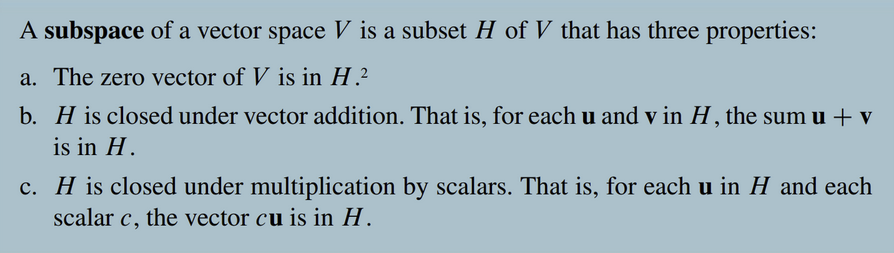
Subspace Definition
A vector space is a subspace
Relation between null space and subspace

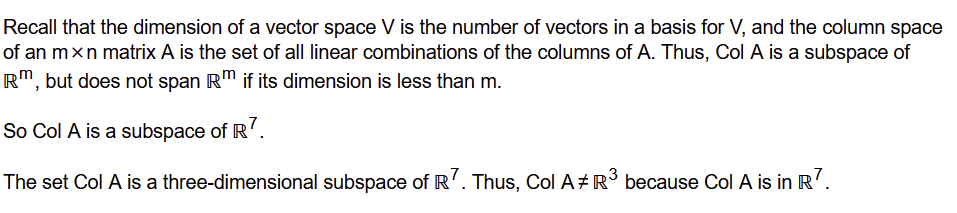
Relation between column space and subspace

Row space
The row space of a matrix is the set of all possible linear combinations of its row vectors, forming a subspace within Rn. It is equivalent to the span of its rows and has the same dimension as the column space (the rank of the matrix). The non-zero rows of a matrix's row echelon form (REF) constitute a basis for its row space.
Span of a matrix is the same as the column space
linear dependence relation

Dimension of a subspace
Number of vectors in the basis of the subspace

HW #21
Eigenvector and eigenvalue

Eigenspace
The eigenspace is the set of all solutions to the equation
(A - λI) = 0
In other words, the eigenspace is the null space of (A - λI)
The basis of the eigenspace can be found by solving the equation, or generating a set of all linearly independent eigenvectors
Determine eigenvectors from eigenvalue

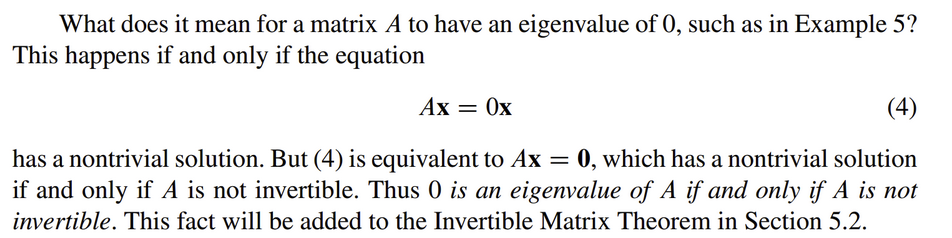
Conditions for eigenvalue of 0
Characteristic equation

Multiplicity (algebraic) of an eigenvalue
The number of times the eigenvalue occurs as a factor in the characteristic polynomial.
(λ - 2)2 means multiplicity of 2 for eigenvalue of 2
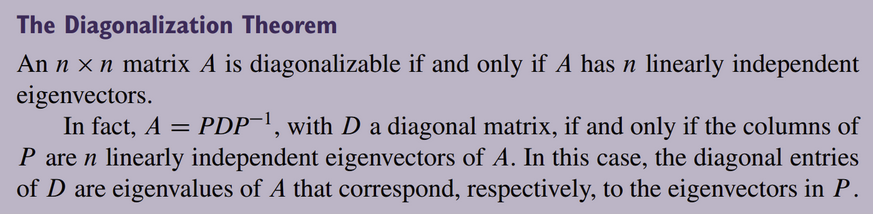
Diagonalization
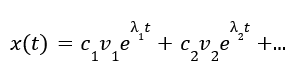
General solution of x’=Ax
Spanning Set
A collection of vectors that can generate any vector in a vector space (or a subspace) through linear combinations
Fact about linearly independent set of vectors
Every linearly independent set of vectors in Rn consists of at most n vectors.
Explanation: “Think of Rn as a space with exactly n distinct dimensions. Every time you add a linearly independent vector to your set, you are pointing in a brand new, mathematically unique direction that cannot be reached by combining the previous vectors.”
Similar matrices
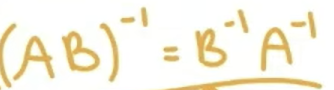
Definition: A is similar to B if there exists an invertible matrix P such that A=PBP-1 or equivalently B=P-1AP.
Similar matrices have same eigenvalues and characteristic polynomial. Matrices with the same eigenvalues are not always similar.
Similar matrices generally do not have the same eigenvectors
Similar matrices and diagonalizability
If A and B are similar, and A is diagonalizable, then B is also diagonalizable.
Way to find general real solution
Multiply by cost + i sint
Properties of determinant
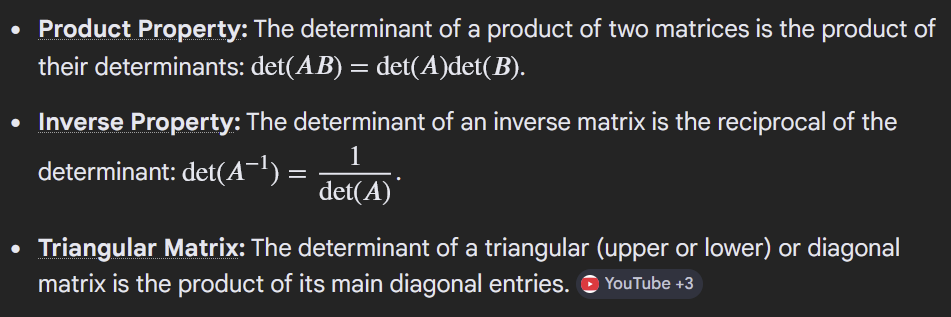
The determinant of a matrix A and its transpose AT are equal
Zero vector in eigenspace and eigenvector
The zero vector technically satisfies Ax=λx for any matrix but cannot an eigenvector because the linear algebra gods said so
The zero vector however IS in the eigenspace of a matrix
An eigenspace is a subspace of the vector space on which the matrix A acts.
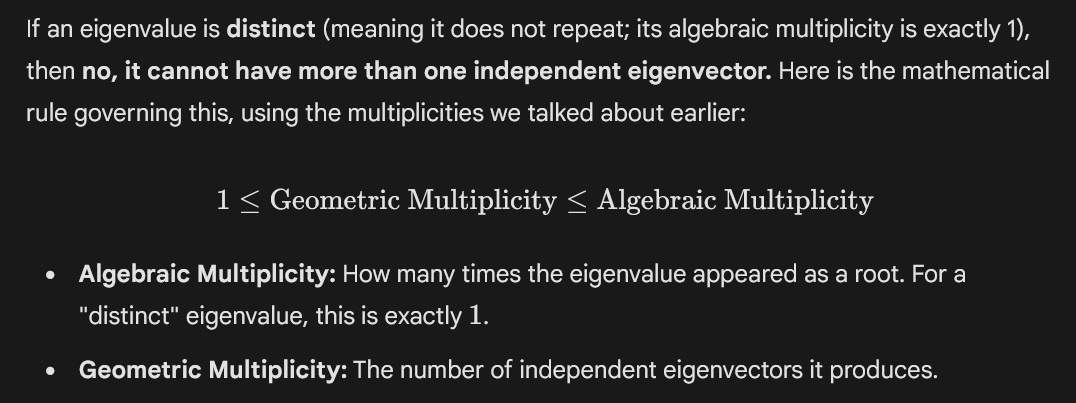
Algebraic Multiplicity and Geometric Multiplicity
How diagonalization relates to multiplicities
algebraic multiplicity must equal geometric multiplicity for all eigenvalues
If for a n x n matrix, all eigenvalues are distinct, and the number of eigenvalues is n, then the matrix is diagonalizable
Transformation matrix relative to a basis
Spring 2023 Exam #2 Q8
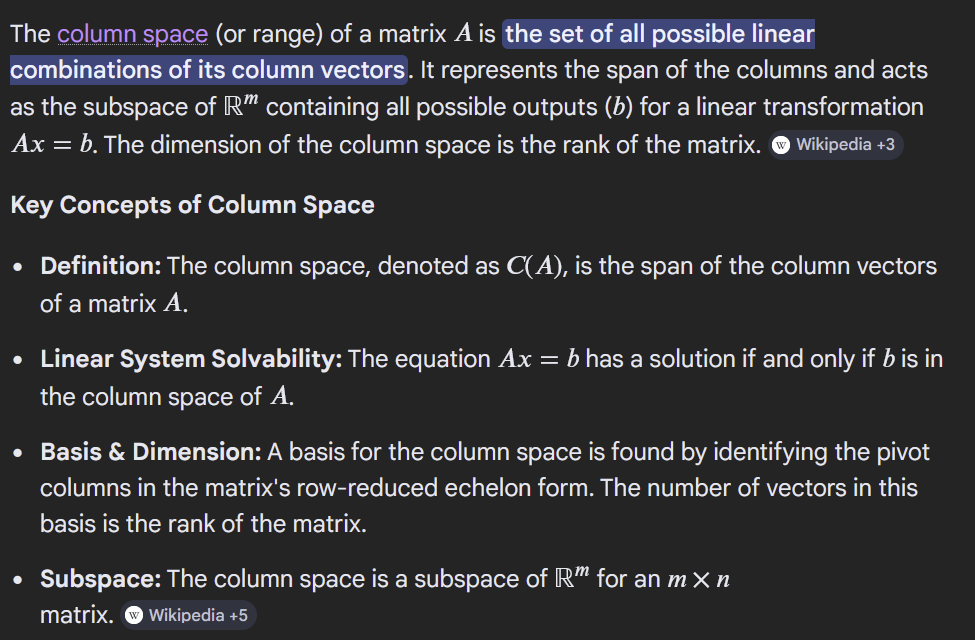
Column space (Also called the range)
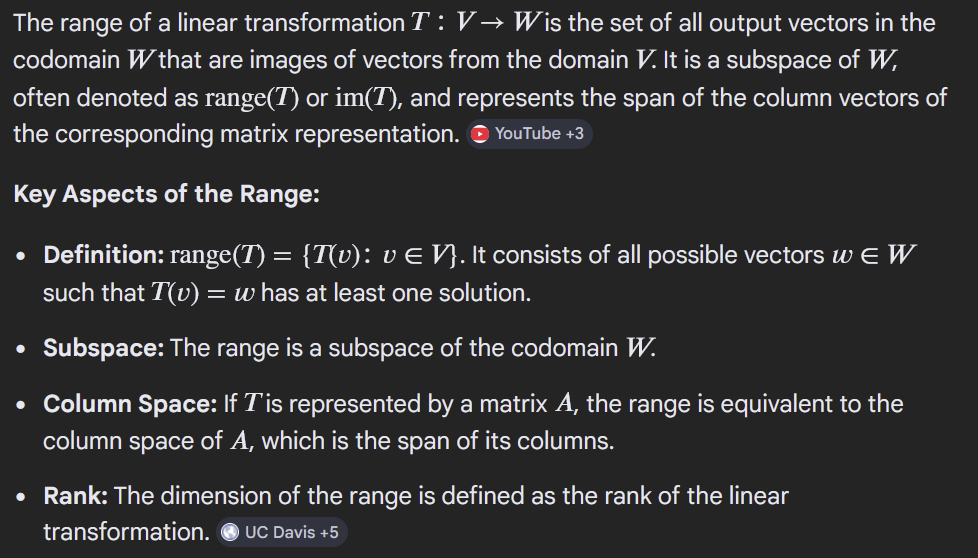
Range of a linear transformation
B-matrix of a linear transformation T (same as: Find a matrix for T relative to the basis { … })
Behavior at origin for differential equation problems
Real Eigenvalues (No imaginary part):
Repeller: Both eigenvalues are positive (pushing outward).
Attractor: Both eigenvalues are negative (pulling inward).
Saddle: One is positive, one is negative (pushing one way, pulling another).
Complex Eigenvalues (α ± βi):
Spiral away from origin: Real part (α) is positive.
Spiral toward origin: Real part (α) is negative.
Ellipses: Real part (α) is exactly 0.