Psychology 3/4 Chapter 7 & 8: Sleep
 Call Kai
 Learn
Learn Practice Test
 Spaced Repetition
 Match
Match Flashcards
 Knowt Play
1/82

There's no tags or description
Looks like no tags are added yet.
Name | Mastery | Learn | Test | Matching | Spaced | Call with Kai |
|---|
No analytics yet
Send a link to your students to track their progress
83 Terms
Consciousness
the awareness of your own internal mental processes, including your thoughts, feelings, sensations and perceptions, and your awareness of the external world around you
Psychological construct
a concept that cannot be objectively observed or measured directly through the collection of data, but is widely understood to exist
Normal Waking Consciousness (NWC)
a state associated with being aware of our internal and external environments
Altered state of consciousness (ASC)
any state that differs in awareness when compared to normal waking consciousness
naturally occuring altered state of consciousness
an altered state of consciousness that occurs without any external influence
induced altered state of consciousness
an altered state of consciousness that has been brought about on purpose
sleep
a naturally occurring and reversible altered state of consciousness, characterised by a reduction in awareness and responsiveness to external surroundings
Non-Rapid Eye Movement (NREM) Sleep
a type of sleep characterised by a progressive decline in physiological activity
N1 (stage 1, NREM)
Light sleep: Transition from wakefulness; easy to wake up, may experience drifting thoughts or muscle twitches.
N2 (stage 2, NREM)
Light-to-moderate sleep: Body temperature drops, heart rate slows; harder to wake than N1 & is stage experienced most throughout sleep episode
N3 (stage 3, NREM)
Deep sleep (slow-wave sleep): Most restorative; body repairs & regenerates tissue, boosts immune function, and consolidates some memory; hardest to wake from. mostly experienced first 1/2 of night
Rapide eye movement (REM) sleep
a type of sleep characterised by rapid eye movements behind closed eyelids, increased physiological activity (such as irregular heart rate, breathing, and higher brain activity), & vivid dreaming.
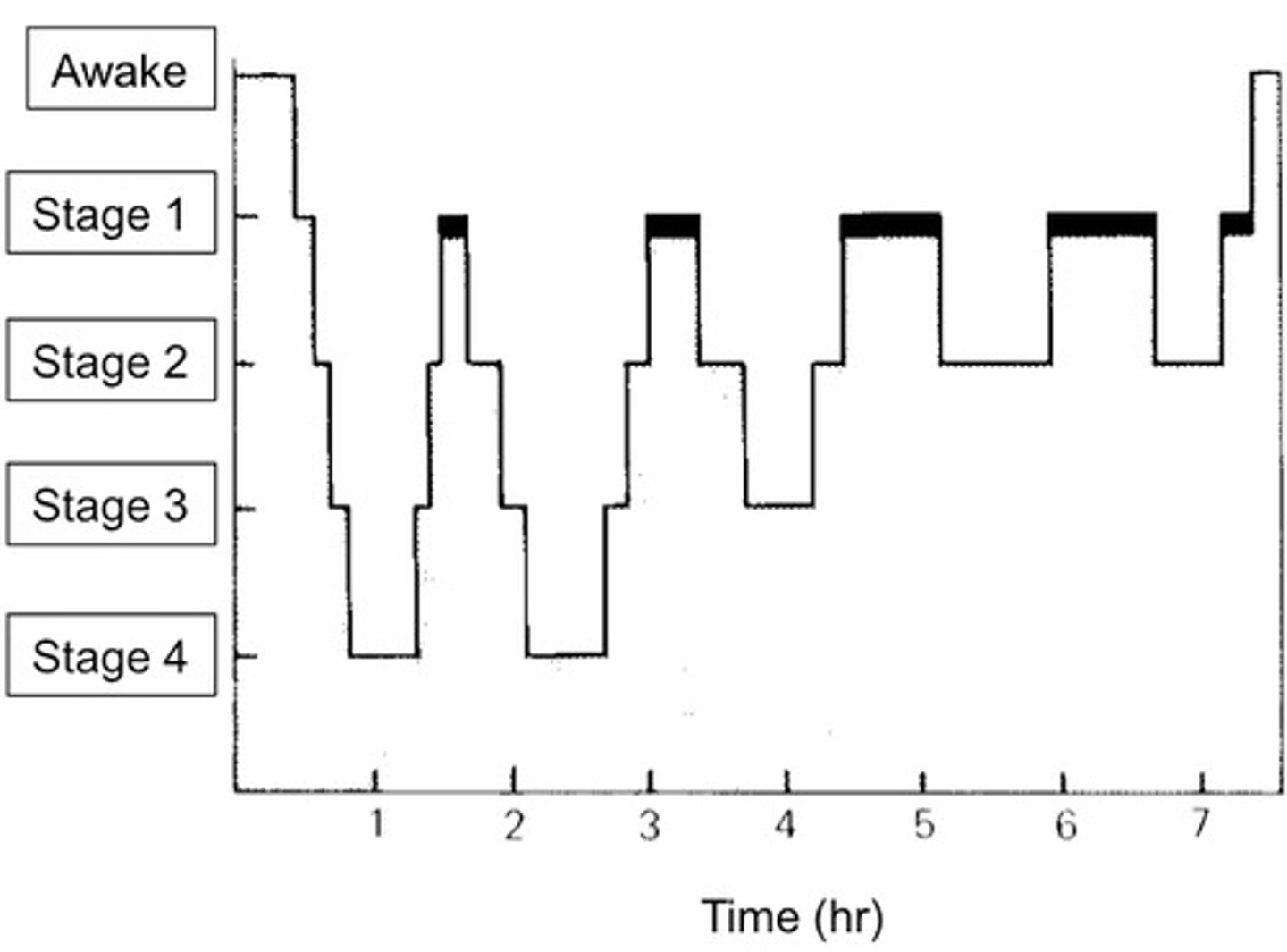
Hypnogram
a line graph that represents the stages of sleep plotted against time
polysomnography
a multi-parameter sleep study used as a diagnostic tool in sleep medicine
Electro-encephalography (EEG)
a technique that detects, amplifies and records the electrical activity of the brain -DARE. Different types and stages of sleep produce distinct brain waves. Electrodes attached to scalp. Identifies specific stages or abnormal brain activity.
Beta waves (EEG)
Highest frequency, lowest amplitude. During NWC; Awake, alert & focused; High environmental stimulation; Brain working on several things at once
Alpha waves (EEG)
high frequency, lowest amplitude. During Lower alertness; Awake but relaxed; Quiet & calm; Drowsy; Eyes closed; Low environmental stimulation
Theta waves (EEG)
low frequency high amplitude. During Low alertness; Light sleep; Senses withdrawn from external environment; Deep meditation
Delta waves (EEG)
lowest frequency, highest amplitude. During Lowest alertness; Deep N3 sleep; Dreamless sleep
Electromyography (EMG)
detects, amplifies & records the electrical activity of skeletal muscles. Electrodes attached around jaw or on legs
Electro-oculography (EOG)
detects amplifies & records electrical activity of muscles controlling/surrounding EYES. electrodes attached to skin around side of each eye. helps determine onset of sleep, monitor stages & types of sleep.
Sleep Diary
subjective self-report tool used by a person to track their own sleep and wake patterns
Video monitoring
sleep study tool used to collect qualitative visual and audio information about a person's sleep
circadian rhythms
biological processes that coordinate the timing of body activities over a 24-hour period
ultradian rhythm
biological processes that coordinate the timing of body activities over a period of LESS than 24 hours
suprachiasmatic nucleus (SCN)
a master body clock in the hypothalamus that regulates body activities to a daily schedule of sleep and wakefulness
Zeitgeber
environmental cue such as light, temperature and eating patterns that can synchronise and regulate the body's circadian rhythm
melatonin
a hormone that induces drowsiness and decreases cell activity
newborn (0-3 months) sleep
14-17 hrs. 50% REM & NREM. They sleep the most, with high REM sleep that aids brain growth, memory, and sensorimotor development.
Infant (4-11 months) sleep
12-16 hrs. 30-40% REM & 60-70% NREM. As their circadian rhythm develops, they begin sleeping for longer periods in line with day-night cycles.
toddler (1-2 years) sleep
11-14 hours. 25-30% REM & 70-75% NREM. Proportion of REM sleep has undergone its greatest decline & continues to decrease only slightly throughout the rest of the lifespan.
Preschooler (3-5 years) sleep
10-13 hrs. 25% REM & 75% NREM. Circadian rhythm may shift earlier, & sleep moves to earlier in evening as daytime naps are dropped.
school age children (6-13 years) sleep
9-11 hrs. 20% REM & 80% NREM. From early to late childhood, the circadian rhythm gradually delays, causing sleep to shift to later in the evening.
Adolescent (14-17 years) sleep
8-10 hrs. 20% REM & 80% NREM. Delayed circadian rhythm from later melatonin release, leading to later bedtimes & less sleep, worsened by school demands, independence, & constant access to entertainment & social media.
Young adults (18-25 years) sleep
7-9hrs. 20% REM & 80% NREM. Sleep patterns change due to study, work, social life, & independence, with a circadian phase advance & declining melatonin leading to earlier sleep preferences.
Adult (26-64 years) sleep
7-9 hrs. 20% REM & 80% NREM. sleep patterns change due to lifestyle factors like parenting, work, & health, while N3 sleep declines, N2 increases, & melatonin continues to decrease.
Older Adult (65+) sleep
7-8 hrs. 18-20% REM & 80-82% NREM. Sleep is affected by lifestyle & health changes, with earlier sleep times, longer sleep latency, frequent awakenings, less N3 sleep, lower melatonin, and reduced sleep due to difficulty, not less need.
Partial sleep deprivation
the experience of achieving inadequate sleep in terms of quantity or quality
affective functioning
a person's experience of their emotions
When sleep deprived,
you may have trouble regulating or controlling your emotions
Behavioural functioning
A person's observable actions
When sleep deprived, you may have trouble controlling your behaviour
Cognitive Functioning
a person's mental processing.
when sleep deprived you may experience cognitive functioning issues like trouble with memory, slower thinking, poor concentration, lack of motivation
Blood Alcohol Concentration (BAC)
the percentage of alcohol in the bloodstream
legal BAC limit for driving in Victoria, and why is this relevant to consciousness?
Under 0.05%. A BAC at or above this level significantly impairs cognitive and affective functioning, similar to sleep deprivation.
What does 17 hours of sustained wakefulness impairments equate to in terms of BAC?
Equivalent to a BAC of 0.05%, which is the legal limit for driving in Victoria.
what does 24 hours of sustained wakefulness equate to in terms of BAC?
Equivalent to a BAC of 0.10%, double the legal limit and associated with serious impairment.
cognitive functions are impaired by both sleep deprivation and alcohol consumption?
Attention, concentration, decision-making, and problem-solving.
affective functions impaired by both sleep deprivation and alcohol consumption?
Emotional regulation, increased irritability, and emotional instability.
Circadian rhythm sleep disorders
a category of sleep disorders in which sleep is disrupted because the circadian rhythm and a person's sleep-wake schedule are misaligned
symptoms of circadian rhythm sleep disorders
Insomnia, excessive daytime sleepiness, and functional impairment.
treatment for circadian rhythm sleep disorder
Bright light therapy.
bright light therapy
a therapy to treat a sleep disorder in which the person is exposed to a bright light to reset the sleep- wake cycle
How does bright light therapy work?
Influences the suprachiasmatic nucleus and melatonin release to adjust the circadian rhythm.
Delayed Sleep Phase Syndrome (DSPS)
a circadian rhythm sleep disorder characterised by a delay in the timing of sleep onset and awakening compared with the timing that is desired, commonly affected by adolescents and young adults
causes of DSPS
delayed circadian rhythm, sensitivity to evening light, reduced sensitivity to morning light.
symptoms of DSPS
rouble falling asleep at normal time, insufficient sleep on school/work days.
DSPS treatment
Bright light therapy in the morning to advance the sleep-wake cycle.
Advanced sleep phase disorder (ASPD)
a circadian rhythm sleep disorder characterised by an advance in the timing of sleep onset and awakening compared to the timing that is desired, commonly affected by older adults
symptoms of ASPD
Early sleepiness in the evening, early waking, difficulty staying awake for evening events.
ASPD treatment
Bright light therapy in the evening to delay the sleep-wake cycle.
shift work disorder
A disorder caused by working during normal sleep times (e.g. night shifts), disrupting circadian rhythms.
symptoms of shift work disorder
Insomnia, daytime sleepiness, reduced alertness, poor performance, health issues.
health risks of shift work
Increased risk of depression, gastrointestinal problems, cardiovascular disease, and cancer.
shift work treatment
Bright light therapy before/during night shift and light avoidance during the day.
What roster pattern is best for shift workers?
Forward-rotating rosters (morning → afternoon → night).
sleep hygiene
the sleep-related behaviours and environmental conditions that are beneficial for sleep
good sleep hygiene practices
Avoid screens/caffeine before bed, keep a consistent routine, ensure a cool, quiet, dark environment.
benefit of good sleep hygiene
Helps fall asleep faster, stay asleep longer, and improves sleep quality and mental wellbeing.
zeitgeber
environmental cue that regulates the circadian rhythm (e.g. light, temperature, eating).
How do zeitgebers influence the circadian rhythm
By syncing internal body clocks with the external environment.
most powerful zeitgeber
light
lights affect on sleep-wake cycle
suppresses melatonin, promoting wakefulness; darkness increases melatonin, promoting sleepiness.
What is blue light and why is it problematic?
wavelength from screens and LEDs that strongly suppresses melatonin and disrupts sleep.
How can light be used to improve sleep?
Get morning sunlight and reduce blue light exposure at night.
body temperature link to sleep
Sleep onset occurs as core body temperature drops.
ideal room temperature for sleep onset
19-21°C.
ideal skin/bed temperature during sleep
31-35°C.
Why is temperature control important for elderly people?
improves deep sleep and reduces early morning waking due to weaker thermoregulation.
food timings affect on circadian rhythms
Eating at night can desynchronise peripheral clocks from the suprachiasmatic nucleus.
effect of eating late at night (within 3-4 hrs of sleep)
Poorer sleep quality, longer sleep onset, more awakenings.
How long before sleep can caffeine still be in effect
Up to 6 hours.
How can eating patterns be adjusted to improve sleep
Eat during the active (light) phase, avoid caffeine late, and avoid meals just before sleep.
three pillars of health
Sleep, diet, and exercise.
mental/physical health problems linked to poor sleep
Depression, anxiety, obesity, diabetes, heart disease.