Electric fields
 Call Kai
 Learn
Learn Practice Test
 Spaced Repetition
 Match
Match Flashcards
 Knowt Play
1/45

There's no tags or description
Looks like no tags are added yet.
Name | Mastery | Learn | Test | Matching | Spaced | Call with Kai |
|---|
No analytics yet
Send a link to your students to track their progress
46 Terms
What do all charge particles generate?
an electric field
what does an electric field do?
it exerts a force on nearby charged particles.
what is coulombs law?
the electrostatic force between two points charges is directly proportional to the product of the charges and inversely proportional to the square of their seperation,
F= 1/4πε₀ * Q₁Q₂/r²
What is the coulomb constant k?
1/4πε₀
are electric forces always attractive?
no they can be attractive or repulsive
what happens between two like charges?
they repel
what happens between two positive charges?
they attract
what is the key similarity between electric and gravitational forces?
Both follow an inverse square law
What is the main difference between gravitational and electric forces?
gravity is always attractive but electric forces can attract or repel
when can a spherical conductor (material that lets electric charge move through it easily) be treated as a point charge?
for a point outside the sphere if the sphere is uniform
where is the charge of a spherical conductor considered to be?
at its centre
what should you assume about air in coulombs law?
treat it as a vacuum, air has the same effect as empty space
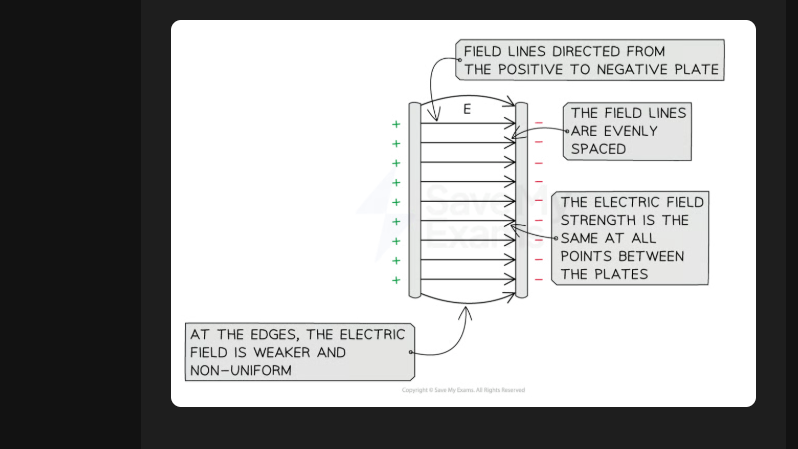
which way do electric field lines spoint?
from posotive to negative
what do uniformly spaced field lines mean?
a uniform electric field with constant strength
what happens to field strength in a radial field as distance increases?
it decreases
how do field lines around a positive point charge- look?
they point radially outwards
how do field lines around a negative point charge look?
they point radially inwards
where is the electric field strongest
where the field lines are closer together
what is the electric field inside a charged conducting sphere?
zero
what happens between two opposite charges?
field lines go from positive to negative and force is attractive
what happens between two like charges?
field lines do not connect and force is repulsive.
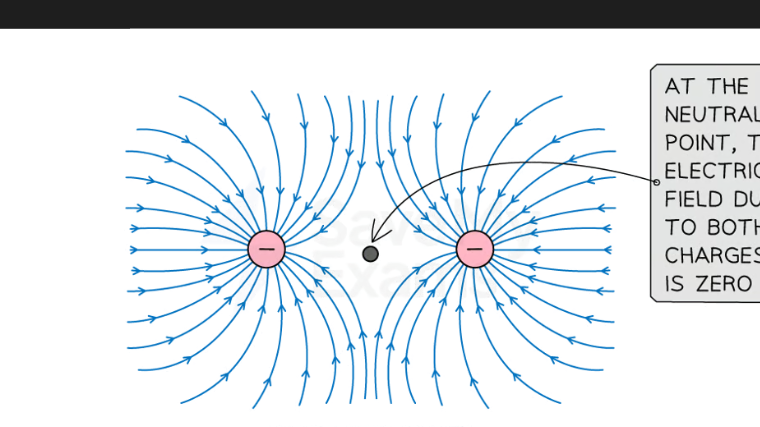
what is a neutral point?
a point where the resultant electric field is zero.
what is the field like between parallel plates?
unfiform in the middle, non uniform at the edges.
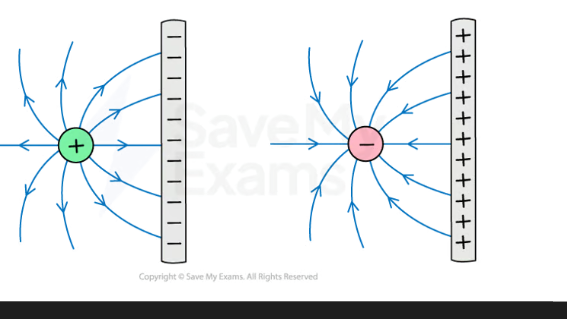
what happens to field lines between a point charge and a parallel plate?
they curve and become parallel when they touch the plate
what is an elctric field?
a region in space in which an electric charge experiences a force
how is electric field strength defined
the force per unit charge experienced by a small positive test charge at that point
what is the equation for electric field strength
E=F/Q
electric field strength (NC-¹)= electric force (N)/ charge (C)
what is the electric field strength between two parallel plates?
E= V/d
electric field strength= potential difference between plates/ separation between plates
what are the units of electric field strength?
Vm-¹ or NC-¹
can E=V/d be used for a point charge?
no it can only be applied to parallel plates
What is the equation for force on a charged between parallel plates?
F=QV/d (not given)
what is the equation for work done moving a charged across the plate?
W= Fd (not given)
What is the equation for work done in moving a charged through a potential difference?
W=QV
what happens if one plate is earthed?
if one plate is connected to the earth, its potential difference is zero
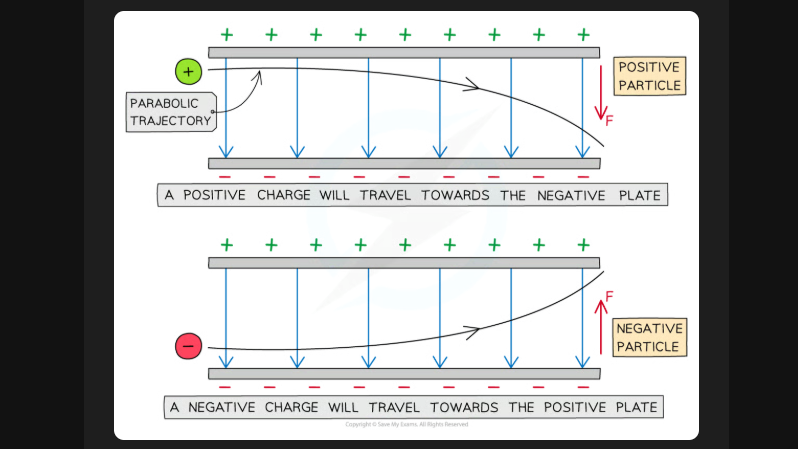
What happens to a charged particle in an electric field?
it will experience a force and will move
what path does a charged particle take if it enters a uniform electric field with a horizontal velocity?
it follows a parabolic trajectory
what happens to an uncharged particle in an electric field?
it experiences no force and will travel straight through
how does mass affect deflection?
greater mass means smaller deflection
how does charge affects deflection?
greater charge magnitude means greater deflection.
hwo does speed affect deflection?
greater speed means smaller deflection
what is the force on a charged particle in a uniform electric field like?
its constant and always in the same direction
why is a boron nucleus less deflected than a proton in the same field?
It has a much larger mass so its harder to deflect even though it has a larger positive charge-.