Bio 2 Test 5
 Call Kai
 Learn
Learn Practice Test
 Spaced Repetition
 Match
Match Flashcards
 Knowt Play
1/61

There's no tags or description
Looks like no tags are added yet.
Name | Mastery | Learn | Test | Matching | Spaced | Call with Kai |
|---|
No analytics yet
Send a link to your students to track their progress
62 Terms
Where do the interaction between species occur? How are they grouped? What can they involve?
The interactions between species occur at the community level.
They are grouped based on their influence to the involved species
Could be positive (+), negative (-), or neutral (0)
Can involve:
Feeding (trophic)
Symbiosis (a species living in or on another species)
Ex: microbiota
How are these species positive, negative, or neutral further sorted?
Predation, Competition, and Amensalism
Feeding vs non-feeding (trophic vs non-trophic).
Carnivore species 1 could be lion, species 2 could be gazelle. Gazelle dies Lion feeds.
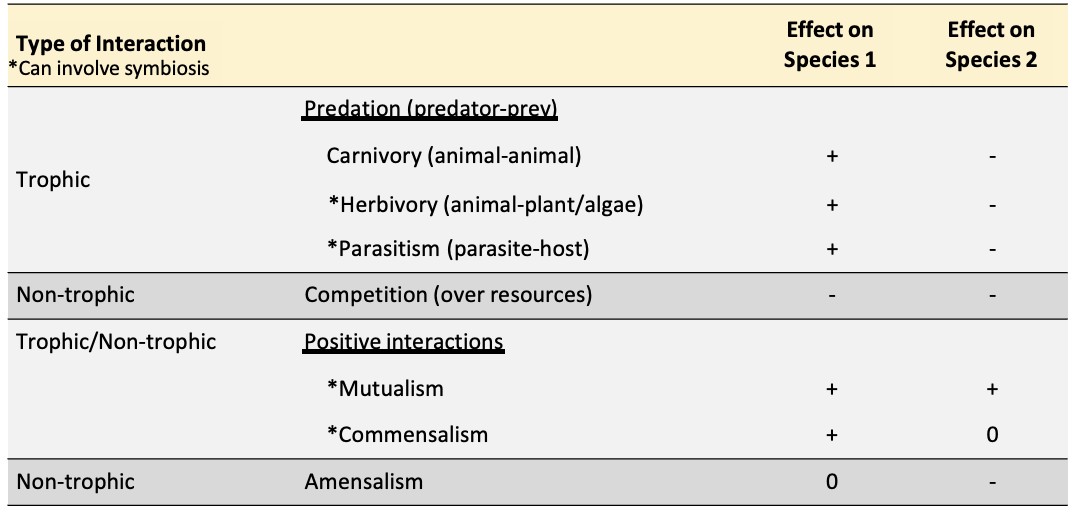
What are the three types of predation (predator-prey) interactions, how are they represented, and what is an example?
Carnivore (+,-): an organism obtaining energy (benefit) at the expense of another organism.
Ex: a house cat catching and eating a mouse
Herbivory (+,-): an organism obtaining energy at the expense of a plant
Ex: A white-tailed deer grazing on grass or eating leaves
Parasitism (+,-): an organism benefits at the expense of another - primarily involving latching to or living inside said organism (classified as a host)
Ex: a tick feeding off a dog (host) for energy and growth, causing harm to said dog.
What are the two types of positive interactions, how are they represented, and what is an example?
Mutualism (+,+): a relationship between two organisms, where both organisms are benefited
Ex: a bee and a flowering plant
Bee: receives nectar (food)
Flowering plant: gets pollinated (beneficial for reproduction)
Commensalism (+,0): a relationship between two organisms, where one organism benefits and the other is not impacted
Ex: Barnacle and a whale
Barnacle: transportation and access to food
Whale: not helped or harmed
What is competition and amensalislm, how are they represented, and what is an example?
Competition (-,-): two organisms using the same limited resources - expending energy in order to reach said limited resource first
Ex: two squirrels competing for nuts in a park
Amensalism (0,-): a relationship where one organism is unaffected while the other is harmed
Ex: A tree blocking sunlight from plants below it
Tree: unaffected
Plants: harmed because they are unable to access the sunlight needed to carry out critical activities to survive
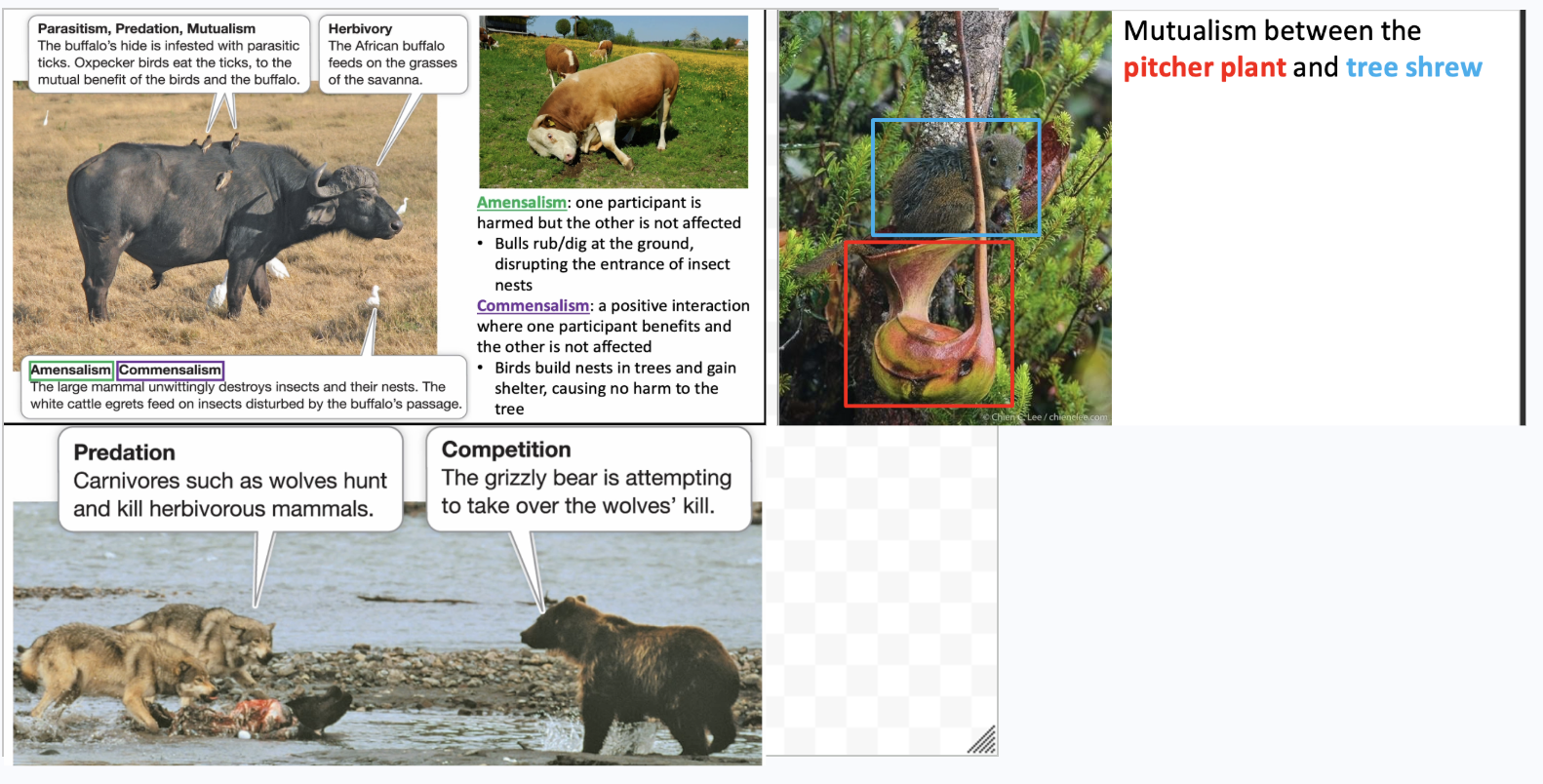
CLASS OVERVIEW EXAMPLES OF SPECIES INTERACTIONS
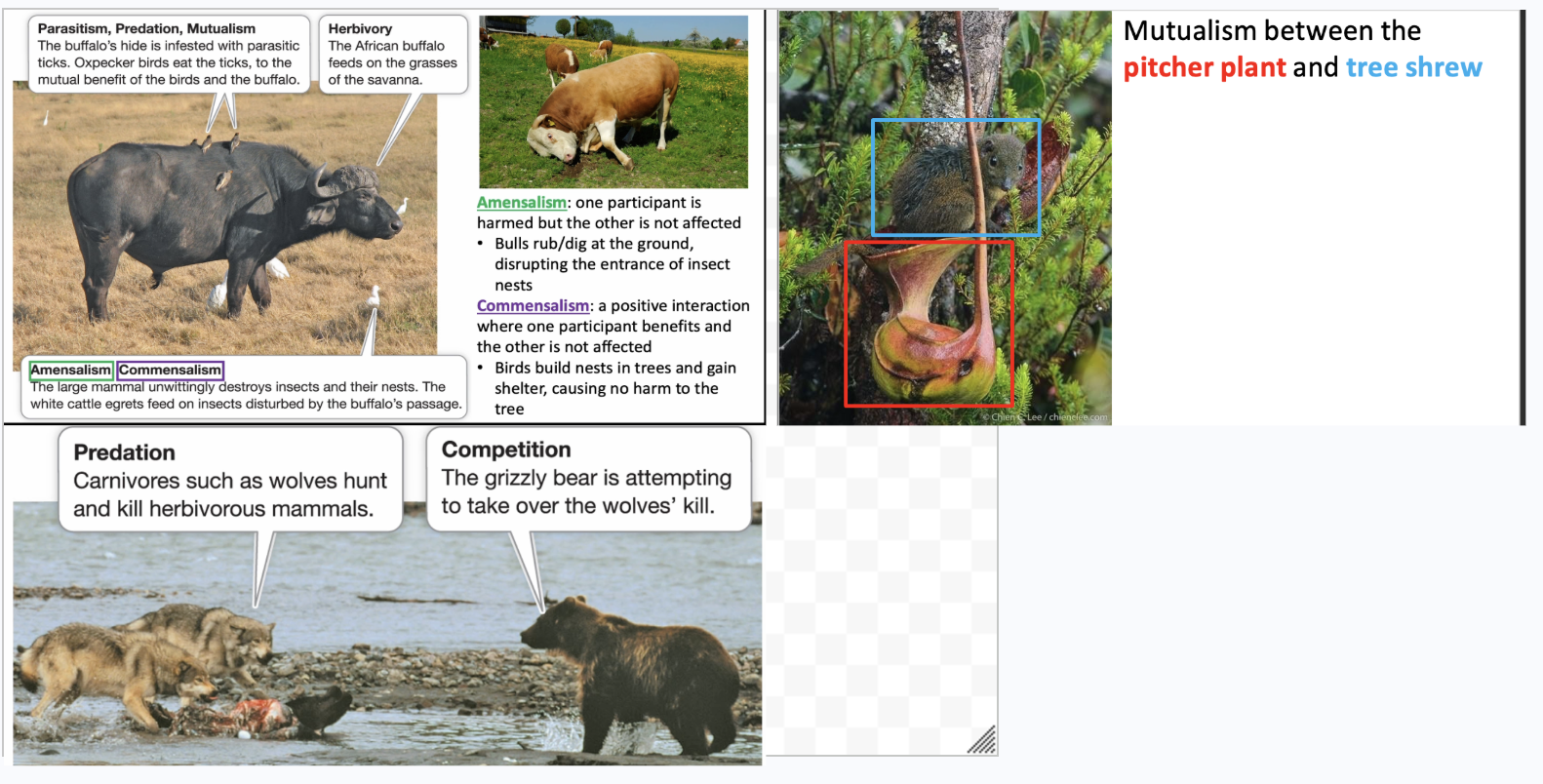
CLASS OVERVIEW EXAMPLES OF SPECIES INTERACTIONS
“You can’t see the ticks that are all over the buffalo sucking up. Ticks are parasites, birds eating the ticks are predation, and the buffalo and the birds. Herbivory is when the buffalo feeds on grass. Amensalism and commensalism play into the birds, where the buffalo destroyes their nests. The white cattle egrets on insects distributed by the buffalo’s passage. Positive effect for one individual and neutral for the other.”
Grizzly bear introduces competition. Likely trying to take over the wolves kill.
What are the two interactions between predator and prey that lead to co-evolution? How does strategy play into it?
Predators evolve strategies to capture prey
Prey evolve strategies to avoid predation
Specific strategies have the ability to benefit organisms
in both preying on other organisms and avoiding being
preyed upon.
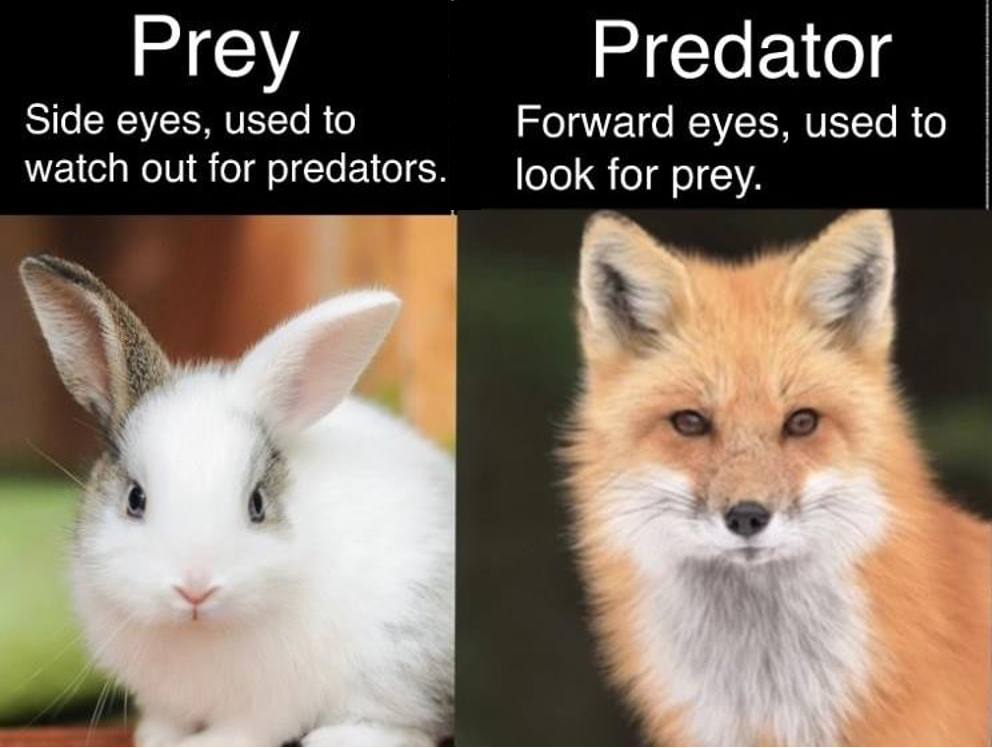
Look at eye position, trait that has evolved over time to help categorize
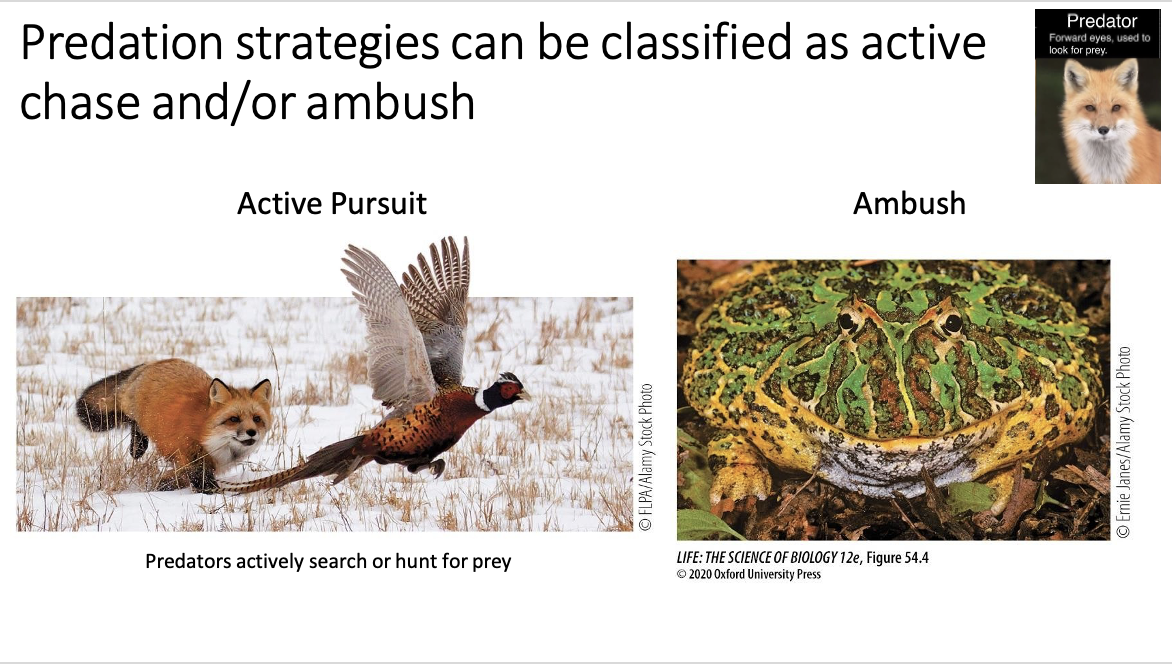
What are the two types of Predator Strategies?
Can be active chase and/or ambush
Active chase: predators actively searching and hunting prey
Ambush: predator waits in one place and suddenly attacks when prey comes close
Through processes like camouflage (blending in) or hiding
What are the four types of prey strategies?
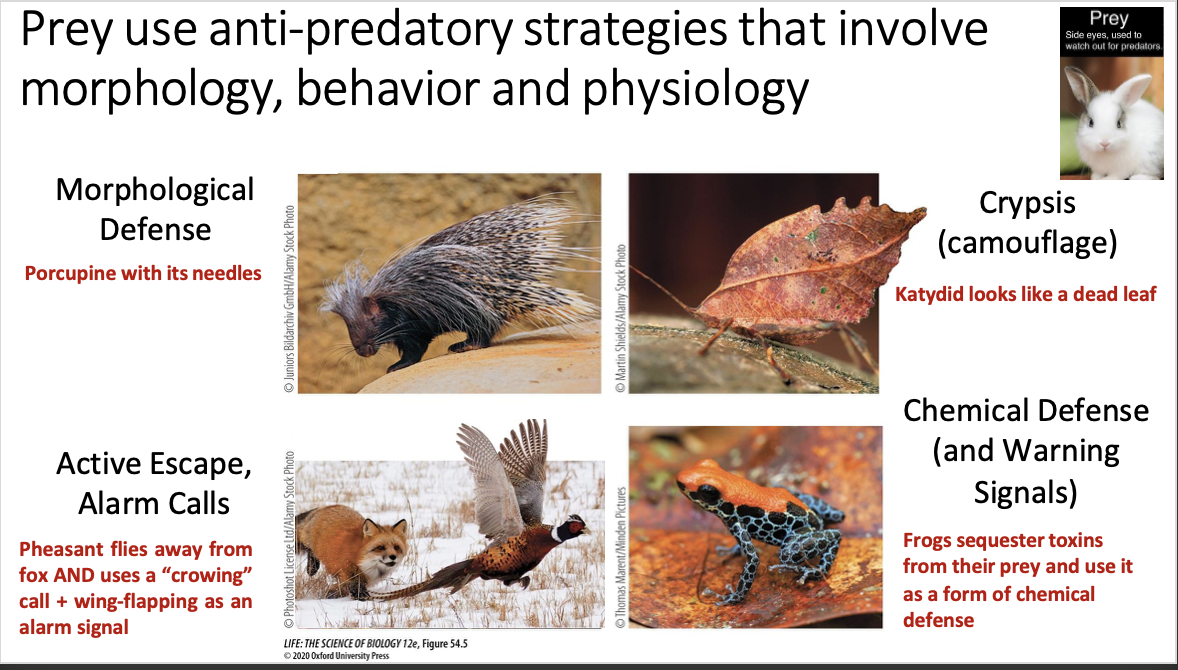
Involve things like morphology, behavior, and physiology
Morphological Defense: A porcupine’s needles can make a predator think twice about attacking
Active Escape, Alarm Calls: Pheasant flying away from a fox and using a ‘crowing’ call and flapping their wings to signal others
Crypsis (Camouflage): a katydid appearing as a dead leaf in order to avoid being spotted by a predator
Chemical Defense (and Warning Signals): frogs isolate toxins from their prey and use that to their advantage - the bright color serves as a chemical defense that can discourage a predator’s attack
What do warning signals lead to the evolution of? Explain the two types of this. What about predator edgucation?
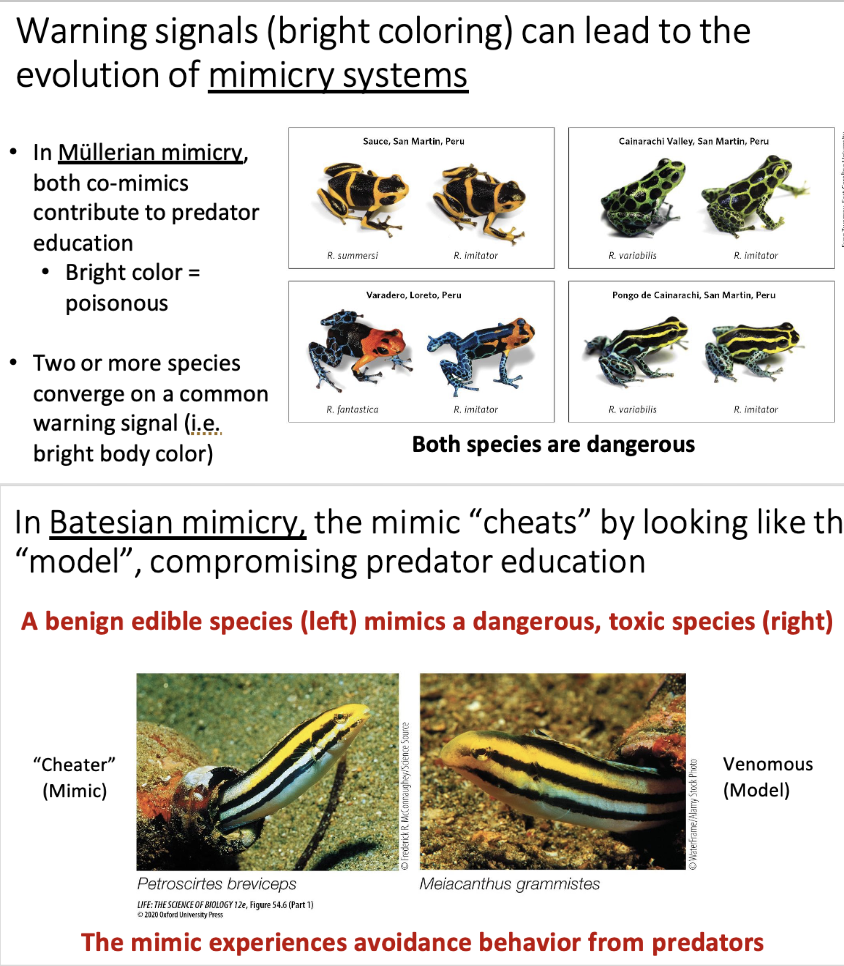
Mullerian mimicry
Two or more harmful species resembling each other.
A bright color can appear on two types of frogs, contributing to predator education.
This occurs after two or more species adopt a common warning signal (such as a bright body color on a frog or a high frequency vibration from a snake)
BOTH species are dangerous to predators, even though one species inhabit an identical trait of another
Batesian mimicry
A benign species that is not harmful can mimic a species that is harmful, compromising a predator’s education
This allows said mimic to be avoided by predators, unless they catch on
Predator education can be seen within these colors present. I don’t eat anything with colors like this because they are dangerous and deadly to me
The beginning species leverages the predation education to take advantage of not being predation.
How have plants developed resistance against herbivory? Does resistance develop?
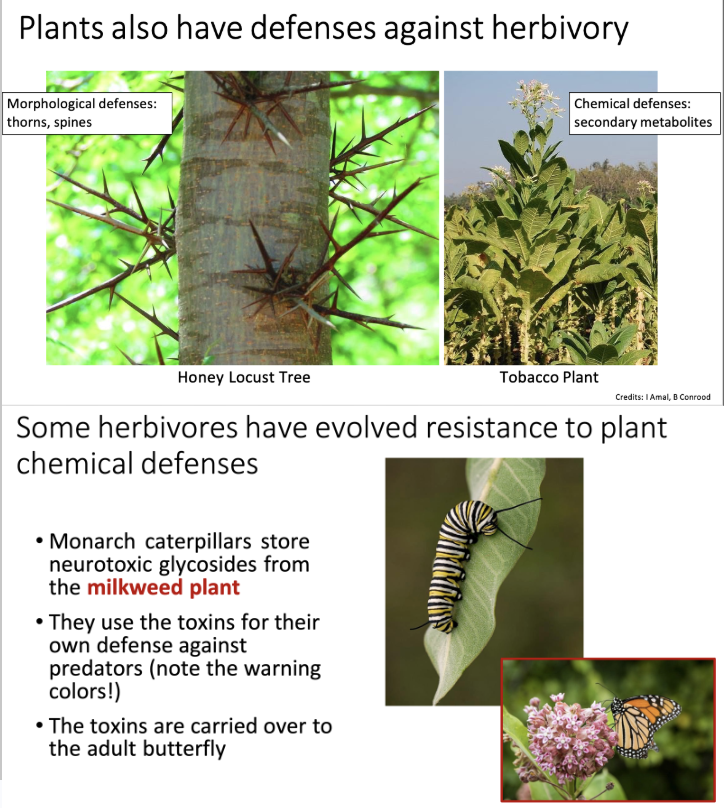
Have both morphological and chemical defenses against herbivory
Morphological: thorns and spines
Chemical: secondary metabolites (toxic)
Some herbivores have evolved resistance
Ex: Monarch caterpillars storing neurotoxic glycosides from the milkweed plant
They use them for their own defenses against predators and this defense even carries over to their adult version (butterfly)
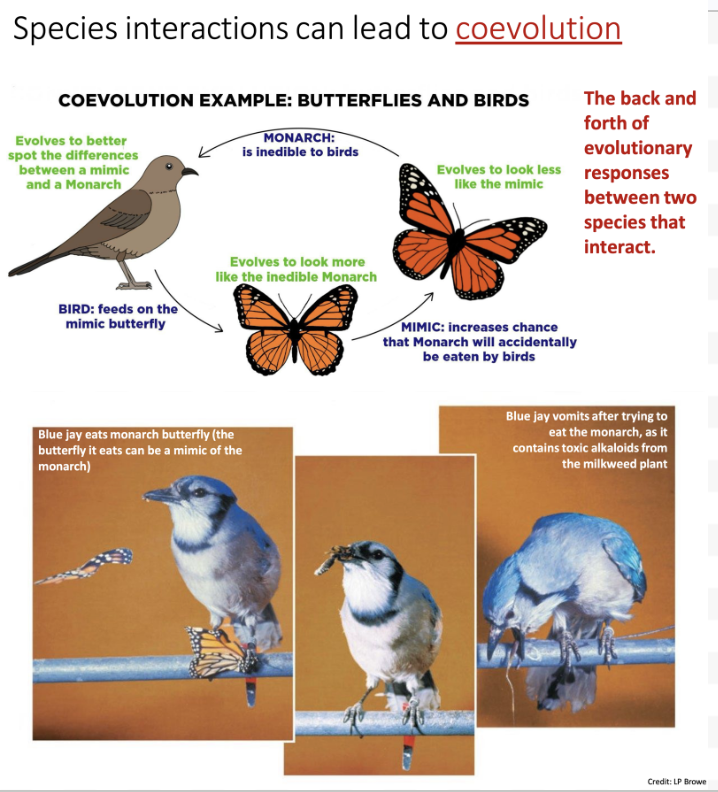
A blue jay eating a monarch butterfly (or a butterfly that mimics the monarch) and vomits due to it containing toxic alkaloids (harmful substance) from the milkweed plant
How can species interactions lead to co-evolution with birds and butterflies?
Species interactions can lead to coevolution
EX: Butterflies and birds
A predator (bird) preys on edible butterflies, driving selection for the butterfly to visually appear as the inedible species (Monarch)
The edible mimic butterfly evolves to look like the inedible monarch, avoiding predation.
This mimicry results in the bird accidentally eating more inedible monarchs, driving selection for monarchs to look less like the mimic
The bird must continue to evolve better visual analyses to distinguish between the changing mimic and monarch.
This cycle occurs continuously!
What are parasites? What kind of interaction? What is their abundance and “Hyper” versions? How does their interactions have an outward effect?
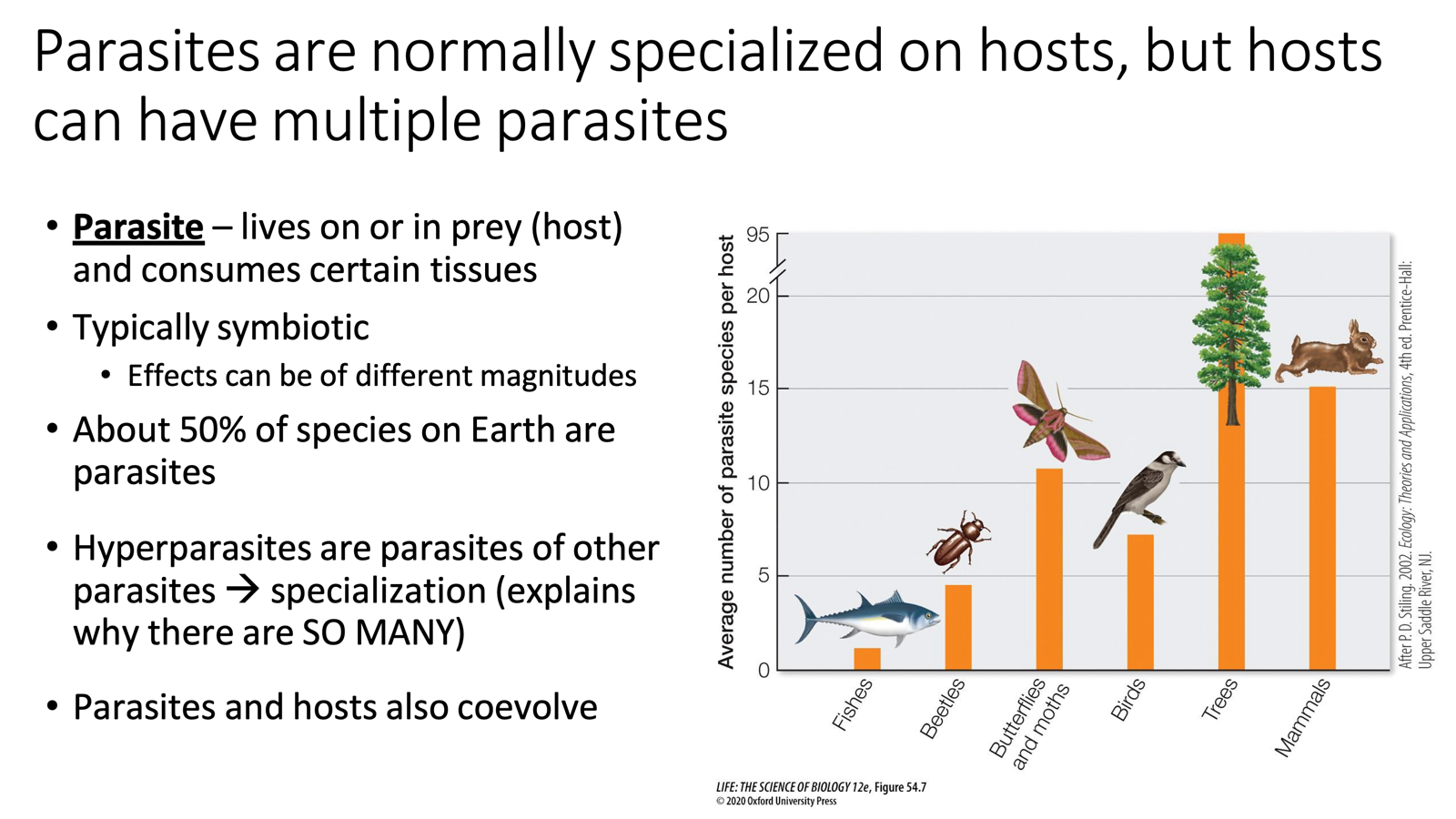
Lives on or inside of prey and consumes certain tissues
Parasites are normally specialized on hosts, but hosts can have multiple parasites
Prey is referred to as host in a parasitic interaction
This interaction is usually symbiotic
About 50% of Earth’s species are parasites!
Hyperparasites are parasites of other parasites → specialization (explains why there are SO MANY)
Higher rate of specialization promotes speciation
Parasites and hosts also coevolve
How can you classify parasites? What are the two types, their subsets, and how their host associations separate them?
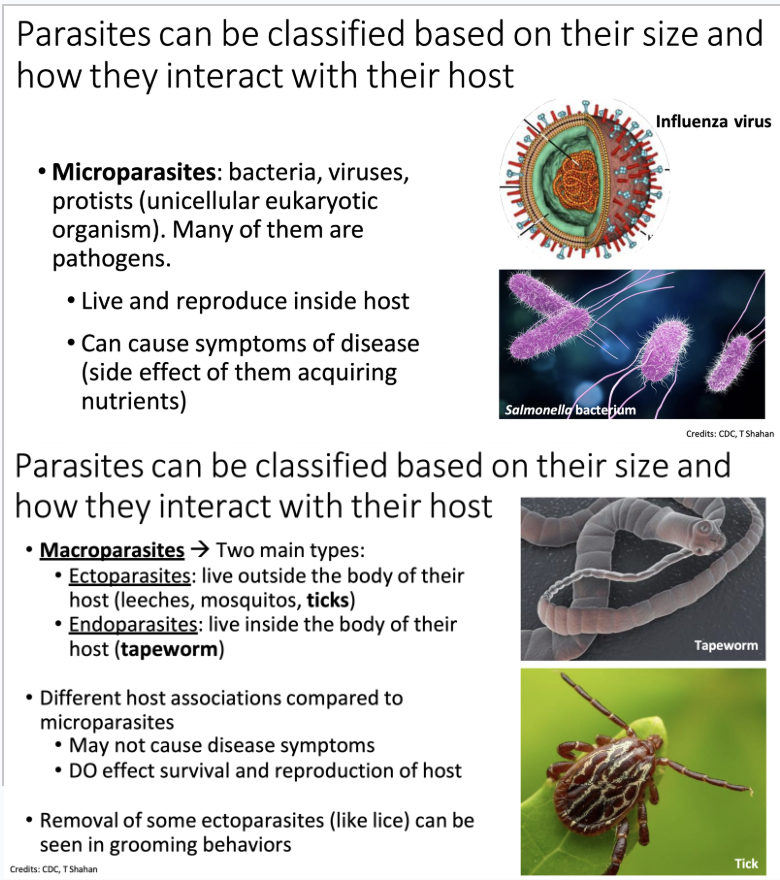
Based on size and interaction with host
Microparasites: live/reproduce inside host. Can cause symptoms of disease.
Ex: bacteria, viruses, protists.
Many microparasites are pathogens
Macroparasites: two types
Ectoparasites: live OUTSIDE body of host
Ex: leeches, mosquitoes, ticks
Some removed through grooming behaviors (like lice)
Endoparasites: live INSIDE body of host
Ex: tapeworm
How do host associations differ from microparasites?
Macroparasites may not cause disease symptoms
Have the ability to impact survival and reproduction of host
What is significant about predator-prey populations over time?
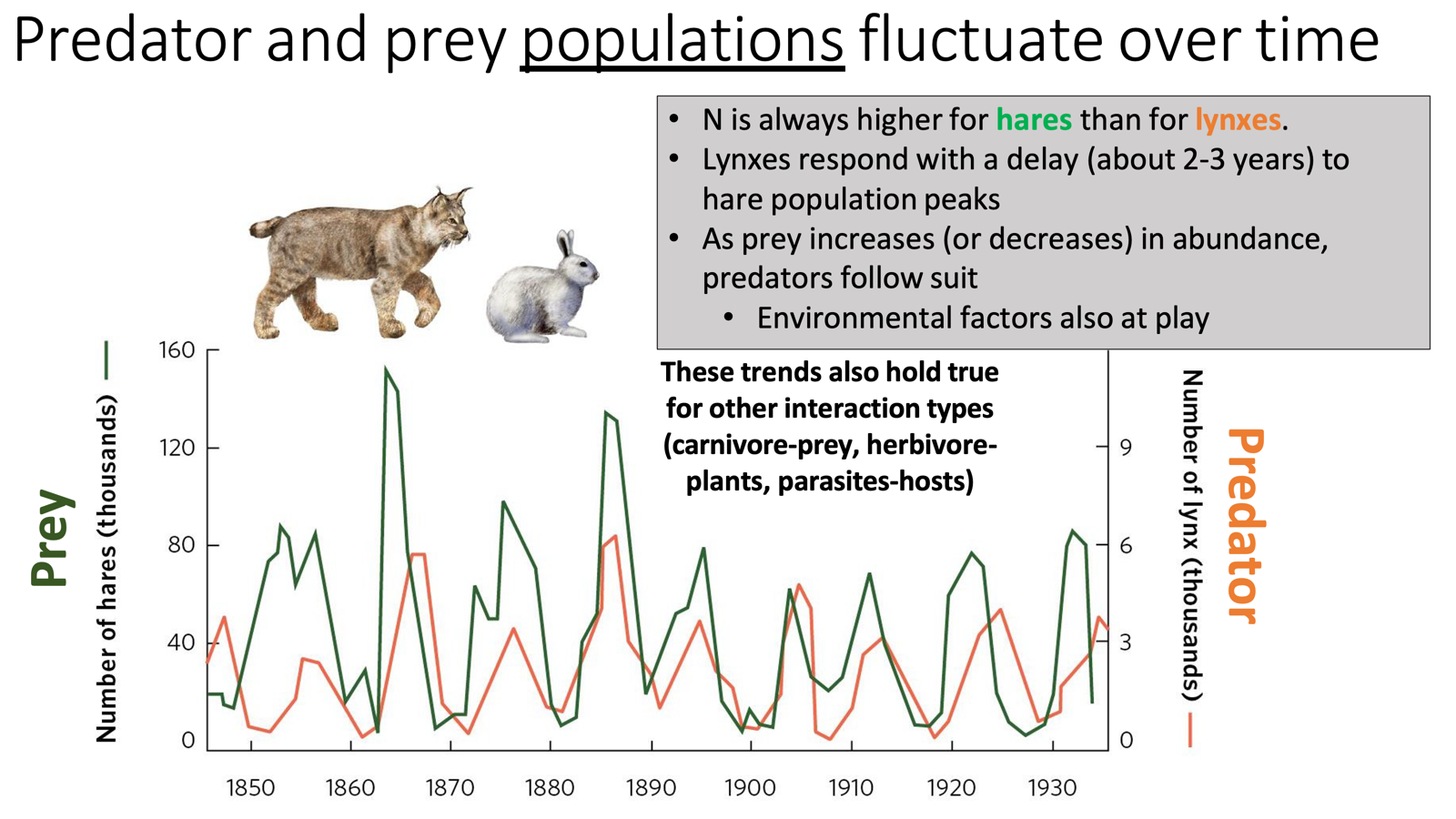
Predator-prey populations fluctuate over time in response to one another
Ex: hares and lynxes have a positive correlation! Hares may always have a higher population size
Remember though, environmental factors can also impact populations!
What are the two different kinds of competition?
Intraspecific versus interspecific
Intra: Within species (limits K ← carrying capacity (maximum number of organisms that a specific environment can support)
Inter: external to species (one species versus another, affects each species’ population growth).
What is competitive exclusion?
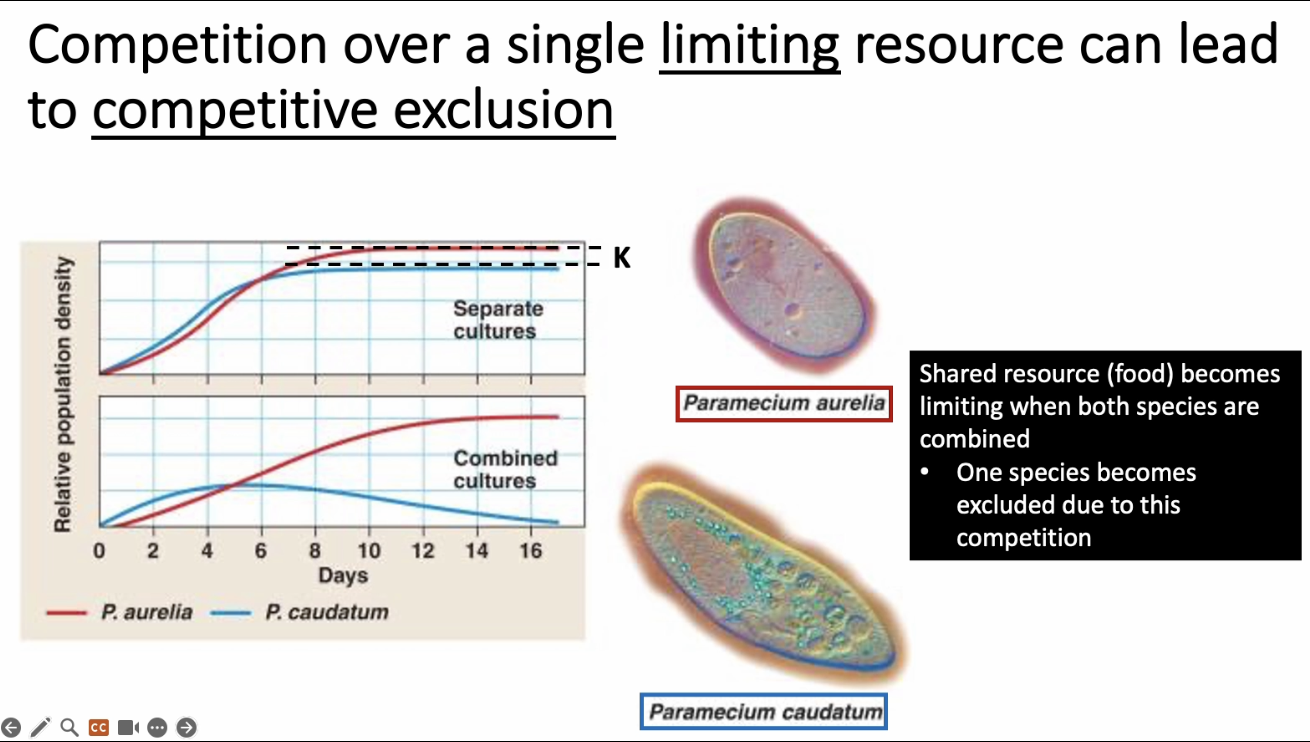
Competition over a single limiting resource can lead to competitive exclusion
Ex: FOOD - when two species are combined, the food becomes limiting, and one species will be excluded!
“When grown together someone has to win over the other. Blue starts to decline and die off while Red will reach it’s carrying capacity. Red is a lot smaller so it doesn’t need as much and can grow much more rapidly than the blue.”
What is exploitation competition? What about Interference competition?
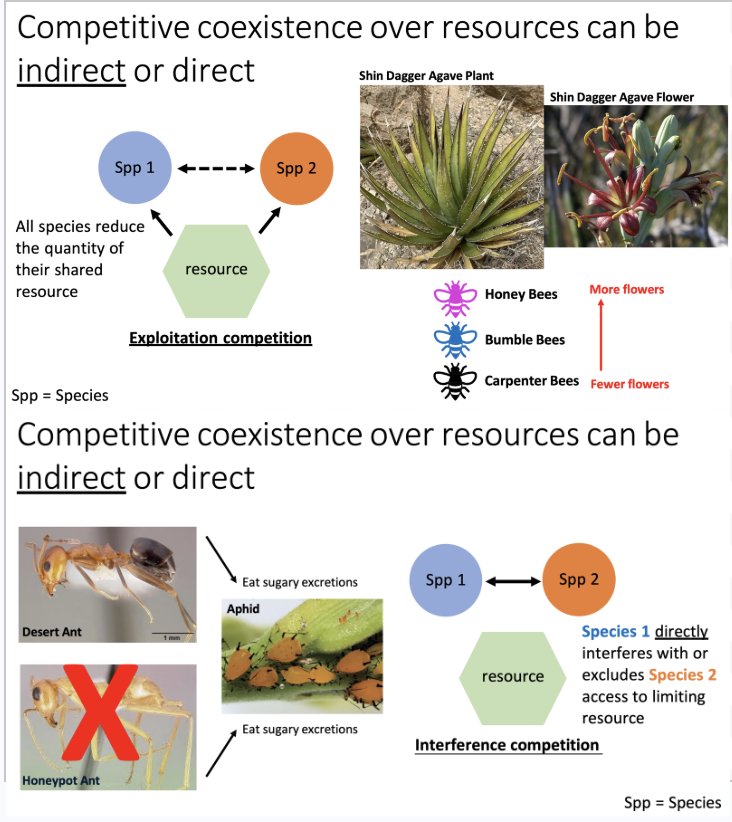
INDIRECT competitive coexistence: exploitation competition
Ex: species of insects that feed on nectar depleting flowers in a field - each species REDUCES the quantity of their shared resource
“Carpenter forage at fewest flowers. They are not directly interacting with each other for the resources but rather are collectively reducing the shared resources that they all hope to harvest. Exploitative because they aren’t directly but are still depleting.”
DIRECT competitive coexistence: interference competition
Ex: one species of ants directly excluding another from a shared limited resource (through physical or chemical interferences)
“Species involved directly interfere with their access to the shared resource. Desert ant can block the entrance/exit with stones, the honeypot ant cant get to the shared resources and here that would be interference competition.”
How can multiple species show competitive coexistence? What is this called?
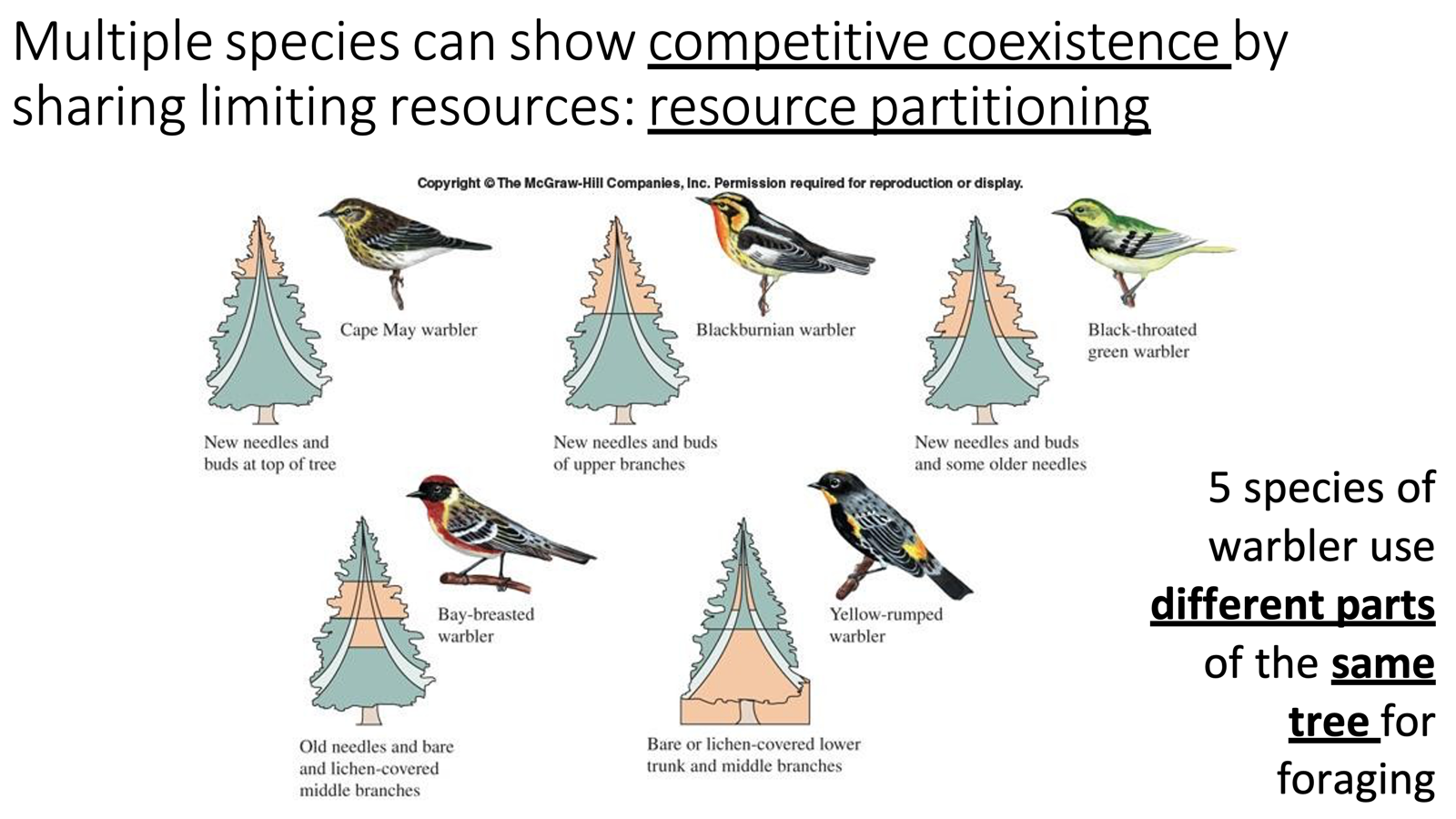
Resource Partitioning
Competitive coexistence: sharing limited resources
Species of warbler (type of bird) using different parts of one tree for foraging
What can impact competition outcomes?
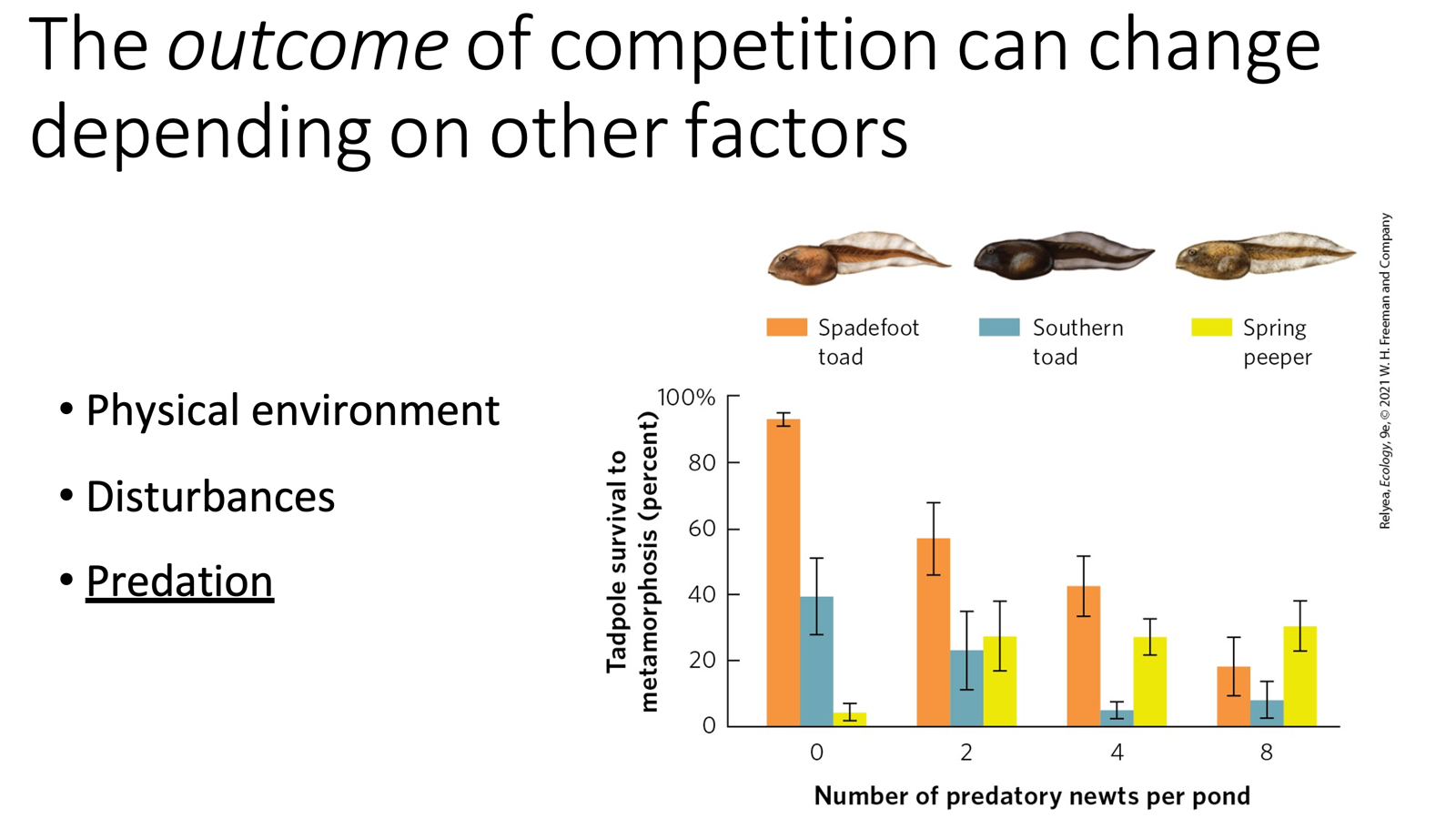
Physical environment
Disturbances
Predation
What is competition’s impact on where a species lives? What are the two types and what is a good example of them?
Competition’s impact on habitat
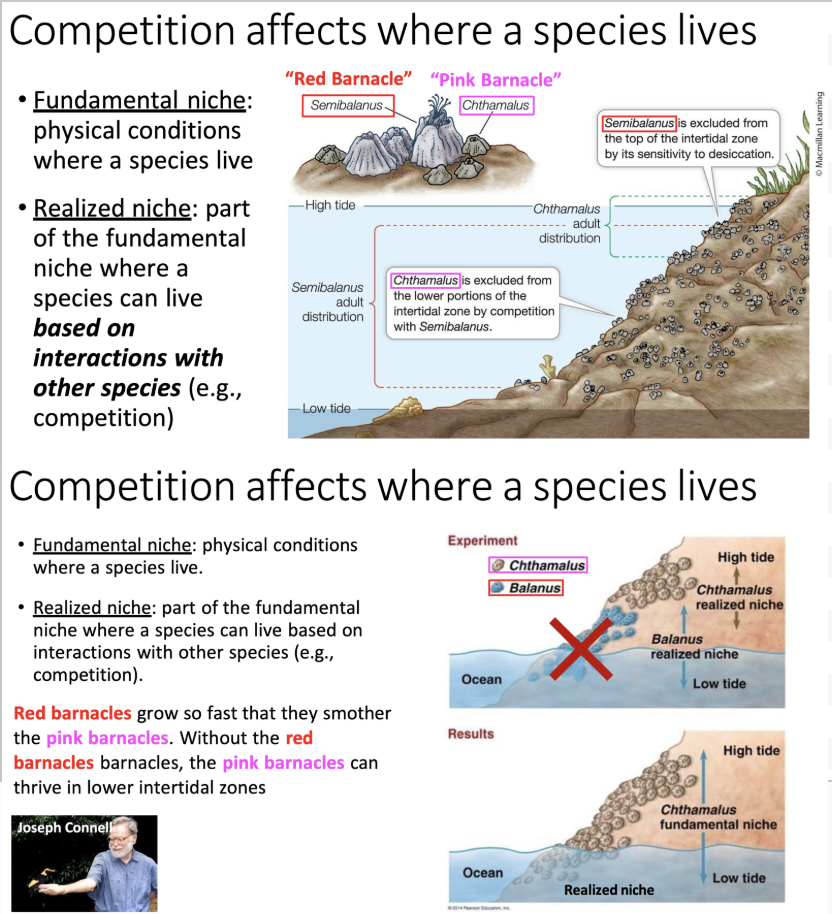
Fundamental niche: physical conditions where a species live
Realized niche: part of the fundamental niche where a species lives based on competition
“Fundamental niche for her is when her husband isn’t home. Her realized niche is when he is home excluding his room where he plays video games. Live within an intertidal zone. Red larger in the low tidal zone”
Example: barnacles!
A species of barnacles (red) grow so fast that they interfere with another species of barnacles (pink)
If we remove the red barnacles, we find out that pink barnacles can thrive in low intertidal zones (this zone is a part of their fundamental niche!)
“Without the larger red ones that smother growth, the pink ones can compose the entirety of the intertidal zone.”
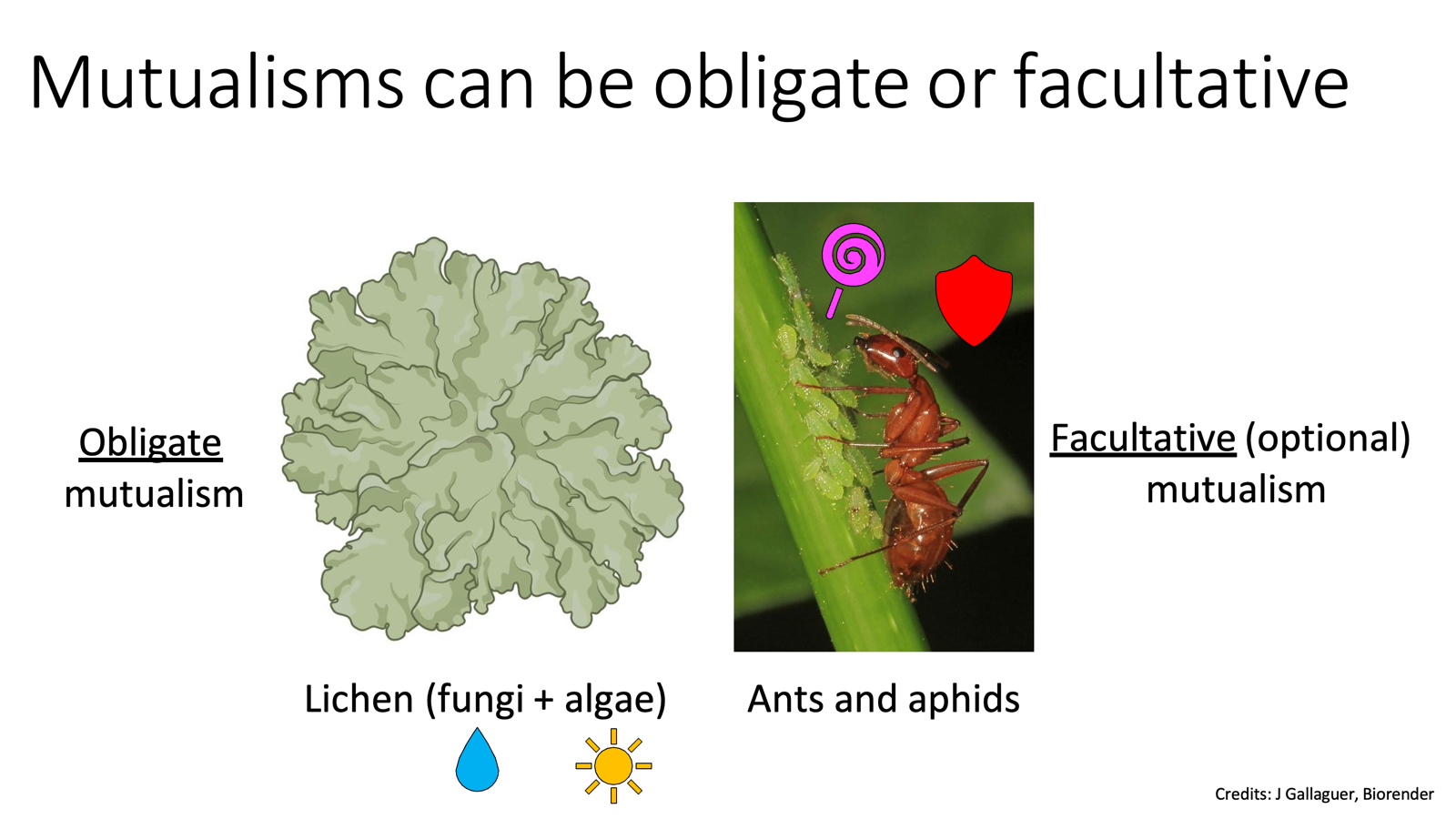
Positive interactions - What are the two subsets of mutualism?
Obligate ← obligation! (mutualistic relationships needed to survive and thrive!)
Facultative ← optional! Not necessary for survival or reproduction, but both species can benefit.
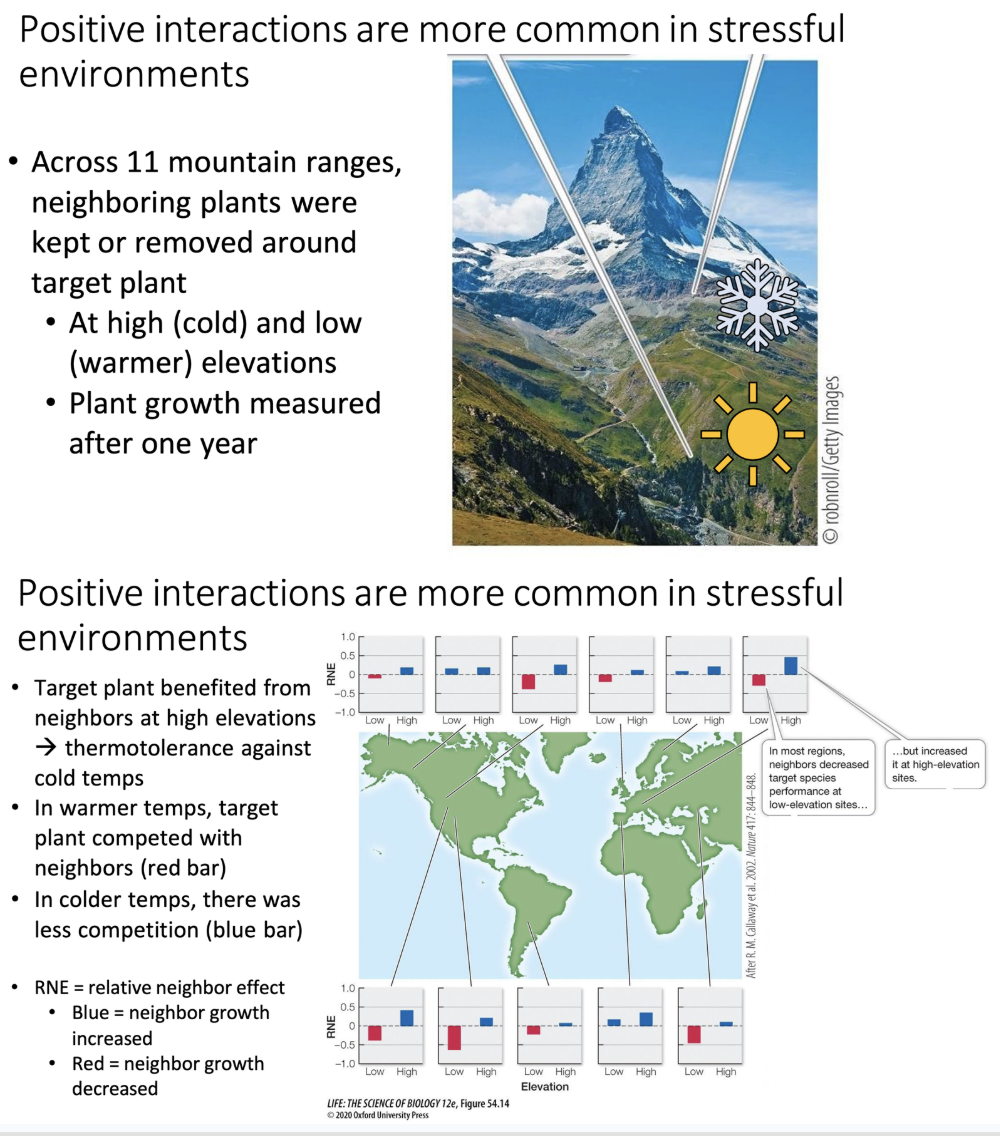
Where are positive interactions more common?
Stressful environments!
Target plants competed less at a higher elevation and in colder temperatures (increase in neighbors in these stressful scenarios)
Look at graph for graphical representations
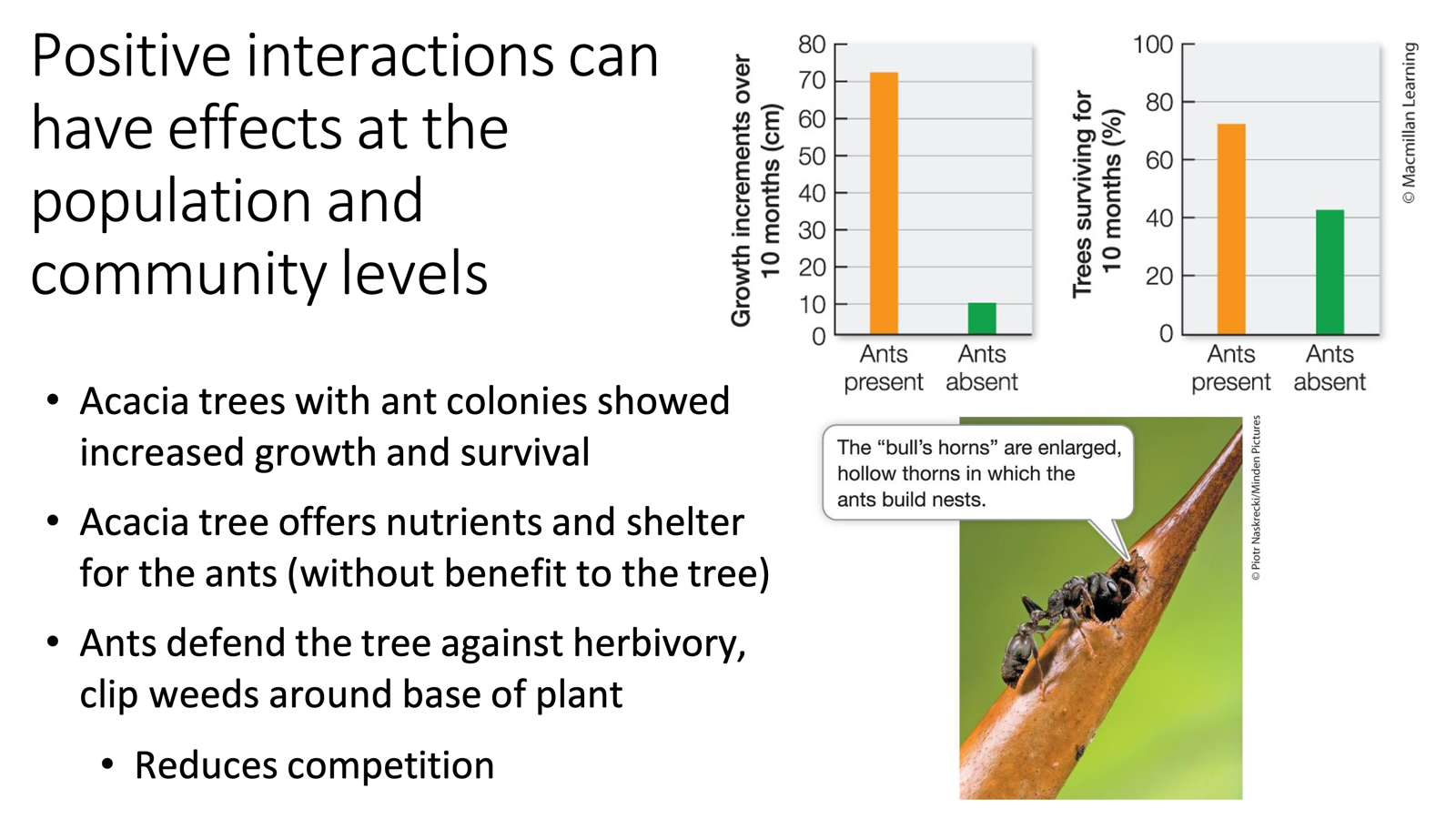
Where are we able to measure positive interactions effects?
Population AND community levels
Example: acacia trees with ant colonies have increased growth and survival
Acacia trees offer nutrients and shelter
With no benefit to the tree
Ants defend the tree against herbivory through weed clipping
Reduces competition (less likely for neighbors to form and outgrow tree)
END OF CHAPTER 54! - Make sure you go back and look at these tophats!
END OF CHAPTER 54! - Make sure you go back and look at these tophats!
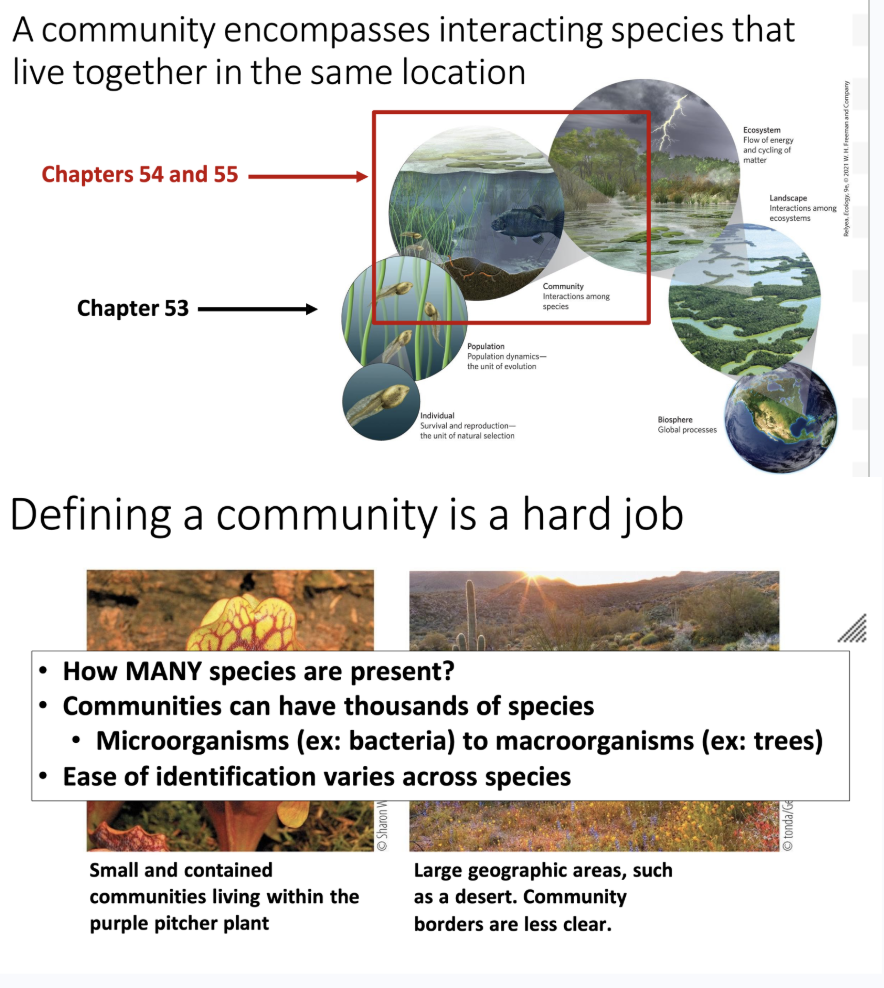
What is a community? Why is this vague?
A community encompasses interacting species that live together in the same location.
Community can be a very vague statement ranging to the inside of a plant or a large geographic area.
Scale and lack of clear borders can make it harder to define.
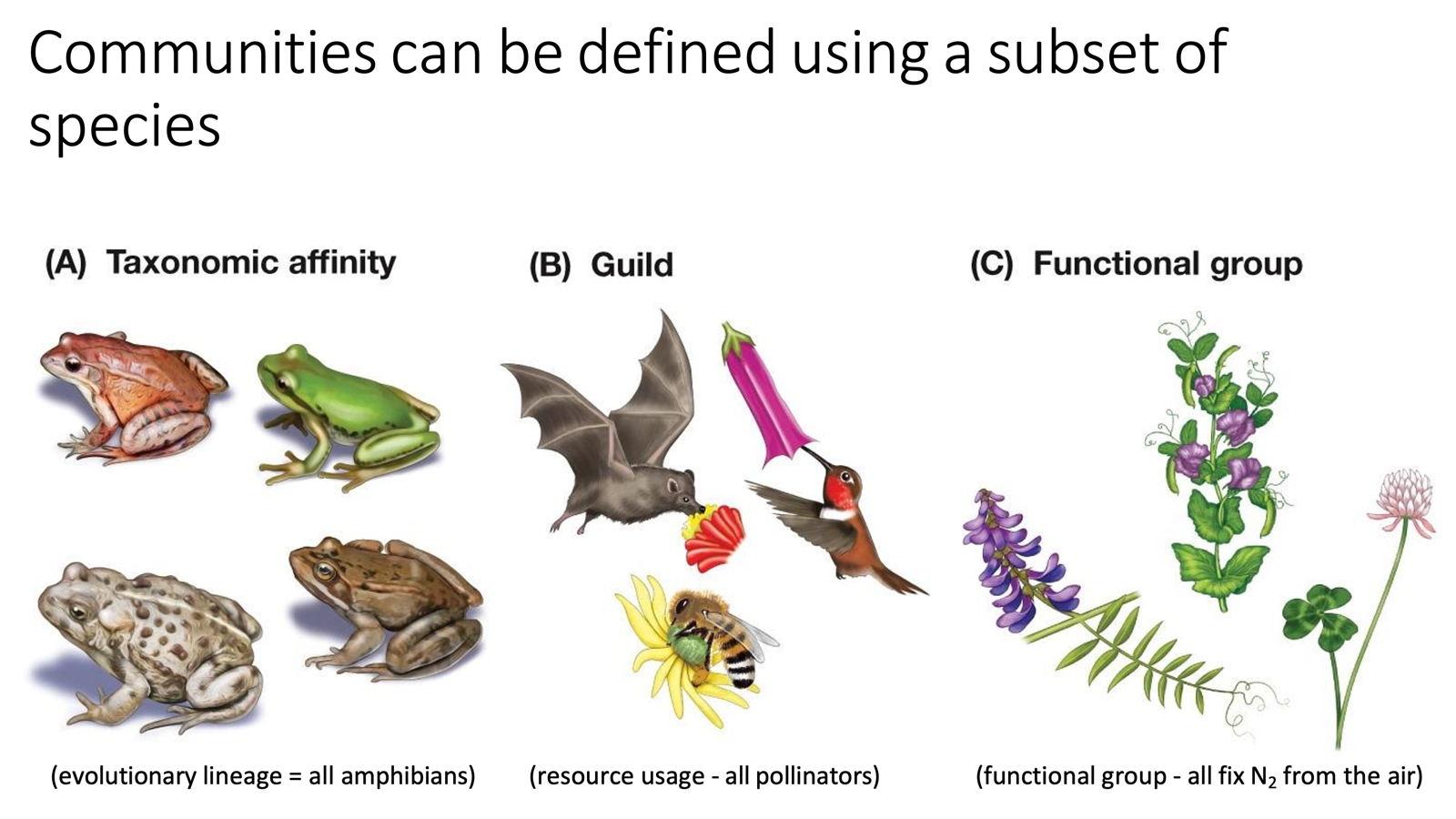
What are the three types of subsets a community can be defined by?
Can be defined by certain subsets, such as:
Taxonomic affinity
Focuses on who they are (evolutionary relationships/common ancestors).
Guild
Focuses on what they eat or use (similar resource exploitation).
Functional group
Focuses on how they act (similar ecological roles/traits)
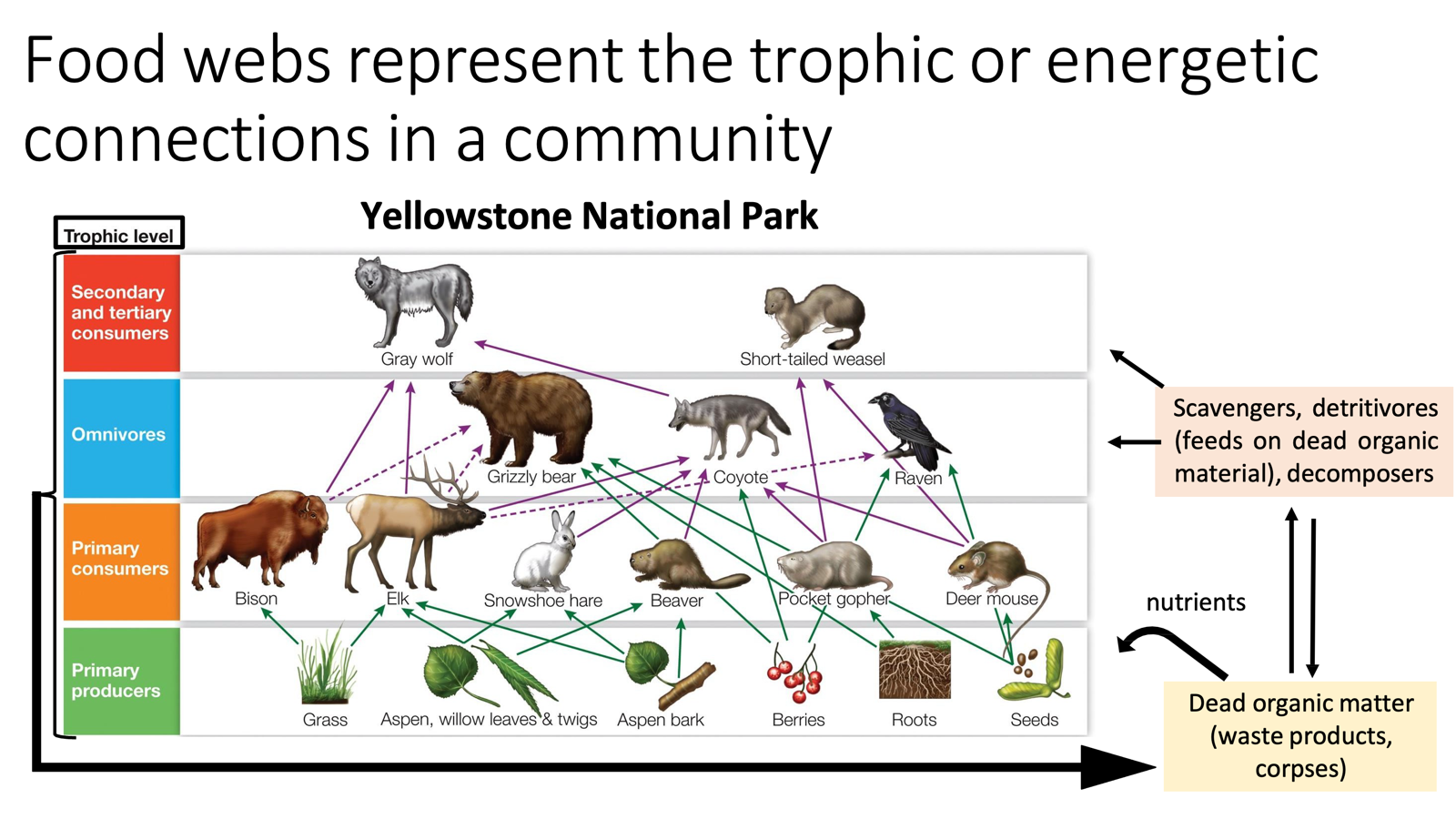
How are connections in a community portrayed? What do they represent?
Connections in community portrayed on the food web.
Food webs represent the trophic or energetic connections in a community
Trophic is food invilving!
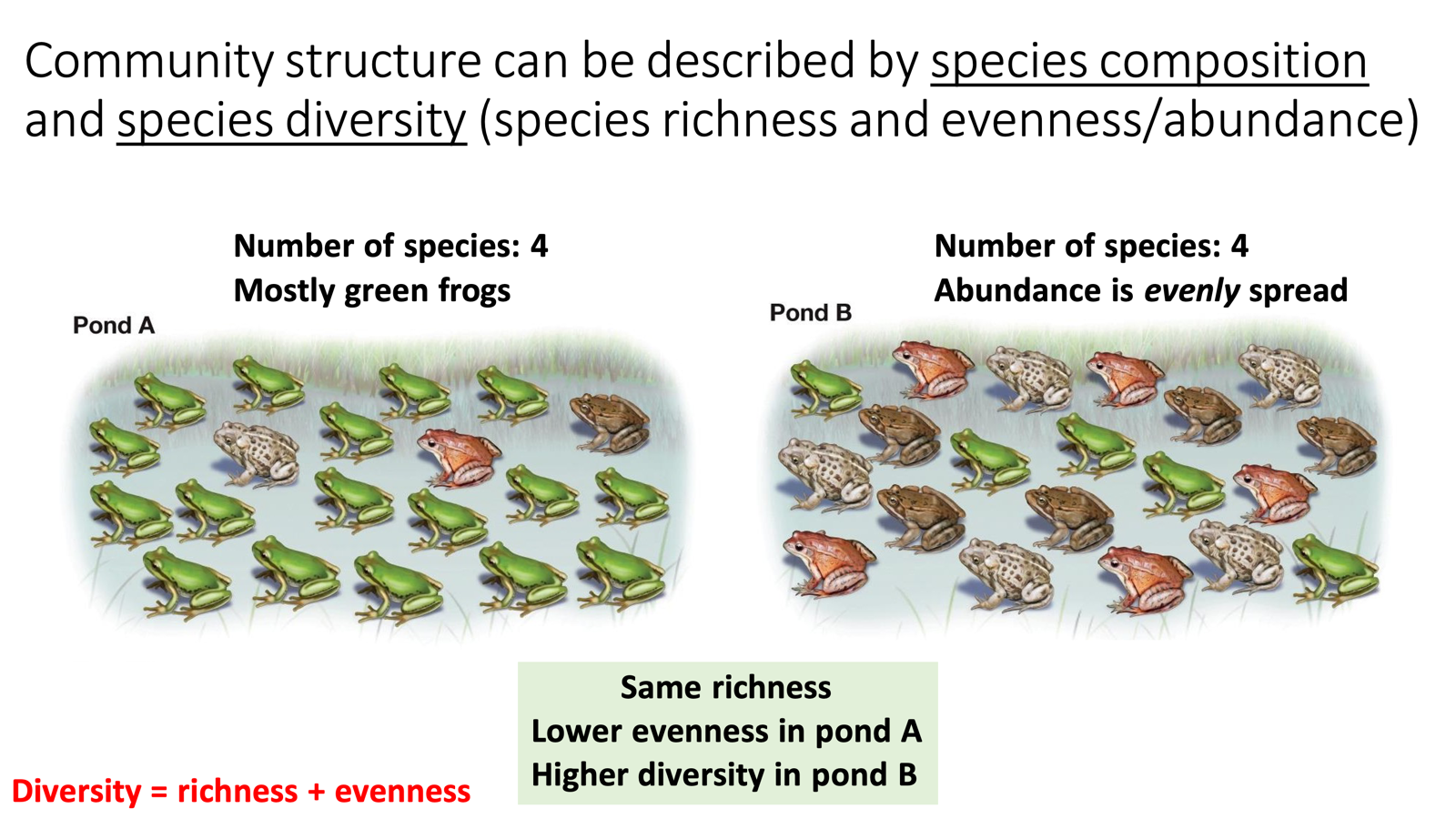
What two things can a community structure be described by? What is this a product of?
Community structure can be described by species composition and species diversity (species richness and evenness/abundance)
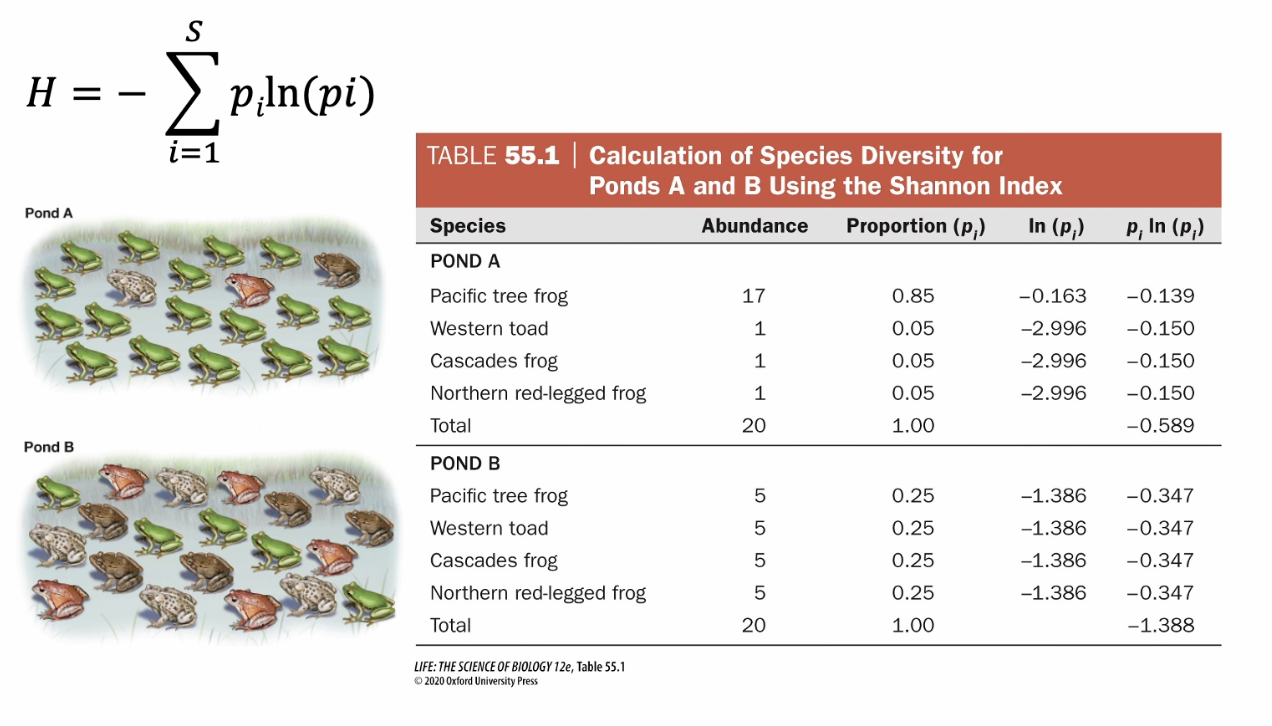
Same richness Lower evenness in pond A Higher diversity in pond B
Diversity = richness + evenness
What is the Shannon Index of diversity?
The Shannon index of diversity (H) is used to numerically estimate species diversity of a community
0 is the lowest the value can be (very low diversity).
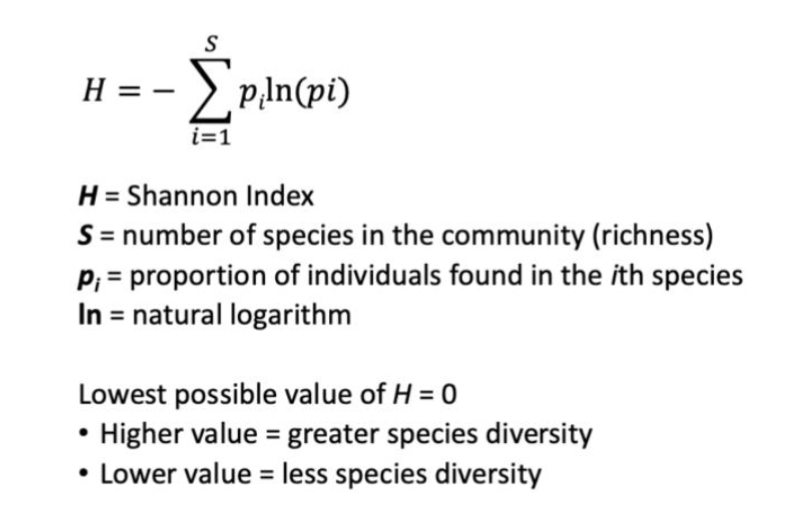
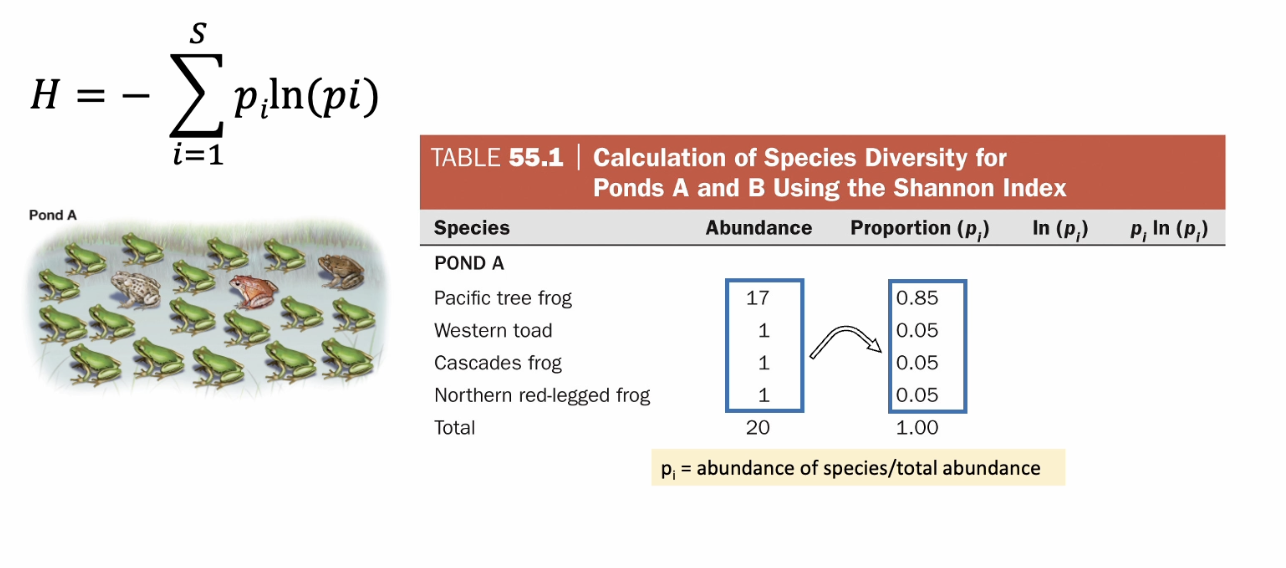
Mock shannon index question.
Put steps here:
20 individuals in the community. Sub is 17/20 and 1/20 respectively for e sub i. Need to equal one when they add up. Middle two colums multiplied to get the last colum. Add up all of the values and get the negative of that number (far right top). Greater than zero so at least somewhat diverse.
But essentially you just add, divide each one, ln each one, and multiply ln x the dividend prod , add those up, make the negative un-negative.
How do species’ form communities? What are the 4 “filters”?
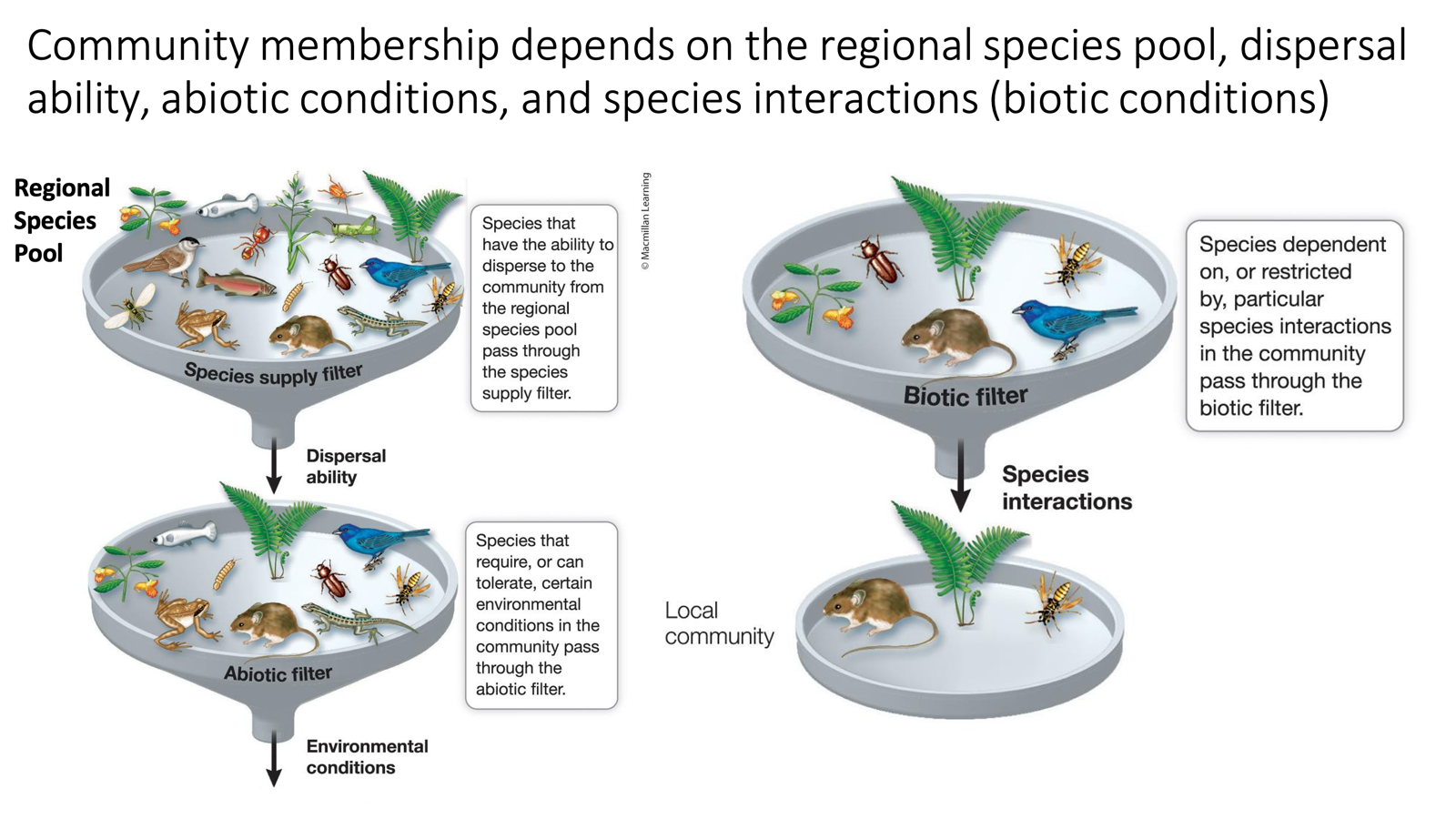
There’s many filters that determine community membership:
A. Regional species pool
B. Dispersal ability
C. Abiotic conditions
D. Species interactions
Species that have the ability to disperse to the community from the regional species pool pass through the species supply filter
Species that require or can tolerate certain environmental conditions pass through the abiotic filter
Species dependent on or restricted by species interactions pass through the biotic filter
After all species are processed through these filters a local community is produced, which is a small community which interacts very closely and well with each other.
How can a community interact with one another?
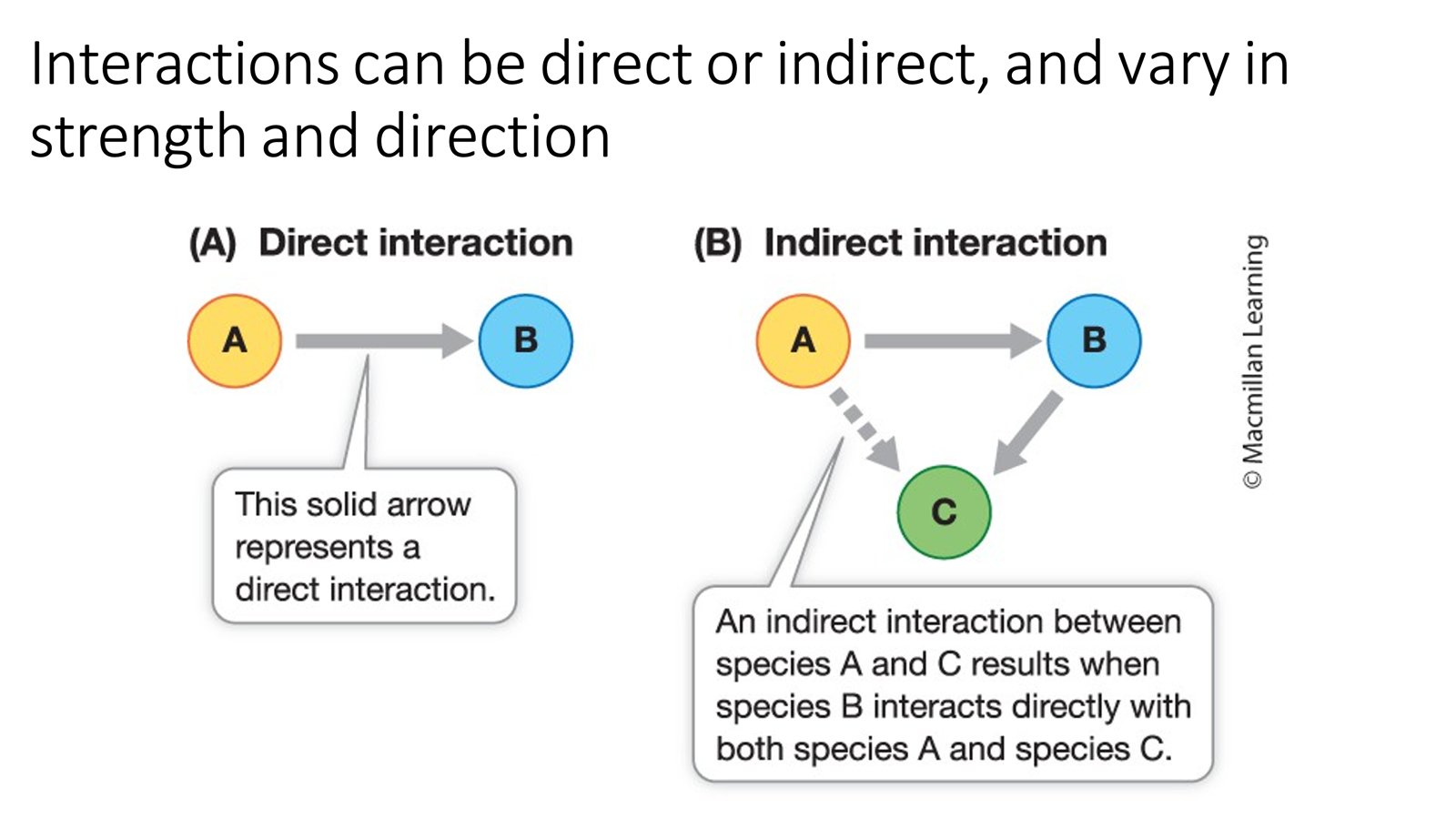
Interactions can be direct or indirect, and vary in strength and direction.
Direct often strong, indirect weaker per-say.
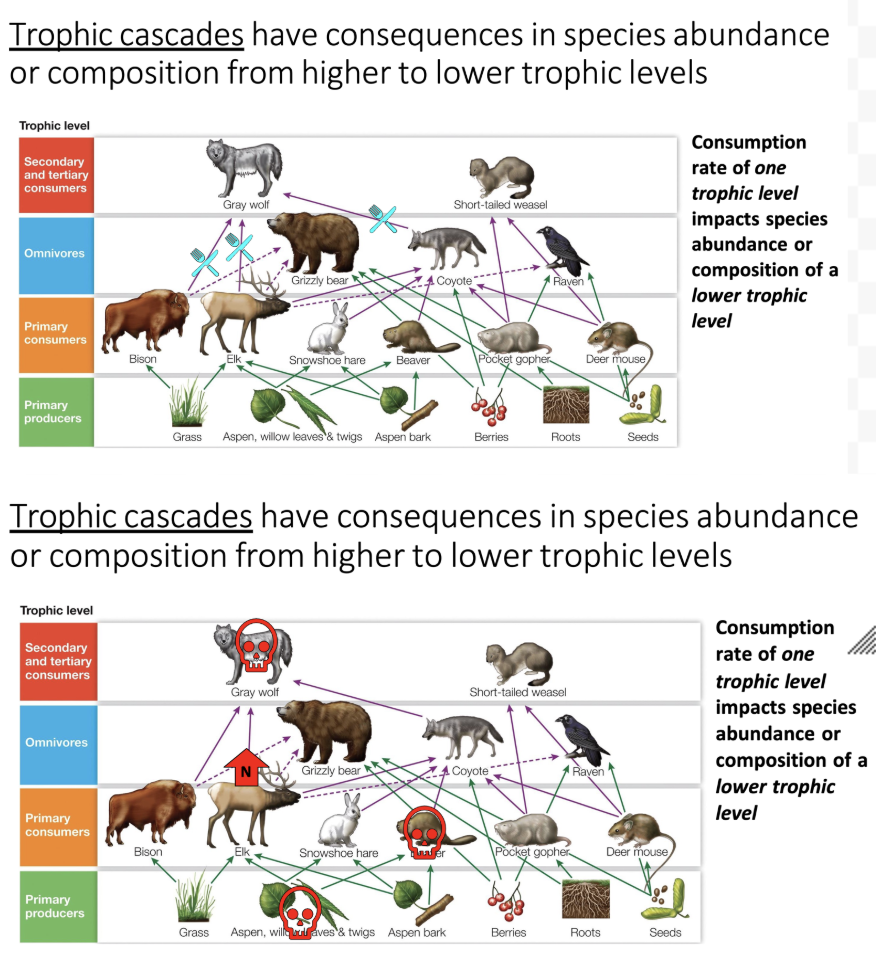
What is a trophic cascade and it’s consequences?
An ecological phenomenon where adding or removing top predators causes reciprocal, "cascading" effects that ripple down through multiple levels of a food web, impacting herbivores and plant biomass
Trophic Cascades have consequences in species abundance or composition from higher to lower trophic levels
Each level’s consumption effects those above and below it
(If an apex predator dies, herbivore prey will be abundant, plants will all be eaten.This messes up the organization)
Wolf – eats quite a few.
When wolf goes extinct has effect on other trophic levels. Elk increase without predator.
More elks now, they reduce the population size of the plants and trees that it eats.
Elk isn’t the only one who eats these as the beaver does as well. If the elk ate everything the beaver can than effectively go extinct as-well.
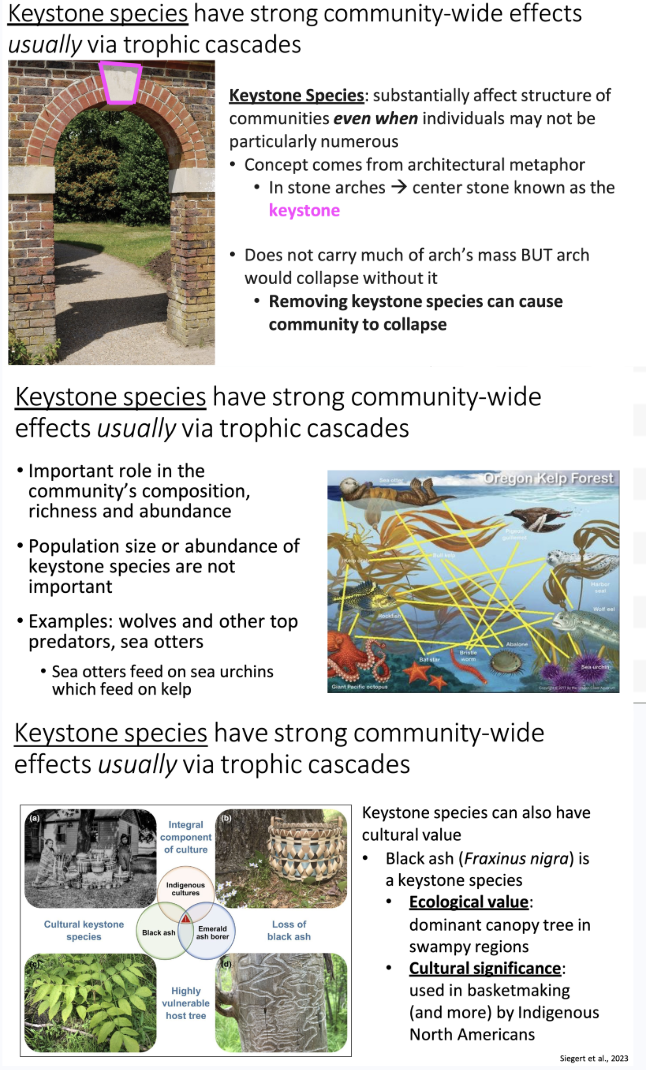
What is a keystone species? How does it effect communities?
Species that substantially affect structure of communities even when individuals may not be particularly numerous
Concept comes from architectural metaphor
In stone arches → center stone known as the keystone
Does not carry much of arch’s mass BUT arch would collapse without it
Important role in the community’s composition, richness and abundance
Ex. top predators, sea urchins (feed on kelp), etc.
Removing keystone species can cause community to collapse
Keystone species have strong community-wide effects usually via trophic cascades
Their abundance isn’t as overly valued as is their general presence vs absence.
Can also have cultural significance like the black ash, which is the dominant canopy tree in swamp regions, and gets very effectively utilized by the Indigenous North Americans.
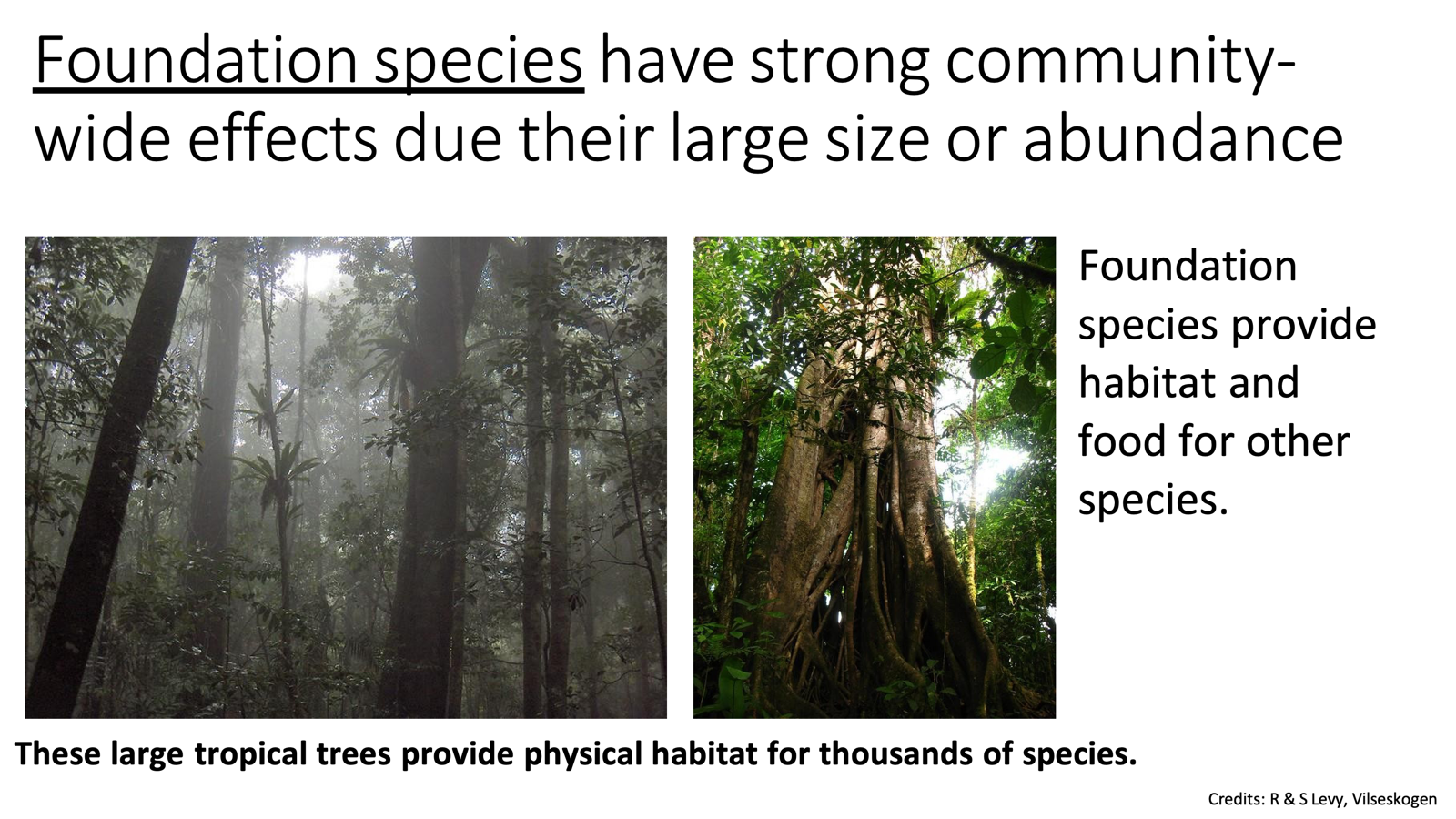
What is a foundation species? What is unique to them over kystone species?
Foundation species are those that have strong community-wide effects due their large size or abundance
Provide habitat and food for other species
Large trees, many small fishes in an ocean, etc
“Their size have a bigger impact rather than their trophic cascades. Can act as a food source and protection/habitat for other species. Giant trees being cut down would have a big impact on the trees themselves.”
What are ecosystem engineers and what do they do?
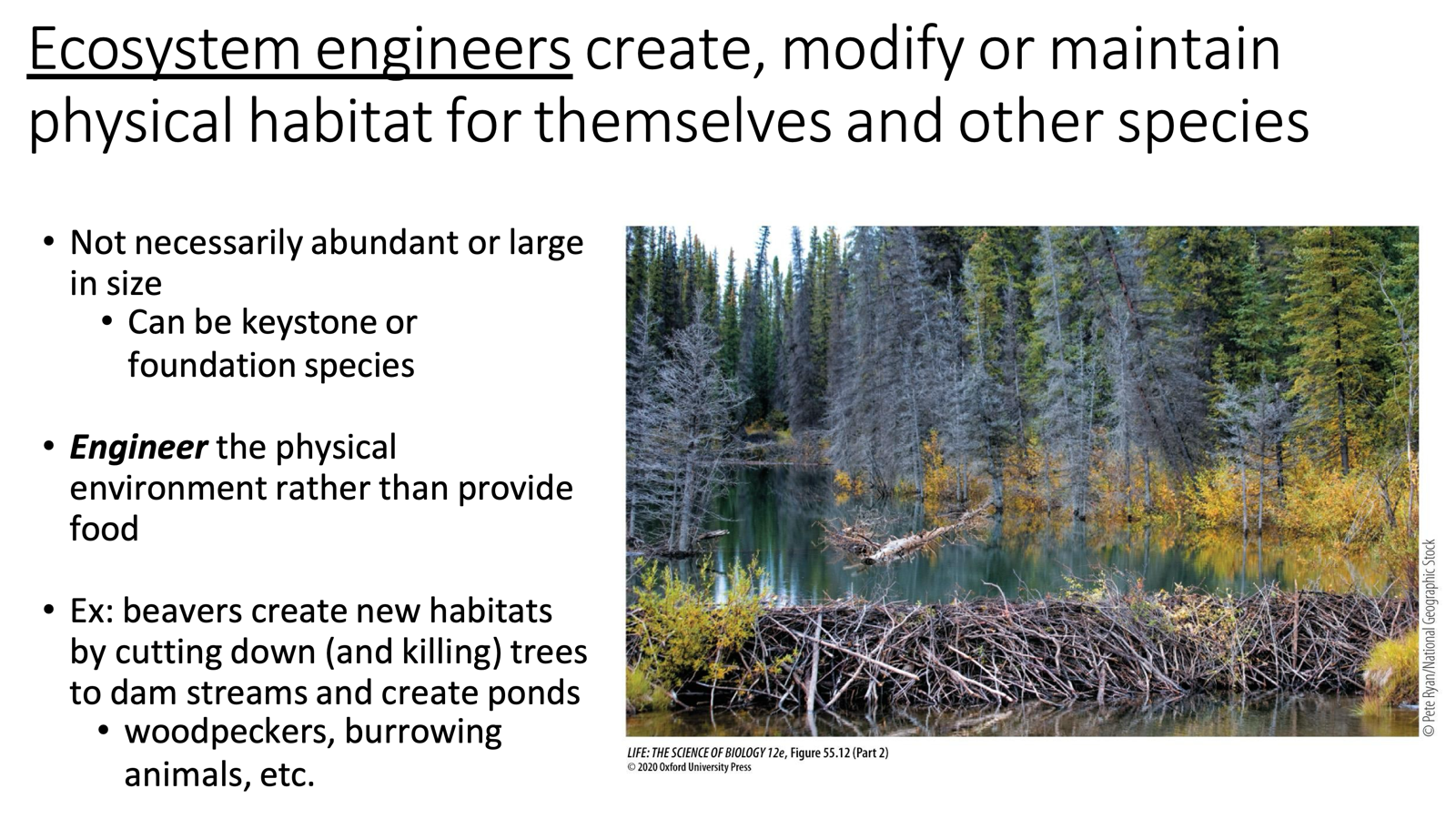
Ecosystem engineers create, modify or maintain physical habitat for themselves and other species.
They change the physical environment, rather than just providing food.
Not necessarily abundant or large in size
Can be keystone or foundation species
Ex: beavers create new habitats by cutting down (and killing) trees to dam streams and create ponds
woodpeckers, burrowing animals, etc.
foundation species
What is community succession?
A community succession is a change in the community’s species composition over time, following a disturbance
Disturbance = an abiotic event that physically or chemically injures or kills individuals, creating opportunities for others to grow and reproduce
Can be small scale (elephant trampling vegetation) or large scale (hurricane, forest fire)
What is the period right after the disturbance called? What is a moraine and a climax community?
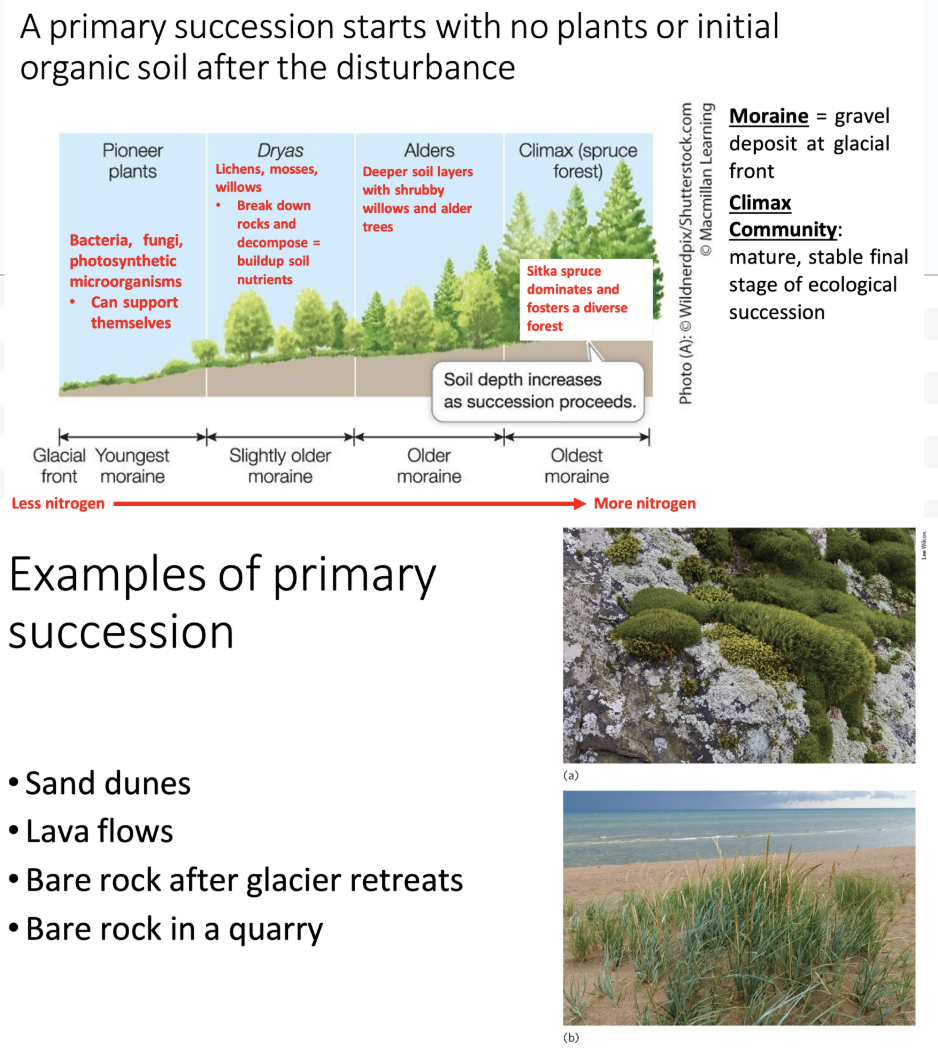
The period right after the disturbance, with no soil or plants is called the primary succession.
As time passes, moraine, gravel deposit at glacial front, gets older, and more nitrogen is emitted a community starts to form again.
Moraine = gravel deposit at glacial front
Primary successions include sand dunes, lava flows, bare rock and glacier retreats, and bare rock in a quarry.
Once the community is rebuilt, this is called climax.
Climax Community: mature, stable final stage of ecological succession
“Start with primary succession. Pioneer plants/species don’t require much to thrive, and can live off of their own. Once it’s more habitable, more species can come into being sustained/survive. Older and more established in Alders helps encourage new inhabits. The climax forest is the mature final stage of ecological succession.”
What is the period right after the disturbance called where there is still some soil and organisms?
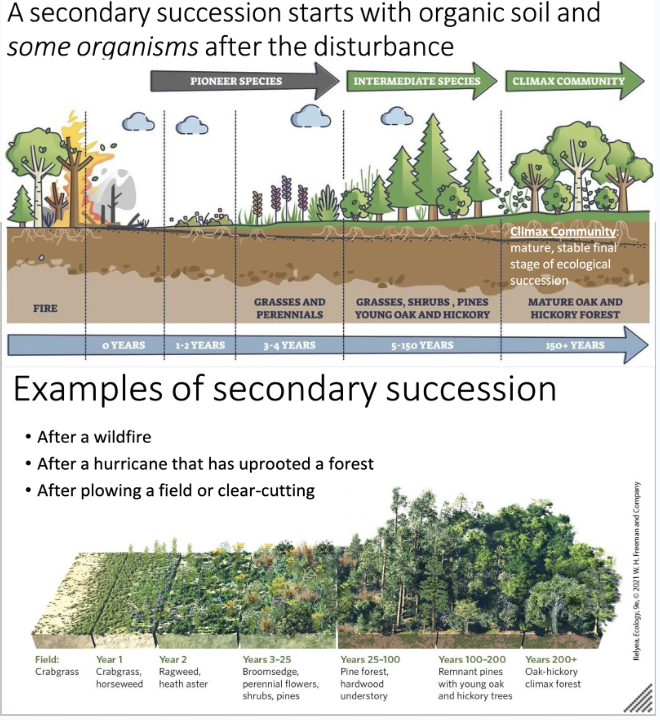
If a disturbance still leaves soil and some organism– it is referred to as a secondary succession.
Each succession starts with a pioneer species that can support themselves, and they are used as food for an intermediate species.
Slowly, a community of species and a food chain forms.
“Think about the starting material to differentiate between primary and secondary.
Primary succession occurs in lifeless, soil-free areas (like lava flows or retreating glaciers) and takes centuries, driven by pioneer species.
Secondary succession occurs in disturbed, soil-rich areas (like after forest fires or farming) and is faster, taking decades, as it builds on existing soil and organic matter.”
What happens in the time between pioneer and climax communities?
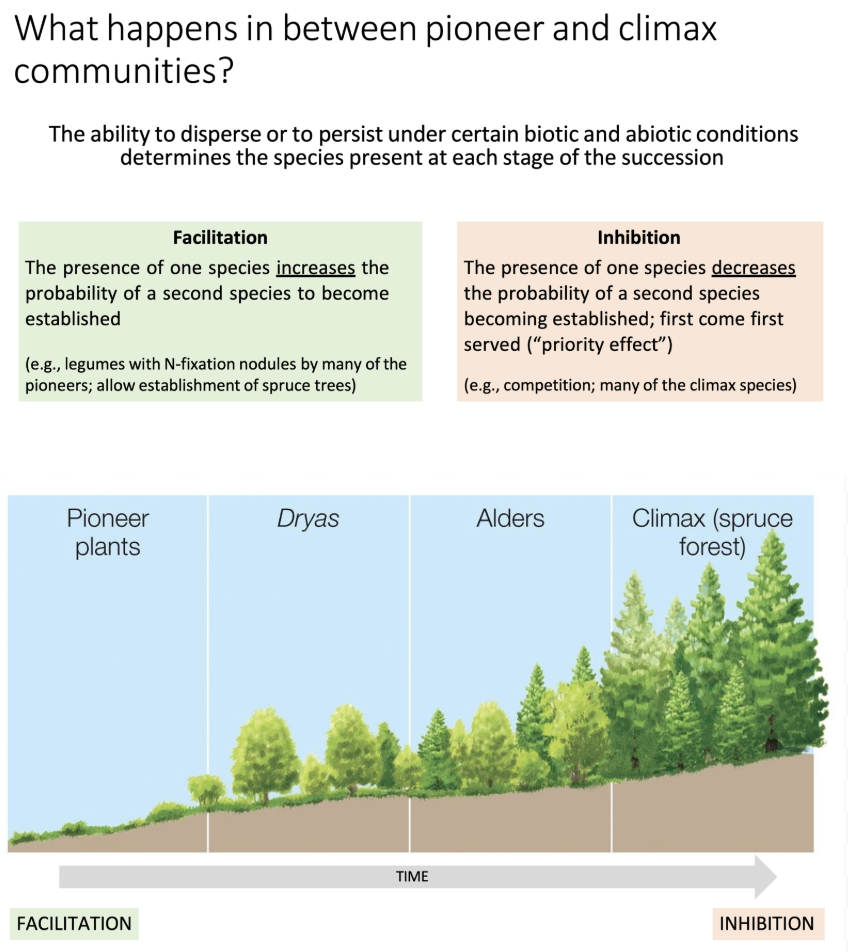
Facilitation takes place– The presence of one species increases the probability of a second species to become established.
Inhibition takes place– The presence of one species decreases the probability of a second species becoming established; first come first served (“priority effect”)
The ability to disperse or to persist under certain biotic and abiotic conditions determines the species present at each stage of the succession
A mixture of both processes over a very long period of time forms a complete climax community
Initially, facilitation is taking place because the community needs to be established, but as the community approaches climax, there is competition for resources, limited places to occupy, etc; which leads to inhibition.
What are alternative states?
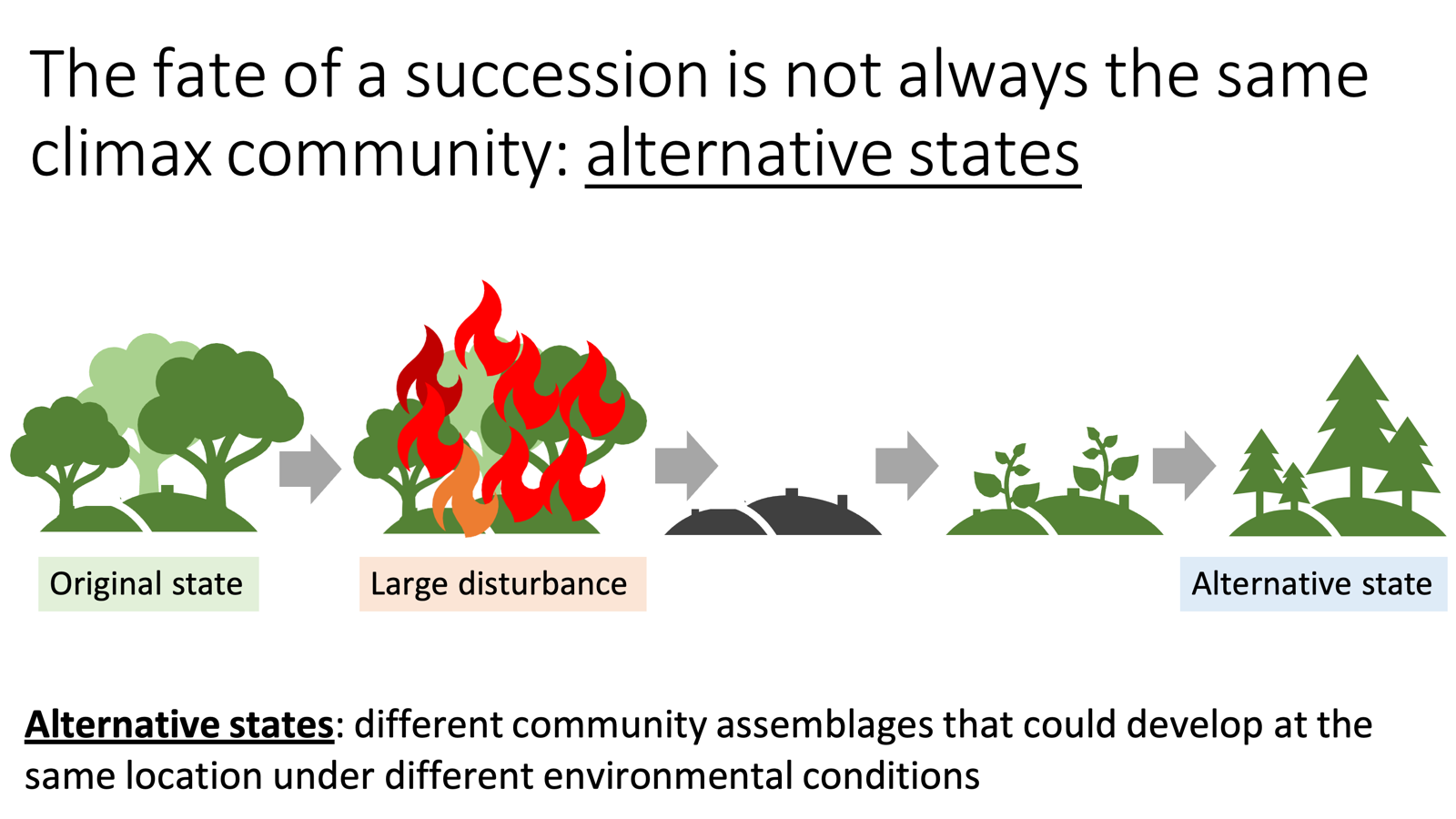
When The fate of a succession is not always the same climax community → Alternative states
State where different community assemblages that could develop at the same location under different environmental conditions
Can arise after disturbance
Succession does not always lead to a climax community because things can be changed immensely.
“Pre-wildfire and pos-wildfire climax community likely look much different from one another. Secondary successional stages can develop an alternative state. Won’t usually see sich a drastic change in tree type (just there for visual aid) but will be change.”
When is a community more productive and stable? What does this play into and how can it be used in agriculture?
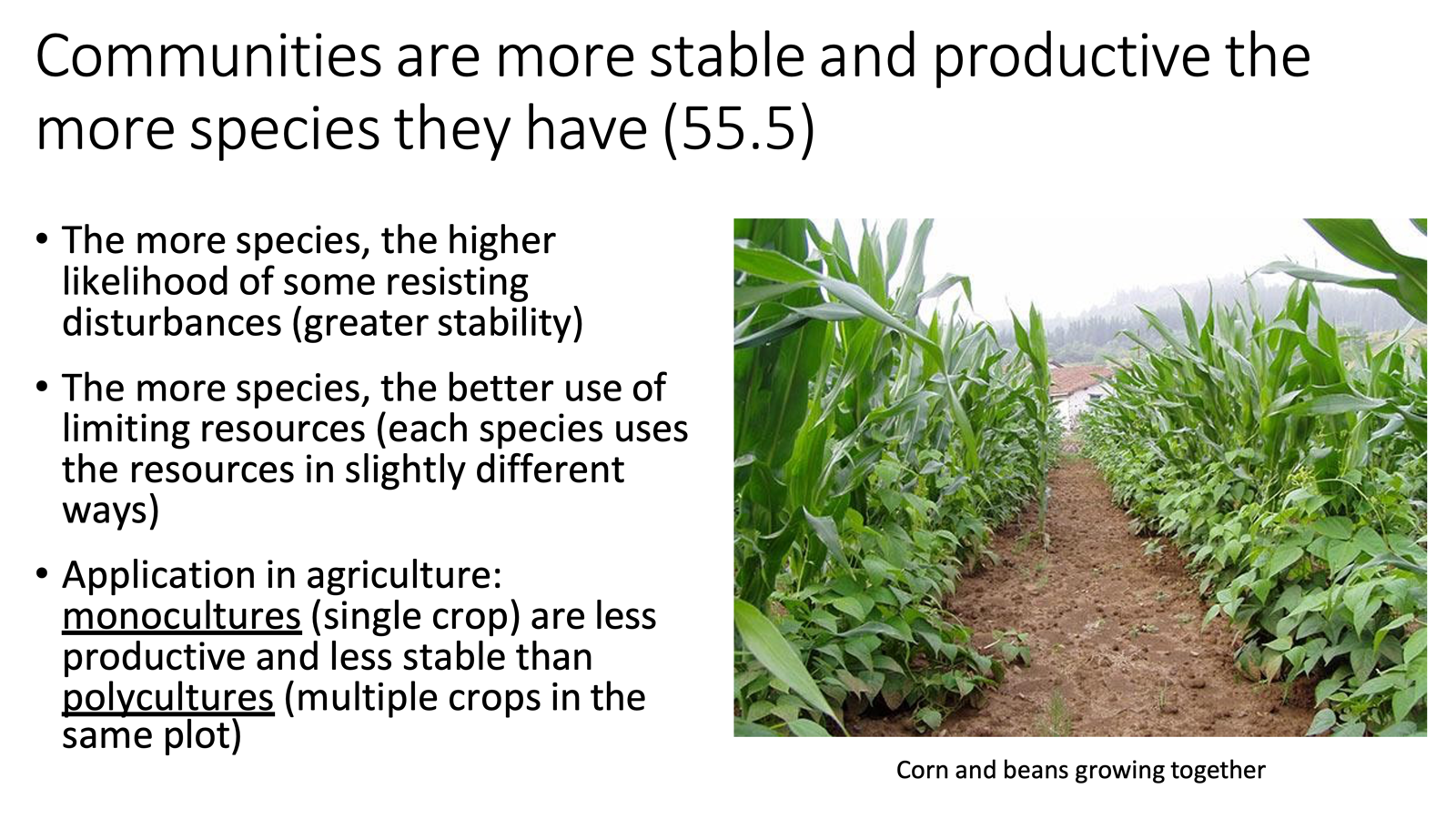
Communities are more stable and productive the more species they have.
The more species, the higher likelihood of some resisting disturbances (greater stability)
The more species, the better use of limiting resources (each species uses the resources in slightly different ways)
More even flow of energy!
Application in agriculture: monocultures (single crop) are less productive and less stable than polycultures (multiple crops in the same plot)
END OF CHAPTER 55 (PLEASE DO TOPHATS)
END OF CHAPTER 55 (PLEASE DO TOPHATS)
What is an ecosystem? What is unique about their interactions?
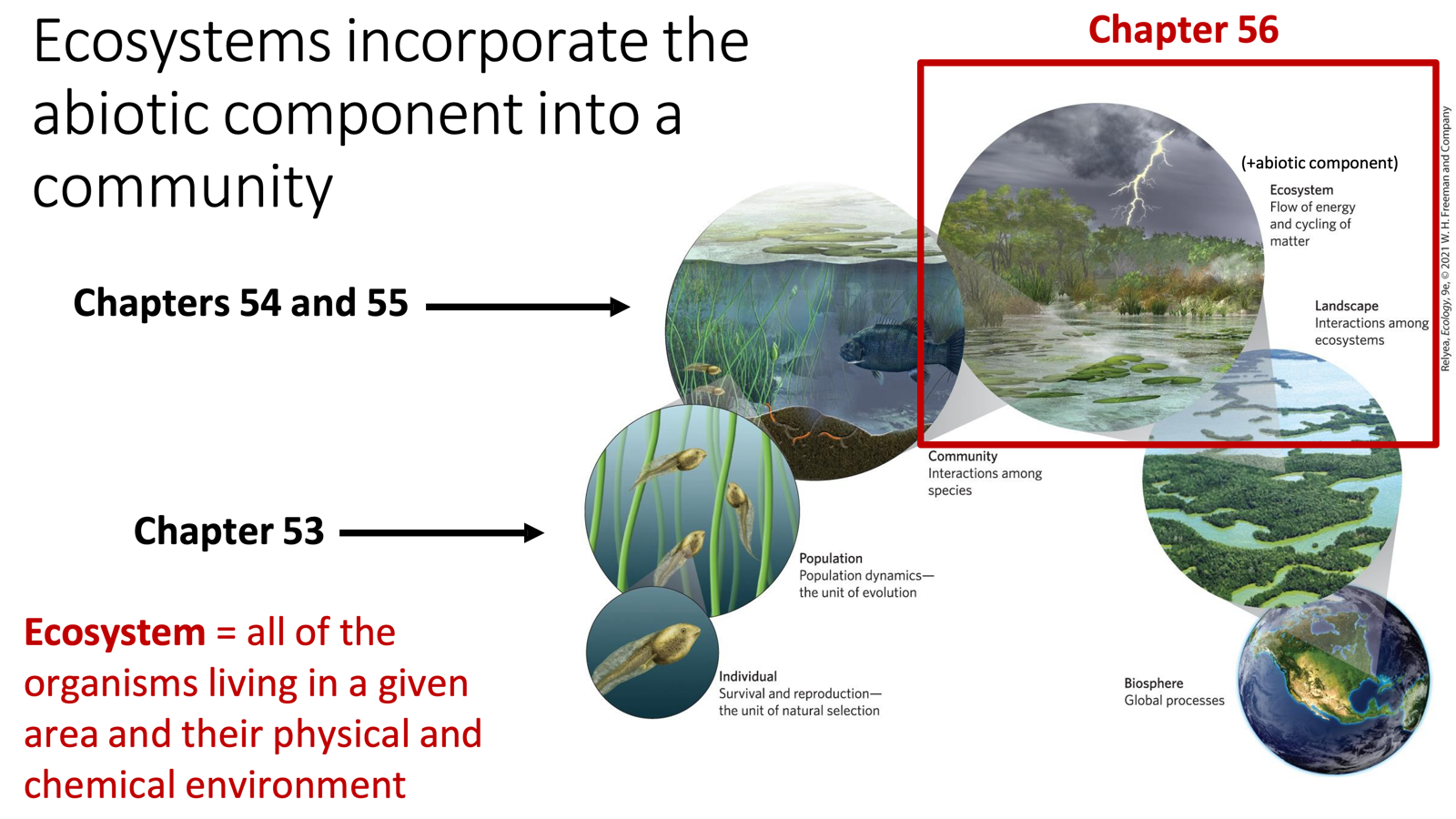
All organisms living in a given area AND their physical/chemical (abiotic) environment
Ecosystems combine the community (Chp. 54–55) with the abiotic component.
How do energy and nutrients flow between organisms and their physical environment? What are the subsidiary aspects of these processes?
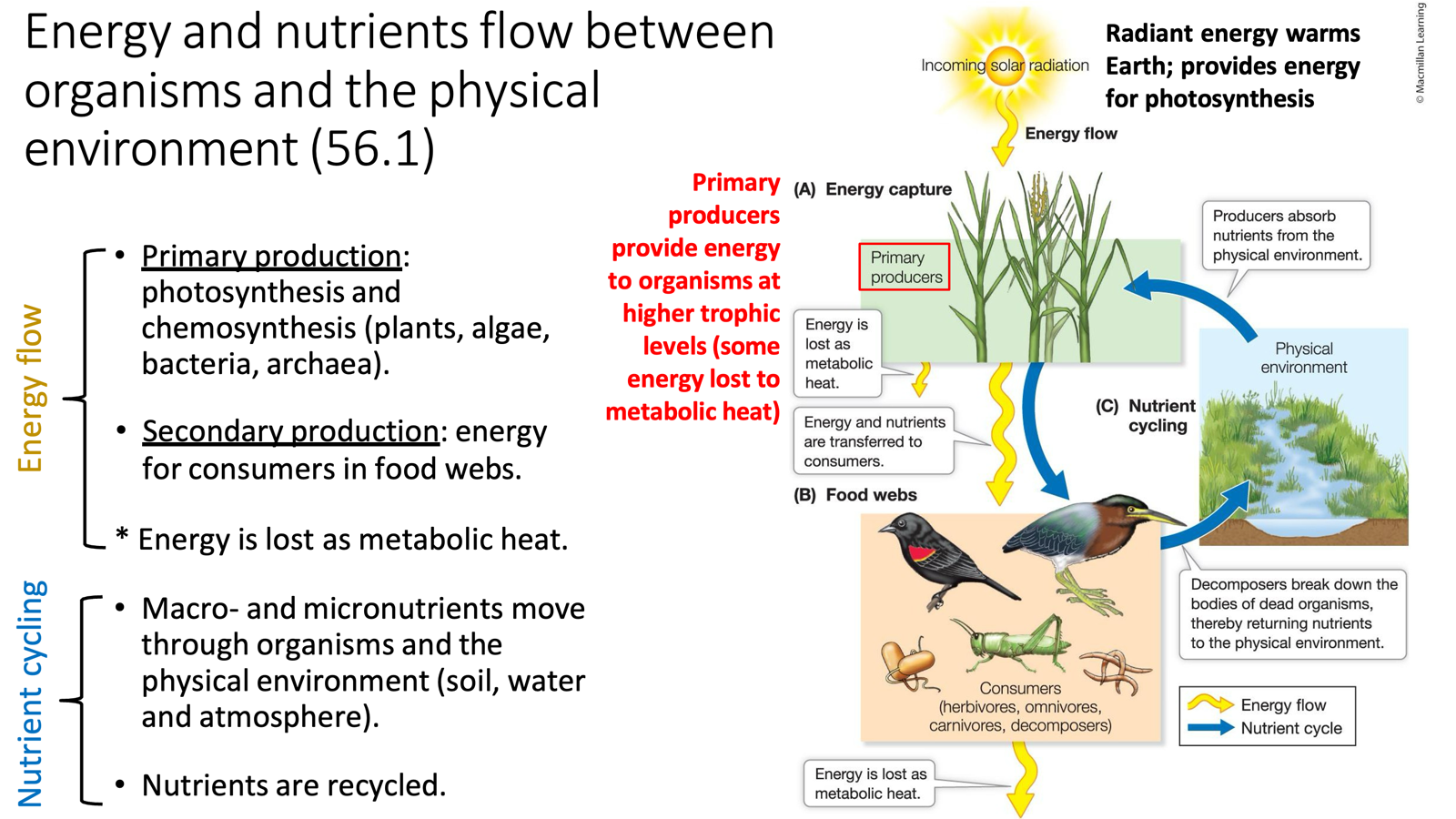
Energy flow
solar energy → primary producers → consumers; lost as metabolic heat at each step
Primary production: photosynthesis and chemosynthesis (plants, algae, bacteria, archaea).
Secondary production: energy for consumers in food webs.
Nutrient cycling
macro- and micronutrients move between organisms and the physical environment (soil, water, atmosphere)
Leads to nutrients being recycled
How is primary production measured, and how can it be divided? Is there an equation for this? What about respiration?
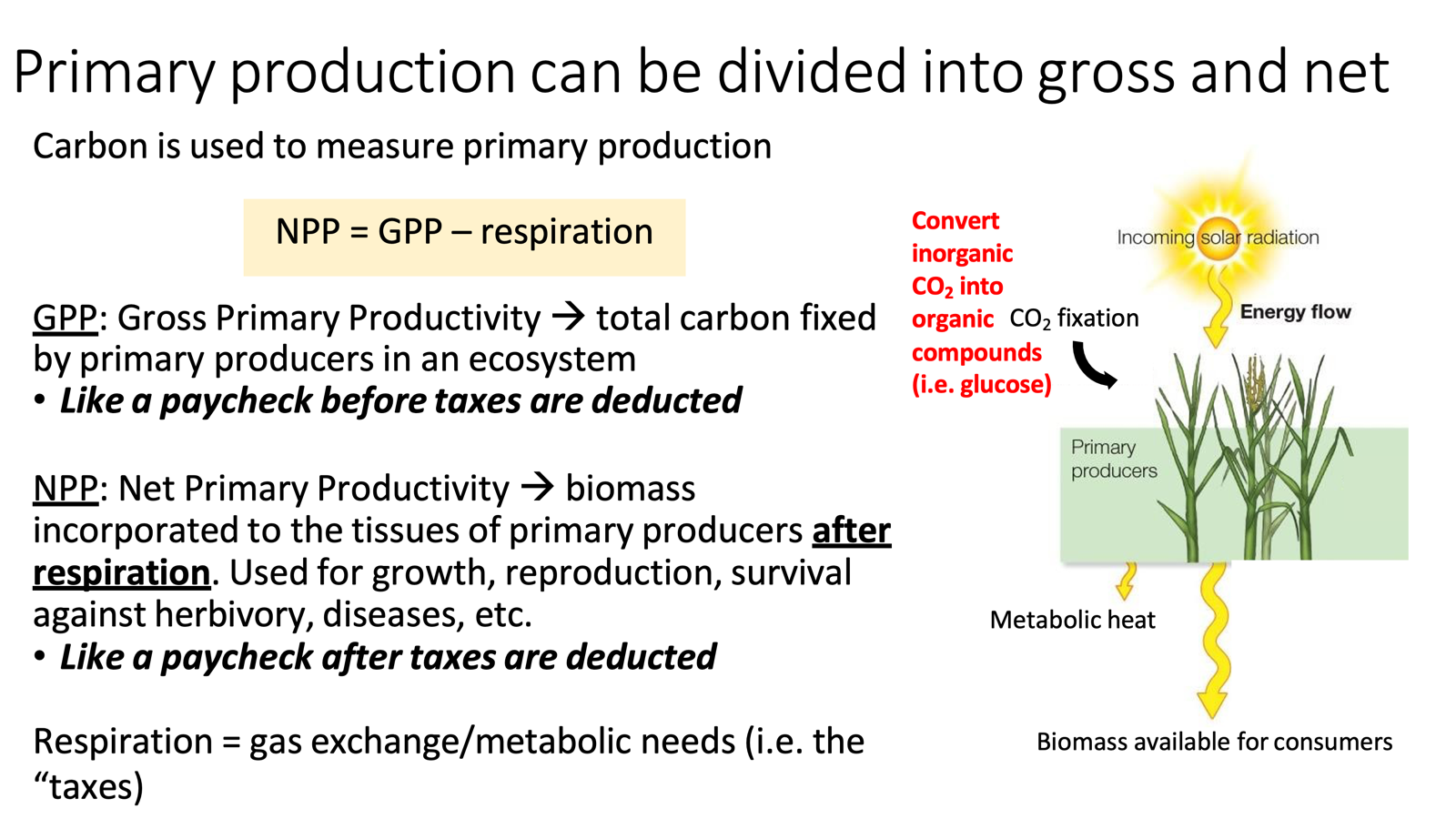
Carbon is used to measure primary production
GPP (Gross Primary Productivity)
The total carbon fixed by primary producers
“Like a paycheck before taxes”
NPP (Net Primary Productivity)
The biomass incorporated into producer tissues after respiration
Used for growth, reproduction, survival against herbivory, diseases, etc.
“Like a paycheck after taxes”
NPP = GPP - respiration
Respiration = gas exchange/metabolic needs
“The taxes”
LOOK AT TOPHAT PRACTICE
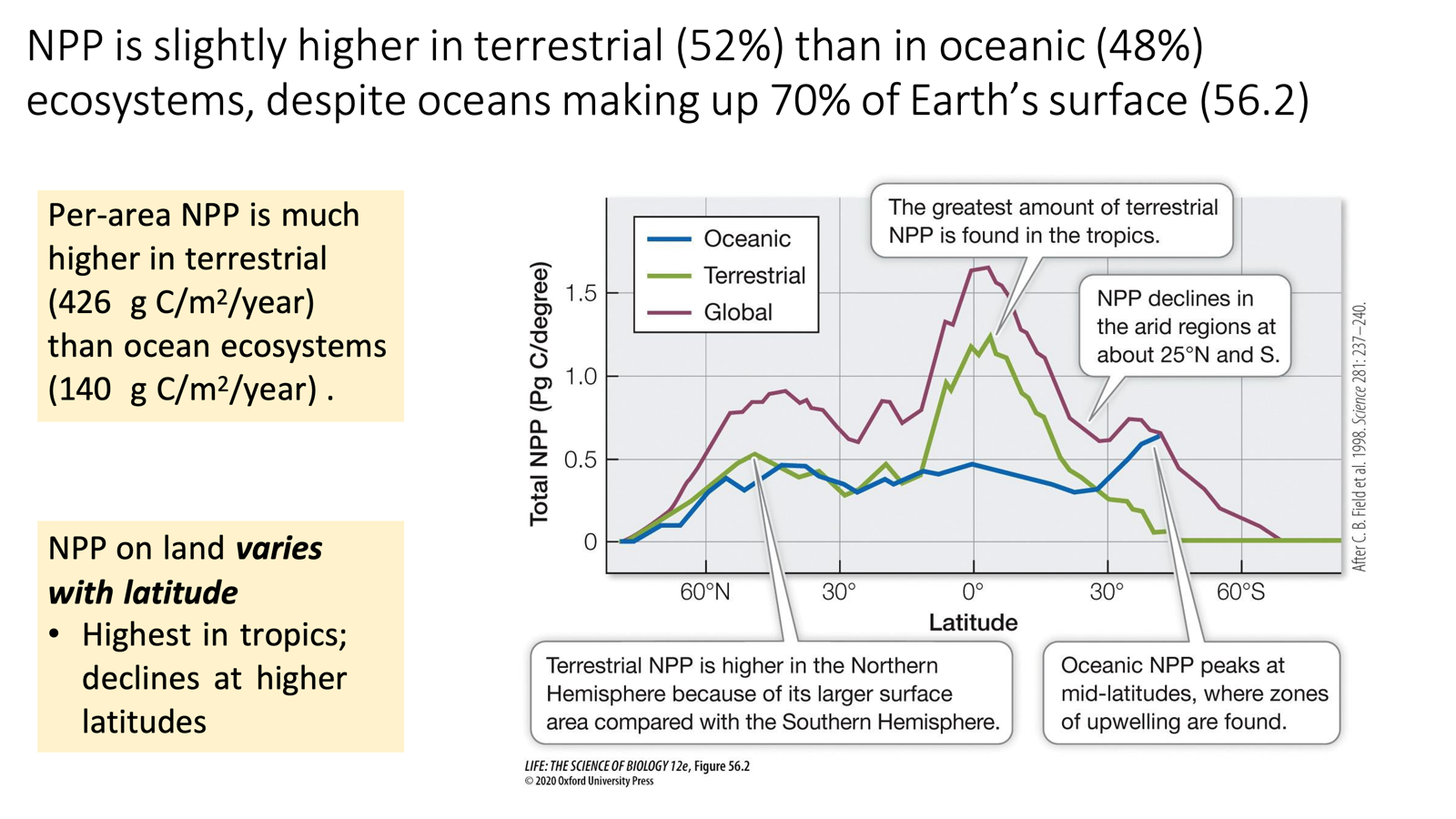
Is NPP found in certain patterns on land and ocean? Are there certain trends?
Terrestrial ecosystems account for ~52% of global NPP; oceans ~48%, despite oceans covering 70% of Earth's surface
Per-area NPP is much higher in terrestrial (426 g C/m2/year) than ocean ecosystems (140 g C/m2/year) .
NPP on land varies with latitude
Peaks at the equator/tropics for terrestrial patterns.
Logically, this makes sense as with increasing latitude, NPP will decrease with declining temperature and precipitation.
Given this trend, it follows that similarly to the global wind patterns. 20-30 degrees north and south take a dip because they are associated with the subtropical deserts/arid regions
NPP concerning oceanic trends remains semi-consistent but peaks at mid latitudes where zones of upwelling are found.
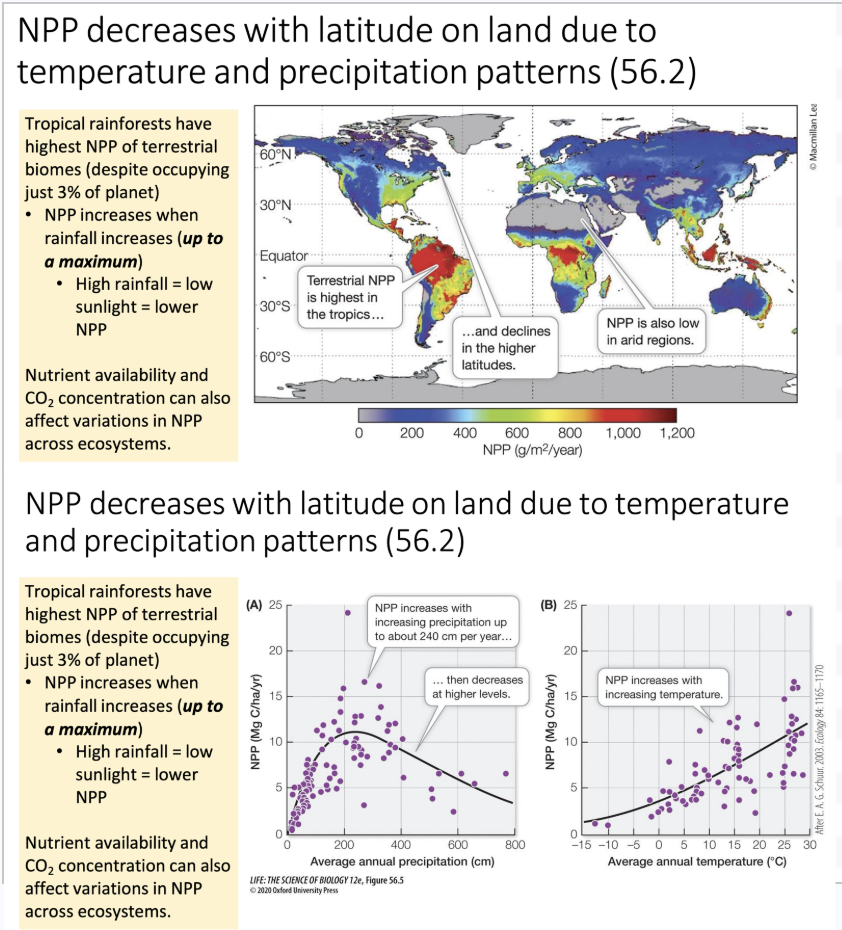
So, in turn, how is terrestrial NPP directly affected by temperature and precipitation?
Is there a limit to any of these?
How can they be represented geographically and graphically?
NPP decreases with increasing latitude due to declining temperature and precipitation.
Tropical rainforests have the highest NPP of terrestrial biomes
NPP increases when rainfall increases (up to a maximum)
High rainfall = low sunlight = lower NPP. Cloud coverage and soil nutrient leaching can be present.
On the map, cooler tone = lower NPP, higher tone = higher NPP. Very high in the tropics with solar radiation, etc.
On the graphs, precipitation starts to decline with nutrient leaching, cloud cover that blocks light penetration to the surface etc.
Don’t see this with temperature as they both increase and increase.
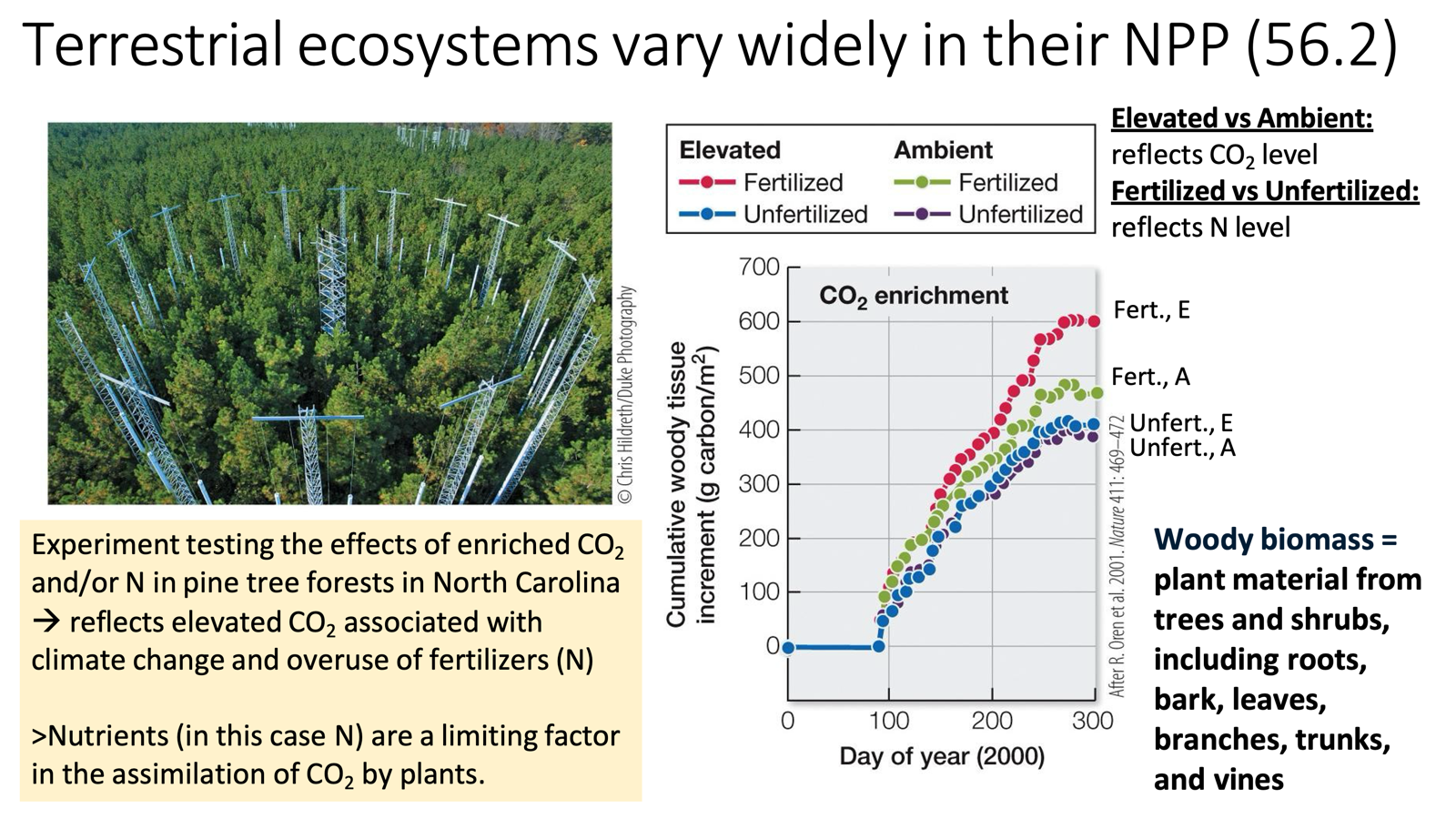
How do nutrient availability and CO2 concentrations play into affecting NPP?
Experiment testing the effects of enriched CO2 and/or N in pine tree forests in North Carolina
Reflects elevated CO2 associated with climate change and overuse of fertilizers (N)
Nutrients (in this case, N) are a limiting factor in the assimilation of CO2 by plants.
Elevated is elevated CO2 conditions, ambient is current/normal CO2 conditions.
Under either elevated or ambient conditions, NPP was highest in the forest that received additional nitrogen.
Hence, if a nutrient is limiting, it might need another to support it. CO2 can be useful, but only when given nitrogen to supplement.
Where and how is the aquatic system NPP affected by light and nutrient concentration?
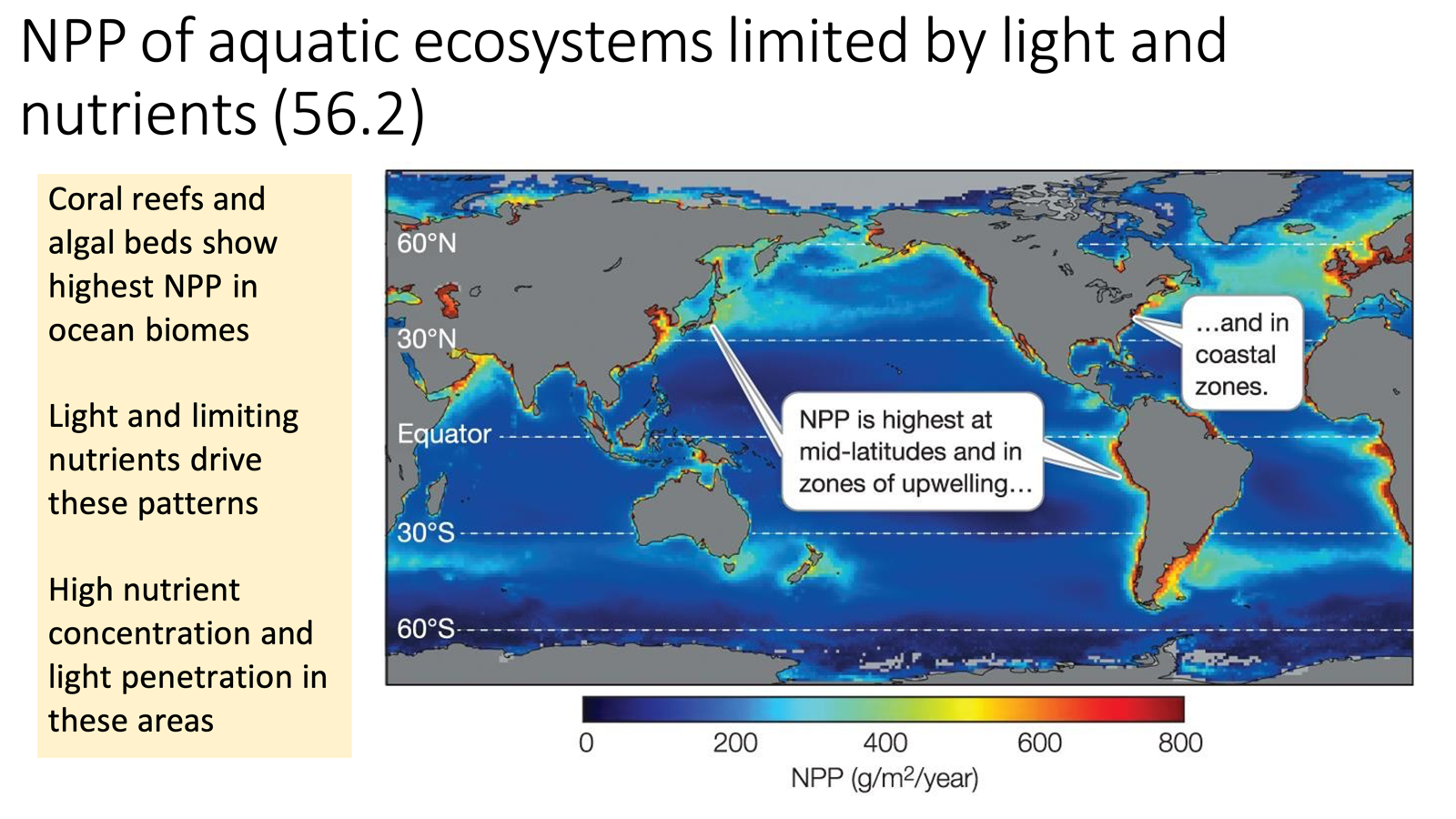
Coastlines upwelling, coral reefs, and algal beds show the highest NPP in ocean biomes
Light and limiting nutrients drive these patterns
High nutrient concentration and light penetration in these areas
Very deep water/open ocean low NPP, very low with nutrient and light permeability.
How is aquatic NPP represented within a lake environment? What is a driving factor and its effect?
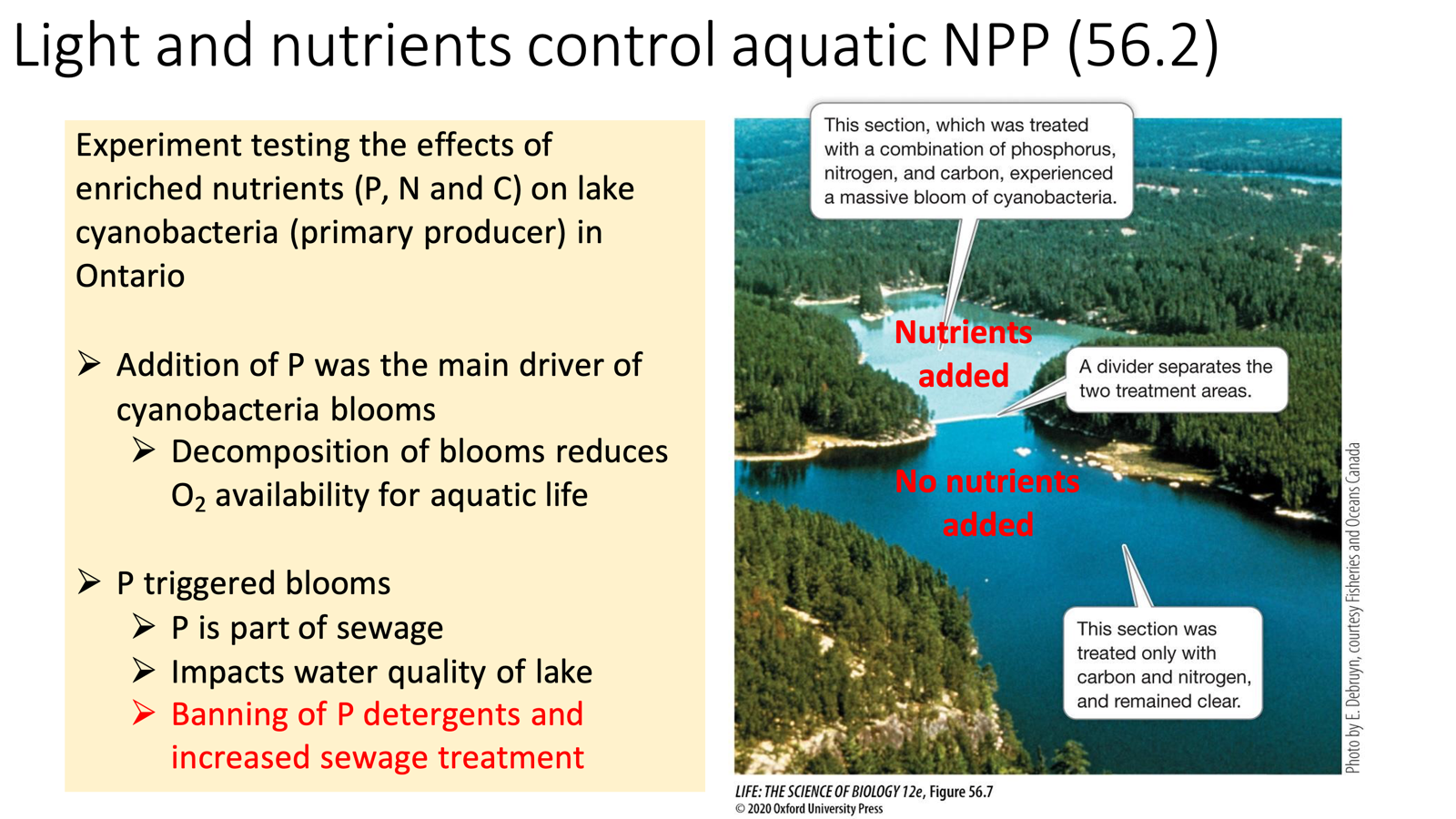
Experiment testing the effects of enriched nutrients (P, N, and C) on lake cyanobacteria (primary producers) in Ontario
The addition of P was the main driver of cyanobacteria blooms
But with these blooms in the terminal stage, decomposition of blooms reduces O2 availability for aquatic life.
Triggers eutrophication, where the lake’s water quality deteriorates, and ecosystems are severely
P triggered blooms, but P is part of sewage and impacts the water quality of the lake.
Banning of P detergents and increased sewage treatment can help combat this.
Overall, nutrients are useful to promote aquatic NPP, but also want to make sure that it’s not eliminate or limit other organisms in that same ecosystem.
What is secondary production, and what happens in the process between primary and secondary production? How can this be related back to the caterpillar?
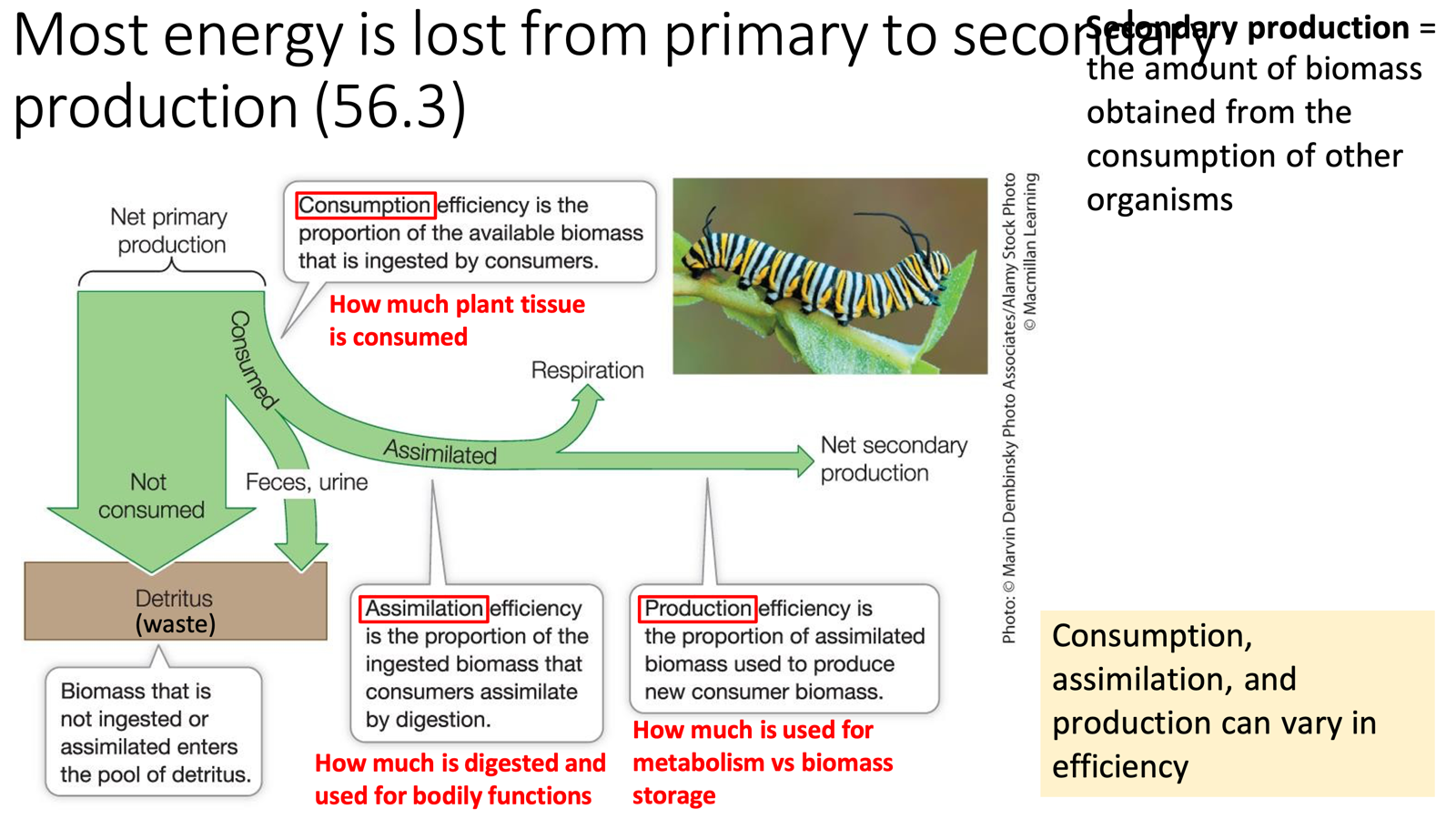
Secondary production = amount of biomass obtained from the consumption of other organisms
Three steps determine how much energy is transferred:
Consumption: how much plant/prey tissue is eaten, aka the actual available biomass that is ingested by consumers.
Assimilation: how much is digested and used for bodily functions (vs. excreted as waste)
Production: how much is used for biomass storage vs. lost to metabolism.
In terms of a caterpillar, the giant arrow is the giant leaf that can be consumed.
Very little fraction of that leaf is consumed, as lots of what the caterpillars eat goes back into the ecosystem as resources generated via waste or respiration.
Not one size fits all, as different organisms have varying production efficiencies.
How does production efficiency vary between organisms?
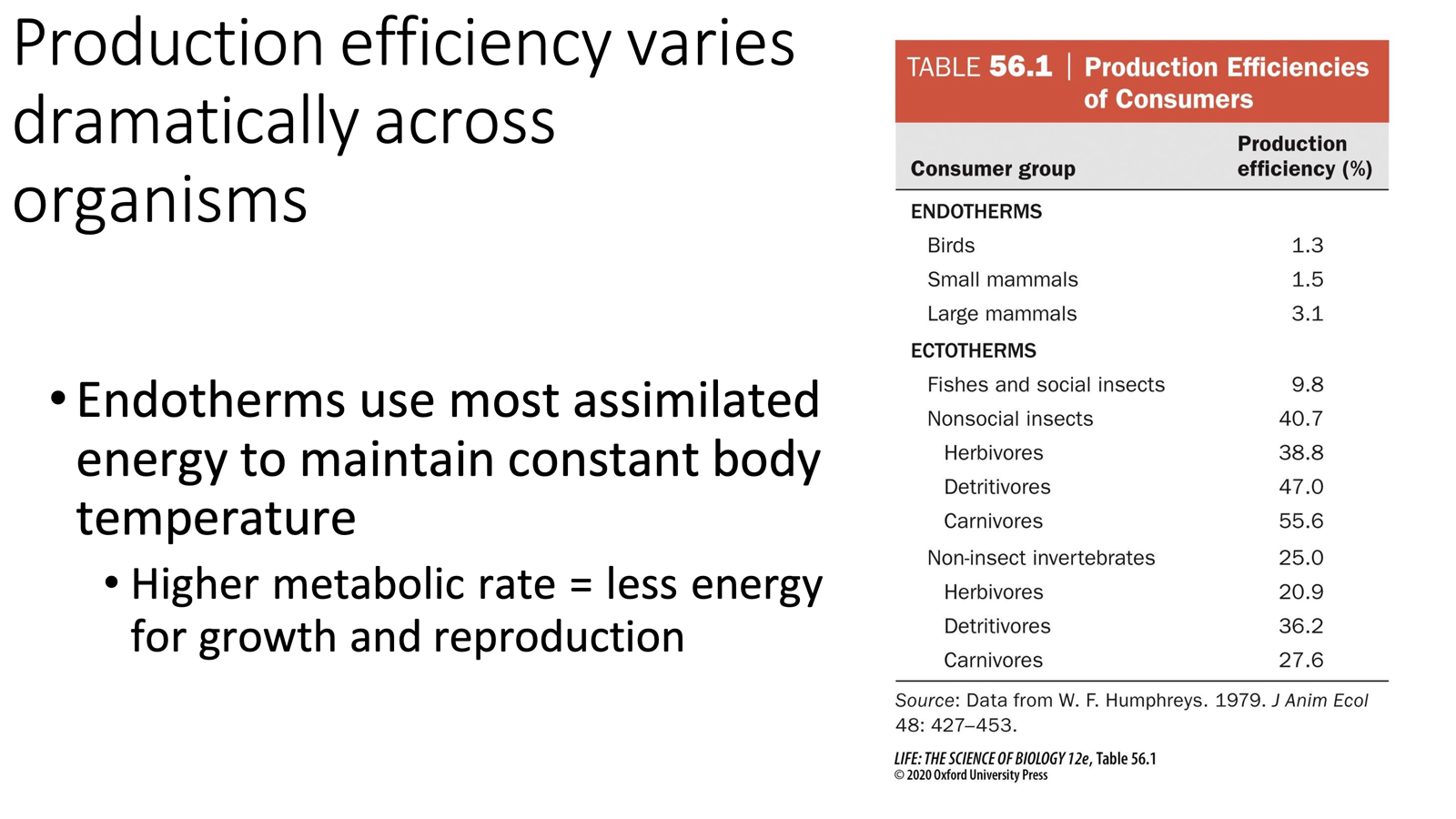
Endotherms (warm-blooded): use most assimilated energy to maintain body temperature → less energy for growth and reproduction → lower production efficiency.
Large mammals and endotherms are small because we use a lot of our energy to maintain our body temperature.
Ectotherms (cold-blooded): more assimilated energy goes to growth → higher production efficiency
Other ectotherms are more efficient/ higher because they have much simpler processes or don’t need to use as much of what they assimilate to maintain their body temp
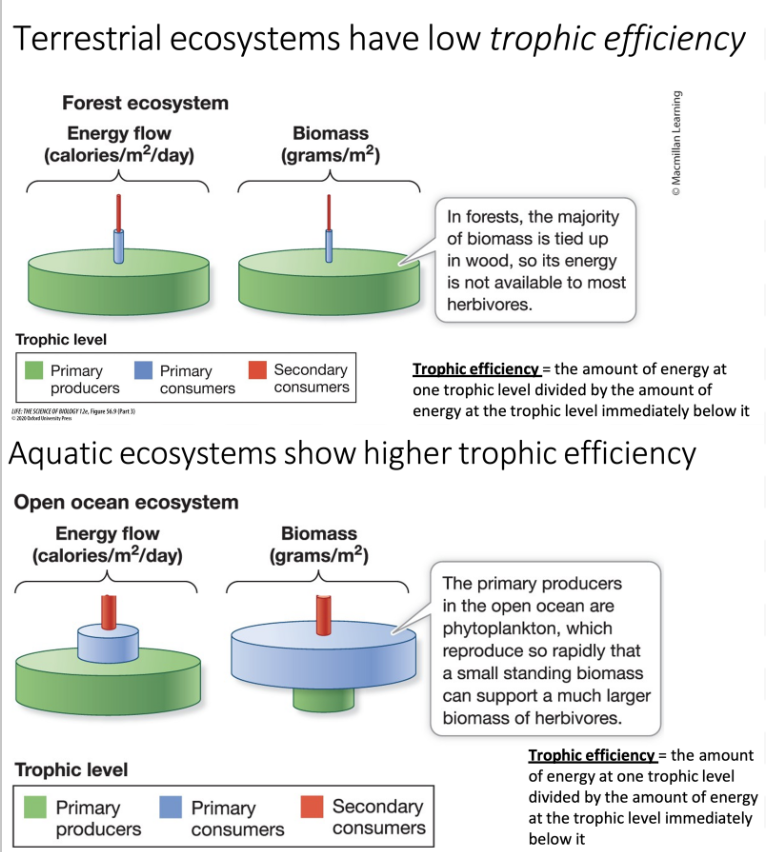
What is trophic efficiency, and what kind of trophic efficiency to terrestrial ecosystem have? How is this represented in energy flow and biomass? What about for aquatic ecosystems?
Trophic efficiency = energy at one trophic level ÷ energy at the trophic level below it
Terrestrial ecosystems: generally LOW trophic efficiency
Lots of trees compose terrestrial ecosystems.
Starts at the lowest level (primary producers).
Bark is harder to eat than leaves, so lots of it isn’t useful at the trunk or branches, tying up biomass; they need the leaves, and hence it’s rapidly abundant at the bottom.
Much of the biomass energy cannot be passed on to primary consumers as they can not consume it.
This, in turn, limits the amount available for secondary consumers.
Aquatic ecosystems: generally HIGHER trophic efficiency
Primary producers like phytoplankton.
Opposite trend between energy flow and biomass.
Not a lot of biomass though because they offer a lot of energy but reproduce so rapidly and are in turn consumed very quickly.
The entirety of a phytoplankton is consumable, the entirety of a tree is not.
Smaller biomass of phytoplankton supports a very large biomass of primary consumers. Resulting in high initial energy flow but low initial biomass.
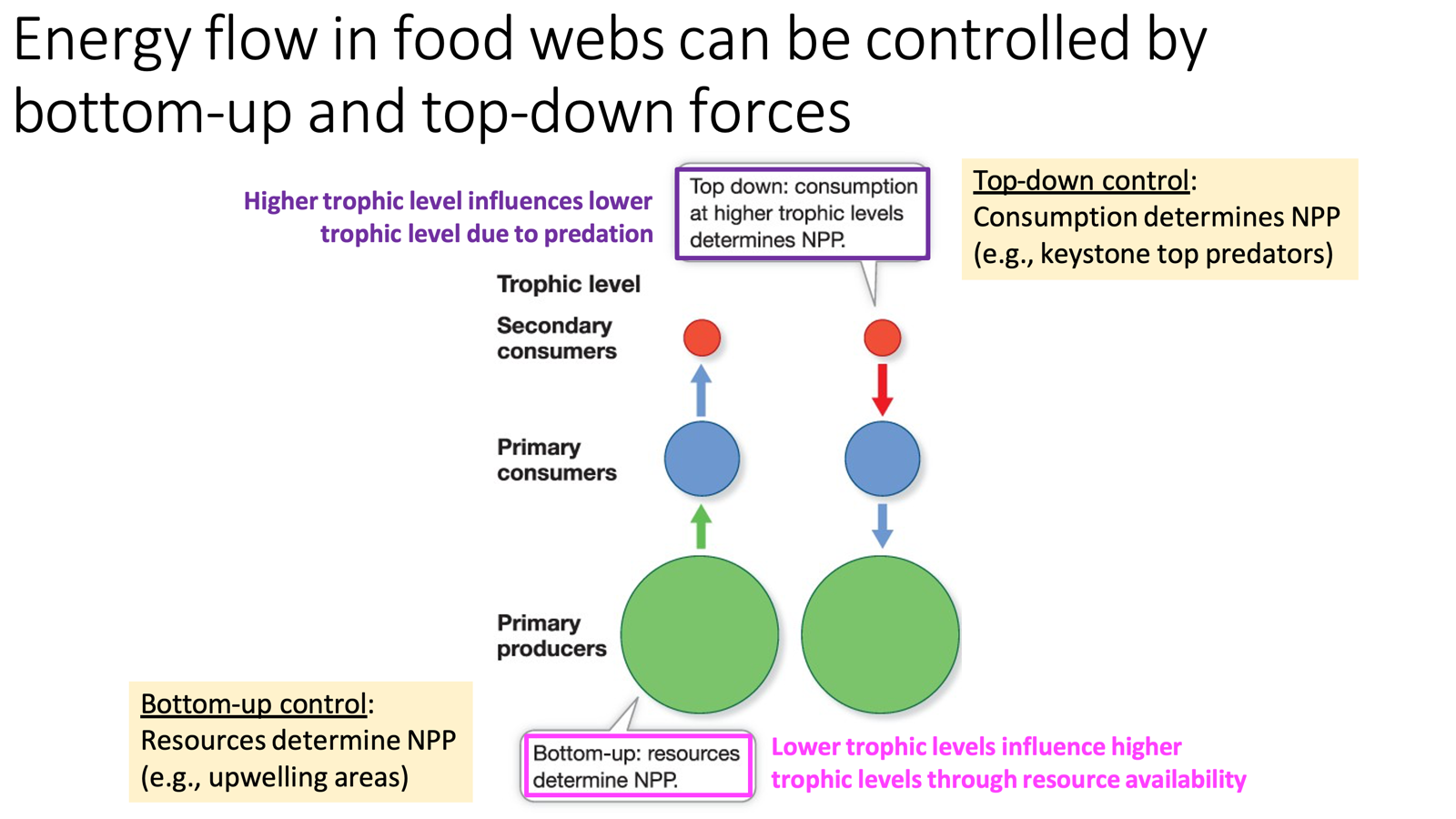
Explain how energy flow and NPP in food webs can be controlled by bottom-up and top-down forces.
Bottom-up control: resources (nutrients, light) determine NPP, which drives higher trophic levels
Ex: nutrient upwelling in oceans → phytoplankton bloom → all trophic levels increase
Top-down control: consumption by predators at higher trophic levels limits lower ones. Consumption determines NPP.
Ex: keystone predator removed → prey explodes → vegetation collapses
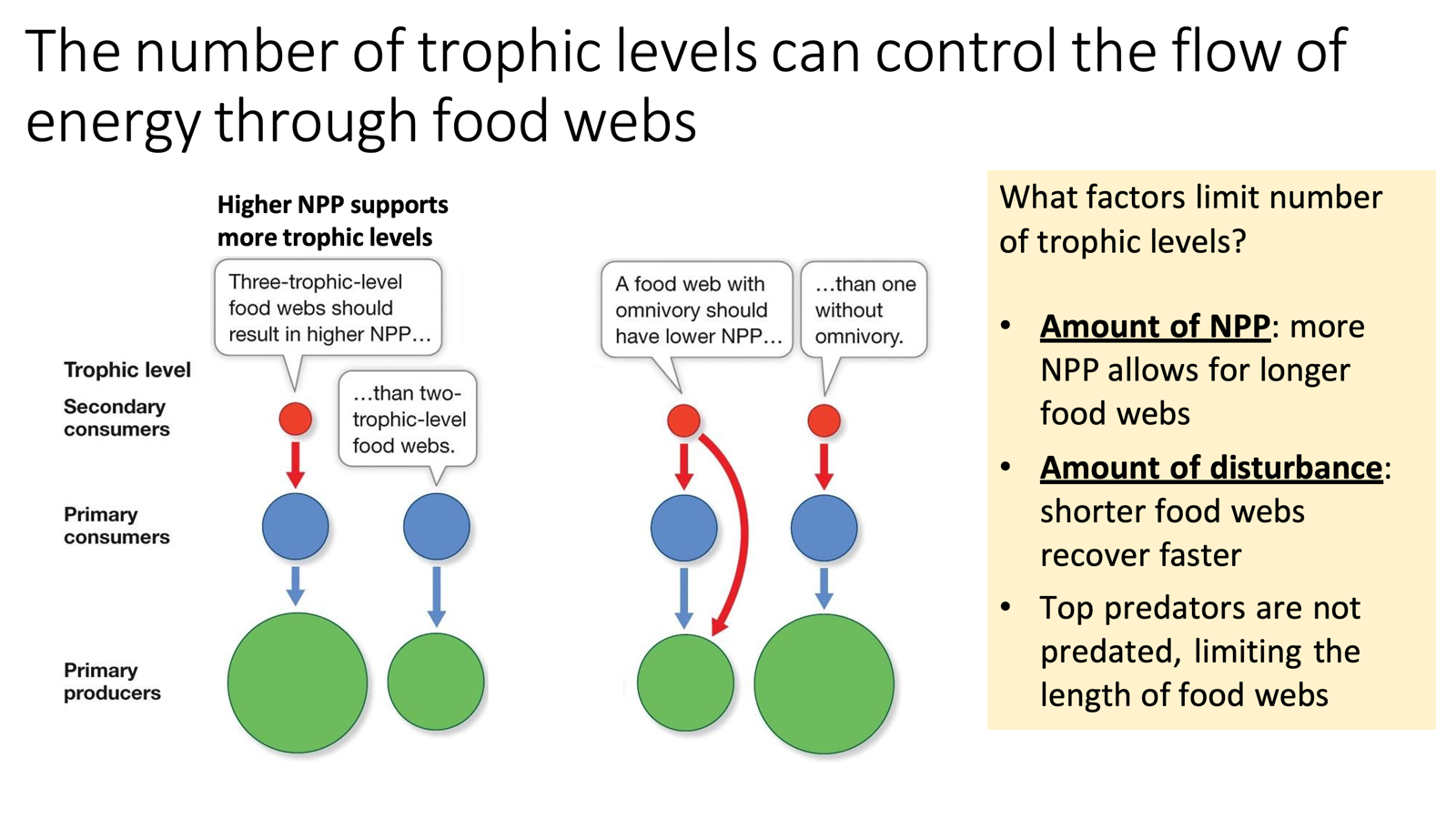
Explain how disturbances and NPP in food webs can control the number of trophic levels.
Amount of NPP: More NPP supports longer food webs
Higher NPP (large green) supports more trophic levels than a smaller NPP.
Three trophic levels, all connected, need a lot of Primary Producers to support all levels.
NPP can be smaller if there’s only one blue level to support.
Disturbance: Shorter food webs recover faster after disturbance
Must also consider who is within the food web.
Omnivores can eat both the primary consumers and producers, which will have a lower NPP as it’s being consumed twice
Carnivore is only being consumed once. # of trophic levels and the interactions present.
Top predators are not predated – limits the extension of the food web
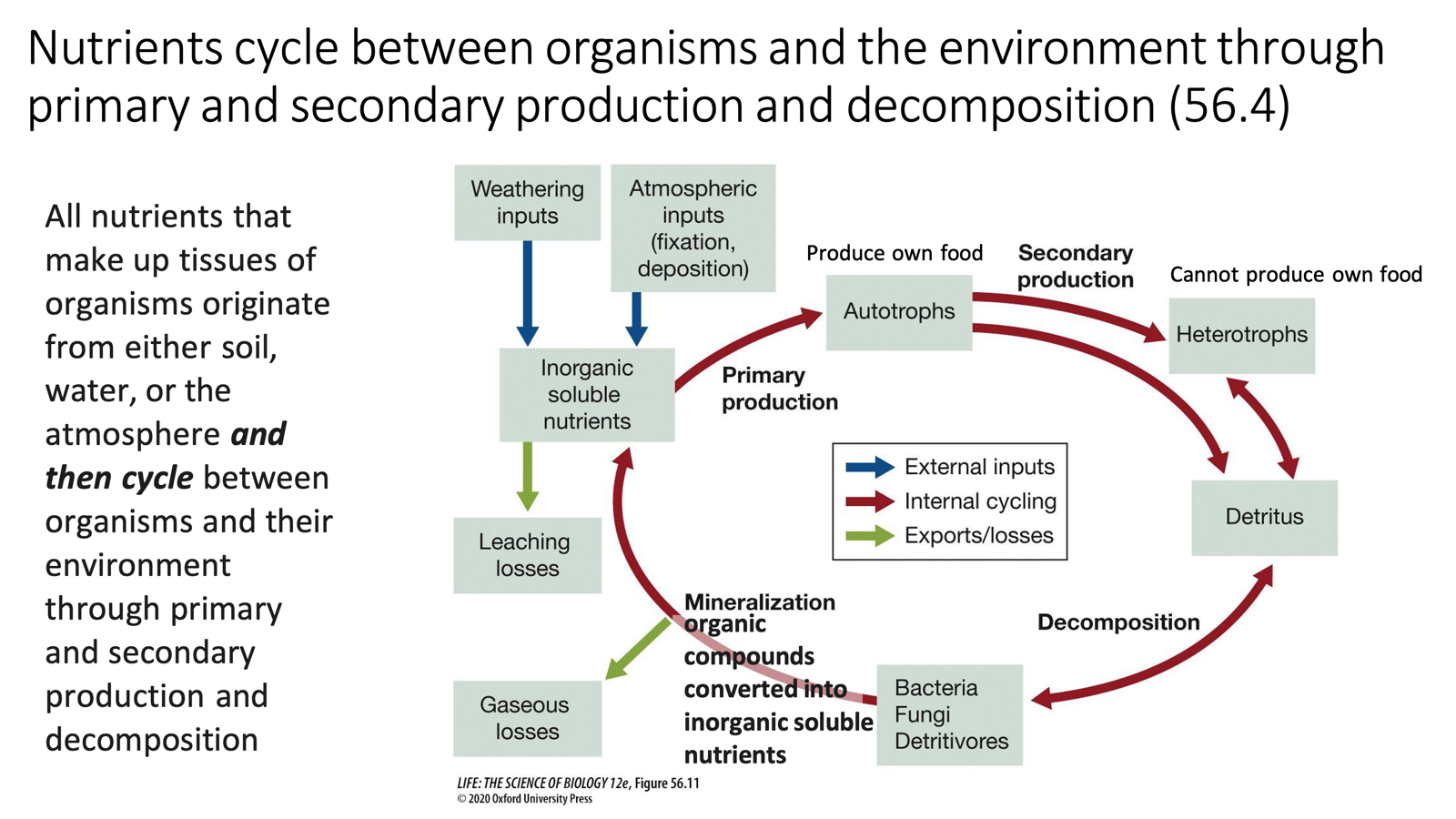
Explain the process of nutrient cycling and where producers and/or decomposers fit in. Explain the brown food web that coincides with this.
All nutrients that make up an organism tissues originate from soil, water, or the atmosphere….
These nutrients then cycle between organisms and the environment through:
Primary production: autotrophs fix inorganic nutrients into organic compounds
Secondary production: heterotrophs consume organic matter
Decomposition: organic compounds broken back down into inorganic soluble nutrients – made available again
Producers (autotrophs) produce their own food; consumers (heterotrophs) cannot
━━━━⊱⋆⊰━━━━━━━━⊱⋆⊰━━━━━━━━⊱⋆⊰━━━━━━━━━
A brown food web is a detritus-based ecosystem energy pathway driven by the consumption of dead and decaying organic matter, bacteria, and fungi, rather than living plants.
The main energy flow here can come from solar radiation, photosynthesis, etc which then contributes to the energy flow between trophic levels.
Didn’t talk about where the other nutrients really come form though or how they are being recycled through.
Some nutrients come from atmosphere and weather (blue arrows) influencing availability of inorganic soluble nutrients.
Primary production leverages a lot of these inorganic soluble nutrients through autotrophs.
Then offers the heterotrophs our primary consumers resources bc they can’t make their own food leveraging primary producers as their source.
Large majority of what is available to an organisms goes into waste of the ecosystem. This can be further broken down in decomp.
Inorganic soluble nutrients is what's available for plants to use as their nutrient resources allowing the cycle to continue.
Overall: Need to also consider what is going back into the ecosystem that supports the primary producers and in turn all other trophic levels!!
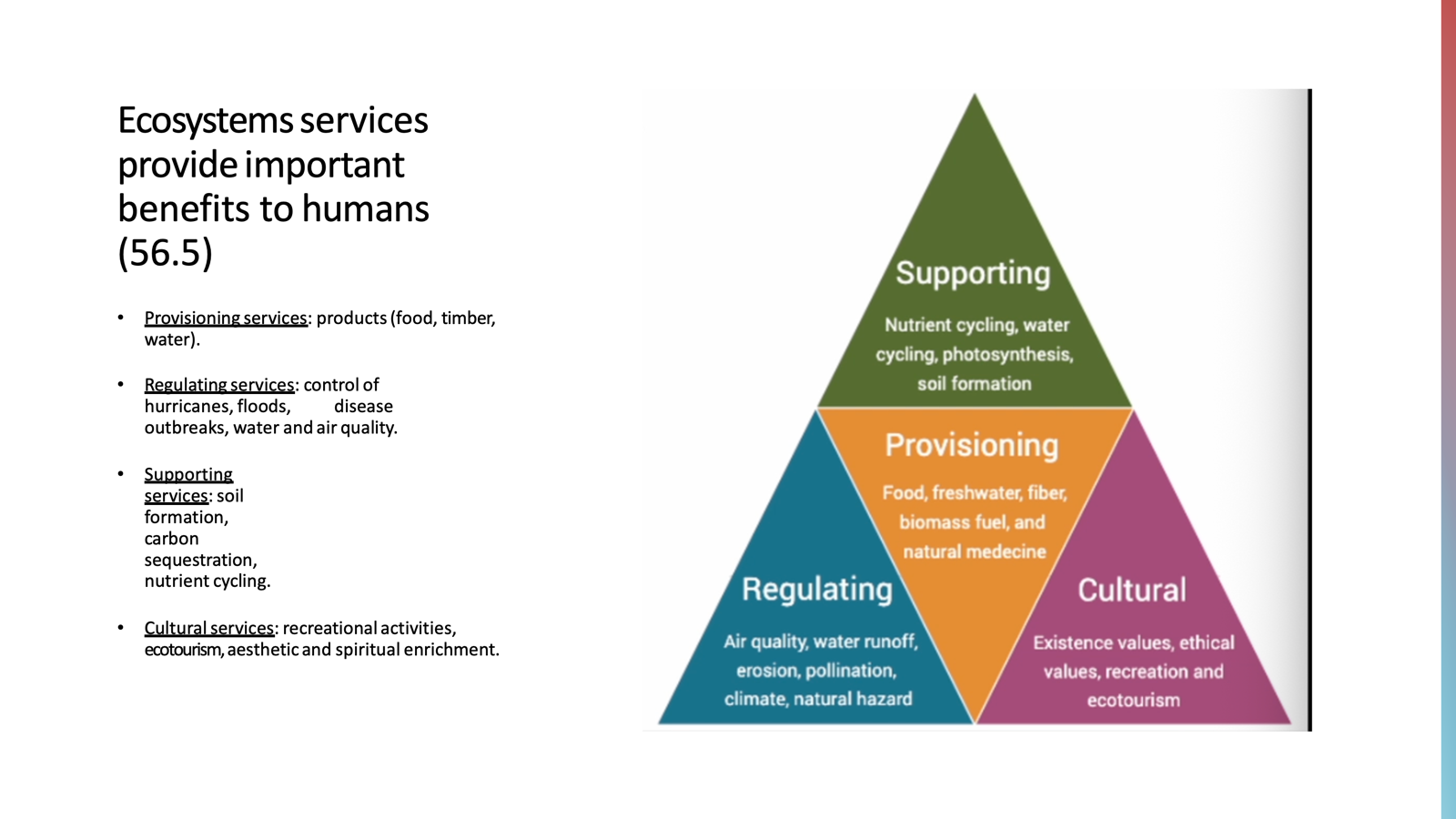
Explain the 4 ecosystem services that provide important benefits to humans.
Type of Service | Description | Examples |
Provisioning | Products obtained from ecosystems | Food, timber, fresh water |
Regulating | Benefits from the regulation of processes | Flood/hurricane control, disease control, water and air quality |
Supporting | Services that support all other ecosystem services | Soil formation, carbon sequestration, nutrient cycling |
Cultural | Non-material benefits | Ecotourism, recreation, aesthetic, and spiritual enrichment |
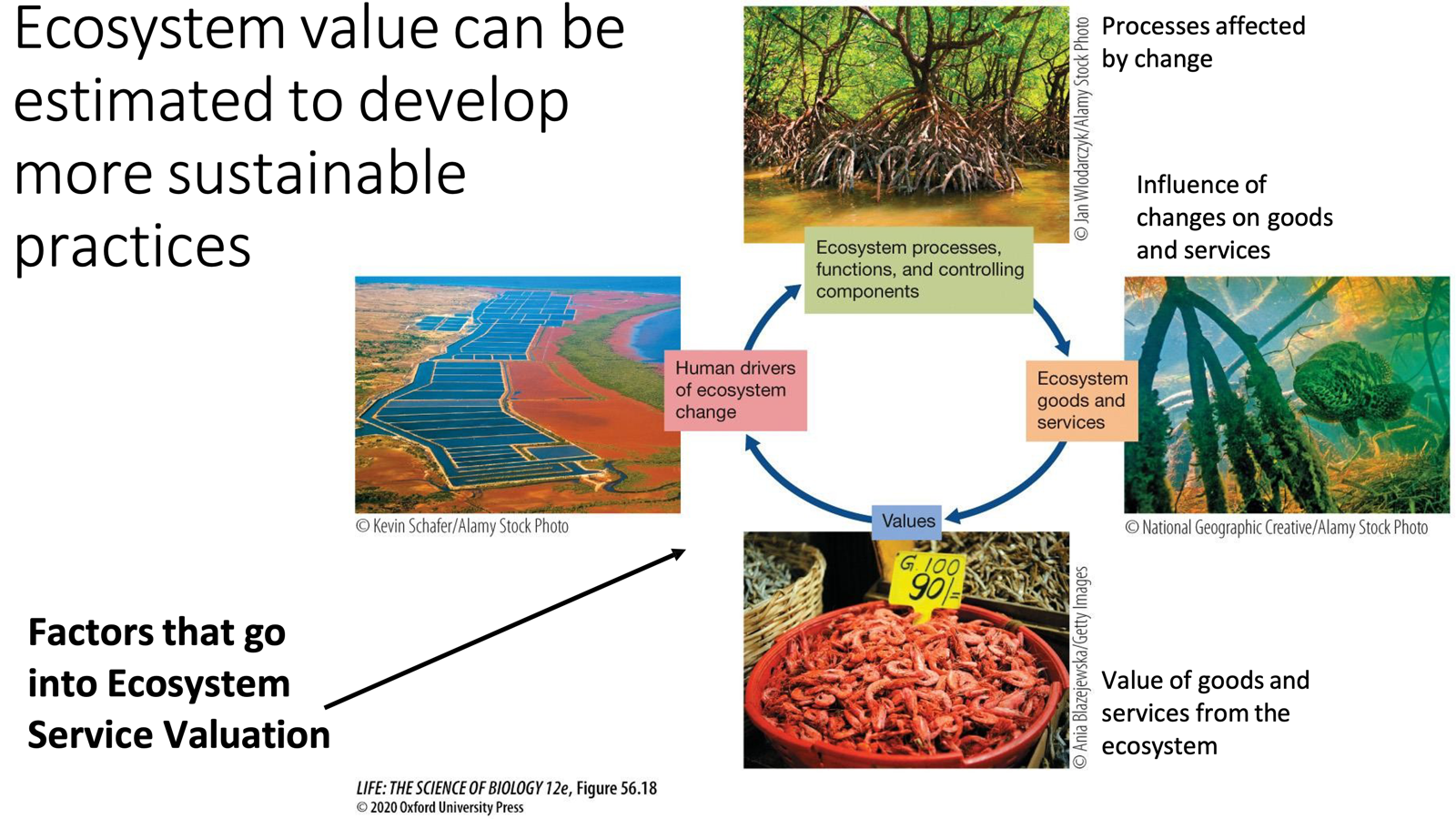
How can an ecosystem’s value be leveraged to develop more sustainable practices? What factors are considered?
Think about what goes into estimating an ecosystem and evaluating what is worth saving or what is not worth saving.
Value of goods and services provided
Influence of changes on those goods and services
What are we as humans doing to change the ecosystem, and how is it changing the entirety of the ecosystem as a whole?
Apple Orchard has AI servers built next door,
Draws a lot of water to cool down the servers, which slows/limits/impacts the growth of the apples
Apples, which are needed for the growth and development of these primary producers,
Fewer apples would likely grow from the trees and in turn raise the price of them.
What is a general finding about an ecosystem evaluation if converted?
Sustainably managed ecosystems have HIGHER economic value than converted (e.g., agricultural or commercial) ecosystems
Ecologists and economists help in this evaluation!
Wetlands in Canada have much higher value when left unconverted.
In the short term might make sense to convert them for examples listed on the slides, but in the long term reduces their value.
Be sustainable!!!
END OF TEST 5
END OF TEST 5