JS 398AG FINAL EXAM
 Call Kai
 Learn
Learn Practice Test
 Spaced Repetition
 Match
Match Flashcards
 Knowt Play
1/55

There's no tags or description
Looks like no tags are added yet.
Name | Mastery | Learn | Test | Matching | Spaced | Call with Kai |
|---|
No analytics yet
Send a link to your students to track their progress
56 Terms
Private violence
all violence that occurs in a private context
Domestic violence
all members of the family
Family violence
preferred term specifically for violence
between family members
• Includes intimate partner violence (IPV)
• Includes child abuse
• Includes elder abuse
• Includes violence between siblings and other family members
Act of Commission
acts that are committed upon an individual
• Physical
• Sexual
• Psychological
• Economic
• Social
• Spiritual
Acts of Omission (neglect)
purposeful withholding of acts
• Physical
• Emotional
• Medical/dental
• Educational
• Supervisory
• Violence exposure
IPV
abuse or violence that occurs:
• within a marriage, common law, or otherwise dating
• In both different-sex and same-sex relationships
• Affects all genders
• During the relationship, during separation, or after it ends
Motivation for IPV
violence = tool but is a power
exert dominance in the relationship and gain control over aspects of victim’s life
The Power Control Wheel
shows abusive tactics that
partners experience in IPV
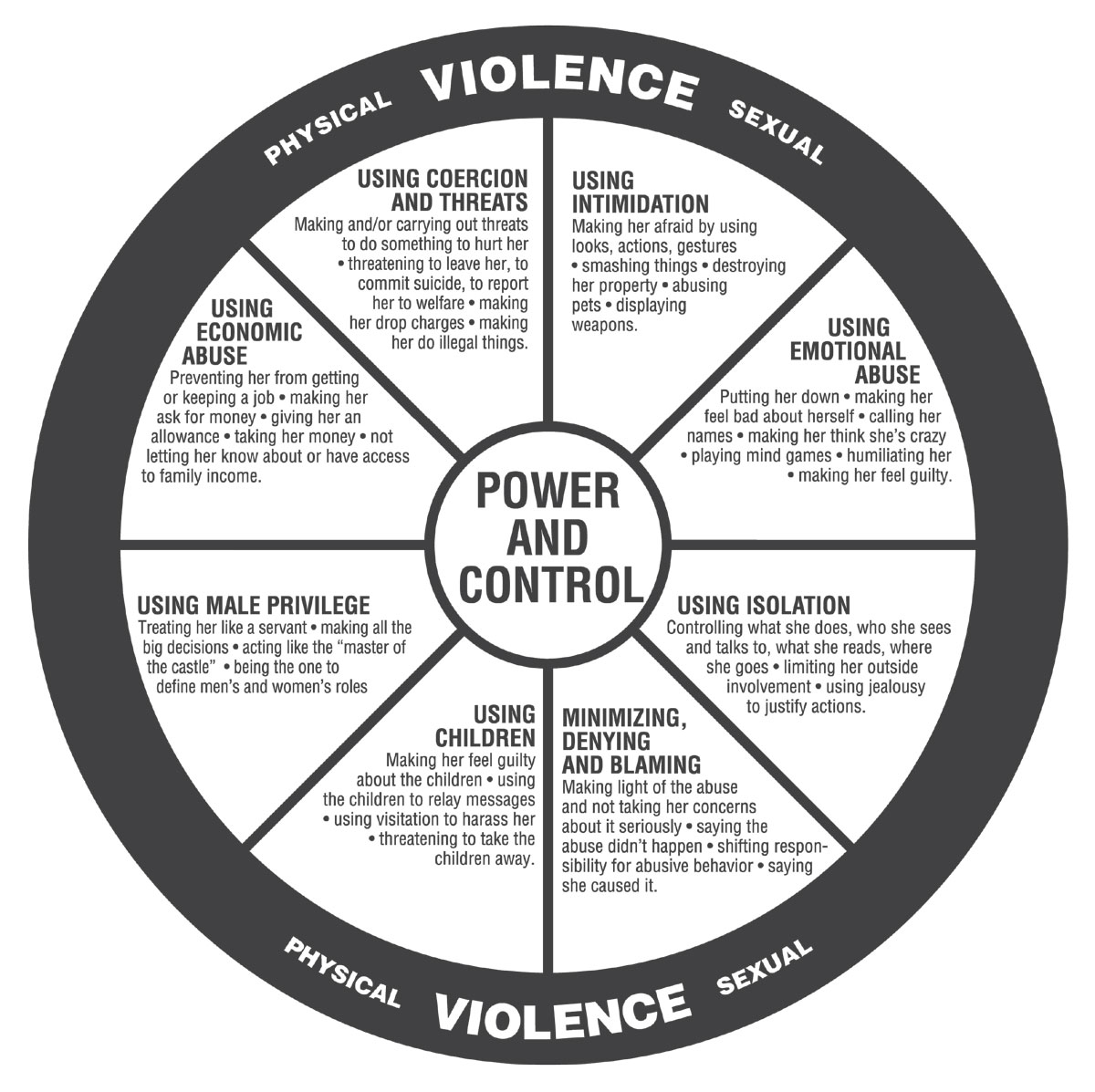
Learned helplessness
doesn’t matter what I do, can’t change my situation
Forms of Family Violence in Canada
child abuse and neglect
neglect
elder abuse
violence based on honour
forced marriage
female genital mutilation
Child abuse and neglect
legally: harm or risk of harm experienced by a person under 18 years of age within a relationship of responsibility trust authority
Neglect
failure to provide necessary care, supervision or protection
Includes:
• Inadequate food, clothing, shelter
• Failure to provide medical care
• Lack of supervision
• Emotional neglect (withholding affection, support, or attention)
Elder abuse
Any action, behaviour or failure to act, by a person in a position of trust, like an adult child, family member, friend or caregiver, that causes or risks causing harm to an older adult
• Includes:
• Physical, sexual or emotional harm
• Damage to or loss of property or assets
Missing Persons
1. The person’s whereabouts are unknown and,
• the person has not been in contact with people who would likely be in contact with the person, or
• it is reasonable in the circumstances to fear for the person’s safety because of the circumstances surrounding the person’s absence or any other prescribed considerations
2. A member of a police force is unable to
locate the person after making reasonable efforts to do so
Missing Persons - Trends in Canada
90% resolves within 24-48 hours
Direct Victimization
a crime has been committed
harm us identifiable
there is an offender
Example in missing persons cases:
• Abduction
• Homicide
• Human trafficking
• Assault
Risk-based victimization
recognizes:
• exposure to significant harm
• heightened vulnerability
• structural precarity
• A missing person may face:
• Environmental danger
• Exploitation risk
• Violence exposure
• Survival risk
• Victimization may exist before harm is confirmed
Police response to missing persons
initial response
investigation and search
What contributes to these issues (marginalized women, MMIWG, LGBTQ)
resources
training
police derception
broader
Routine activity theory
• Argues that crime occurs when three elements converge:
• Motivated offender
• Suitable target
• Absence of capable guardianship
• Application to Missing Persons:
• going missing often removes guardianship
• disconection from faming social networks weakens protection
Interactionist perspective
argue that:
• certain characteristics highten risk because offenders percieve them as exploitable
• Relevant traits may include:
• Age
• Gender
• Social marginalization
• percieved isolation
• Offenders assess vulnerability
Lifestyle exposure theory/lifestyle theory
suggests victimization risk is shaped by:
• Daily routines
• Social associations
• Time/place exposure
• In missing persons cases, vulnerability may intersect with:
• homelessness
• substance dependency
• survival work
• transience
•exposure shapes risk
Cultural construct
is a concept or behaviour that gains me acting through shared beliefs and social norms. rather than being inherently defined by law
Quasi-Criminal Acts
Are behaviours that:
• cause real harm
• May resemble criminal behaviour
• But are not always illegal or prosecuted
• They often exist in a grey zone between social misconduct and crime
• are considered a crime in give place or circumstance but may not
• Examples include:
• Harassment
• Doxxing
• Non-consensual image sharing (before criminalization)
4 parts to understanding victimization according to Sacco and Kennedy’s criminal event perspective
victim interest
offender interest
private sphere
public sphere
Types of bullying
physical bullying
emotional /psychological
cyberbullying
social
discrimination
Must reach a level of criminal conduct for Criminal Code offences to apply, including:
• criminal harassment (section 264)
• uttering threats (section 264.1)
• intimidation (subsection 423(1))
• mischief in relation to data (subsection 430(1.1))
• unauthorized use of computer (section 342.1)
• identity fraud (section 403)
• extortion (section 346)
• false messages, indecent or harassing telephone calls (section 372)
• counselling suicide (section 241)
• defamatory libel (sections 298-301)
• incitement of hatred (section 319)
• child pornography offences (section 163.1)
Criminal Harassment (CC s.264)
This offence occurs when someone repeatedly engages in behaviour that causes another person to reasonably fear for their safety
• Examples relevant to bullying or cyberbullying:
• Repeated messages or online contact
• Persistent unwanted communication
• Monitoring someone online or offline
• Threatening behaviour
• Often referred to as “ stalking”
Uttering threats (CC s.264.1)
It is a criminal offence to knowingly threaten:
• Death
• Bodily harm
• Damage to property
• Harm to animals
• In cyberbullying contexts, threats will be upheld if documented
and appear, such as:
• Text messages
• Social media posts
• Direct messages
• Gaming platforms
Non-conserval distribution of intimate images (s.162.1)
Introduced in 2015 following several high profile cyberbullying cases in Canada
• This offence involves:
• sharing intimate images of someone
• without their consent
• knowing or being reckless about the lack of consent
• Often associated with:
• “revenge porn”
• image-based abuse
• online harassment
Defamatory Libel (CC ss.298-301)
• Defamatory libel involves publishing false statement that damage a persons
Types of bullying reported by Statistics Canad
called names, having rumours spread about them, being left out and insults and being made fun of
Bullying victim types by Lawrence and Adams (2006)
submissive and less aggressive children
• Labelled sensitive
• Often quiet, anxious, and insecure
children more aggresive but are agitating children
• Connection to ADHD
• Are more likely to fight back than #1, but are likely to cause tension and irritability
very popular, bright or talented chidren
• Targeted because thought to intimidate bullies in some way
largest Indigenous population
ontario
19th Century
Residential
Gradual Civilization Act. 1857
enfranchised Indigenous peoples and recognized them as British not Indigenous
1920
Attendance at residential schools was mandatory for all Indigenous children between 7 to 15 years
• Thus, children were forcibly taken from their families by priests, Indian agents, and police officers
1930
80 residential schools were operating in Canada
1948
72 schools were operating with 9,368 students
1960
Indigenous peoples granted the right to vote
Mid 70s
Control of residential schools was turned over to Indigenous peoples
1979
There are 12 residential schools with 1,899 students
1980s
Claims began to emerge about mistreatment at resident schools
• Stories of sexual and physical abuse
• Neglect
• Hunger
• Poor working conditions
• Emotional cruelty
1996
door closed lease federally funded residential school
1985
B-C.31 passes
1989s and 1990s
apologies
LSP
but this required legal fees and financial resources
ADR
was more informal but only dealt with physical and sexual abuse, imposed rigid compensation guidelines
CEP
compensated survivors based on time spent in one of the listed schools as abusive – but ignored intergenerational effects and children of survivors
IAP
meant to replace #2, promised to process any residential school abuse claim within a 9-month period, but had to condition that survivors had to withdraw any lawsuits they had filed
Victimization Trends (IP)
disproportionate exposure to violence
early victimization
cycle of victimization across life cycles
gendered and intersectional vulnerabilities
systemic inequity and institutional contact
Victimless crime
Meaning crime where victim and victimizer are the same person
Indigenous resilience
cultural resurgence
community led justice healing
youth leadership and advocacy
self determination and governance
Vulnerability
individual weakness or risk factor
marginalization
the process by which individuals or groups pushed to the edge of social economic and political life
Structural vulnerability
exposure to harm spaces by social position and institutional arrangements