IB L8 - Supply chains and logistics
 Call Kai
 Learn
Learn Practice Test
 Spaced Repetition
 Match
Match Flashcards
 Knowt Play
1/19

There's no tags or description
Looks like no tags are added yet.
Name | Mastery | Learn | Test | Matching | Spaced | Call with Kai |
|---|
No analytics yet
Send a link to your students to track their progress
20 Terms
What is the difference between a supply chain and logistics?
Supply chain
The complete network involved in creating and delivering a product, including:
Suppliers
Manufacturers
Warehouses
Distributors
Customers
Logistics
The management of:
Transportation
Storage
Material flow
Delivery of goods and information through the supply chain
Goals:
Deliver the correct product
At the correct time/place
At minimum cost
👉 Key idea:
The supply chain is the overall system, while logistics manages the movement and storage operations within it
How have supply chains and logistics evolved historically?
Early military logistics relied on “pillage and plunder”
As armies grew (16th–18th century), logistics became essential for survival and supply management
Napoleon emphasised logistics using forage parties
Frederick Taylor introduced scientific management
Industrial/logistics developments:
19th century industrial revolution:
Railways
Steam engines
Refrigeration
Modern developments:
1940s: transport management and warehousing
1970–80s: computerisation and supply chain integration
1990–2010s: enterprise planning systems and CAD
Today: AI, data-driven tools, and redesign of global supply networks
👉 Key idea:
Modern supply chains evolved from military logistics and industrialisation into highly integrated digital global systems
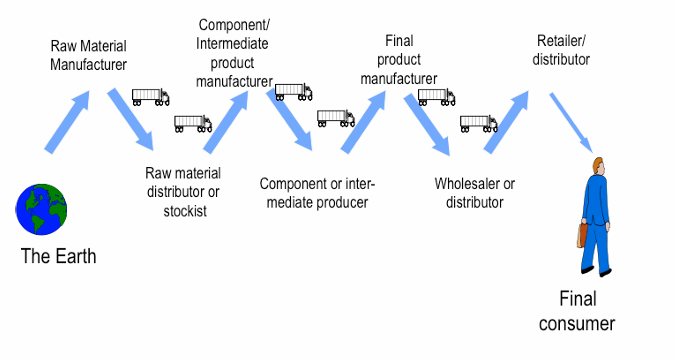
What is a supply chain?
A supply chain is:
“A set of three or more companies directly linked by upstream and downstream flows of products, services, finances, and information from a source to a customer.”
Different companies manage different stages between:
Raw material production
andFinal customer delivery
Examples of participants:
Suppliers
Manufacturers
Warehouses
Distributors
Retailers
Supply chains also exist in:
Services
Software development
Logistics systems
👉 Key idea:
A supply chain is the connected flow of materials, information, and services from source to customer across multiple organisations
What is a supply network?
A supply network is:
“A network of connected and interdependent organisations working together to manage and improve the flow of materials and information from suppliers to end users.”
Unlike a simple supply chain:
Suppliers may supply multiple customers
Customers may buy from multiple suppliers
Flows in the network:
Materials move toward the customer
Information and money flow back through the network
The structure of the supply network can affect:
Cost
Quality
Flexibility
Delivery performance
Final product availability
👉 Key idea:
Real supply systems are interconnected supply networks rather than simple linear supply chains
Why are supply chains critical to product competitiveness?
A final product is not solely the achievement of the OEM (Original Equipment Manufacturer)
Customer experience depends heavily on the supply chain:
Quality
Cost
Delivery performance
Much of a product’s value comes from suppliers and external partners.
Supply chains are:
Interdependent connected systems, not isolated individual systems
Therefore:
The competitiveness of one company depends on surrounding suppliers and distributors
As stated by Martin Christopher (2002):
“It is the value chains that compete.”
👉 Key idea:
Modern competitiveness depends on the performance of the entire interconnected supply/value chain rather than a single company alone
What is the contemporary definition of supply chain management?
Supply chain management is:
The management of the flow of goods from raw material source (“earth”) to the end consumer
The management of internal and external resources to fulfil customer needs
The coordination of:
Logistics
Quality
New product development
Buying and selling activities
This occurs:
Within organisations
andAcross supplier and customer interfaces
👉 Key idea:
Modern supply chain management integrates operations, resources, and commercial activities across the entire interconnected supply network
Why are supply network structures often confidential?
Companies often keep supply network structures confidential to protect:
Competitive advantage
Supplier relationships
Pricing and sourcing strategies
Manufacturing capabilities and capacity
Confidentiality helps prevent:
Competitors copying supply arrangements
Competitors approaching key suppliers
Exposure of strategic dependencies or weaknesses
Supply networks can therefore be:
Complex
Interdependent
Difficult for outsiders to fully map or analyse
👉 Key idea:
Supply network confidentiality protects strategic relationships and competitive advantage within interconnected supply systems
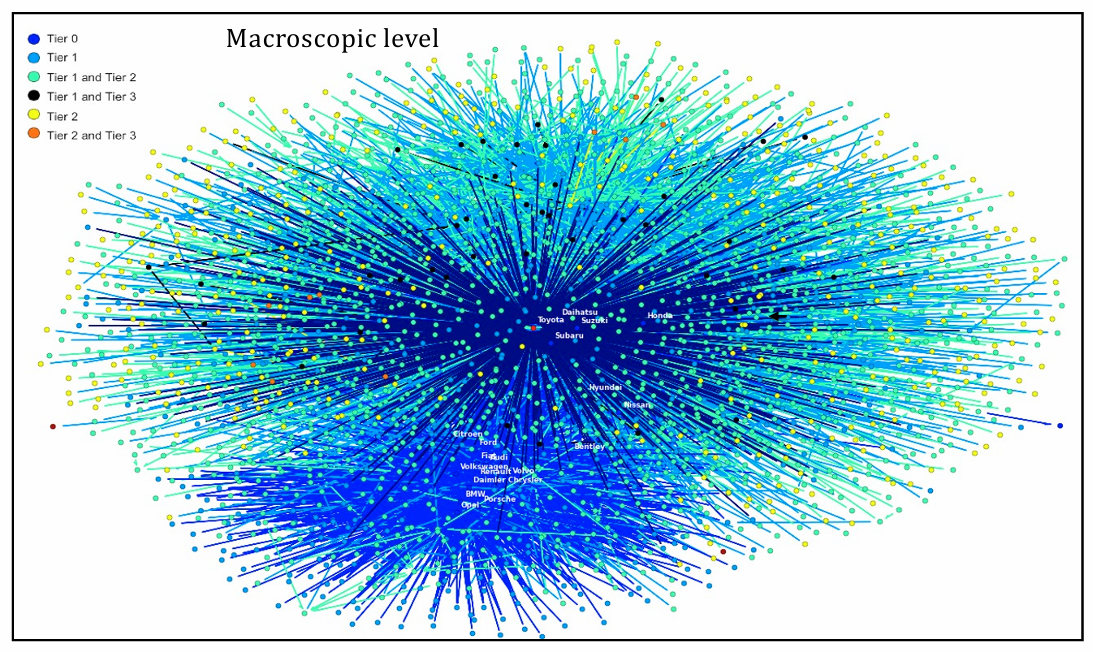
How are supply networks visualised and analysed?
Supply networks can be visualised by:
Grouping companies into clusters based on shared characteristics
Clusters may share:
Common suppliers
Similar products or technologies
Geographic location
Manufacturing capability
Customer markets
Visualisation helps identify:
Key suppliers and dependencies
Bottlenecks and risks
Highly connected companies
Opportunities for optimisation
If we zoom out further:
Multiple supply networks and industrial sectors begin to intersect, forming broader industrial ecosystems.
👉 Key idea:
Supply network visualisation helps understand interconnected company relationships, while larger industrial ecosystems show how entire sectors become linked together
What is the difference between agile and lean supply chains?
Agile supply chain
Designed for:
Rapid response to demand fluctuations and unexpected changes
Characteristics:
Flexible
Responsive
Adaptable to uncertainty and changing customer needs
Used when:
Demand is unpredictable
Product variety changes quickly
Fast reaction is important
Lean supply chain
Designed for:
Efficient operation in stable, predictable conditions
Characteristics:
Low waste
High efficiency
Standardised processes
Cost reduction focus
Used when:
Demand is steady and predictable
Products are standardised
Established supply and production systems already exist
👉 Key idea:
Lean supply chains optimise efficiency for predictable demand, while agile supply chains prioritise flexibility and responsiveness to change
What do coffee, flower, and organ donation supply chains demonstrate?
Coffee supply chain (lean supply chain)
Long global agricultural supply chain
Climate uncertainty and high environmental impact (carbon footprint from land use - deforestation, fertiliser use) BUT provides economic value to markets
Many stages add value from farm to customer
Rose supply chain (agility and leanness)
Large seasonal demand fluctuations
There is a steady state (base response - lean) but demand grows quickly on Valentine’s day and Mother’s day therefore multiple shipment options…
Requires both lean efficiency and agile responsiveness
Uses refrigerated logistics, AI, and digital twins for quality control
Organ donation supply chain (agile supply chain - temporary logistic)
Extremely time-critical temporary logistics network
Requires rapid matching, transport, and coordination
Uses optimisation algorithms and data science
👉 Key idea:
Different supply chains face different challenges, including sustainability, demand variability, perishability, and extreme timing constraints
What risks arise from poor visibility and information flow in supply chains?
Complex supply chains can become difficult to fully track and manage.
Examples:
IKEA horsemeat scandal:
Organisations lost visibility of suppliers and product origins
Raises questions:
Who monitors the supply chain?
Where should checks occur?
Who is responsible?
Poor visibility can lead to:
Illegal or unsafe products
Supply chain slavery
Deforestation
Quality failures
Information system failures can also disrupt operations:
Target Canada (“Barbie disaster”):
Barcode and IT mismatches caused warehouse overloads and empty shelves
Resulted in major financial losses
👉 Key idea:
Modern supply chains depend heavily on visibility, traceability, and reliable information systems to prevent quality, ethical, and operational failures
What challenges characterise modern supply networks?
Modern supply networks are:
Complex global systems
~80% of trade flows through multinational corporations (MNCs)
Key challenges include:
Volatility and geopolitics
Especially for food, medicine, and energy supply systems
Systemic ethical/environmental issues
Human rights violations
Environmental damage
Security concerns
Constantly changing supply chain configurations and dependencies
New technologies
Creating new and evolving supply network structures
👉 Key idea:
Modern supply networks are globally interconnected, technologically evolving, and increasingly influenced by geopolitical, ethical, environmental, and security challenges
What are key objectives and challenges in supply chain management?
Common supply chain objectives:
Low cost
Resilience
Sustainability
Good delivery/service performance
Challenges:
Different companies may optimise different costs
Objectives can conflict across suppliers and buyers
Example:
Buyers may want small frequent deliveries
Sellers may prefer large batches to reduce transport cost
Supply chain decisions therefore involve:
Trade-offs
Incomplete information
Information asymmetry
(one party has more information than another and may use it advantageously)
KPIs (Key Performance Indicators) are used to measure:
Cost
Delivery
Inventory
Reliability
Sustainability performance
👉 Key idea:
Supply chain management balances competing objectives across interconnected organisations operating with imperfect information
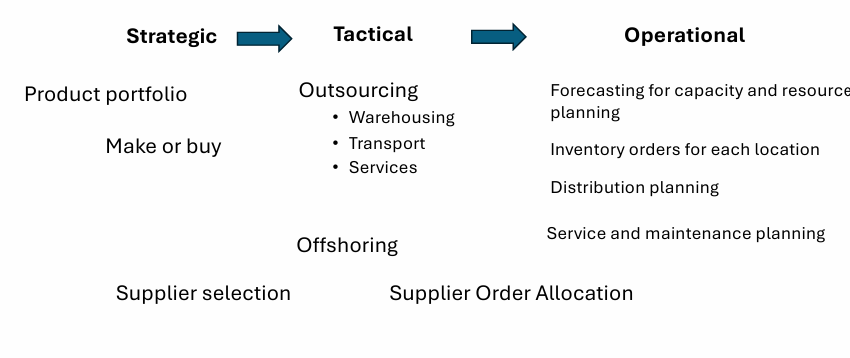
What are the different decision levels in supply chain management?
Strategic decisions (long-term)
Major organisational decisions such as:
Product portfolio
Make-or-buy decisions
Offshoring
2. Tactical decisions (medium-term)
Planning and resource decisions such as:
Outsourcing
Warehousing
Transport
Supplier selection
Service and maintenance planning
3. Operational decisions (short-term/day-to-day)
Daily execution and optimisation such as:
Forecasting for capacity/resource planning
Inventory ordering
Distribution planning
Supplier order allocation
These decision levels are interconnected:
Strategic decisions influence tactical and operational decisions below them
👉 Key idea:
Supply chain management involves linked strategic, tactical, and operational decisions across different time horizons
What quantitative tools are used in supply chain management?
Supply chain management uses data-driven tools for:
Forecasting
Optimisation
Simulation
Prediction and decision-making
Examples:
Statistical forecasting (regression, ARIMA)
Optimisation methods (MILP, genetic algorithms)
Simulation (Monte Carlo, digital twins)
AI and machine learning:
Classification
Clustering
Reinforcement learning
Applications:
Demand prediction
Supplier performance
Inventory and pricing decisions
👉 Key idea:
Modern supply chains rely heavily on quantitative modelling, simulation, optimisation, and AI for decision-making
What quantitative tools are used in supply chain management?
Supply chain management uses data-driven tools for:
Forecasting
Optimisation
Simulation
Prediction and decision-making
Examples:
Statistical forecasting (regression, ARIMA)
Optimisation methods (MILP, genetic algorithms)
Simulation (Monte Carlo, digital twins)
AI and machine learning:
Classification
Clustering
Reinforcement learning
Applications:
Demand prediction
Supplier performance
Inventory and pricing decisions
👉 Key idea:
Modern supply chains rely heavily on quantitative modelling, simulation, optimisation, and AI for decision-making
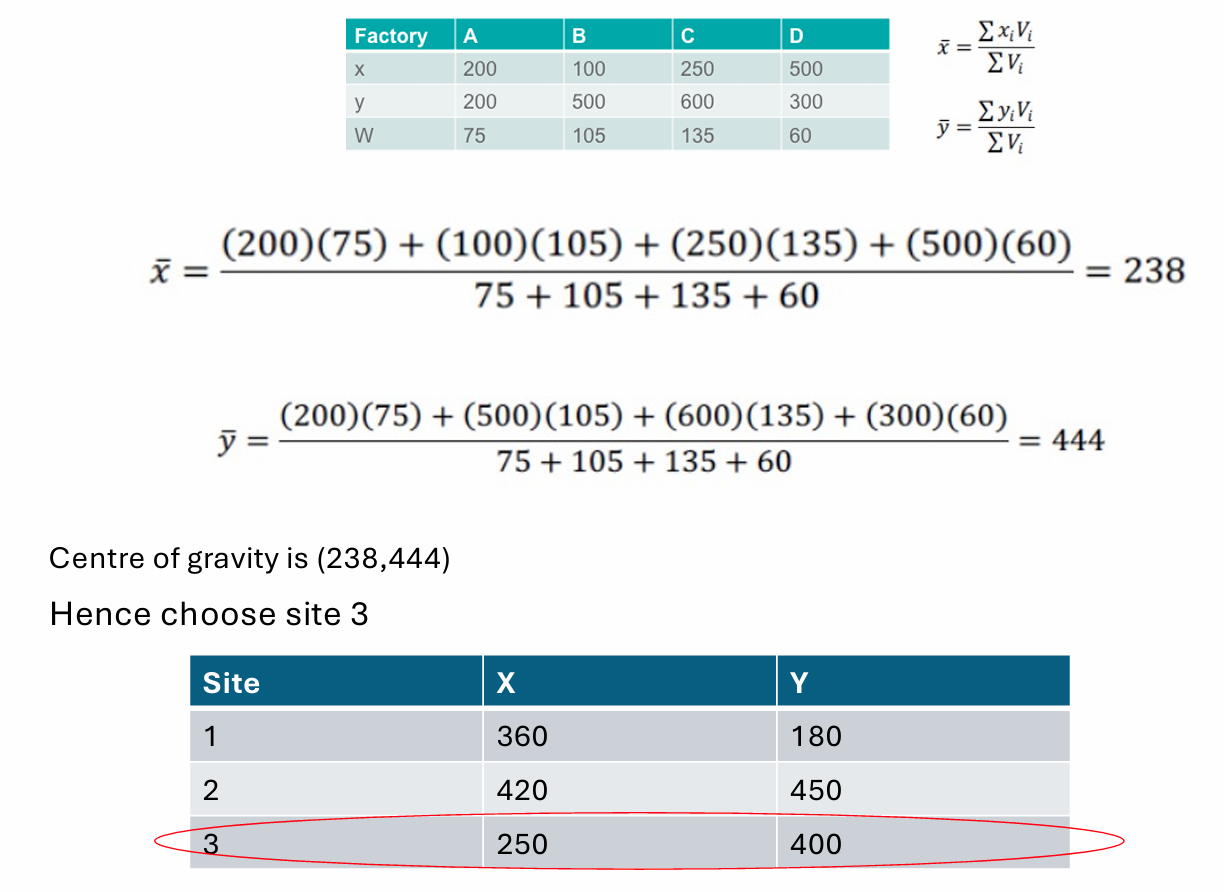
What is the Centre of Gravity method in logistics?
The Centre of Gravity (CoG) method is used to find a location (e.g. warehouse or factory) that minimises transportation cost.
It calculates a weighted central location based on:
Destination/source coordinates
Shipment volumes
Where:
xi,yix_i, y_ixi,yi = coordinates of locations
ViV_iVi = quantity shipped
Pros
Simple and quantitative
Useful for identifying candidate locations
Cons
Simplified/one-dimensional approach
Actual feasible sites may not exist exactly at the CoG
👉 Key idea:
The CoG method estimates the best logistics location by balancing transport distances and shipment volumes
What are distribution decisions in supply chain management?
Distribution decisions determine:
How much product to transport
From which factories
To which distribution centres
…while satisfying:
Supply constraints
Demand constraints
Transportation cost limits
These are optimisation problems involving:
Material flow planning
Cost minimisation
Resource allocation
Typically solved using:
Optimisation algorithms and mathematical models
👉 Key idea:
Distribution planning optimises product flows across the supply network while balancing cost, supply, and demand constraints
What are common distribution strategies in logistics?
Direct shipping
Point-to-point delivery from supplier to customer
Good for:
Perishable goods
Large/bulky items
Low storage needs but limited risk pooling
Warehousing
Products stored until demand occurs
Enables:
Risk pooling
Shared resources
Closer access to customers
Adds inventory and handling costs (+ obsolescence risk)
Cross-docking (mass-retailers)
Goods move rapidly through distribution centres with minimal storage
Requires:
Strong IT coordination
Fast transport
High distribution volumes
Reduces storage and retailer congestion
Transshipment
Goods transferred between transport modes or shipment sizes
Used for:
Consolidation/deconsolidation
Transport hub operations
May include temporary storage and product customisation
May enable risk pooling
👉 Key idea:
Different distribution strategies balance transport cost, storage, responsiveness, handling complexity, and inventory risk differently
What are key conclusions about modern supply networks?
Supply chains are actually interconnected supply networks
Different supply networks overlap and interact
No single organisation owns or controls the entire network
Organisations have:
Different goals
Time-dependent priorities
Partial/incomplete information
Supply networks function because of:
Mutual benefits
Profit and sales incentives
Influence of dominant players
Logistics is:
A subset of supply chain management focused on physical goods flow within an organisation’s control span
The overall behaviour of supply networks is:
Emergent
Influenced rather than fully controlled
👉 Key idea:
Supply networks are complex interconnected systems whose behaviour emerges from many independent organisations interacting with partial control and shared incentives