Stage 1 Overview
 Call Kai
 Learn
Learn Practice Test
 Spaced Repetition
 Match
Match Flashcards
 Knowt Play
1/139

Earn XP
Description and Tags
Limits, Specs, and Gen. Knowledge.
Name | Mastery | Learn | Test | Matching | Spaced | Call with Kai |
|---|
No analytics yet
Send a link to your students to track their progress
140 Terms
Main rotor diameter
33'
Tail rotor diameter
5'
Overall Length
38' 3"
Height
11' 5"
Usable fuel, total fuel
73.6 gal, 74.6 gal
Max gross weight (MGOW)
2700 lb
Min gross weight
1400 lb
Electrical system voltage and battery type
28 volts, lithium-ion
What is the fuel system design?
Single bladder, gravity fed
Engine model and mount angle
Rolls-Royce 250-C300/A1 at 37*
Drive train design
Sprag-type overrunning clutch mated directly to the splined engine power takeoff shaft
Main rotor design
Semi-rigid, underslung
Free to teeter and cone
2 blades
33' diameter
Tail rotor design
Free to teeter, rigid in plane
2 blades
60" diam
No twist
Hover controllability on Performance Charts was substantiated with these conditions
up to 17 kt winds
up to 11,000' DA
Engine type
Free turbine turbo shaft
Manufactured shaft horse power rating
300 SHP
5 min SHP takeoff rating
270 SHP
Continuous SHP rating
224 SHP
Approved fuel
Jet A, Jet A1
Oil quantities: Min and Max
min oil: 4 qt
Max oil: 6 qt
Low fuel light
5 gal of fuel, ~10 min flight time
When is the <12 gal annunciation inaccurate & by how much?
at cg limits; ±4 gal
Aft/left loads = a late annunciation (<12 gal left)
forward/right loads = an early annunciation (>12 gal left)
The rotor turns this direction
counterclockwise
Rotor normal operating range (green arc)
88-106%
Main rotor low RPM horn and warning light activate @...
95% RPM
Tail rotor turns this direction
clockwise (from portside)
Main rotor min RPM power off
88%
main rotor power on RPM range
99-101%
main rotor max RPM power off
106%
What kind of battery is installed?
24 volt lithium ion battery
When does the GCU disengage the starter?
N1 @ 58%
The main bus powers
non-critical equipment (lighting, accessories)
The essential bus powers
governor, fuel pumps, engine instruments
Normal voltage range (gen on)
27.3-28.7 V
Starter cycle
40 sec on, 60 sec off (x2), third attempt 40 sec on, wait 30 min
What drives the hydraulic pump
the main gearbox
climb speed
60 KIAS
Vne above 2200lb
130 KIAS
Autorotation Glide (up to 9000') VNE
100 KIAS (max)
Vne below 2200 lb
140 KIAS
Max airspeed at 83% torque
65 KIAS
Max airspeed with doors removed
100 KIAS
N1 max
105%
MGT 5 min limit
782*C
MGT continuous limit
706*C
MGT transient limit
843*C for 6 sec
MGT start limit
927*C
Torque max continuous
83%
Torque 5 minute limit
83-100%
When does N1 stabilize and the engine is considered self sustaining?
65-67%
What N1 setting will the rotor begin to turn at?
25%
What is true altitude
Actual height above mean sea level (MSL)
What is pressure altitude?
the height above a Standard Datum Plane (SDP), which is a theoretical level where the air pressure equals 29.92 inches of mercury (Hg)
what altimeter reads if 29.92 put in Kollman Window
What is density altitude?
The pressure altitude corrected for nonstandard temperature.
Maximum operating density altitude
14,000'
Max operating altitude AGL
9000'
When is closing throttle prohibited?
Above 10,000' DA
When cabin heat on
Up to what altitude is a 100 KIAS auto permitted?
9000' DA
How long can you stay in N2 yellow transient arc before reaching an exceedance?
75-88% for 60 sec (power on only)
What N1 setting does fuel get added during start?
15%
TOP
Takeoff power
Max seat weight
300 lb
Max in seat compartment
50 lb
What flight profile is prohibited ?
Aerobatic flight
What is a low-g pushover recovery?
Slight aft cyclic to reload rotor system BEFORE arresting the roll
Buckle this
Forward left seat
T/F TCAS is sufficient for traffic avoidance
False
VFR night FAA requirements
CLAPS (FAR 91.205)
circuit breakers
landing light
anti-collision lights
position lights
source of electrical energy
Must maintain this at night
Visual reference with the ground
Max ambient temp
ISA+35*C limited to 50*c
ISA+63*F limited to 122*F
Min Ambient Temperature for Operation
-40*C (-40*F)
Flight into these conditions is prohibited
Known icing
Anti-ice shall be turned on in
@ or Below 4*C and visible moisture
Takeoff/climb speed
60 KIAS
What light switch remains on?
aft strobe switch
Ideal torque range during engine start
30-40%
Torque should not exceed _______ % hover torque
10%
Auto entry procedure
Close throttle THEN down collective
Desired airspeed and rate of descent
60 KIAS <500 fpm
If below 30kts, what is max rate of descent?
300 fpm
Why perform N1 deceleration check?
ensure the fuel control unit properly reduces engine speed during power reduction.
What is the ATIS freq.
120.7
What is Meacham field elevation?
710'
What is Copeland's field elevation?
693'
Hover Checks
Panel clean,
RPM's married at 100%,
make note of hover torque %,
gauges green,
fuel adequate,
cg within limits
Before landing checks
panel — clean
Gauges — green
Fuel — note approx. amount (half tank, 1/3, etc)
Throttle — verify full open
Shutdown checks
Fuel, bypass indicators, TRGB, fluid levels
Landing Pattern Numbers
DW: 1300 MSL, 70 KIAS
Base: 1000’ MSL, 60 KIAS
Final: 1000’ MSL, 50 KIAS
Primary source of electrical power in flight
Generator
Perform this landing if hydraulic failure and why
Run on, touching down above ETL reduces required control inputs
Point of max lift and minimal drag
L/D Max; 55-65 kts
Hazard of exceeding aft CG
not able to attain higher airspeeds due to max forward cyclic; tail strike
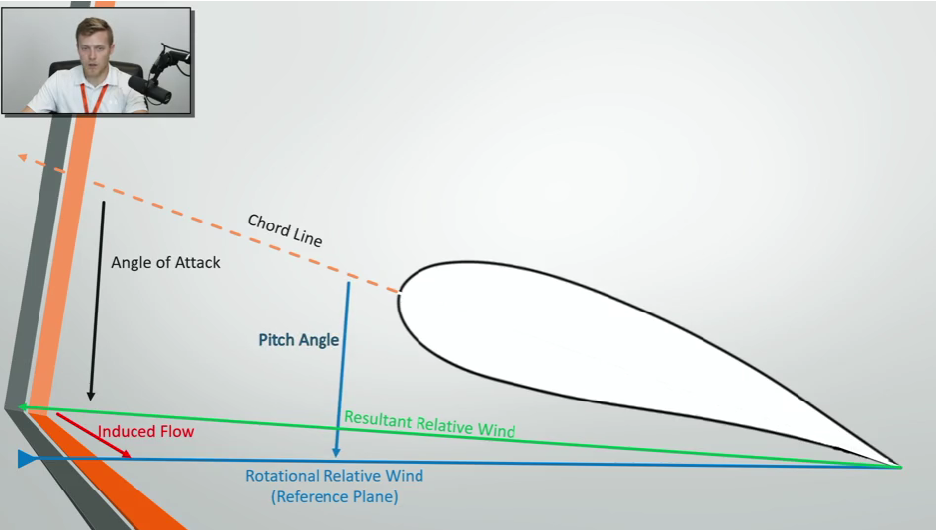
Airfoil diagram (for rotor)
label
How does power turbine governor communicate with FCU?
Air pressure through tubing
What is low-g mast bumping?
abrupt fwd cyclic that induces a roll to the right, followed by opposite pilot input
SAS
stability augmentation system
Hazard of exceeding fwd CG limits
Unable to slow down or flare
Role of flare in auto
1. Arrest descent
2. Slow down
3. Trade airspeed for RPMs
4. Build rotor RPM
What is the name of the force that causes helo to drift in the direction of TR thrust?
Translating tendency
Why does the generator load shown on the ammeter start high and gradually decrease after turning the generator on?
Charging the battery after the battery was used to start the engine