MACRO EXAM
 Call Kai
 Learn
Learn Practice Test
 Spaced Repetition
 Match
Match Flashcards
 Knowt Play
1/72

There's no tags or description
Looks like no tags are added yet.
Name | Mastery | Learn | Test | Matching | Spaced | Call with Kai |
|---|
No analytics yet
Send a link to your students to track their progress
73 Terms
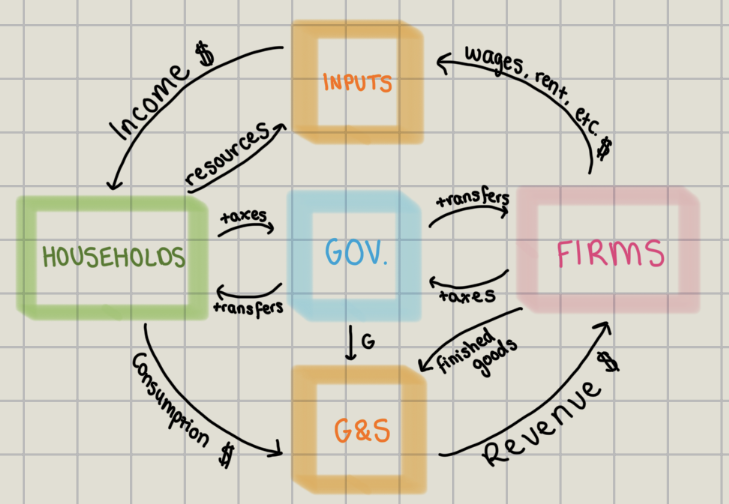
What does the 3 sector flow model depict? + describe the interactions
3 agents making decisions on the allocation of scarce resources through engaging in interactions with each other in two markets - inputs (factors of production) and outputs (G&S)
Describe recent global trends in GDP and inflation
GDP growth relatively positive worldwide post-IR, with 2 major dips being GFC of 08 and COVID-19
Inflation worldwide was relatively stable pre-COVID but then once lockdowns subsided, supply chains couldn’t return their production to keep up with bounced-back demand
What measure do we use to quantify the 3 sector flow model?
GDP - an aggregate measure of economic activity
What does GDP stand for/what do the letters represent?
Gross - doesn’t subtract depreciation
Domestic - within the bounds of a particular economy
Product - refers to the production approach of measuring GDP
What is NOT included in the measurement of GDP?
Anything that doesn’t have a market value (PxQ) - provides a common unit of measurement
E.g. - non-market activity (home production, black market economy), government production (defence, public health) (evaluated on cost, not price), purchasing of financial assets/non-G&S items
How are intermediary goods counted in the measurement of GDP?
Accounted for either by looking at the value of the final product (production approach) or summing the value added at each stage (expenditure approach)
What are the 3 methods of measuring GDP and their respective equations?
Production Approach: market value of all final G&S - PxQ
Expenditure Approach: sum of all domestic expenditures used to produce G&S - Y = C + I + G + (X-M)
Income Approach: sum all domestic income generated from said productive activity - Y = wL + rK
What are the limitations of using GDP as a measure?
1) leaves out non-market activity, doesn’t see value in things that don’t have market price
2) doesn’t account for depletion of natural resources & environmental degradation
3) GDP per capita doesn’t actually tell us (accurately) anything about income distribution and inequality
How is the relationship between real and nominal GDP defined mathematically?
the product rule
nominal gdp = real gdp x gdp deflator
where real gdp = quantity index and gdp deflator is the price index (aka inflation)
What’s the difference between the traditional and modern approaches to calculating real gdp?
traditional = base year approach, base year prices x changing year quantities, summed
modern = chain-weighted index, calculated as if the base year is the year before the target year, then multiplied by target year nominal gdp
What is the equation for the CPI?(/average cost of living per household)
CPI = Pt/P0 × 100
index component in base year should be 1
What are the costs of inflation?
1) indexing wages to keep up with inflation creates a wage-price spiral plus inflation expectations
2) bracket creep, despite having no real increase in purchasing power
3) increased costs incurred in volatile price changes for firms - “menu costs”
4) decision-making troubles, lack of fundamental G&S knowledge due to differing rises product per product
What are the measurement issues associated with inflation?
1) people may begin to substitute away from goods rising at a higher rate (away from goods in the CPI basket)
2) rising quality may mean that consumers are getting more for their money, CPI may be misleading
What does it mean to be “underemployed”?
either part-time workers (working < 35 hrs/week) available for more hours or full-time workers (working > 35 hrs/week) actually working part-time hours during survey week for “economic reasons”
What is the underutilisation rate?
the sum of unemployment and underemployment
What are the seperation and finding rates? (s and f)
s = E to U
f = U to E
When is unemployment in steady state in terms of s and f?
u = s/s+f or sE = fU
Is unemployment greater-ly caused by changes in s or f and why?
F because it requires more resources to find and train new workers (considering f is largely about increase or decrease in the hiring of new workers), and is more susceptible to changes in the business cycle - job vacancies is good leading indicator
What are the 4 main types of unemployment?
Frictional: job matching process
Structural: changes to the underlying structure of the economy - mismatch between skills demanded and supplied in the labour market
Cyclical: changes in the business cycle
Natural: the rate that occurs in a state of full employment (can only be estimated, all except cyclical)
Describe the broad trends in Australian unemployment, participation, underutilisation etc.
Unemployment - downward trend
Participation - upward trend
Underutilisation - upward trend but significant decrease since COVID
What is a recession?
Two consecutive quarters of negative real GDP growth
What is potential output? Y*
the amount of output produced when using resources at a normal rate (kinda like natural productive capacity)
What is the relationship between the unemployment gap, full employment, and the NAIRU?
Unemployment gap: actual unemployment u - natural rate u* = Cyclical unemployment
Full employment = state where cyclical unemployment = 0, natural rate in that state = NAIRU
Explain the two main theoretical approaches to business cycle theory
1) Classical - Say’s Law
states that supply creates its own demand, thrf an economy-wide lack of demand isn’t possible and AD policy is counterproductive
2) Modern - Keynesian Theorem
at macroeconomic level, Say’s theory does not hold
business cycles are driven by fluctuations in AD - can cause market failure
What is the key assumptions of Keynesian theory?
1) Prices are sticky - they don’t fully adjust in the short-run
2) Output can be demand-determined - through things like inflation expectations, animal spirits etc.
What is animal spirits?
Consumer and investor sentiment, not dependent on income aka exogenous
denoted by Cbar and Ibar
What happens on the Keynesian cross and in the economy when…PAE<AE, PAE > AE?
PAE < AE: demand below that of expectations/desired, unplanned inventory accumulation
PAE > AE: surprisingly high demand, inventory draw down
What does the Keynesian multiplier explain and how does it change when tax rate t is introduced?
equilibrium output Y changed by factor 1/1-c for every 1 unit change in Cbar, Ibar or Gbar (not Tbar which has -c coefficient)
the keynesian multiplier decreases when tax rate is introduced, becomes…1/(1-c)(1-t)
How does public savings (T-G) impact fiscal outcomes?
Positive public savings (T>G) = fiscal surplus
Negative public savings (T<G) = fiscal deficit
Explain the paradox of thrift
Being thrifty means planned autonomous consumption (Cbar) decreases, which causes a subsequent unit increase in planned exogenous private savings Sbar (two sides of the same coin) - aka shift up in S equation
+ decreased C = decreased Y short-run output in Keynesian function, paradoxically harms the overall economy
Globally, which countries have the highest government expenditure and revenues as a proportion of their GDP and why?
G - ageing population, generous welfare, high debt - Greece, Italy, France
T - above-average income tax rates, richness in natural resources (companies taxed highly) - Norway and Brazil
What are the categories/types of expenditure and sources of revenue in fiscal policy?
Expenditure involves 1) government purchases Gt, 2) transfers (taken to other side of budget equation and included in net taxes Tt), 3) interest payments on pre-existing debt iBt
Revenue = taxes.
What are the limitations of managing demand through fiscal policy?
1) Changes in taxes may distort incentives to work and/or invest (efficiency effects)
2) Deficit-financed government spending may push up interest rates and crowd out private firms from investing
3) There are lags in implementing policy - relevancy issues
Why are some countries allowed to accumulate SO MUCH debt?
Because borrowing is constrained by the present value of future primary fiscal surpluses (i.e. expectations of future G and T)
What are the RBA’s 3 current monetary policy goals?
1) Stability of the currency - inflation 2-3%
2) Maintenance of full employment - NAIRU 4.5%
3) Economic prosperity and welfare for Australians
What is the theorem that explains why we interpret the maintenance of full employment as employment at the natural rate?
The Natural Rate Hypothesis: in the long-run, the economy returns to Y* potential output, so we should aim for the corresponding rate of employment
BUT ALSO, attempts to push u below u* has been found to accelerate inflation without lowering unemployment. This is due to long-run MONEY NEUTRALITY, which describes that increasing the money supply doesn’t allow for growth in real terms, doesn’t change what is scarce or abundant or increase living standards
What is the quantity theory of money?
Assumes…
1) long-run money neutrality (Y=Y*)
2) velocity of money (rate at which money circulates through an economy) is constant
3) the supply of money is controlled by the central bank
What are the limitations of the quantity theory of money?
1) doesn’t say anything about the short-run (impacts of MP)
2) in reality, Vt is not constant (largely due to technological advancements)
3) in reality, banks have control over a narrow measure of money supply
What are the implications of long-run money neutrality and short-run non-neutrality on other parameters?
LRMN means that monetary policy shouldn’t impact Y* and u*, aka there is no supply side changes in economic activity
SRMN-N means that MP should impact the output gap and cyclical unemployment
What is Okun’s Law?
a model that describes the negative relationship between the output gap and cyclical unemployment (unemployment gap)
In the AD AS model, how do the AD and AS curves show the relationship between inflation pi and output Y?
AD: 1) rel b/n Y and r (Goods Market Equation) and 2) rel b/n r and pi (Monetary Policy Reaction Function)
AS: 1) rel b/n Y and u (Okun’s Law) and 2) rel b/n u and pi (Phillip’s Curve)
How does the AD AS model differ between the short-run and the long-run?
In the long run:
demand and supply shocks (denoted by epsilon d and epsilon s) aka changes in exogenous parameters ‘A’, = 0
inflation expectations pi^e are consistent = pi
Y = Y* and pi = pi*
Why do inflation expectations remain anchored in the short run?
Because consumers implicitly assume that the central bank is credible and therefore they will retain long-run beliefs
Explain the key differences between demand and supply shocks
That they drive output and inflation differently

What are the slopes of the AD and AS curves?
AD (when rearranging equation for pi on the LHS) = -1/axgamma
AS = fixbeta
What is the impact of changing the parameter values in the slopes of the AD and AS curves?
AD: When a or gamma increase, greater change will be in output than inflation
AS: When fi or beta increase, greater shock will be absorbed by inflation than output
What are some key motives for private saving?
1) life-cycle saving (against predictable events), 2) precautionary saving (against unpredictable events), 3) bequests (saving for the next generation)
Explain how “today’s savings is tomorrow’s capital”
St is converted into Kt+1 to have productive capacity (change from t to t+1 due to it being a stock variable measured at a point in time rather than a flow variable measured over a period like all the Keynesian parameters), which is then converted to Yt+1
What does an aggregate production function describe?
Models how an economy produces and its long-run changes in growth. Economy-wide output Yt (real GDP) is a function of inputs (alllll commodities), particularly K capital, L labour, and A total factor productivity. It represents long-run AS.
What are the 3 important properties of the Cobb Douglas Production Function?
1) Positive marginal product → additional contributions of capital and labour are ALWAYS positive - partial derivative of K and L with respect to Y are always > 0 (use lowercase delta)
2) Diminishing returns to each input → each additional K or L brings a lower marginal benefit than the last (declining rate of marginal product) - 2nd partial derivative is always < 0
3) Constant returns to scale → no diminishing returns when you scale all 3 by the same amount, i.e. A(xK)^a(xL)^1-a = xY
What are the two ways that labour productivity/output per worker increases?
A) increase in capital per worker/capital intensity which are movements in the CDPF
B) increase in total factor productivity A which shifts the CDPF
In the effective worker edition of the Solow Swan model, what does it mean when the investment curve is above depreciation, and below depreciation?
i > delta = capital per effective worker is increasing (ie capital accumulation > 0), and i < delta = capital per effective worker is decreasing
What does it mean that Solow Swan predicts conditional convergence?
It’s conditional on the respective parameters of each country (s, delta, ga, gL), therefore the same parameters would mean the same long-run output per worker - doesn’t predict that there would be the same output per worker regardless of parameters
What is the difference between absolute and comparative advantage?
Absolute: who can produce more of one good on its own with the same amount of inputs
Comparative: when a country can produce a good at a lower opportunity cost than any other good
What is autarky?
When all countries are forced to produce all goods
How do you define relative prices and what must this value be for trade to occur between two countries?
Relative price = P1/P2 and i must be between the opportunity costs of the two countries producing that good for trade to occur
What are Australia’s main imports and exports?
Exports: resources (e.g. natural gas), services (e.g. education), and rural/manufacturing
Imports: services, consumption (e.g. oil), and intermediary capital
In what scenario of comparison between world price and autarky price (taken as given) does a country decide to import and export?
Pw < pa = import (consumers win)
Pw > pa = export (producers win)
What is consumer surplus?
The difference between the price a consumer pays and the max they were willing to pay?
What is producer surplus?
The difference between the price a producer receives and the minimum they were willing to operate at
What’s the difference between a direct quote and indirect quote? (exchange rates)
Direct quote = how much domestic currency is needed to buy 1 unit of said foreign currency
Indirect quote = how much foreign currency is needed to buy 1 unit of domestic
What is the law of one price?
LOOP explains that in the long-run, quantity (q) > 1 should always revert back to 1 because (assuming transport costs are negligible) internationally-traded goods should sell for the same price in all markets
What is purchasing power parity (PPP)?
Applies the law of one price across the entire consumption basket for two countries, claiming that the exchange rate equilibrium should thrf occur where purchasing power is the same in both countries (for an absolute CPI, P, not pi)
How do you determine whether a currency is overvalued or undervalued?
Undervalued if the Epeg(/fixed rate) < E(free market fundamentals)
Overvalued if Epeg > Efun
Explain how a central bank uses international reserves to support a fixed exchange rate system
To maintain the peg (if over or under valued), the central bank must be willing and able to buy/sell its currency to meet excess demand or supply, through its holdings on other currencies, called INTERNATIONAL RESERVES
if undervalued, excess demand for currency, CB sells its currency, increasing their reserves
if overvalued, excess supply (Aussies demanding stronger currency), CB must buy back, depleting IRs
What is the main risk of using international reserves to help with pegs?
A CB cannot maintain an overvalued ER in the long-run because it depletes reserves, causing a devaluation of the currency, which can cause speculative attacks
Speculative attacks: a massive selling of domestic currency assets
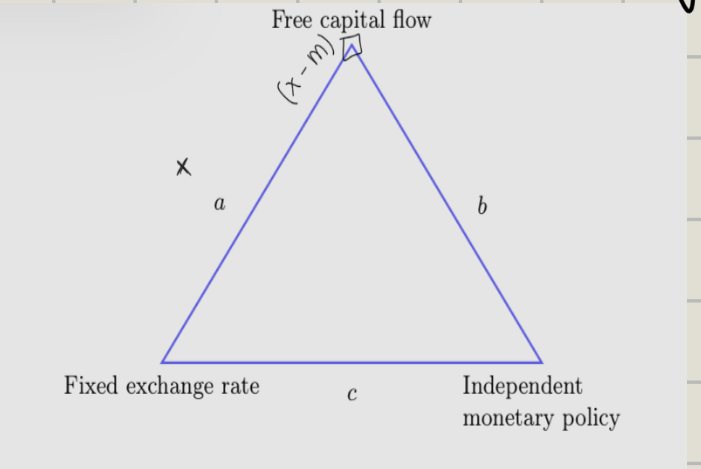
What is the policy trilemma?
A theory that explains that you can only choose to pursue 2/3 of a listed monetary policy and exchange rate goals simultaneously
What does the current account comprise of?
1) the trade balance (X-M)
2) net foreign income (capital and labour income, not buying or selling of an asset)
3) net foreign transfers (aid)
Explain the relationship between savings, investment, and the trade balance
Economists believe that trade deficits arise from macroeconomic policy that make domestic savings less than investment. Through algebra, trade balance (X-M) = total savings (S + (T - G)) - investment (I), so M > X = I > S + (T - G)
How do you calculate the external position of an economy?
By summing net capital flows within the CA and CAFA
whereby Net Foreign Liabilities = gross foreign liabilities - gross foreign assets
What are the pessimistic and optimistic views of current account deficits?
pessimistic: CA deficit is bad because we have low savings and/or are relying on foreign investors, debt burden will grow, and consumption will inevitably fall
optimistic (common): CAFA surplus is good because it means our economy is a good place to invest in, receiving large flows of savings from low-growth countries
What are the 3 determinants of net capital flows?
1) real return on domestic assets (real interest rate ‘r’)
2) real return on foreign assets (overseas real interest rate ‘r^f’)
3) international risk premia → needed for risk averse investors to compensate for country specific risk
Briefly explain the Eurozone sovreign debt crisis
The Eurozone sovereign debt crisis was a major financial crisis that began in late 2009. It occurred when several European countries could no longer pay off or refinance their government (sovereign) debt, threatening the stability of the entire Eurozone (euro est. in 1999). When the global financial crisis hit in 07/08, governments were left with massive amounts of debt they couldn't afford to pay back. They were shut out of international bond markets and had to partake in bailout programs.