Interference
 Call Kai
 Learn
Learn Practice Test
 Spaced Repetition
 Match
Match Flashcards
 Knowt Play
1/24

There's no tags or description
Looks like no tags are added yet.
Name | Mastery | Learn | Test | Matching | Spaced | Call with Kai |
|---|
No analytics yet
Send a link to your students to track their progress
25 Terms
Briefly describe what interference is
CRISPR is transcribed into crRNA that forms an interference effector complex that base pairs with complementary MGE DNA - each crRNA is from one spacer DNA. The interference complex activates cutting of MGE DNA leading to its nucleolytic destruction.
Why do R-loops cause instability?
R-loops expose ssDNA and stalls replication forks, causing breaks and recombination.
Draw cascade CRISPR locus
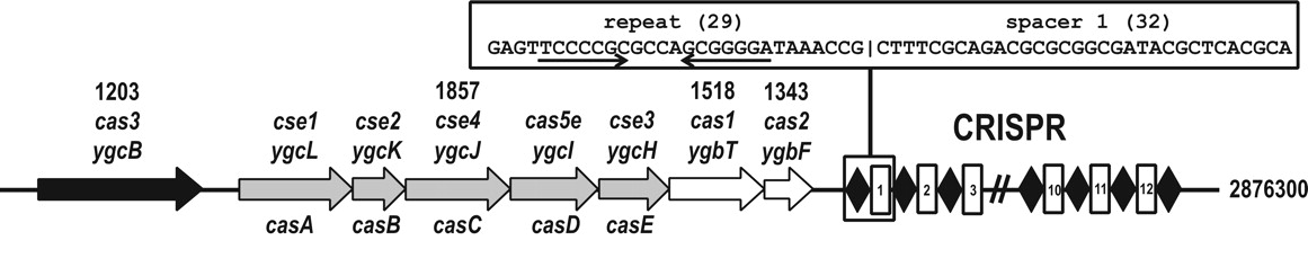
What special feature does Cas3 have that acts as a gate?
Tryptophan-406 acts as a physical structural "gate" or valve. It sits in the channel between the helicase and nuclease domains, and shifts position to control whether single-stranded DNA can access the nuclease cutting site.
Mutation (W406A): Removing this gate creates a hyperactive shredder that destroys DNA much faster.
Does Cas9 make a PAC?
Like Cascade, Cas9 forms a multi‑protein adaptation complex with Cas1–Cas2 and Csn2. This complex captures, protects, and sizes prespacer DNA fragments, ensuring only DNA of the correct length is integrated into the CRISPR array.
Explain how R-loop is made in class 1 interference
5’ ATG PAM is recognised in double strand form in the minor grove of cascade by CasA base-specific hydrogen bonds and shape read out, causing local DNA bending and destabilisation.
Glutamine wedge in CasA forces DNA apart, exposing the target strand, crRNA binds.
Glycine loop stabilises the RNA-DNA hybrid and the lysine finger holds them apart so they don’t re-anneal.
Explain how R-loop is made in class 2 interference
Cas9 opens DNA using REC lobe and WED domain facilitates the physical separation of the target DNA strands, crRNA binds to the seed reigon.
Target strand pairs with crRNA.
Non-target strand is guided to the RuvC domain.
HNH and RuvC become active and nuclease activity occurs.
What is the model organism for class 1 CRISPR systems?
E.coli
What are features of class 1 CRISPR systems?
multi-protein effector complexes
require a separate nuclease (Cas3)
most common in bacteria and archaea (~90%)
What is the structure and name of cascade?
CasA(1), CasB (2), CasC (6), CasD (1), CasE (1) + crRNA
CRISPR-associated complex for anti-viral defence
What are each component of cascade for?
CasA - landing pad for PAM recognition, this is located on the very end of cascade in a highly solvently exposed position.
CasB (1&2) - give general shape to cascade
CasC (1-6) - acts as a backbone for the R-loop that delivers crRNA to DNA and prevent DNA from snapping back.
CasD
CasE - ribonuclease that processes pre-crRNA into crRNA by cutting at hairpins.
What is the R-loop, how does it work, what’s its limitation in therapeutics?
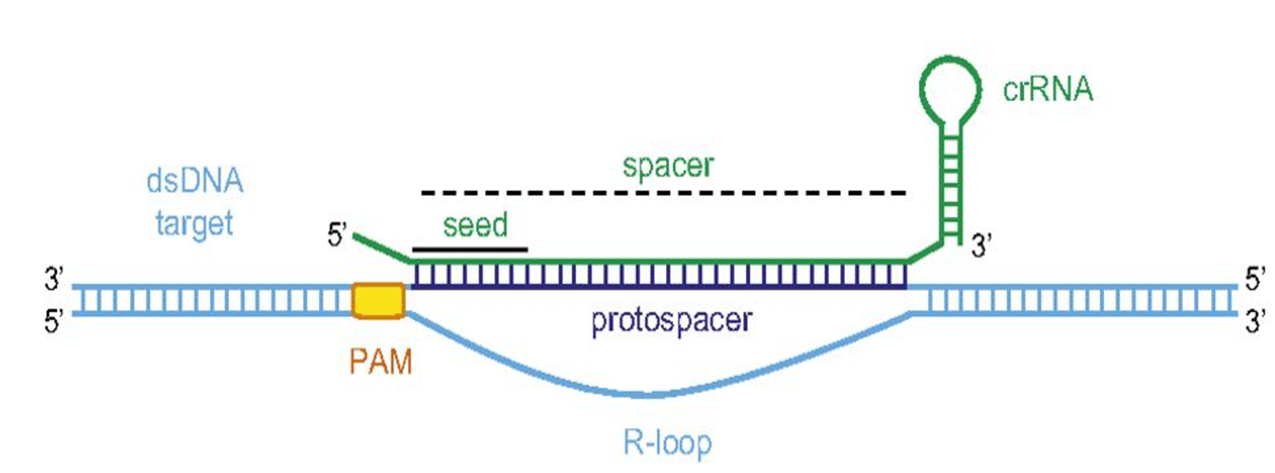
R-loops are RNA-DNA base pair hybrid that forms a lop of displaced ssDNA. Cascade/Cas9 targets MGE DNA by making a R-loop duplex with DNA complementary to crRNA. One DNA strand makes a loop, while the other pairs with crRNA. R-loops act as a roadblock in viral replication, and cause catastrophic genome instability.
R-loops have a half life of ~20 hours, this is a drawback for Cas9 editing as it causes genome instability, so is not common in therapeutics.
What are the elements of an R-loop?
Draw an R-loop structure.
Protospacer = captured viral DNA
PAM = protospacer adjacent motif, a trinucleotide sequence that acts as a sampling point to spot that cascade is int he correct place, as a result cascade only targets invader DNA. Acts as a first checkpoint.
dsDNA target
crRNA
R-loop
Seed = when PAM has been found, it tries to pair crRNA with protospacer, if there is a match in the seed region (6/7 nts), energetic lock R-loop in place as it is energetically favourable.
How does CasA in cascade recognise PAM?
The 5’-ATG PAM is recognised in the double stranded form, in the minor grove side of cascade by CasA. Done by base-specific hydrogen bonds, and shape read-out
How does PAM prevent autoimmunity?
PAM sequences prevent self-targeting because Cas effector complexes only initiate interference on DNA containing a correct protospacer-adjacent motif, which is absent from the host CRISPR locus. During interference, proteins such as Cascade or Cas9 scan for a PAM to initiate seed-region binding and R-loop formation; without a PAM, the DNA cannot unwind or be cleaved, and Cas4 processing ensures PAM sequences are removed during spacer integration to maintain self/non-self discrimination.
Explain what Cas3 is and how it carries out nuclease activity in class 1 CRISPR systems?
Cas3 is the class 1 CRISPR interference nuclease, it is a ss-DNA nuclease and an Superamily 2 ATP dependent helicase in the CRISPR/Cas immune system.
Cas3 is loaded by CasA on ssDNA in the R-loop, and carries out nuclease activity within its HD nuclease domain.
Both H (histidine) and D (aspartic acid) residues have active sites in nuclease domain, they co-ordinate a metal ion such as Mg2+ or Mn 2+ for nucleophilic attach by H2O on the phosphodiester backbone and catalyse bond cleavage.
After, helicase domain engages and translocates 3’ to 5’ (ATP dependent), unwinding the helix - processive degeneration.
Does Cas3 ride with cascade or find cascade later on? what evidence is there?
Hochstrasser et al. (2014) showed that Cas3 is recruited to Cascade only after CasA/Cse1 recognises the correct PAM.
What are key features and 3 different class 2 interference complexes?
Class3 interference complexes have a single protein complex, the main ones include Cas9 (type II) which makes a clean dsDNA break, Cas12 (type V) which makes a sticky end dsDNA break, and Cas13 (type VI) which makes a ssRNA break and is naturally much less common.
What is tracrRNA?
a small, non-coding RNA molecule that acts as a vital structural component of the CRISPR-Cas9 immune system. It binds to the crRNA (CRISPR RNA) to form a functional guide RNA, serving as the scaffold that locks the Cas9 protein into place to find and cut specific DNA sequence. It has 2 functions:
cutting pre-crRNA at hairpins into crRNA comprising a single spacer uding RNase III
activation of Cas9 apo-enzyme to become an active nuclease.
What evidence is there that demonstrates tracrRNA is needed in Cas9?
Jinek et al used cyro-EM analysis that showed apo-Cas9 is auto-inhibited as a nuclease, and the binding of tracrRNA opens it up to make DNA binding surfaces and a channel to become active.
Deltcheva et al 2011 revealed that tracrRNA directs the maturation of crRNA’s by the activities of the widely conserved host derived RNase III.
What is Cas9?
Cas9 is a single polypeptide with 2 active site nuclease domains, one is RuvC and one is HNH, both cut DNA and are exactly opposite one another making a clean dsDNA break.
How is nuclease activity carried out in Cas9?
RuvC is made of 3 segments (RuvC-I to RuvC-III) with a-helical lobes between. It cuts one DNA strand based on Asp residues and works via two metal ions.
HNH cuts the other strand, and has a one metal active site.
What is the PAM rich in in Cas9 systems? How is the PAM detected in Cas9?
PAM is rich in G, usually NGG
PAM-interacting domain has amino acid residues that ‘read’ the hydrogen bonding code - similar principle to class 1.
Briefly describe Cas12 and Cas13
Cas12 is a single polypeptide that associates with itself, however it does not use tracrRNA, and does process crRNA unlike Cas9. It creates a staggered cleavage.
Cas13 is a single polypeptide and the most diverse group in class 2 interference systems as they target primitive and highly diverse RNA viruses, all have RNase active sites called HEPN (higher eukaryote and prokaryote nucleotide binding) and their PAM is called PFS (protospacer flaking sites.
What are key common themes in interference enzymes both in class 1 and 2?
They multitask through multiple domains/subunits, illustrating the evolution of protiens.
Each use nuclease active sites in each case placed in a different modular context.
They each use some kind of recognition (PAM/PFS) sequence, asserting a strong pressure to avoid self-targeting that could harm the cell.
Each targets nucleic acid as an immune effector rather than anything else e.g. protein/lipids. This stops the virus at the source of replication.