Science 1.1

0.0(0)
Studied by 0 people
call kaiCall Kai
learnLearn
examPractice Test
spaced repetitionSpaced Repetition
heart puzzleMatch
flashcardsFlashcards
GameKnowt Play
Card Sorting

1/19

encourage image

There's no tags or description

Looks like no tags are added yet.

Last updated 4:12 AM on 6/5/26
Name
Mastery
Learn
Test
Matching
Spaced
Call with Kai

No analytics yet

Send a link to your students to track their progress

20 Terms

1
New cards

What Does dna stand for

 Deoxyribonucleic acid  is the carrier of genetic information

Deoxy – Means without oxygen

Ribose- A type of sugar

Nucleic Acid- A compound  of  carbon, hydrogen, oxygen, nitrogen & phosphate

2
New cards

Whats the purpose of DNA


Carries instruction to make all parts of cells and instructions to prommage how it works

3
New cards

WHere is DNA located and whats the DNA Molecule cstructure


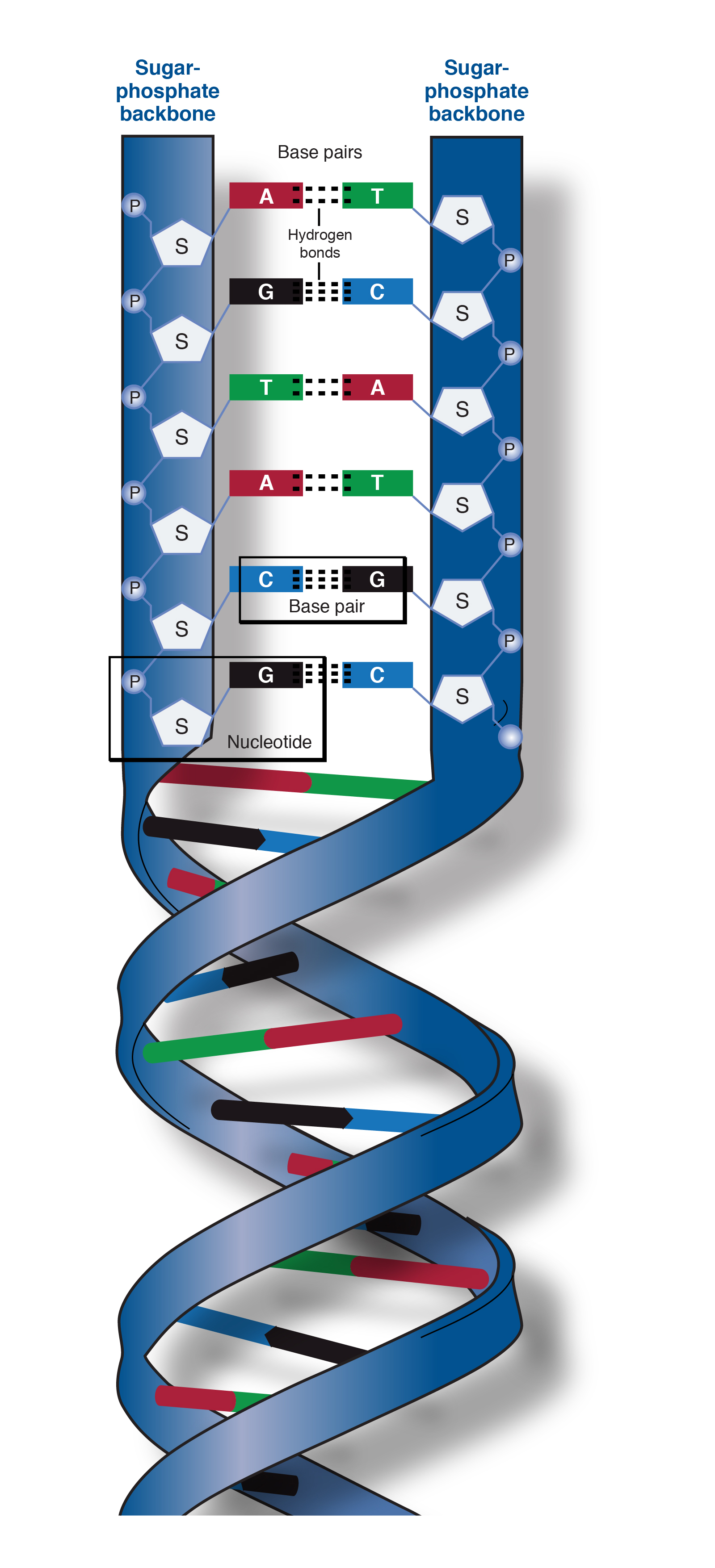
Dna located in the nucleus of cells . It shaped ladder is called a double helix .
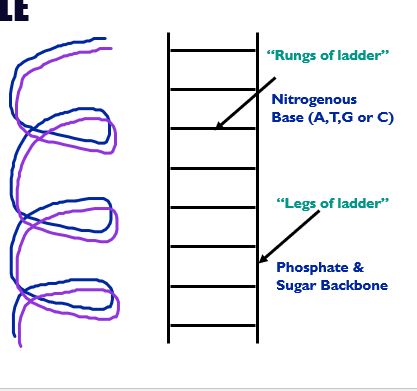
<p>&nbsp;</p><p>Dna located in the nucleus of cells . It shaped ladder is called a double helix .</p><p></p>
4
New cards

WHats the side of the ladder of dna called and its units

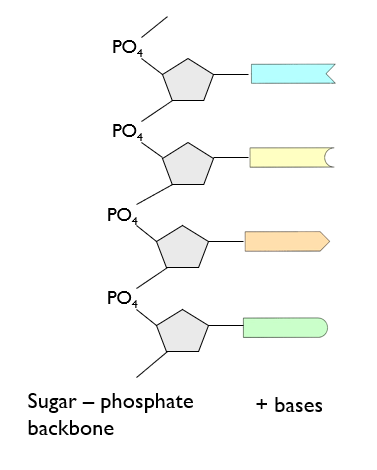
  • It’s made of alternating sugar (deoxyribose) and phosphate groups.

  • These units are linked by strong covalent bonds, forming a long, stable chain.

  • The backbone runs along the outside of the DNA double helix.

  • The nitrogenous bases (A, T, C, G) attach to the sugars and point inward.

<ul><li><p>It’s made of <strong>alternating sugar (deoxyribose) and phosphate groups</strong>.</p></li><li><p>These units are linked by <strong>strong covalent bonds</strong>, forming a long, stable chain.</p></li><li><p>The backbone runs along the <strong>outside</strong> of the DNA double helix.</p></li><li><p>The <strong>nitrogenous bases</strong> (A, T, C, G) attach to the sugars and point inward.</p></li></ul><p></p>
5
New cards

WHats a nucloetide

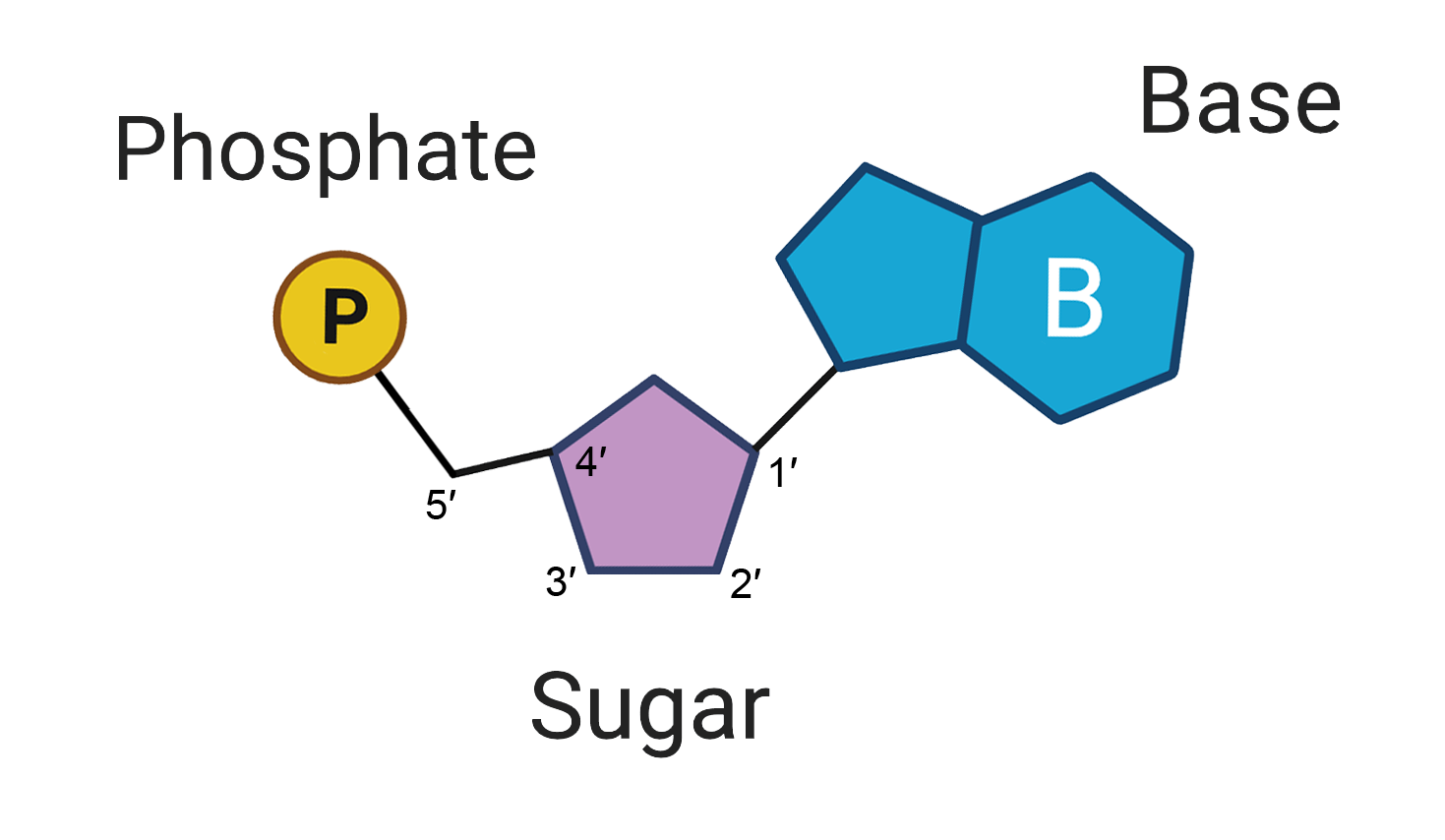
In DNA, the nucleotides are the individual building blocks that make up each strand. Each nucleotide has three parts:

  • A phosphate group

  • A sugar (deoxyribose)

  • One nitrogenous base:

<p></p><p>In DNA, the <strong>nucleotides</strong> are the individual building blocks that make up each strand. Each nucleotide has three parts:</p><ul><li><p><strong>A phosphate group</strong></p></li><li><p><strong>A sugar (deoxyribose)</strong></p></li><li><p><strong>One nitrogenous base</strong>:</p><p></p></li></ul><p></p>
6
New cards

What types of chemical bonds hold the DNA double helix together, and why are they important?

  • Covalent bonds hold sugar‑phosphate backbone of each DNA strand.

  • These bonds are strong, keeping the DNA strands stable during replication and protein synthesis.

  • Hydrogen bonds connect the nitrogenous bases (A–T and C–G) in the center of the helix.

  • bonds weaker, allowing the two strands to separate so the genetic code can be accessed.

<ul><li><p><strong>Covalent bonds</strong> hold sugar‑phosphate backbone of each DNA strand.</p></li><li><p>These bonds are <strong>strong</strong>, keeping the DNA strands stable during replication and protein synthesis.</p></li><li><p><strong>Hydrogen bonds</strong> connect the nitrogenous bases (A–T and C–G) in the center of the helix.</p></li><li><p>bonds  <strong>weaker</strong>, allowing the two strands to separate so the genetic code can be accessed.</p></li></ul><p></p>
7
New cards

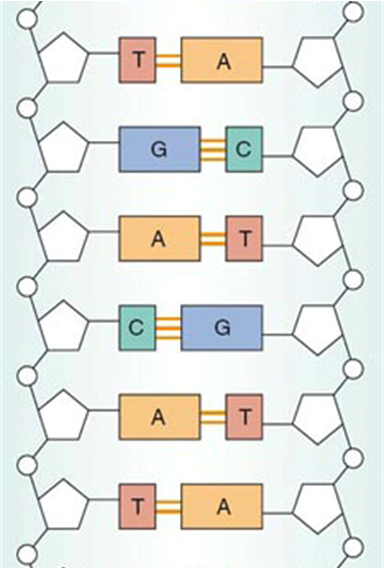
Whats the complementary base pairing rule and what holds these bases together

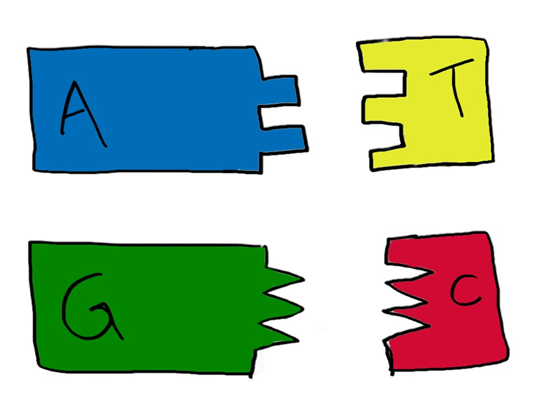
Adenine always pairs with Thymine (A – T)

Guanine always pairs with cytosine (G – C)

The bases are held together by weak hydrogen bonds.

<p><span><span>Adenine always pairs with </span></span><span style="background-color: yellow;"><span>Thymine</span></span><span><span> (A – T)</span></span></p><p><span><span>Guanine always pairs with cytosine (G – C)</span></span></p><p>The bases are held together by <span style="background-color: lime;"><span>weak hydrogen bonds.</span></span></p>
8
New cards

HOw many nitrogenous bases in DNA

4 nitrogenous base  (adenine , thymine , guanine ,  and cytosine) . 

9
New cards

polynucleotide vs nucleic acid

Poly nucleotide - chain of nucleotides joined together , a long polynucleotide is nucleic acid

<p>Poly nucleotide - chain of nucleotides joined together , a long polynucleotide is nucleic acid</p>
10
New cards

Whats DNA molecule

  • Two long strands of dna molecule made of nucleotides bonded together . Each nitrogenous base is connected to weak hydrogen bonds that form complimentary bases

11
New cards

QUiz what has tripple hydrogen bond

knowt flashcard image
12
New cards

WHats a gene and how does it work

It’s a section of dna that  is a basic functonal unit of heredity ..

traits are passed down from parent to offspring .

Every human has two copies of each gene from both parents

13
New cards

Some genes code for protein ( basic bulidng blocks for bodies ) , how does protein help

  • Repair and make new tissues

  • Make much of skin , hair muscle, bone

  • Make chemical messenger systems of hormones, blood and antibodies

Other genes code for a variety of molecules with different functions

14
New cards

WHat can genes do

Determine Genotype: Genetic code for a specific gene/ genes

--> Your genes make up you Genotype

Genome: : Your genes can also  determine  your genome  ( an organisim entire sequence of DNA ( like a set) 

15
New cards

Whats a alleles


Variations of genes that control the same trait is called alleles one of two or more alternative versions of a gene located at a specific position (locus) on a chromosom ( a variation of genes) .
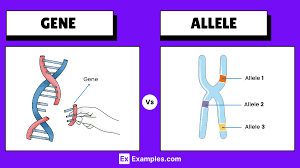
 

<p>&nbsp;</p><p>Variations of genes that control the same trait is called<span style="background-color: lime;"> alleles </span><span>one of two or more alternative versions of a gene located at a specific position (locus) on a chromosom</span><span style="background-color: lime;"> ( a variation of genes) .</span></p><p>&nbsp;</p>
16
New cards

How is genes expressed

Phenotype ; Genes are expressed through your phenotype ( how the genotype is physically expressed like eye colour  and blood type etc)
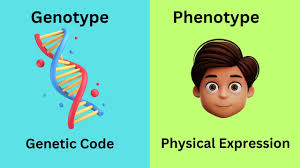
<p>Phenotype ; Genes are expressed through your phenotype ( how the genotype is physically expressed like eye colour<span><span>&nbsp; </span></span>and blood type etc)</p>
17
New cards

chromosome

.chromosomes  At various stage ( before cell division) It becomes tightly coiled and becomes visible  . The packed DNA is called chromosome that pass infro from parents to offspring )

they wrap dna with the double helix

18
New cards

How are chromosomes made

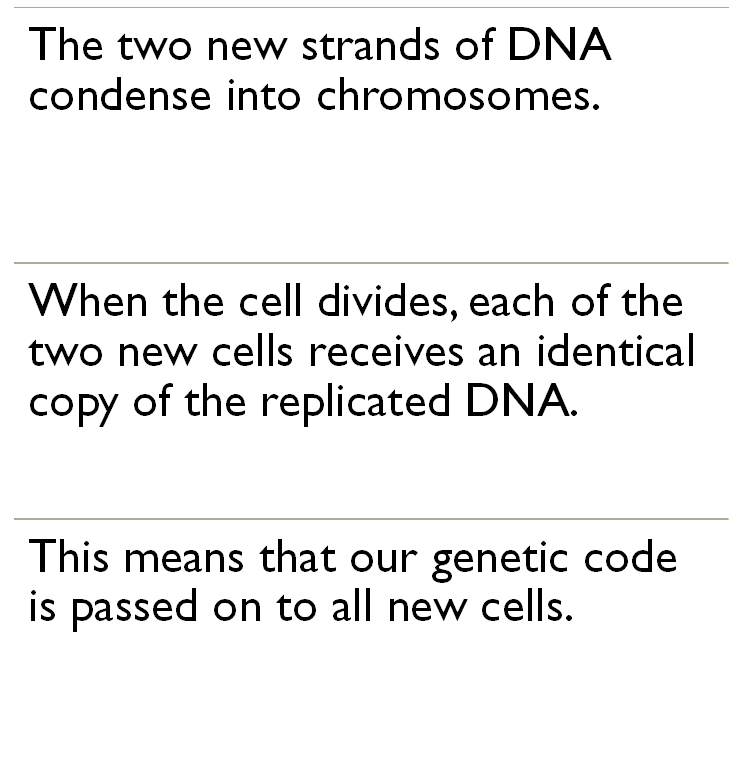
 Chromosomes form when DNA coils up and becomes visible

This happens just before the cell divides.
<p>&nbsp;<span style="font-family: &quot;Gill Sans MT&quot;;">Chromosomes form when DNA coils up and becomes visible</span></p><p style="text-align: left;"><span style="font-family: &quot;Gill Sans MT&quot;;">This happens just before the cell divides.</span></p>
19
New cards

Pair of crhomosomes

Humans normally have 23 pairs of chromosomes ( 46 in total )

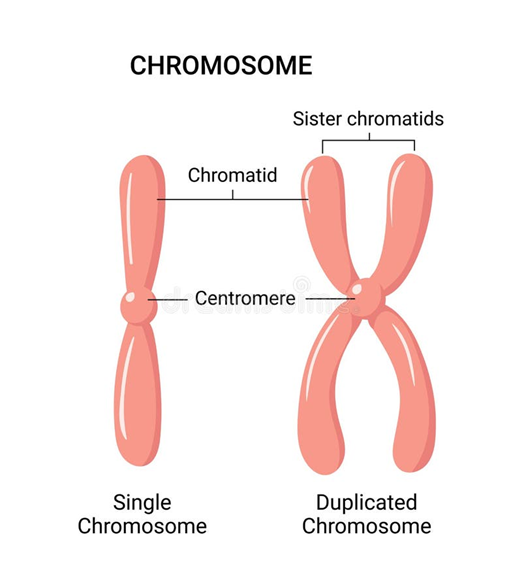
Each chromosome is made of two identitical chromatids

20
New cards

Chrmosome vs chromostide

  • Each chromosome is made up of identical chromatids.

  • The two chromatids are joined so they have long and short arms.
<ul><li><p><span style="font-family: &quot;Gill Sans MT&quot;;"><span>Each chromosome is made up of identical chromatids.</span></span></p></li><li><p><span style="font-family: &quot;Gill Sans MT&quot;;"><span>The two chromatids are joined so they have long and short arms.</span></span></p></li></ul><p></p>