Physiology of trauma and healing
 Call Kai
 Learn
Learn Practice Test
 Spaced Repetition
 Match
Match Flashcards
 Knowt Play
1/43

There's no tags or description
Looks like no tags are added yet.
Name | Mastery | Learn | Test | Matching | Spaced | Call with Kai |
|---|
No analytics yet
Send a link to your students to track their progress
44 Terms
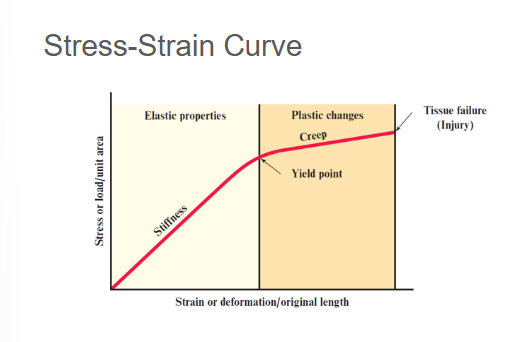
What do these terms mean when it comes to tissue properties?
Load
Stiffness
Stress
Strain
Load
An external force acting on the body causing internal reactions within the tissues
Stiffness
Ability of a tissue to resist a load
Greater stiffness = greater magnitude of load it can withstand
Stress
Internal resistance of tissue to a load
Strain
Extent of deformation of tissue when it is loaded
What does elasticity allow for in human tissue? What is the yield point?
Allows tissues to return to normal length following deformation
Tissue is deformed to an extent that it no longer reacts elastically
Beyond yield point, deformation continues even after load is removed
Permanent/plastic changes to tissue
If yield point is exceeded, mechanical failure occurs resulting in damage to the tissue
What do the following terms mean?
Compression
Tension
Shear
Compression
A load that produces a crushing or squeezing type force
Tension
Force in the opposite direction, pulling or stretching the tissues
Shear
Equal but not directly opposite loads are applied to opposing surfaces
Tends to cause sliding or displacement
Traumatic/Acute vs Overuse/Chronic injuries?
Traumatic/Acute
Direct blow or an event that initiates the injury process
E.G
Contusion
Ligament sprain
Muscle strain
Bone fracture
Joint dislocation
Overuse/Chronic
Injury doesn’t heal properly and often results from repetitive dynamic use over time (Running, jumping, throwing, etc.)
E.G
Tendinopathies
Osteoarthritis
Stress fracture
Muscle soreness
What are the different kinds of musculotendinous unit injuries?
Muscle strains
Muscle soreness
Tendon Injuries
Myofascial trigger points
Contusions
What are muscle strains? What do each of the grades mean?
Stretch or tear of a muscle or tendon
MOI: Tension force
Most common site for tears is near the musculotendinous junction
Graded on a 3-point scale
Grade 1 - Mild
Pain
Full ROM
No decrease in strength
Grade 2 - Moderate
~50% torn
Pain, swelling
Grade 3 - Severe
Completely torn
Significant pain and swelling
No AROM or strength
What is Muscle Soreness? What are the 2 types?
Overextension in strenuous exercise resulting in muscular pain
Generally occurs following participation in an activity individual is unaccustomed to
2 Types
Acute-Onset Muscle Soreness
Accompanied by fatigue, transient pain, experienced immediately after exercise
Delayed-Onset Muscle Soreness
Pain that occurs 24-48hrs following activity that gradually subsides
Potentially caused by slight microtrauma or connective tissue structures
Prevent soreness through gradual build-up of intensity
What are some key points about tendon injuries?
Parallel collagenous fibers organized in bundles
Can produce 8700 to 18000 pounds per square inch → very strong
Collagen straightens during loading but will return to original shape after loading
Breaking point occurs at 6-8% of increased length
Tendon usually 2x strength of muscle it serves
T/F Tears are commonly at muscle belly, musculotendinous junction, or bony attachment
Chronic overuse injuries involving tendons represent 50% of all sports injuries
What does tendinopathy mean?
Umbrella term for pathology of the tendon
Refers to pathological condition with pain and thickening of the tendon
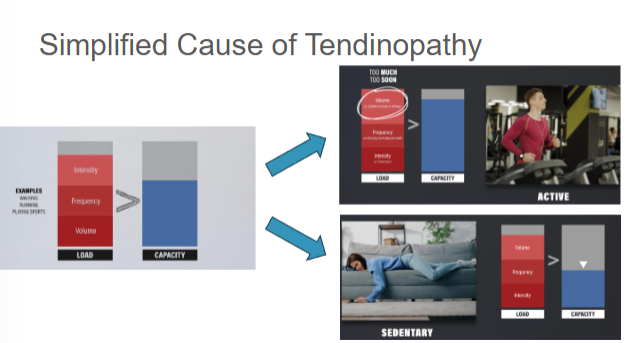
Onset and continued pain are a result of changes in typical loading patterns, inappropriate loading volume or frequency
Most common at Patellar tendon, Achilles tendon, Rotator cuff, or lateral epicondyle
Can refer Tendinitis or Tendinosis
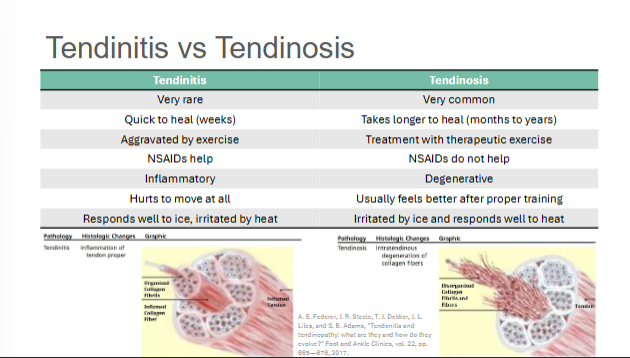
Tendinitis = inflammation of tendon
Tendinosis = microtears or degeneration of tendon
What is tendinitis? How long does it take to heal and what are the treatments?
Presence of acute inflammatory cells and proteins
Pain, swelling, redness, warmth
Pathology of youth (<30 years)
Primarily affects younger people
Pain with resisted mm. Testing for young patients indicates tendinitis - NOT tendinosis
Should resolve w/in 6 weeks
Crepitus
Sticking of the tendon due to the accumulation of inflammatory by-products on irritated tissue
Treatment = Rest
Eliminate repetitive motion causing irritation
Substitute activity to maintain fitness
What is Tendinosis? How long does it take to heal and what are the treatments??
Gradual, progressive, degenerative changes affecting the tendon
Increased apoptosis (process of programmed cell death)
Low pro-inflammatory markers
Source of pain is unclear d/t lack of inflammation
Tendon will be thick d/t poor tissue healing → can progress to partial tear
Takes 3 months - 1 year to resolve, often with lots of recurrence
Limited role for NSAIDs d/t no inflammation
NSAID = Non-steroidal anti-inflammatory drug
Best managed through eccentric loading
Physiological effect at the cell level that allows for regeneration of the tendon/cellular turnover
What is the difference between Tendinitis and Tendinosis
Why is Tendinosis not an appropriate term in many cases, like Achilles Tendinopathy?
Docking et al. in 2021 found that the prevalence of Achilles tendon abnormalities in people without symptoms ranged from 0 to 80% Study by Lieberthal et al. in 2019 concluded a high prevalence of tendon pathology (46%) in an asymptomatic male running population with no history of Achilles tendon pain
What is the simplified cause of Tendinopathy? What are the Goals in rehabbing it?
Understanding and monitoring pain
Load management and activity modifications
Understand rehab stages
What is it important to ask yourself when monitoring pain?
Ask yourself:
Is your pain tolerable during exercise?
try to keep it <5/10
Is my pain better, worse or the same after exercise?
Tendinopathy is often subject to the warm-up effect, t/f pain feels better after exercise
Is my pain better, worse or the same the day after exercise?
If you are significantly worse the next day, back off the intensity
What should you avoid when going through physical rehab? What should you instead focus on?
Mistakes include doing too little (fear of pain) and doing too much (pushing through the pain)
Instead, focus on function, not pain
Work towards a physical goal
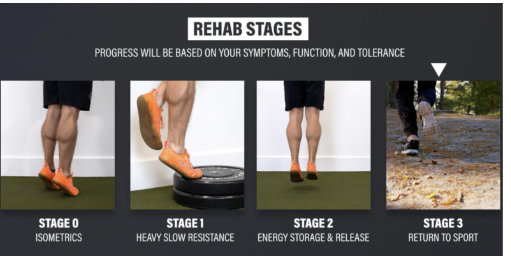
What are the different stages of rehab?
Stage 0 - Anyone can do this exercise with minimal symptoms
Stage 1 - Heavy, slow exercise that biases eccentric activity
Stage 2 - Plyometrics, explosive activity
Stage 3 - Return to sport
What is Achilles tendinopathy? What are the treatments
Definition: Achilles tendinopathy = persistent Achilles tendon pain and loss of function due to mechanical loading
Not inflammation-driven - Ice and complete rest are not the main rehab strategies
Not degeneration-focused - Interventions should not aim to change tendon structure
Cause - Occurs when tendon loading exceeds recovery and adaptation capacity
Rehab goal: Balance load and capacity so the tendon can tolerate daily and weekly demands. Avoid Boom-bust cycles
Early strategy: Avoid too much too soon and find a goldilocks zone that keeps symptoms manageable
Exercise program: Commit to at least 3+ months of progressive exercises to restore function and tolerance
Adjunct treatments: Pain relief options can help, but should not be the main focus, especially if costly or risky
Key to success: No quick fix, requires patience, consistency, and dedication to a structured plan
What are Myofascial Trigger points?
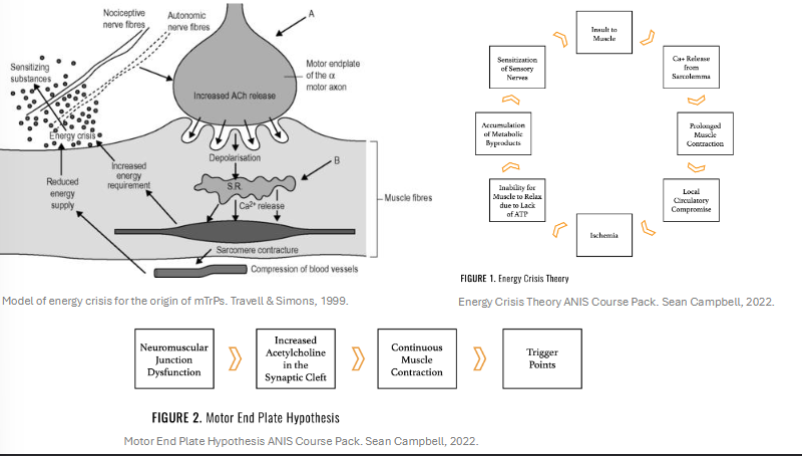
Discrete and hypersensitive nodule within tight band of muscle or fascia
Result of acute trauma or microtrauma
Hypothesized that build up of ACh at neuromuscular junction or lack of ATP leads to the formation of taut band
Can be treated with manual soft tissue techniques, foam rolling, dry needling
Classified as latent or active
Latent = does not cause spontaneous pain but may restrict movement or cause muscle weakness → aware once pressure is applied
Active = causes pain at rest, elicits “jump sign” when pressure is applied, causes a referred pain pattern similar to the patient’s pain complaint
Ischemia - Lack of blood flow
What are contusions? How long does it take to heal and what are the treatments?
Result of sudden blow to the body
AKA “bruise”
MOI: Compression
A hematoma results from blood flowing into the surrounding tissue
Causes Ecchymosis
Bluish-purple discoloration of the skin
Pain usually resolves w/in a few dats, discoloration disappears w/in a few weeks
Avoid aggressive massage or repeated blows to an area d/t risk of Myositis Ossificans
Myositis ossificans - Bone tissue grows inside of the muscle
What are ligament sprains? What are the different grades? Can ligaments heal?
Stretch or tear of ligament
MOI: Tension or shear force
Compromises the ability of the ligament to stabilize the joint
Graded on a 3-point scale
Grade 1
Mild - moderate pain
No laxity
Firm end-feel
Local swelling
Grade 2
Mod - severe pain
Laxity
Firm end-feel
Trouble WBing
Grade 3
Pain?
Laxity
No end-feel
Loss of function
The greatest difficulty with grade one and two sprains is restoring stability due to stretched tissue and inelastic scar tissue formation
To regain joint stability, strengthening of muscles around the joint is critical
Dynamic stability = stability created from muscles around the joint
What is joint subluxation/dislocation?
Joint force beyond normal limits results in separation of bony articulating surfaces
Dislocation:
Occurs when at least one bone in a joint is forced out of alignment and must be manually a or surgically reduced
Subluxation:
Partial dislocation causing incompletes
Bines come back together in alignment
Stabilizing structures of the joint are disrupted
Joints often become susceptible to subsequent dislocations
X-ray is the only absolute diagnostic technique
Dislocations (particularly the first time) should always be considered and treated as a fracture until ruled out
Once a dislocation, always a dislocation
Dislocations should only be reduced after thorough ax of sensory, motor, and vascular status
What is osteoarthritis? How is it managed
Degeneration of hyaline cartilage
Changes in joint mechanics lead to joint degeneration
Commonly affects weight-bearing joints but can also impact the shoulders and cervical spine
Pain (particularly in the morning), stiffness, creaking
One of the leading causes of disability in population
Physical activity is the highest level of evidence for managing arthritis currently
GLA;D program for knee and hip arthritis (GLA;D = Good life with arthritis, Denmark
TKA, THA if pt doesn’t respond to conservative therapy
Recent evidence from Stanford shows blockage of a specific protein may allow for cartilage repair
Protein 15-PGDH increases with age → interferes with cartilage repair, contributing to OA
In mice, blocking the 15-PGDH led to thicker, healthier knee cartilage → prevented OA after joint injury
Cartilage regeneration occurred without stem cells → existing cartilage cells changed their activity to repair tissue
Treated mice move more normally and showed less pain, suggesting real functional improvement
Similar cartilage regeneration effecrs were seen in human knee tissue samples (post-TKA) showing potential for future OA Tx
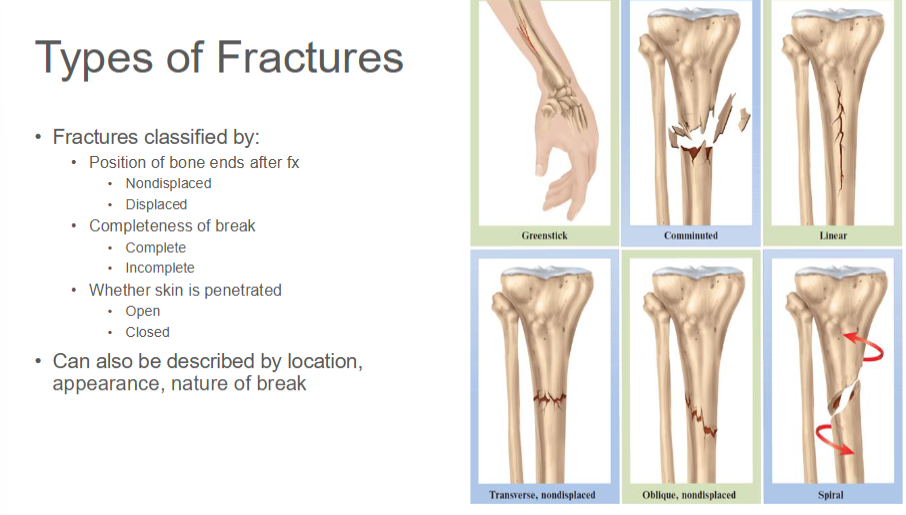
What are Bone fractures? (MOI, Classifacation, signs & symptoms, treatments)
MOI
Fracture may be direct (at point of force application) or indirect
Classified as either closed or open
Closed = little movement or displacement, no disruption to skin
Open = displacement of the fractured ends and breaking through the tissue
Signs and symptoms
Deformity
Pain
Point tenderness
Swelling
Pain with AROM & PROM
Xray necessary for diagnosis
Treatment may require reduction if fx displaced
Closed reduction
Physician manipulates into correct postion
Open reduciton
Surgical pins or wires secure ends
Immobilization of bone with cast required for healing
Time required depends on severity, bone that broke, age of patient
What are stress fractures? (MOI, signs and symptoms, most common sites, treatment)
Sometimes called a hairline fx
No specific cause but with a number of causes
Overload due to muscle contraction, altered stress, distribution due to muscle fatigue, changes in surface, and rhythmic repetitive stress vibrations, altered bone density
Typical MOI
Coming back to competition too soon after injury
Changing events without proper conditioning
Starting initial training too quickly
Changing training habits (surfaces, shoes, etc)
Signs and symptoms
Early stages: swelling, focal tenderness, pain with activity
Later stages: Pain becoming constant & more intense, particularly at night, positive percussion tap test at site away from suspected fx
Most common sites - Tibia, fibula, metatarsal shaft, femur, pars interarticularis (l-sp vertebrae), ribs, humerus
Since early detection is difficult, a bone scan is useful; xray is effective after several weeks
Treatment is varied, but often rest 2-4 weeks so doesn’t progress to true fx
How is the blood and nerve supply for each of these tissues?
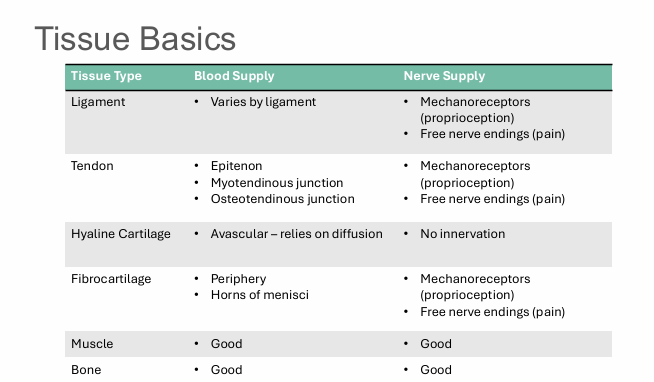
Ligament
Tendon
Hyaline cartilage
Fibrocartilage
Muscle
Bone
What are the three phases of the healing process?
inflammatory response
Proliferation/fibroblastic repair
Maturation/remodeling
What does the inflammatory response phase entail?
Time course: immediately to 4 days post-injury
Function: to start healing, stop the bleeding, and remove foreign material
Chemical mediators & cells cause vascular and cellular changes
Initial vascular response is vasoconstriction to limit blood loss (5 -10 mins)
Platelets critical for formation of a clot to stop the bleeding
Histamine then causes vasocilation and increases cell permeability
Reults in swelling but brings neutrophils and macrophages to clean up area and remove cellular debris caused by injury
Prostaglandins sensitize pain receptors (hyperalgesia)
What are the cardinal signs of inflammation and why do they happen?
Red (Rubor)
Hot (Calor)
Swollen (Tumor)
Tender (Dolor)
Loss of function
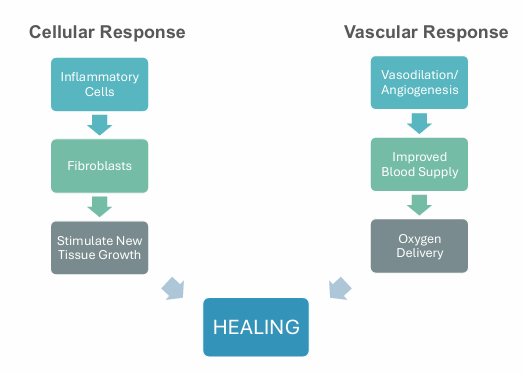
Local vasodilation and fluid leakage into extracellular spaces = redness, swelling, and increased tissue temperature
Mechanical distention, resulting in pressure on soft tissue, coupled with chemical irritation of specific nerve receptors = pain
What happens in the Proliferation / Fibroblastic Repair phase?
Time course: ~3-4 days post injury up to 4-6 weeks
Function: Scar formation and repair of injured tissue
Formation of granulation tissue
Angiogenesis (blood vessels)
Collagenous scar tissue → produced by fibroblasts
Angiogenesis
Essential for scar formation
Need new capillaries for bringing fibroblasts, oxygen and nutrients
Chemical stimulus for angiogenesis from macrophages and platelets
Fibroblasts appear 2-3 days after injury
Produce glycosaminoglycans (GAGs) and collagen (Both part of the extracellular matrix)
GAGs attract water
Collagen fibres fill in gaps in tissue between cells
Collagen production begins after 3 days
Initially type lll
Increase in collagen correlates with wound tensile strength
How does cellular response and vascular response work together towards healing?
What happens in the maturation/remodeling phase?
Three weeks up to 3 years
Function: to increase scar strength
Continued breakdown and synthesis of collagen
Conversion of Type lll collagen to Type l collagen
Increased number of cross-links = increase in strength
Orientation of collagen fibers along direction of mechanical force
Tissue will gradually resume normal appearance
Though rarely returns to same tensile strength d/t scar
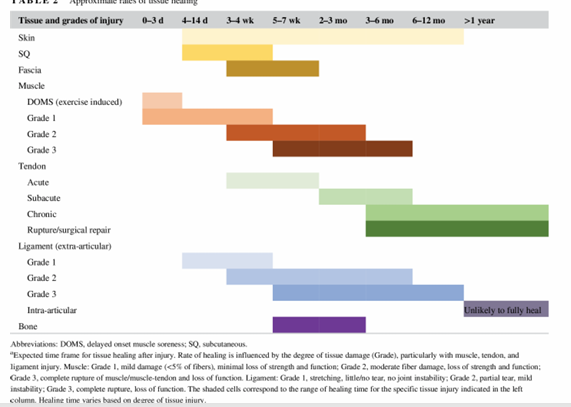
Gain a general understanding to how long each type of tissue takes to heal
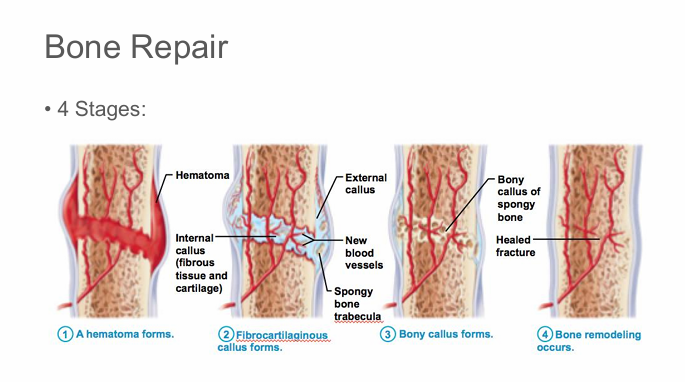
What are the 4 stages of Bone repair? What is happen in each stage?
Hematoma formation
Clotted blood from torn blood vessels
Soft callus formation
Macrophages clear cellular debris
Collagen fibers connect broken ends to allow catilage to be laid down
Hard callus formation
Trabeculae are formed from cartilage, and lay down spongy bone
Bone remodeling
Spongy bone remodelled into compact bone and excess bony material is removed
What are the overall goals of physical rehab?
Reduce pain
Restore ROM
improve strength
What is the old method for acute injury treatments? What is the new method to acute injuries? How do they compare?
Old method
RICE
Rest - to reduce risk of further injury or irritation
Ice - Relives pain and reduces internal and external bleeding
Compression - To reduce swelling
Elevation - Also helps to reduce internal bleeding and swelling
New method
PEACE & LOVE
PEACE
Protect - limit movement for 1-3 days to reduce risk of further injury or irritation
Elevate - Raise injured limb above heart to reduce swelling buildup
Avoid anti-inflammatories - Can delay healing
Compression - Elastic bandage to support circulation, provides swelling control
Education - Learn about your injury and how to treat it
LOVE
Loading - light, pain-free loading promotes blood flow and tissue healing
Optimism - Brain has a significant effect on prognosis and optimal recovery
Vascularization - light aerobic activity improves blood flow
Exercise - Restores mobility, strength and proprioception
What is the role of progressive mobilization?
Initally must maintain some immobilization in order to allow for initial healing
In proliferation phase, controlled activity should be added
Work toward regaining normal flexibility and strength
Protective bracing may also be incorporated
Facilitates tissue remodelling and realignment
Must be aware of pain and other chemical signs, may be too much too soon
What is pain defined as?
An unpleasant sensory and emotional experience associated with actual or potential tissue damage, or described in terms of such damage
Major indicator of injury
Individual and subjective
Modified by past experiences and expectations
Pain is an output, not an input
The result of the brain’s scrutiny of many inputs, including nociception, emotional state, context, past experiences, body region, cultural values, etc
What is Pain vs Nociception?
Nociception
To receive information about harm or damage
Nociception is but one input required for the output that we think of as pain
Nociception is neither necessary nor sufficient for pain experience
Acute pain
Pain associated with tissue damage or the threat of such damage and typically resolves once the tissue heals or the threat resolves
Chronic pain
Pain that lasts longer than 6 months and is in the absence of tissue damage
Pain that lasts longer than the tissue healing process
Arthritis doesn’t count; even though the pain might be chronic, there is an underlying issue
What are some sources of pain?
Cutaneous pain
Sharp, bright, and burning; it can have a fast or slow onset
Deep somatic pain
Originates in tendons, muscles, and joints, and blood vessels, often achy or throbbing
Visceral pain
Begins in organs, and is diffuse at first and may later be localized
Psychogenic pain
Felt by the individual but is emotional rather than physical
What are nociceptors?
Free nerve endings
Located as distal ends of peripheral neurons
Respond to mechanical, thermal and chemical stimuli
Found in all tissues except the central nervous system
Nociceptors are triggered, and then the impulse travels to the brain to potentially produce pain
Transmitted to the spinal cord via A-delta fibres and C fibers
What is the nociceptive pathway? What are 1st, 2nd, and 3rd order neurons?
1st-order neuron synapses in the dorsal horn of SC
2nd-order neurons cross the midline and ascend SC
End in thalamus
3rd-order neurons travel to the somatosensory cortex
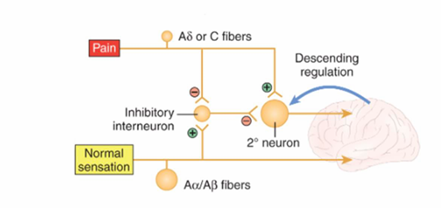
What is the gate control theory of pain?
Published by Melzack and wall in 1965
Explains how a stimulus that activates only non-nociceptive nerves can inhibit pain
Sensory fibres that transmit normal sensation are going to travel on a different pathway, they don’t synapse on the second order neuron so they get to the brain faster
Normal sensation has an excitatory signal to the inhibitory interneuron (exciting inhibition = inhibition of pain reception)
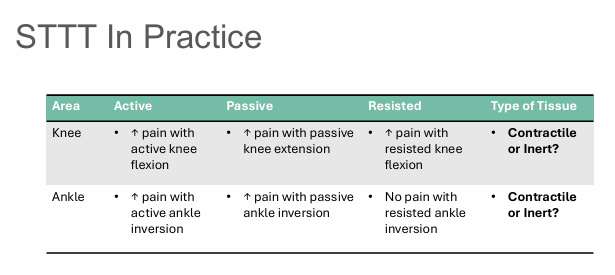
What is the theory of selective tissue tension testing (STT)? How is it used in practice?
Systematic examination by testing the injured part with active, passive and resisted movements to determine if problem is contractile or inert to decide on appropriate treatment strategy
Contractile structures
Muscle, tendon
Implicated when pain increases with active and resisted movement in the same direction, and passive movement (stretch) in the opposite direction
Inert Structures
Ligament, fascia, nerve roots, joint capsules
Implicated when pain increases with stretch of the tissue but resisted movement is not painful