chem paper 2 mistakes
 Call Kai
 Learn
Learn Practice Test
 Spaced Repetition
 Match
Match Flashcards
 Knowt Play
1/22

There's no tags or description
Looks like no tags are added yet.
Name | Mastery | Learn | Test | Matching | Spaced | Call with Kai |
|---|
No analytics yet
Send a link to your students to track their progress
23 Terms
what is the order of priority when naming molecules?
carboxylic acids >aldehydes>ketones>alcohols>alkenes>halogenoalkanes
what intermolecular forces are in aldehydes and ketones?
dipole-dipole (C=O)
two ways of maximising the yield of a compound obtained by distillation of a mixture?
keep the temperature of the reaction mixture below the boiling point of the other compounds in the mixture
cool the collecting vessel
when dehydrating an alcohol to make an alkene w/ H2SO4, what is used as the electrophile?
H+ from the H2SO4
attracted to the lone pair on O in the OH
used to undergo elimination
how does E/Z stereoisomerism arise?
C=C bond cannot rotate and
each carbon in the double bond has 2 different groups attached.
bonding and shape of a benzene molecule?
each C has three covalent bonds
the spare electrons in a p orbital overlap
forming a pi cloud of delocalisation
6C ring in a planar shape, 120 BA
C–C bonds equal in length
stability of benzene vs that of the hypothetical cyclohexa-1,3,5-triene molecule?
the expected enthalpy of hydrogenation of theoretical is –360 kJ mol–1
that of benzene is less exothermic by 152 kJ mol–1
benzene is more stable
what would be a suitable enthalpy of hydrogenation for cyclohexa-1,3-diene, as it is not exactly double that of cyclohexene?
–239 to –121
alternating double bonds
allows some delocalisation/overlap of p orbitals
equation to form electrophile for F-C acylation?
CH3CH2COCL + AlCl3 → AlCl4- + C+OCH2CH3
what is removed when acyl chloride and alcohol react via nucleo/add slim to form an ester?
HCl
propylamine reaction in water and colour change when universal indicator added?
CH3CH2CH2NH2 + H2O ⇌ CH3CH2CH2NH3+ + OH–
green turns blue
why is an aqueous solution is obtained when nitrobenzene is reduced into phenyl amine even though phenylamine is insoluble in water?
C6H5NH2 is present as ionic salt
glycerol structure?
propane-1,2,3-triol
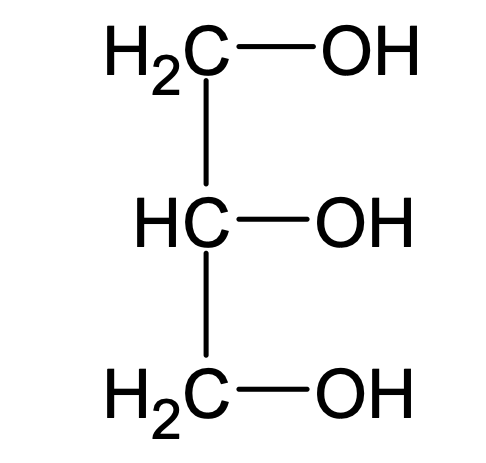
what is a suitable reagent for the hydrolysis of a protein in TLC?
concentrated HCl to hydrolyse the peptide bond/amide link O=CNH
how may two functional group isomers with the same relative atomic mass be differentiated between via high res mass spec using electrospray ionisation?
their precise relative molecular masses will be different
meaning of the term complementary when it is used to refer to DNA strands?
must have base sequences that match
AT GC
explain how carbon dioxide causes global warming
C=O absorbs IR radiation
collisions between molecules transfer the radiation warming the atmosphere
how does shaking distillate from reflux with saturated NaCl solution allow the desired product to be separated using separating funnel?
the liquids are immiscible/dont mix
how can you tell if a cloudy liquid has been dried by a drying agent?
will go clear
why does NaBH4 reduce aldehydes but not alkenes?
the H- ion is attracted to partially positive C in aldehydes
but in alkenes the C=C is electron rich
so it repels the ion and can only be attacked by electrophiles
why does presence of Cl make a carboxylic acid stronger?
electron withdrawing/has (-) inductive effect
so weakens the O-H bond
or makes COO- less negative/more stable so less likely to accept H+
why would using a conical flask instead of a beaker give more accurate results in an experiment?
reduces loss of liquid droplets
conditions for fehlings test and colour change?
warm in water bath
blue to red colour change due to red ppt formation