Chapter 5: Lipids
 Call Kai
 Learn
Learn Practice Test
 Spaced Repetition
 Match
Match Flashcards
 Knowt Play
1/98

There's no tags or description
Looks like no tags are added yet.
Name | Mastery | Learn | Test | Matching | Spaced | Call with Kai |
|---|
No analytics yet
Send a link to your students to track their progress
99 Terms
What are lipids?
family of organic compounds, soluble and organic solvents (fats)
Three classes of lipids
•Triglycerides
•Phospholipids
•Sterols
Trigylercides
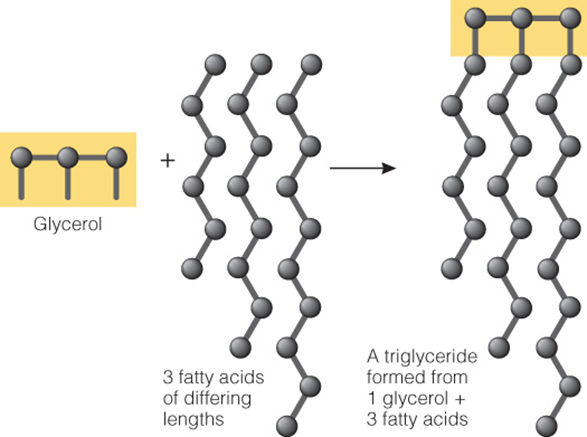
three fatty acids (tri) are attached to a molecule of glycerol to form a triglyceride molecule; chief form of fat and food, 95% of lipids
phospholipids
consists of a molecule of glycerol with fatty acids attached, but it contains two, rather than three, fatty acid; present in all cell membranes
Sterols
large, complicated molecules consisting of interconnected rings of carbon atoms with side chains of carbon, hydrogen, and oxygen attached; structure is similar to cholesterol
fats are __ at room temp
soluble
oils are __ at room temp
liquid
Fats provide ____ of the resting body’s energy and much of the energy used to fuel muscular work
80 to 90 percent
Fats are the body’s chief form of
stored energy
Fats serve as
serve as an emergency fuel supply in times of severe illness and starvation |
. Fats protect
the internal organs from shock, cushioning them with fat pads inside the body cavity
The layer of fat under the skin
insulates the internal tissues against cold temperatures
Fats form the major material of
cell membranes
Lipids are converted to
other compounds, such as hormones, bile, and vitamin D, as needed
Food fats provide what compounds
essential fatty acids, fat-soluble vitamins, and other needed compounds
Fats carry
carry fat-soluble vitamins A, D, E, and K along with some phytochemicals
Fats stimulate
the appetite
T/F: Fats make fried foods crisp and other foods tender
True
Fat contains ___ per gram when consumed
9 cals
Fats are the main storage form for ___.
energy from excess food or adipose tissue
Adipose tissue secretes ____ to regulate appetite
hormones
____ is efficient in that it’s able to store an unlimited amount of fat in fat cells
Adipose tissue
purposes of fat
•Shock absorbers and insulators
•Cell membranes
•Transport (of vitamins and phytochemicals)
•Raw material (for lipid hormones, bile, and vitamin D)
Fat has a concentrated calorie source which means that
lots of energy is in small packages
Fat-soluble nutrients
• Fat Soluble Vitamins
•Essential fatty acids- fatty acids that the body needs but cannot make and therefore must obtain from the diet.
Lipids exit to the blood when ___
there’s a state of famine or malnourishment
When fat cells expands, ___.
it has a hard time reducing in size
•Sensory qualities provided by fat
•Aromas
•Flavors
•Tenderness
•Satiety
•Satiety
-fullness/satisfaction after a meal
-slows down food movement
Triglyercides are fatty acids attached to glycerol that differ in
chain length
degree of saturation
Each animal species makes its own
characteristic kinds of triglycerides
•Saturation refers to
whether or not a fatty acid chain is holding all of the hydrogen atoms it can hold
If every available bond from the carbons is holding a hydrogen, the chain is a
saturated fatty acid
A fatty acid carbon chain that lacks some hydrogen atoms and possesses one or more points of unsaturation is an
unsaturated fatty acid .
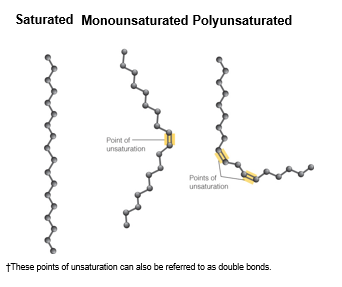
With one point of unsaturation, the fatty acid is a
monounsaturated fatty acid
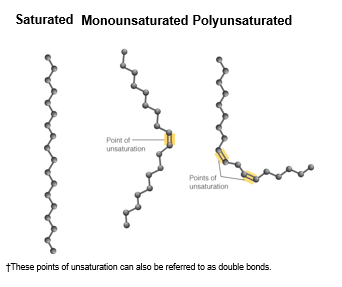
With two or more points of unsaturation, the fatty acid is a
polyunsaturated fatty acid
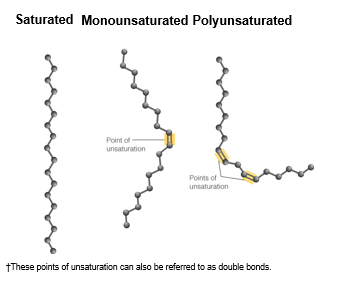
Double Bond placement will determine
points of unsaturation
•Melting point
whether the fat will solid or liquid at food temp
varies w/ degree of saturation
saturated fats are ___ at room temp
solid
unsaturated fats are __ at room temp
liquid
In terms of fat hardness, softer is __.
generally healthier
Veggie and fish oils are more ____.
Unsaturated
Animal fat
more saturated
Phospholipids
•Glycerol containing two fatty acids and a phosphorus molecule
Phospholipids are soluble in __.
water and fat
What do emulsifiers do?
They pull fat and water together; without them the two separate
Sterols
•Rings of carbon with side chains of carbon, hydrogen, and oxygen
Fat Digestion
Stomach → small intestine
- Small intestine is where digestion of fats really starts
- Uses bile to emulsify and suspend fat drops until fat digesting enzymes come into small intestine
- fat becomes readily available for absorption (up to 98% of fats consumed are absorbed)
The more fat taken in at a meal, the
slower the digestive system
How Are Fats Digested and Absorbed?
1.Fat and watery digestive juices tend to separate. Enzymes are in the water and can’t get at the fat
2.When fat enters the small intestine, the gallbladder secretes bile. Bile compounds have an affinity for both fat and water, so bile can mix the fat into the water.
3.After emulsification, more fat is exposed to the enzymes and fat digestion proceeds efficiently.
The Process of Lipid Digestion and Absorption
- In the mouth and stomach: Little fat digestion takes place
2 - In the small intestine: Digestive enzymes accomplish most fat digestion in the small intestine. There, bile emulsifies fat, making it available for enzyme action. The enzymes cleave triglycerides into free fatty acids, glycerol, and monoglycerides
3 - At the intestinal lining: The parts are absorbed by intestinal villi. Glycerol and short-chain fatty acids enter directly into the bloodstream
4 - The cells of the intestinal lining convert large lipid fragments, such as monoglycerides and long-chain fatty acids, back into triglycerides and combine them with protein, forming chylomicrons (which is a type of lipoprotein) that travel in the lymph vessels to the bloodstream
5 - In the large intestine: A small amount of cholesterol trapped in fiber exits with the feces
Transport of Fats are contingent on
size of fatty acid chain; larger lipids need transport assistants (protein carriers)(as travel passengers of lipoproteins)
Transport of Fats
1.Glyercol and shorter acid fatty acids pass through intestinal lining to bloodstream
2.Goes to liver to be processed (no assistance)
Lipoproetins
cluster of lipids that have a protein attached to them
Chylomicron transport
dietary fats and cholesterol from the digestive system to other parts of the body
For storing and using: Fat molecules conserved are transported to
fat deposits which make up the •Subcutaneous fat layer
•Subcutaneous fat layer
acts as padding for organs
lies right beneath the skin
stored for fat energy later on
fat cells store _ and _
fat and excess carbohydrates
Glucose to Fat
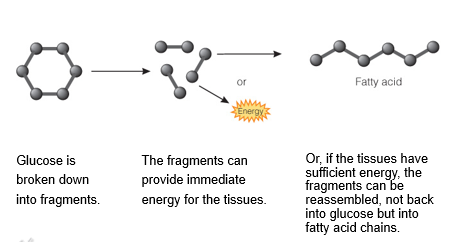
•Cardiovascular disease associated with
•High intakes of saturated and trans-fatty acids
•Intake of refined carbohydrates
Recommendations for Lipid Intakes
Dietary Reference Intake (D R I): Suggests 20 to 35 percent of daily energy/total calories
•Too little lipid: Below 20 percent minimum causes the eater to suffer
American Heart Association
•For adults who would benefit from lowering blood L D L cholesterol: Reduce percentage of calories from saturated fat to between 5 and 6 percent
Dietary Reference Intakes
•Keep saturated fat intake low, less than 10 percent of calories, within the context of an adequate diet
. Trans fat
American Heart Association
•For adults who would benefit from lowering blood L D L cholesterol: Reduce percentage of calories from trans fat
Dietary Guidelines for Americans
•A healthy eating pattern limits trans fats
Polyunsaturated fatty acids: Dietary Reference Intakes Reccomendation: Linoleic acid
•17 grams/day for young men
•12 grams/day for young women
Polyunsaturated fatty acids: Dietary Reference Intakes Reccomendations :Linolenic acid
•1.6 grams/day for men
•1.1 grams/day for women
•U.S. fat intakes are around what number
35% or above
Cholesterol
Dietary Reference Intakes Reccomendations
•Minimize cholesterol intake within the context of a healthy diet
Lipoprotein helps in
movement of fats in the body
Tissues help to extract
fat from chylomicrons
Liver picks up remnants of __ for reuse
chylomicrons/lipoproteins
Types of lipoproteins
•Chylomicrons
•Very-low-density lipoproteins (or V L D L)
•Low-density lipoproteins (or L D L)
High-density lipoproteins (or H D L)
•Low-density lipoproteins (L D L)
•Larger, lighter, and richer in cholesterol
•Deliver cholesterol to tissues
•High levels trigger inflammation and heart disease
•High-density lipoproteins (H D L)
•Smaller, denser, and packaged with more protein
•Scavenge excess cholesterol and other lipids
•High levels oppose heart disease and vice versa
•Two major risk factors for cardiovascular disease (C V D)
•High blood L D L cholesterol
•Low blood H D L cholesterol
How would you •Lower L D L?
Trim saturated and trans fats from diet
How would you raise HDL
•Physical activity
•Body’s response to exercise
•Blood lipids shift toward higher H D L cholesterol
•Muscles of the heart and arteries strengthen and circulation improves
•Larger volume of blood is pumped with each heartbeat, reducing the heart’s workload
•Body grows leaner, reducing the overall risk of cardiovascular disease
•Blood glucose regulation is improved, reducing the risk of diabetes
Essential Polyunsaturated Fatty Acids
•Essential fatty acids that cannot be synthesized by our body
•Linoleic acid and linolenic acid
Deficiencies in •Linoleic acid and linolenic acid leads to
•Cause skin abnormalities and poor wound healing
•Almost unseen among adults
Among Children: can hinder growth and cause vision problems
•Linoleic acid is the parent member of:
•Omega-6 fatty acid
•Arachidonic acid
Arachidonic acid:
Starting material for making eicosanoids
•Linolenic acid is the parent member of:
•Omega -3 fatty acid
Important Omega -3 fatty acids
Docosahexaenoic acid (D H A) and eicosapentaenoic acid (E P A)
•Docosahexaenoic acid (D H A) and eicosapentaenoic acid (E P A) play critical roles in:
•Regulating heart disease
•Cancer prevention
•Promoting healthy tissue functioning by amassing in cell membranes
Brain function and vision
Food Sources of Omega-6 and Omega-3 Fatty Acids
Fatty Acid Family | Food Sources |
Omega-6: Linoleic acid | Nuts and seeds (such as cashews, walnuts, sunflower seeds, others) Poultry fat Vegetable oils (such as corn, cottonseed, safflower, sesame, soybean, sunflower); margarines made from these oils |
Omega-3: Linolenic acida | Nuts and seeds (such as chia seeds, flaxseeds, walnuts, soybeans) Vegetable oils (such as canola, flaxseed, soybean, walnut, wheat germ; liquid or soft margarine made from canola or soybean oil) Vegetables (such as soybeans) |
Omega-3: E P A and D H A | Egg, enriched: 75–100 milligrams D H A/egg (or flaxseed-enriched) and 100–130 milligrams D H A/egg (or fish oil-enriched) Human milk |
Fatty Acid Family | Food Sources |
Omega-3: E P A and D H A | Fish and seafood: Top contributors: (500–1,800 milligrams/3.5 ounces) Barramundi, Mediterranean seabass (bronzini), herring (Atlantic and Pacific), mackerel,b oyster (Pacific wild), salmon (wild and farmed), sardines, shark,b swordfish,b tilefish,b toothfish (includes Chilean seabass), lake trout (freshwater, wild, and farmed) Good contributors: (150–500 milligrams/3.5 ounces) Black bass, catfish (wild and farmed), clam, crab (Alaskan king), croakers, flounder, haddock, hake, halibut, oyster (eastern and farmed), perch, scallop, shrimp (mixed varieties), sole Other contributors: (25–150 milligrams/3.5 ounces) Cod (Atlantic and Pacific), grouper, lobster, mahi-mahi, monkfish, orange roughy,b red snapper, skate, tilapia, triggerfish, tuna, wahoo |
•Hydrogenation
•Altering fatty acids in food while processing
•Makes fats resistant to oxidation and helps stay fresher longer
Unsaturated oils get rancid on
oxidation
•Hydrogenated oils
•Have a high smoking point
•Easy to handle and easy to spread
Hyrdrogenation results in
•Nutrient losses
•Oils lose their unsaturated character and the health benefits that go with it•Alternatives to hydrogenation
•Alternatives to hydrogenation
•Adding chemical preservative that will compete for oxygen
•Keeping the product refrigerated
in Unsaturated fatty acids
Points of unsaturation are places on fatty acid chains where hydrogen is missing. The bonds that would normally be occupied by hydrogen in a saturated fatty acid are shared as a somewhat unstable double bond between two carbons.
In Hydrogenated fatty acids (now fully saturated)
When a positively charged hydrogen is made available to an unsaturated bond, it readily accepts the hydrogen and, in the process, becomes saturated. The fatty acid no longer has a point of unsaturation.
In Trans-fatty acids
The hydrogenation process also produces some trans-fatty acids. The trans-fatty acid retains its double bond but takes a twist instead of becoming fully saturated. It resembles a saturated fatty acid both in its shape and in its effects on health.
Formation of trans fatty acid results from __ and leads to hardening at room temp
hydrogenation
•Health effects of change in structure of fatty acid
•L D L cholesterol levels raised
•Similarities with saturated fat
•Essential fat should be consumed
•Few teaspoons of raw oil per day and two servings of seafood per week
Fats in Protein Foods
•Limit intake to 5 to 7 ounces per day
•Choosing low-fat meats
•Ground turkey and chicken are naturally lean
•Commercial processing adds solid fats
•Milk and milk products: Cream and butter fall in solid fats category
•Grains: Low in fat when in natural state
Defensive Dining Reccomendations
•Read ingredient lists
In grocery stores
•Choosing seafood
•Choosing among margarines and unsaturated oils
•Adding nuts
•Fat replacers and artificial fats
Revamp recipes to cut down on solid fats
•Choosing fast foods low in calories and saturated fats to make fast-food meals healthy
•Change habits
Solid Fat Ingredients on Labels
Beef fat Butter Chicken fat Coconut oil Cream Hydrogenated oil Milk fat | Palm kernel oil; palm oil Partially hydrogenated oil Pork fat (or lard) Shortening Margarine |
Solid Fat Replacements
Instead of these solid fats and oils | Try choosing these |
Regular margarine and butter for spreading, cooking, or baking | Olive, nut, seed, and other vegetable oils; reduced-fat, diet, liquid, or spray margarine; granulated butter replacers; fruit butters, hummus, nut butters, or avocado for spreading |
Shortening or lard in cooking | Nonstick cooking spray, olive oil, or vegetable oil for frying; applesauce or oil for baking |
Solid fats as seasonings: bacon, bacon fat, butter; fried onion or greasy crouton salad toppers | Herbs, lemons, spices, liquid smoke flavoring, ham-flavored bouillon cubes, broth, wine; olive oil; olives; toasted nut or toasted whole-grain crouton toppers |
Instead of these milk products/dairy products | Try choosing these milk products/dairy products |
Whole milk; half and half | Fat-free or reduced-fat milk; fat-free half and half |
Regular ricotta cheese; mozzarella cheese; yogurt or sour cream | Part-skim ricotta or fat-free cottage cheese; part-skim mozzarella; fat-free sour cream, “zero” plain Greek-style yogurta |
Regular cheddar, American, or other cheeses; cream cheese | Low-fat or fat-free cheeses; fat-free or reduced-fat cream cheese, Neufchatel cheese |
Large amounts of mild cheeses | Small amounts of strong-flavored aged cheeses (such as sharp cheddar; grated Asiago, Romano, or Parmesan) |
Ice cream, mousse, cream custards | “Light” ice cream, frozen yogurt, or other frozen desserts; low-sugar sherbet or sorbet; skim milk low-sugar puddings |
Bologna, salami, other sliced sandwich meats; hot dogs | Low-fat sandwich meats and hot dogs (95–97% lean, or “light”) |
Breakfast sausage or bacon | Canadian bacon, lean ham, or soy-based sausage or bacon-like products |
High-fat beef, pork, or lamb; ground beef | Leaner cuts trimmed of fat, broiled salmon or other seafood; ground turkey breast (98% lean), soy-based “ground beef” crumbles; legume main dishes |
Poultry with skin | Skinless poultry |
Commercial fish sticks, breaded fried fish fillets | Plain fish fillets, broiled or rolled in seasoned whole-wheat breadcrumbs and pan sautéed in oil |
Chips, such as tortilla or potato; appetizer crackers | Baked or “light” chips; reduced-fat crackers and cookies, saltine-type crackers; nut, seed, or whole-grain crackers low in saturated and trans fat |
Cakes, cookies; doughnuts, pastries, other desserts | Fresh and dried fruit; whole-grain muffins, quick breads, or cakes made with oil (not shortening) |
Granola, other cereals with saturated fat or hydrogenated fat | Cereals low in saturated fat, with no trans fat (compare the Nutrition Facts panel information) |
Macaroni and cheese | Spaghetti and marinara sauce |
Ramen-type noodles | Soba noodles or other whole-grain noodles cooked in broth, with Asian seasonings |
Frozen or canned main dishes with more than 2 or 3 gram saturated fat per serving | Similar foods with less saturated fat per serving (compare the Nutrition Facts panel information) |
Cream-based, cheese, or “loaded” soups | Broth-based, vegetable, or bean soups; poultry-based, meatless, or other low-fat chili |
•1960s study: Finland and Crete
•Finland had highest death rate from C V D and Crete had lowest
•Difference: Saturated fats versus olive oil