Chemical Equations

0.0(0)
Studied by 0 people
call kaiCall Kai
learnLearn
examPractice Test
spaced repetitionSpaced Repetition
heart puzzleMatch
flashcardsFlashcards
GameKnowt Play
Card Sorting

1/314

encourage image

There's no tags or description

Looks like no tags are added yet.

Last updated 12:51 AM on 5/19/26
Name
Mastery
Learn
Test
Matching
Spaced
Call with Kai

No analytics yet

Send a link to your students to track their progress

315 Terms

1
New cards
  1. What is a chemical change?

A chemical change is when matter turns into a completely different substance. This means new substances with new properties are formed. Signs like gas, heat, or color change often indicate it.

2
New cards
  1. What are common signs of a chemical change?

Common signs include color change, gas formation, light, odor, or a precipitate forming. These indicate that a new substance is being produced. Not all reactions show every sign, but at least one is usually present.

3
New cards
  1. What is a physical change?

A physical change alters the form of a substance without changing its identity. The substance remains the same chemically. These changes are often reversible.

4
New cards
  1. What are common examples of physical changes?

Examples include melting, freezing, cutting, and dissolving. These only affect size, shape, or state. No new substance is created during the process.

5
New cards
  1. How can you tell the difference between a chemical and physical change?

A chemical change creates a new substance, while a physical change does not. Chemical changes are often irreversible, while physical ones are usually reversible. Observing energy changes or new products helps distinguish them.

6
New cards
  1. Why is a banana turning brown a chemical change?

The banana reacts with oxygen and microorganisms. This creates new substances and changes its color and smell. Because a new substance forms, it is a chemical change.

7
New cards
  1. Why is cutting paper a physical change?

Cutting paper only changes its shape and size. The chemical composition of the paper stays the same. No new substance is formed.

8
New cards
  1. Why are hand warmers an example of a chemical change?

Iron reacts with oxygen to form a new compound. This reaction releases heat, making it exothermic. Since a new substance forms, it is a chemical change.

9
New cards
  1. How can a candle show both physical and chemical changes?

The wax melts, which is a physical change because it changes state. The wick burns, which is a chemical change because it produces new substances like carbon dioxide. Both processes happen at the same time.

10
New cards
  1. Why do old pennies change color over time?

Copper reacts with oxygen in the air. This forms a new compound called patina. Since a new substance is formed, it is a chemical change.

11
New cards
  1. What are reactants in a chemical reaction?

Reactants are the starting substances in a chemical reaction. They undergo change during the reaction. They are written on the left side of the equation.

12
New cards
  1. What are products in a chemical reaction?

Products are the substances formed after a reaction occurs. They have different properties from the reactants. They are written on the right side of the equation.

13
New cards
  1. What does the arrow (→) mean in a chemical equation?

The arrow means "yields" or "produces." It shows the direction from reactants to products. It represents the result of a chemical reaction.

14
New cards
  1. What does the equilibrium arrow (⇌) mean?

The equilibrium arrow shows that a reaction can go both forward and backward. This means the reaction is reversible. Both reactants and products can form continuously.

15
New cards
  1. In the equation 4Fe + 3O2 → 2Fe2O3, what are the reactants?

The reactants are Fe and O2. These are the substances that start the reaction. They are found on the left side of the equation.

16
New cards
  1. In the equation 4Fe + 3O2 → 2Fe2O3, what is the product?

The product is Fe2O3. This is the substance formed after the reaction. It appears on the right side of the equation.

17
New cards
  1. What is a coefficient in a chemical equation?

A coefficient is a number placed in front of a chemical formula. It tells how many molecules of a substance are present. It multiplies the entire formula.

18
New cards
  1. What is a subscript in a chemical formula?

A subscript is a small number written to the lower right of an element symbol. It tells how many atoms of that element are in one molecule. It only applies to the element it follows.

19
New cards
  1. In 3NO2, how many nitrogen atoms are there?

There are 3 nitrogen atoms. The coefficient multiplies the number of molecules. Each molecule has one nitrogen atom.

20
New cards
  1. In 3NO2, how many oxygen atoms are there?

There are 6 oxygen atoms. Each molecule has 2 oxygen atoms, and there are 3 molecules. So 3 times 2 equals 6.

21
New cards
  1. In 2H2SO4, what is the coefficient?

The coefficient is 2. This means there are 2 molecules of H2SO4. It multiplies all atoms in the formula.

22
New cards
  1. In 2H2SO4, what is the subscript of oxygen?

The subscript of oxygen is 4. This means each molecule has 4 oxygen atoms. The coefficient will multiply this total.

23
New cards
  1. In 2H2SO4, how many total oxygen atoms are there?

There are 8 oxygen atoms total. Each molecule has 4 oxygen atoms, and there are 2 molecules. So 2 times 4 equals 8.

24
New cards
  1. What is the subscript of chlorine in NaCl?

The subscript of chlorine is 1. When no number is written, it is assumed to be 1. This means there is one chlorine atom per molecule.

25
New cards
  1. What is the total number of chlorine atoms in 2NaCl?

There are 2 chlorine atoms total. Each molecule has 1 chlorine atom, and there are 2 molecules. So 2 times 1 equals 2.

26
New cards
  1. What is the Law of Conservation of Mass?

This law states that matter cannot be created or destroyed. The total mass of reactants equals the total mass of products. This means atoms are rearranged but not lost.

27
New cards
  1. Why must chemical equations be balanced?

They must follow the Law of Conservation of Mass. The number of atoms for each element must be equal on both sides. This ensures matter is conserved.

28
New cards
  1. Is H2 + O2 → H2O balanced? Why or why not?

No, it is not balanced. There are 2 oxygen atoms on the reactant side but only 1 on the product side. This violates the conservation of mass.

29
New cards
  1. How can H2 + O2 → H2O be balanced?

It becomes 2H2 + O2 → 2H2O. This ensures equal numbers of hydrogen and oxygen atoms on both sides. Now it follows the law of conservation of mass.

30
New cards
  1. What is the first step in balancing chemical equations?

Draw boxes around each chemical formula. This helps you avoid changing subscripts. Only coefficients should be adjusted.

31
New cards
  1. Why should you never change subscripts when balancing equations?

Changing subscripts changes the identity of the substance. This would create a different chemical. Only coefficients should be adjusted to balance equations.

32
New cards
  1. What does it mean when an equation is balanced?

It means the number of atoms of each element is equal on both sides. This follows the Law of Conservation of Mass. No atoms are lost or gained.

33
New cards
  1. Balance: N2 + H2 → NH3

The balanced equation is N2 + 3H2 → 2NH3. This ensures equal nitrogen and hydrogen atoms on both sides. Coefficients are used to balance it.

34
New cards
  1. Balance: H2SiCl2 + H2O → H8Si4O4 + HCl

The balanced equation is 4H2SiCl2 + 4H2O → H8Si4O4 + 8HCl. This balances hydrogen, silicon, chlorine, and oxygen. Coefficients ensure equal atoms on both sides.

35
New cards
  1. Balance: CO2 + H2O → C6H12O6 + O2

The balanced equation is 6CO2 + 6H2O → C6H12O6 + 6O2. This balances carbon, hydrogen, and oxygen atoms. It represents photosynthesis.

36
New cards
  1. Balance: NaCl + MgO → MgCl2 + Na2O

The balanced equation is 2NaCl + MgO → MgCl2 + Na2O. This balances sodium and chlorine atoms. All elements are equal on both sides.

37
New cards
  1. Balance: H3PO4 → H4P2O7 + H2O

The balanced equation is 2H3PO4 → H4P2O7 + H2O. This balances hydrogen, phosphorus, and oxygen. Coefficients are minimized.

38
New cards
  1. Balance: AlBr3 + K2SO4 → KBr + Al2(SO4)3

The balanced equation is 2AlBr3 + 3K2SO4 → 6KBr + Al2(SO4)3. This balances aluminum, bromine, potassium, and sulfate groups. All atoms match.

39
New cards
  1. When H2O2 → H2O + O2 is balanced, what is the sum of coefficients?

The balanced equation is 2H2O2 → 2H2O + O2. The sum of coefficients is 5. This includes 2, 2, and 1.

40
New cards
  1. True or False: Physical changes always release energy.

False. Physical changes typically do not release energy like chemical reactions do. They mainly involve changes in form or state.

41
New cards
  1. True or False: A precipitate is a solid formed in a liquid during a chemical reaction.

True. A precipitate forms when two solutions react and create an insoluble solid. This is a sign of a chemical change.

42
New cards
  1. Multiple Choice: Which is a chemical change? (A) Melting ice (B) Burning wood (C) Cutting hair (D) Boiling water

The correct answer is B, burning wood. This process creates new substances like ash and gases. It is a chemical reaction.

43
New cards
  1. Multiple Choice: Which number represents molecules in a chemical equation? (A) Subscript (B) Coefficient (C) Atom (D) Element

The correct answer is B, coefficient. Coefficients tell how many molecules are present. They apply to the entire formula.

44
New cards
  1. Scenario: A substance changes color and produces gas. Is it chemical or physical?

It is a chemical change. These are strong indicators that a new substance is forming. Physical changes do not create gas or new substances.

45
New cards
  1. Fill in the blank: In a balanced equation, the number of atoms on both sides must be ______.

equal

46
New cards
What is chemical equilibrium?
Chemical equilibrium is when the forward and reverse reactions occur at the same rate. The concentrations of reactants and products remain constant over time. However, the concentrations are not necessarily equal.
47
New cards
What does it mean for a reaction to be reversible?
A reversible reaction is one that can proceed in both forward and reverse directions. This is shown using a double arrow symbol. Reversible reactions are necessary for a system to reach equilibrium.
48
New cards
At equilibrium, are the concentrations of reactants and products equal or constant?
At equilibrium, the concentrations are constant, not necessarily equal. This means they do not change over time. The forward and reverse reactions still continue but at equal rates.
49
New cards
What happens to reaction rates at equilibrium?
At equilibrium, the forward and reverse reaction rates are equal. This balance keeps the system stable. Even though reactions continue, there is no overall change in concentration.
50
New cards
What is a “stress” in terms of equilibrium?
A stress is any change that disturbs a system at equilibrium. Common stresses include changes in temperature, concentration, or pressure. The system will respond to reduce this stress.
51
New cards
What is Le Chatelier’s Principle?
Le Chatelier’s Principle states that a system at equilibrium will shift to oppose any applied stress. This helps restore balance in the system. The shift can be toward reactants or products.
52
New cards
How does increasing reactant concentration affect equilibrium?
Increasing reactant concentration shifts the equilibrium to the right. This means more products will form. The system adjusts to reduce the added reactant.
53
New cards
How does increasing product concentration affect equilibrium?
Increasing product concentration shifts the equilibrium to the left. This causes more reactants to form. The system works to reduce the excess product.
54
New cards
What happens when reactants are removed from a system at equilibrium?
When reactants are removed, the system shifts to the left. This produces more reactants to replace what was lost. The system tries to restore balance.
55
New cards
What happens when products are removed from a system at equilibrium?
When products are removed, the system shifts to the right. This forms more products to replace what was removed. The system adjusts to maintain equilibrium.
56
New cards
How does pressure affect equilibrium in gas reactions?
Increasing pressure shifts equilibrium toward the side with fewer moles of gas. Decreasing pressure shifts equilibrium toward the side with more moles of gas. This helps balance the pressure change.
57
New cards
How does increasing temperature affect equilibrium?
Increasing temperature adds energy to the system. The equilibrium shifts away from the side that contains heat. The direction depends on whether the reaction is endothermic or exothermic.
58
New cards
How can you identify an endothermic reaction from an equation?
In an endothermic reaction, heat is written as a reactant. This means energy is absorbed during the reaction. The value of ΔH is positive.
59
New cards
How can you identify an exothermic reaction from an equation?
In an exothermic reaction, heat is written as a product. This means energy is released during the reaction. The value of ΔH is negative.
60
New cards
What is activation energy?
Activation energy is the minimum energy required to start a chemical reaction. It is needed for reactant particles to successfully collide. Without enough energy, the reaction will not occur.
61
New cards
What is the heat of reaction (ΔH)?
The heat of reaction is the difference in energy between products and reactants. It is calculated as products minus reactants. It represents the overall energy change of the reaction.
62
New cards
What is collision theory?
Collision theory states that reactions occur when particles collide with enough energy and proper orientation. Not all collisions result in reactions. Both energy and alignment are important.
63
New cards
Why does increasing temperature increase reaction rate (collision theory)?
Increasing temperature gives particles more kinetic energy. This causes more frequent and energetic collisions. As a result, more collisions are successful, increasing the reaction rate.
64
New cards
What is a catalyst?
A catalyst is a substance that speeds up a chemical reaction. It does this by lowering the activation energy. It is not consumed in the reaction.
65
New cards
How does a catalyst affect equilibrium?
A catalyst does not shift equilibrium. It speeds up both forward and reverse reactions equally. This helps the system reach equilibrium faster but does not change concentrations.
66
New cards
How does a catalyst increase reaction rate?
A catalyst provides an alternative reaction pathway. This pathway has a lower activation energy. As a result, more collisions are successful.
67
New cards
What happens to energy in an endothermic reaction?
In an endothermic reaction, energy is absorbed from the surroundings. This energy is stored in the products as potential energy. The surroundings may feel colder.
68
New cards
What happens to energy in an exothermic reaction?
In an exothermic reaction, energy is released to the surroundings. This energy often appears as heat. The surroundings may feel warmer.
69
New cards
How do energy diagrams show endothermic reactions?

In an endothermic reaction, the products are at a higher energy level than the reactants. This shows that energy was absorbed. The graph ends higher than it starts.
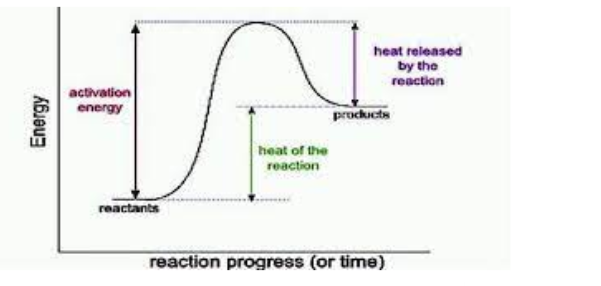
<p>In an endothermic reaction, the products are at a higher energy level than the reactants. This shows that energy was absorbed. The graph ends higher than it starts.</p>
70
New cards
How do energy diagrams show exothermic reactions?

In an exothermic reaction, the reactants are at a higher energy level than the products. This shows that energy was released. The graph ends lower than it starts.
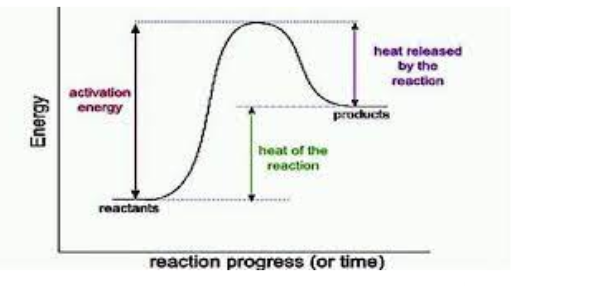
<p>In an exothermic reaction, the reactants are at a higher energy level than the products. This shows that energy was released. The graph ends lower than it starts.</p>
71
New cards
How does a catalyst appear on an energy diagram?

A catalyst lowers the peak of the activation energy on the diagram. This means less energy is needed to start the reaction. The start and end energy levels remain the same.
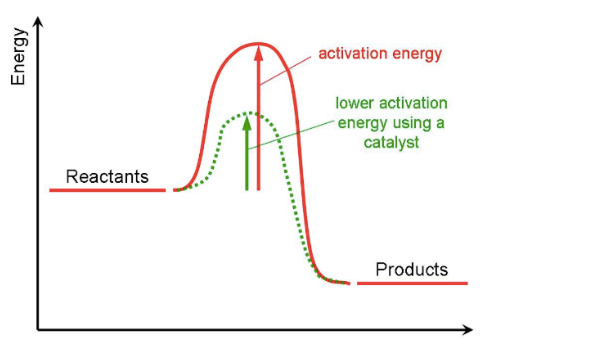
<p>A catalyst lowers the peak of the activation energy on the diagram. This means less energy is needed to start the reaction. The start and end energy levels remain the same.</p>
72
New cards
Multiple Choice: When a system is at equilibrium, the concentrations of reactants and products are?
The correct answer is constant. This means they do not change over time. They are not required to be equal.
73
New cards
Multiple Choice: Le Chatelier’s principle predicts the?
The correct answer is the effect of a stress on the system. It explains how equilibrium shifts. It does not describe activation energy or bonding.
74
New cards
Multiple Choice: Adding a catalyst to a system at equilibrium will?
The correct answer is increase the rate of forward and reverse reactions equally. It does not shift equilibrium. Concentrations remain unchanged.
75
New cards
Multiple Choice: A catalyst works by?
The correct answer is providing an alternate reaction pathway. This lowers activation energy. It does not increase potential energy or supply heat.
76
New cards
Multiple Choice: H2(g) + Cl2(g) ⇌ 2HCl(g) + heat shifts right when?
The correct answer is increasing the concentration of H2. Adding reactants pushes the reaction toward products. Other choices either shift left or have no effect.
77
New cards
Multiple Choice: A(g) + B(g) + heat ⇌ C(g) + D(g) shifts right when?
The correct answer is increasing temperature. Heat is a reactant, so adding heat pushes the reaction right. This produces more products.
78
New cards
Multiple Choice: 2SO2(g) + O2(g) ⇌ 2SO3(g) + heat, increasing pressure causes SO2 to?
The correct answer is decrease. The system shifts to the side with fewer gas moles (products). This uses up SO2.
79
New cards
Multiple Choice: Which change increases SO3 concentration?
The correct answer is increasing O2 concentration. Adding reactants shifts equilibrium right. This produces more SO3.
80
New cards
Multiple Choice: X2(g) + 2Y2(g) ⇌ 2XY2(g) + heat shifts right when?
The correct answer is increased pressure and decreased temperature. Fewer moles are on the right, and removing heat favors products. Both changes push equilibrium right.
81
New cards
Explain why increasing O2 decreases SO2 (collision theory).
Increasing O2 leads to more frequent collisions between O2 and SO2 molecules. More successful collisions form more SO3. This uses up SO2, decreasing its concentration.
82
New cards
Explain why increasing temperature increases SO2 (Le Chatelier).
Increasing temperature adds heat to the system. Since heat is a product, the system shifts left to absorb it. This increases the concentration of SO2.
83
New cards
Multiple Choice: PCl5(g) + energy ⇌ PCl3(g) + Cl2(g) shifts right when?
The correct answer is increasing temperature. Heat is a reactant, so adding it shifts equilibrium right. This produces more products.
84
New cards
What happens to equilibrium when both pressure is increased and the side with fewer gas moles is the products?
The equilibrium will shift toward the side with fewer gas moles. In this case, that is the products side. Increasing pressure favors the side that takes up less space.
85
New cards
What happens if temperature is increased in an exothermic reaction?
Increasing temperature adds heat to the system. Since heat is a product in exothermic reactions, the system shifts left. This reduces the added heat.
86
New cards
What happens if temperature is increased in an endothermic reaction?
Increasing temperature adds heat to the system. Since heat is a reactant in endothermic reactions, the system shifts right. This produces more products.
87
New cards
True or False: A catalyst changes the position of equilibrium.
False. A catalyst does not shift equilibrium. It only speeds up how fast equilibrium is reached.
88
New cards
True or False: At equilibrium, reactions stop completely.
False. Reactions continue in both directions. The rates are just equal, so there is no net change.
89
New cards
Why is proper orientation important in collision theory?
Proper orientation ensures that reacting particles are aligned correctly to form products. Even if particles collide with enough energy, incorrect alignment can prevent a reaction. This reduces the number of successful collisions.
90
New cards
What is meant by “dynamic equilibrium”?
Dynamic equilibrium means reactions are still occurring even though the system appears stable. Both forward and reverse reactions continue at equal rates. There is no visible change in concentrations.
91
New cards
If a reaction shifts right, what happens to products and reactants?
When a reaction shifts right, more products are formed. The concentration of reactants decreases. This helps restore equilibrium after a disturbance.
92
New cards
If a reaction shifts left, what happens to products and reactants?
When a reaction shifts left, more reactants are formed. The concentration of products decreases. This helps counteract the stress applied to the system.
93
New cards
How does removing heat affect an exothermic reaction?
Removing heat is like removing a product. The system shifts right to replace the lost heat. This produces more products.
94
New cards
How does removing heat affect an endothermic reaction?
Removing heat is like removing a reactant. The system shifts left to replace the lost heat. This forms more reactants.
95
New cards
Multiple Choice: Which change would NOT shift equilibrium?
The correct answer is adding a catalyst. A catalyst does not affect equilibrium position. It only changes the rate of reaching equilibrium.
96
New cards
Multiple Choice: If reactants increase, equilibrium shifts?
The correct answer is to the right. The system uses the added reactants to form more products. This helps reduce the stress.
97
New cards
Multiple Choice: If products decrease, equilibrium shifts?
The correct answer is to the right. The system produces more products to replace what was lost. This restores balance.
98
New cards
A reaction has more moles of gas on the left than the right. What happens when pressure decreases?
Decreasing pressure favors the side with more gas moles. In this case, the equilibrium shifts left. This increases the number of gas particles.
99
New cards
A reaction has equal moles of gas on both sides. How does pressure change affect equilibrium?
If both sides have equal gas moles, pressure changes have no effect. The system does not shift in either direction. This is because there is no side that reduces stress better.
100
New cards
Why does a catalyst lower activation energy?
A catalyst provides a different reaction pathway. This pathway requires less energy to reach the transition state. As a result, more collisions lead to a reaction.



