Univariate Statistics Quiz 1
 Call Kai
 Learn
Learn Practice Test
 Spaced Repetition
 Match
Match Flashcards
 Knowt Play
1/73

There's no tags or description
Looks like no tags are added yet.
Name | Mastery | Learn | Test | Matching | Spaced | Call with Kai |
|---|
No analytics yet
Send a link to your students to track their progress
74 Terms
Variable
able to vary, anything that can take on different values for different observations
Constant
something that does not vary, static across observations, no change
Levels
the values that a variable can take on (ex. different ages being the level of the variable of age)
Nominal
(name) a variables level are different only in name (ex. eye colors, birth states)
Ordinal
(inherent order) levels also have a natural order, no sense of how much difference or scale there is between them (ex. military rank, soft drink size)
Categorical values
nominal and ordinal
Interval
(consistent interval) unit interval always means the same thing, a unit has a meaning, there’s a scale, unlike ratio (ex. temperature, calendar years, time of day)
Ratio
the value zero means “none”, allows calculations of ratios that make sense (ex. age, amount of money in pocket)
Continuous values
interval and ratio
Populations
often too big to measure, instead select a subset of the population to pull out and measure, the set of all possible scores
Parameter
summary value that describes a population
Sample
the subset of the population that is actually measured, goal of the sample is to understand the population not just the sample, a summary value described using statistics
Statistics
summary values that describe samples, used to estimate parametersIn
Inferences
drawing conclusions about a population based on what is observed in a sample, importance of the idea of random selection to work with a representative sample of the population
Descriptive statistics
anything that meats the definition of a statistic, wanting to describe the thing that we observed, values meant to describe the data measured, have a UNIT used to describe them (ex. the mean of a sample (range of scores), average)
Descriptive parameters
can describe the population based on descriptive statistics
Test statistics
doing a test to compare statistics, gives a value to find a difference, used to make decisions, don’t help to describe what was in the sample, NO UNIT, only exist in samples not in parameters (ex. z, t, f)
Independent variable
causes
Dependent variable
effect, dependent on the IV
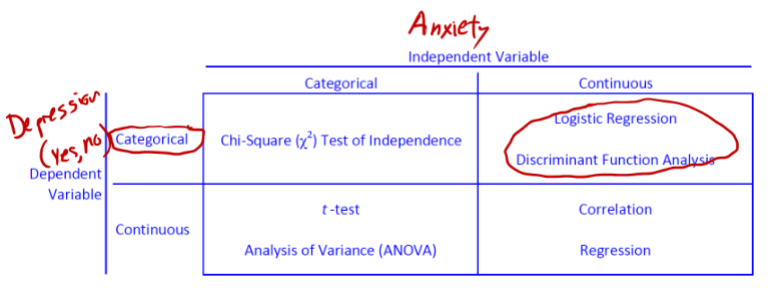
Selecting an analysis
Mean
can be sensitive to extreme scores
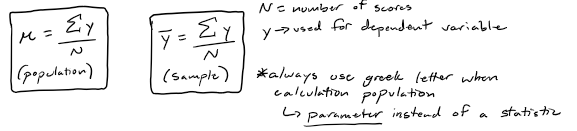
Median
The middle score in a set of ordered scores (the score with the same number of values above and below)
Mode
"where are scores most likely to be"
Most frequently occurring score
Most frequently occurring interval (histogram)
Histogram - break up number line into intervals (used in lab 1)
Score with highest probability density (top of the curve)
Range
max(y) - min(y)
Difference between the highest and lowest value
Limited while only describing two points in the data set
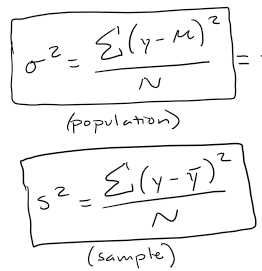
Variance
Average of the squared differences between score and population mean
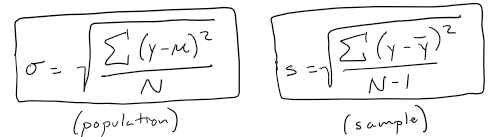
Standard deviation
Square-root of variance (back to the variable's original metric)
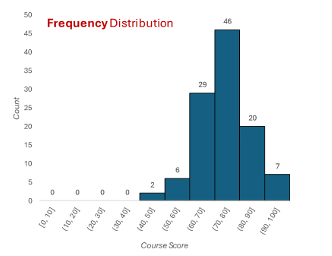
Frequency distribution
Heights of bars represent counts for the number of scores within each interval
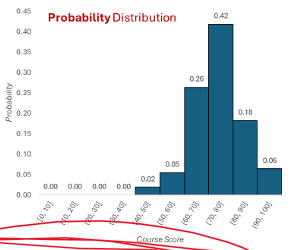
Probability distribution
Showing the scores in each interval as a proportion of the larger total number of scores
Probability density
used to describe the independent variable, integral to find area under curve to find probability
whole curve is the data, integral to find the probability of pulling a score from that certain range

Skew
asymmetry (the normal distribution is symmetrical)

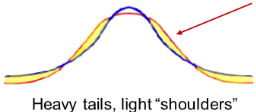
Leptokurtosis
more peaked than a normal curve
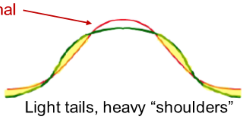
Platykurtosis
flatter than a normal curve
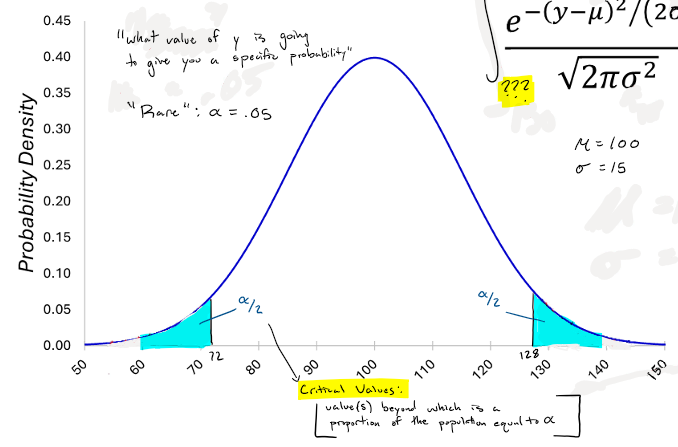
Definition of rare
alpha = .05
Distribution based probabilities
find probability within a specific range using an integral
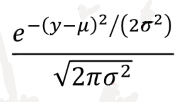
Critical values
value(s) beyond which is a proportion of a population equal to alpha
“what value of y is going to give you a specific probability”
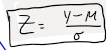
Standardizing equation
Z, simplified metric easier to understand
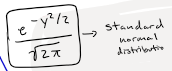
Standard normal distribution
Point estimates
specific point on the number line, precise, almost always wrong (at least a little)
no confidence that it’s the right answer
(ex. 5.7)
Confidence interval
less precise, much more likely correct
(ex. [5.4,6.0]
“Confidence”
stated as a percentage
90% confidence means that if a confidence interval is calculated for many, many samples, 90% of the samples’ confidence intervals will include the parameter being estimated
relationship between percent and confidence (C) and alpha
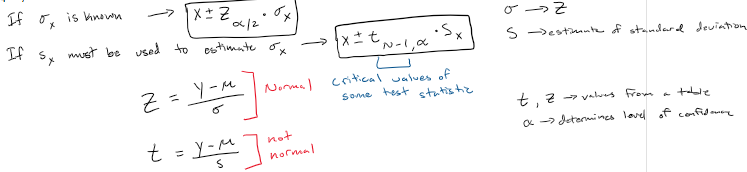
Confidence interval equation with sigma SD known and unknown
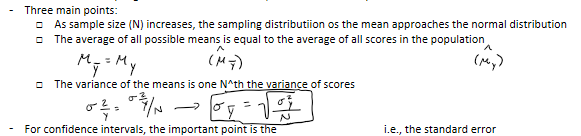
Central limit theorem
describes the sampling distribution of the mean, distribution of sample means
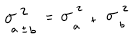
variance sum theorem
for any two unrelated (independent) variables a and b, the following relationship holds:
the variance of the sum or difference is equal to the variance of the sum
Significance testing
decision making tool to help figure out when we can make an inference
Goal of significance testing
Decision-making
Inference
i.e. deciding whether the observed results are strong enough to support a conclusion that the population from which the sample was drawn is different from the null population
If results support such inference, they are said to be "significant
Statistical significance vs. practical significance
Practical significance: a result is big, strong, or important
"the temperature dropped significantly over the weekend"
Statistical significance: a result supports the inference that an effect or characteristic exists in a population
Effects that are of great practical significance can be statistically non-significant
Effects that are of very little practical significance can be statistically significant
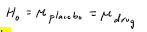
Null hypothesis
the absence of what we are looking for
Data
something we have seen/measures
Target
an effect or characteristic we are looking for
Probability
describes sample relative to null hypothesis
“low” p means” the observed data would be “rare” if the null hypothesis was true

Plum tree example:
We are tying to find a plum tree (target). Observe a tree with purple fruit
Null hypothesis (H): this type of tree is not a plum tree with purple fruit
Purple fruit would be rare among non-plum trees (if H were true, the observed date would be rare)
Conclusion: we reject the not-a-plum-tree idea (reject H) and conclude that we have found a plum tree (assume that the null hypothesis is right until proven wrong)
Focus on knowing what we know that the thing you're looking for does not exist or isn't true
Significance testing procedure
Define "rare" as an arbitrarily low probability (usually alpha = .05)
Specify a target - what are we looking for?
State the null hypothesis
collect data
Find the value of a test statistic (z, t, etc.)
Use the test statistic value to find a p-value or critical value
Decide: if p<a (or if, e.g. z(observed) > z(critical)), reject H
If H is rejected, describe result as "significant" and use descriptive statistics to describe the (estimated) population. E.g., "Symptom Severity is significantly lower among those who received the drug (ybar = 19) than among those who received the placebo (ybar = 73)
If rejecting then null hypothesis, that means that you found what you were looking for
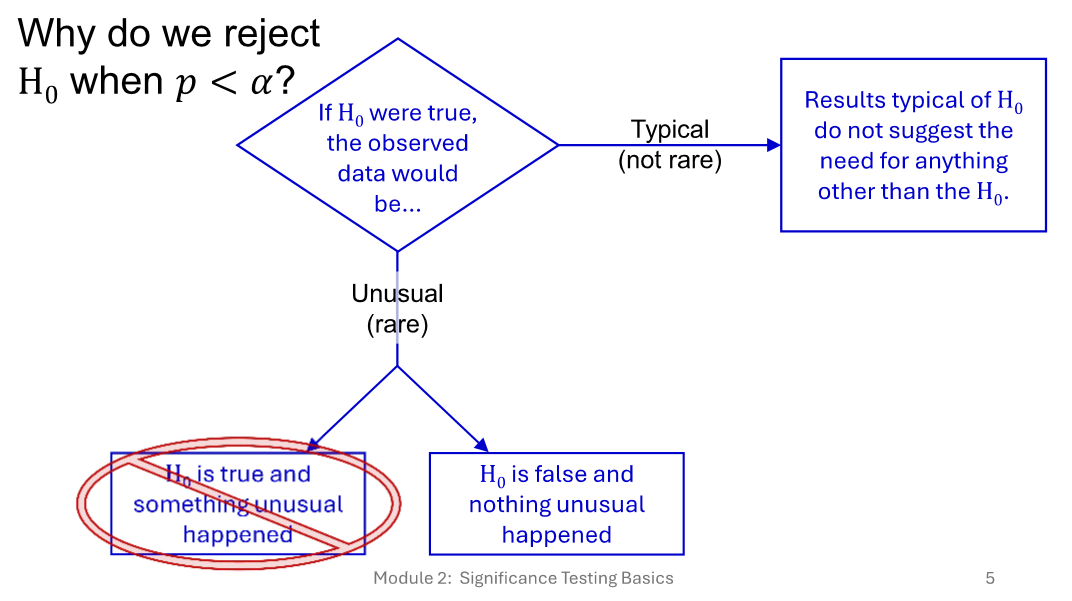
Why do we reject the null hypothesis when probability < alpha?
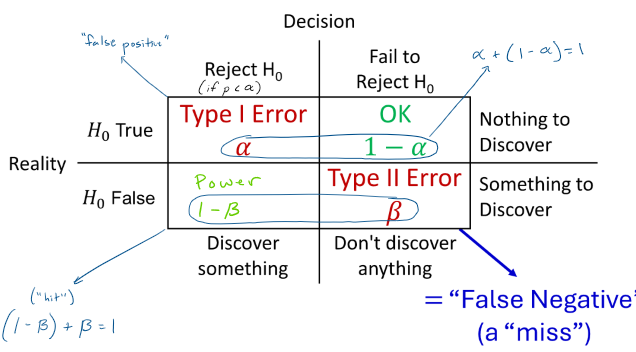
Outcomes: type I error, type II error, power, “ok”
Type I error:
reject null hypothesis, reality that null hypothesis is true
“false positive”
Type II error:
don’t discover anything, something to discover
“false negative”, a miss
power:
reject null hypothesis, reality that null hypothesis is false
“hit”
“ok”: fail to reject null hypothesis, nothing to discover
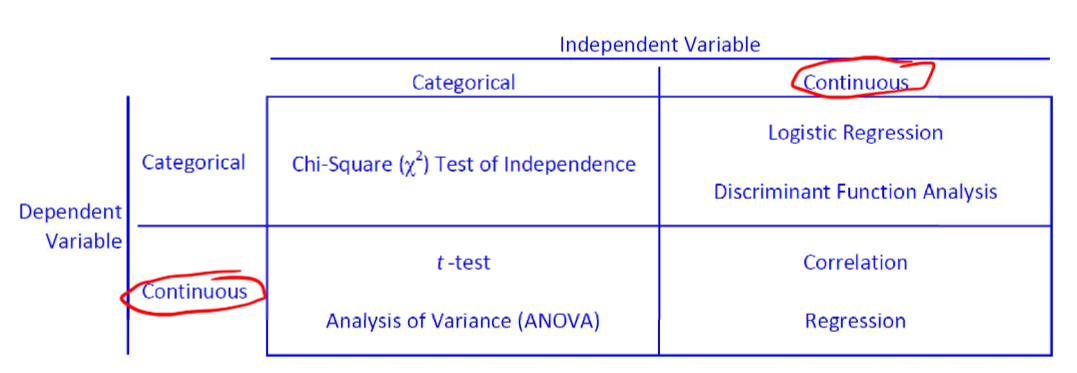
Selecting an analysis
Population variance equation

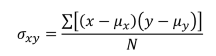
Population covariance equation
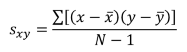
Sample covariance equation
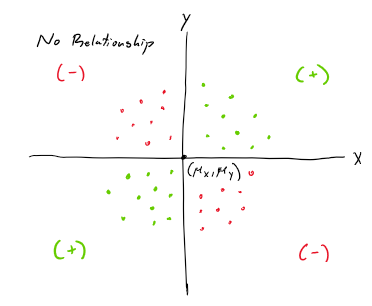
No Relationship scatterplot
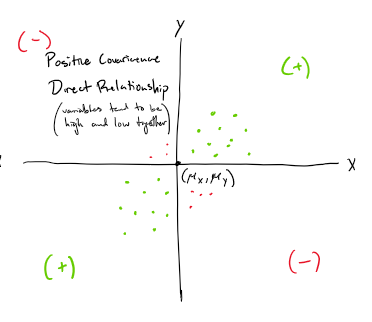
Positive covariance scatterplot
direct relationship
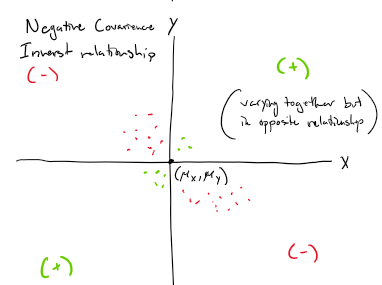
Negative covariance scatterplot
inverse relationship
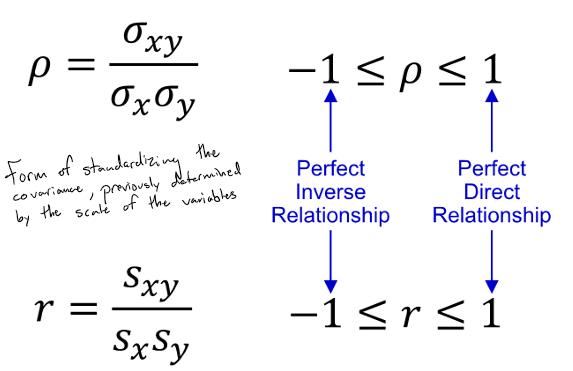
Correlation coefficient
form of standardizing the covariance, previously determined by the scale of the variables
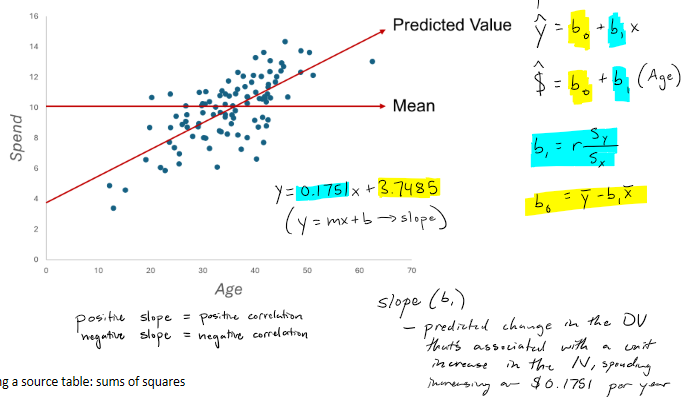
"Predicting" scores" mean vs. regression line
"I now want to be able to guess how much someone Is going to spend
Mean is always the best guess in the long run in general
Regression line
procedure of giving us a way to come up with a best guess, the predicted value
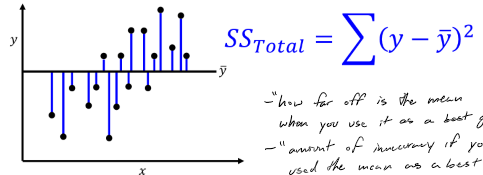
Sum of squares: total
“how far off is the mean when you use it as a best guess”
“amount of inaccuracy if you used the mean as a best guess”
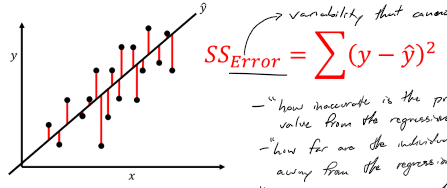
Sum of squares: error
variability that cannot be explained by the regression model
“how far are the individual values from the regression line”
“is it doing better then the mean at a best guess”
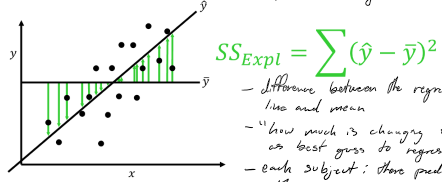
Sum of squares: explained
difference between the regression line and the mean
“how much is changing from mean as best guess to regression line as best guess”
each subject: the predicted value minus the mean
Source table
MS = mean square (average of the square deviations), another way of saying variance
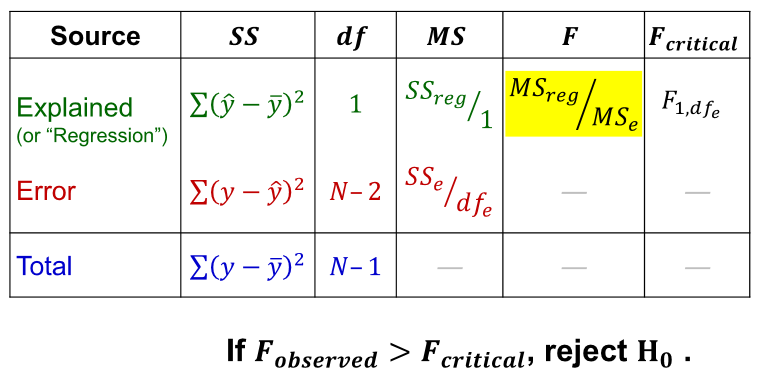
How to use F
F is used to test the null hypothesis, “the IV cannot predict the DV”

Regression assumptions
Linearity
for every line of the IV, all population DV means fall on the same line
Normality of errors
assume that their will be a normal variance of errors
homogeneity of error variance
population variance in the DV is the same for all levels of the IV
independence of errors
no two or more errors are similar to one another because they come from a common source
Selecting analysis: IV categorical, DV categorical
chi-square, test of independence
Selecting analysis: IV continuous, DV categorical
logistic regression and discriminant function analysis
Selecting analysis: IV categorical, DV continuous
t-test and/or analysis of variance
Selecting analysis: IV continuous, DV continuous
correlation or simple regression