Parasitology - EXAM 1
 Call Kai
 Learn
Learn Practice Test
 Spaced Repetition
 Match
Match Flashcards
 Knowt Play
1/49

Earn XP
Description and Tags
Intro and Nematodes - Lectures 1-5
Name | Mastery | Learn | Test | Matching | Spaced | Call with Kai |
|---|
No analytics yet
Send a link to your students to track their progress
50 Terms
Mutualism
Both species in the relationship benefit. (e.g. bird gets food between alligator’s teeth)
Commensalism
1 species benefits and the other doesn’t lose or gain anything (e.g. pilot fish feed off shark’s leftovers)
Parasitism
Parasite lives in/on organism (host) and thrives from it. (e.g. tick feeds off humans blood.)
Facultative Parasite
Acts like a parasite, but doesn’t always need a host.
Obligatory
Requires host to complete life cycle.
Endo-parasite
Lives IN a host, causing infection.
Ecto-parasite
Lives ON a host, causing infestation
Definitive Host
Host helps the parasites adult/reproductive stage.
Intermediate Host
Host helps the parasite’s larval/egg/asexual reproduction stage.
Vector
Can be either definitive or intermediate. Its goal is to transmit a parasitic pathogen from an infected host to an uninfected one.
Reservoir (host)
Animal/plant/environment that harbors a parasite/pathogen indefinitely, may not always show symptoms. Continuous source of infection.
Colonization
Infection agent in or on body, but not causing infection (e.g. lash mites).
Incubation
Time between exposure and appearance of first signs/symptoms.
Latency
Time from infection to being able to transmit infection.
Infection
Infectious agents (bacteria/fungi/parasites) entering your body and may cause infection.
Disease
Occurs after infection, being characterized by signs/symptoms of illness. Can also cause tissue damage, leading to pathological features/conditions.
Lytic Necrosis
Host tissue destruction where the parasite may penetrate the gut wall. In severe cases, it can penetrate the body wall.
Most parasites feed on the host’s body to survive.
True
Hookworms feed on 250μl of host blood daily.
True
Traumatic damage
Larva/adult migrating through the body and damaging host tissue.
Obstruction of Lumens
Blockage of tubes within the body (e.g Ascaris lumbricoides).
Eosinophilia
Increased production of eosinophils (WBC’s) to defend against parasitic infections.
Erythropoiesis
Increase production of RBC’s due to anemia caused by parasitic feeding.
Neoplasia
Uncontrolled proliferation of cells due to excessive tissue damage & repair caused by parasites.
Factors influencing intestinal helminth infections
Poor hygiene
Socioeconomic factors (e.g. poverty)
Host’s biological factors (e.g. health, immuno-competence)
Infrastructure issues (e.g. sewage, waste disposal)
Demographic factors (e.g. family size, population density)
Environmental factors (e.g. humidity, rainfall, intermediate hosts)
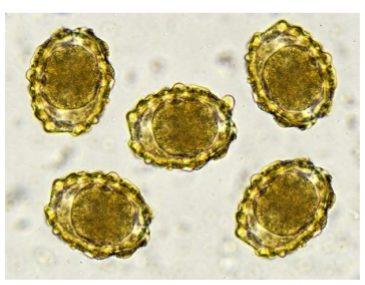
How many eggs do Ascaris lumbricoides females produce daily?
200,000
How does Entamoeba histolytica hyper-reproduce?
Nuclear division in reproductive cyst stage.
Helminths
Nematodes - Roundworms
Intestinal Helminth
Hookworm (Necator americanus OR Ancylostoma duodenale)
Blood & Tissue Helminth
Firey serpent (Dracunculus medinensis)