chem paper 1 past paper
 Call Kai
 Learn
Learn Practice Test
 Spaced Repetition
 Match
Match Flashcards
 Knowt Play
1/10

There's no tags or description
Looks like no tags are added yet.
Name | Mastery | Learn | Test | Matching | Spaced | Call with Kai |
|---|
No analytics yet
Send a link to your students to track their progress
11 Terms

how to tell if something is polar
1- EN difference = polar bond
2- bond dipoles = cancel out if symmetrical, if asymmetrical, dipoles do not cancel out (no NET difference)
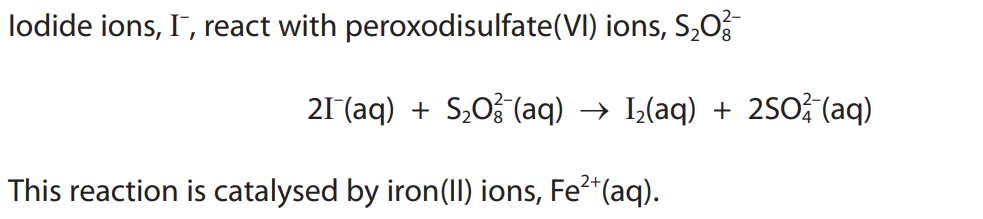
writing equations for catalysts
e.g.
1- find what is oxidised and reduced (S2O8 is reduced, I is oxidised)
2- Fe2+ will get oxidised by S2O82—→ 2SO42- + Fe3+
3- Fe3+ will get reduced by 2I- —> I2 + Fe2+
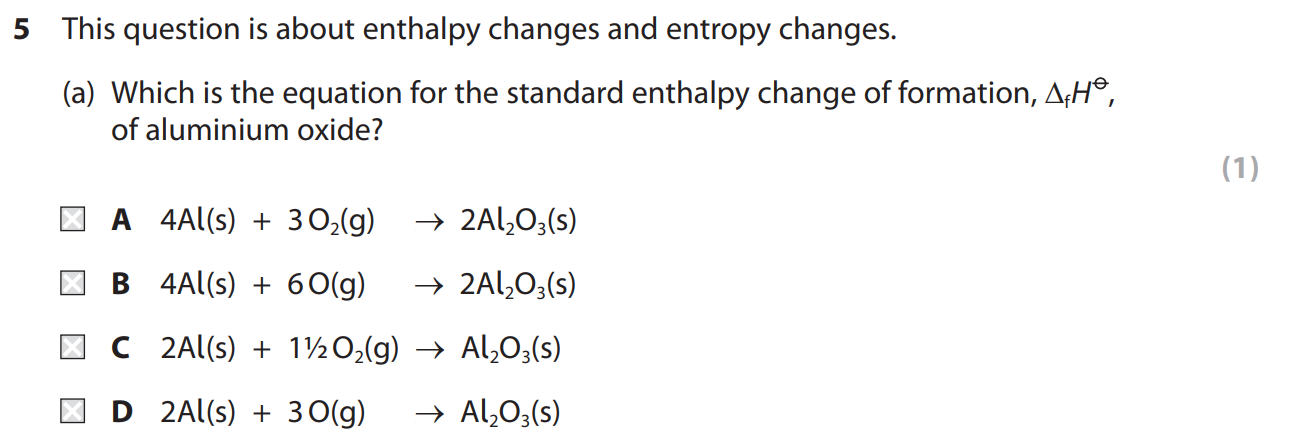
The answer is C - because Oxygen exists as O2 in standard state
ΔH -ve effect on temperature
releases energy (exo), temperature increases
-ve ΔH
exo, releases temp to surroundings
+ve ΔH
endo, absorbs heat energy from surroundings
why is ΔHneut smaller for weaker acids
partially dissociates in solution (add equation)
some energy is needed to break O-H bonds to release H+ ions
enthalpy change of neutralisation includes the enthalpy of dissociation of weak acid so it is less exo