The Effect of Temperature on Enzyme Controlled Reactions
 Call Kai
 Learn
Learn Practice Test
 Spaced Repetition
 Match
Match Flashcards
 Knowt Play
1/4

Earn XP
Description and Tags
https://www.youtube.com/watch?v=mvRtFCeWOZo
Name | Mastery | Learn | Test | Matching | Spaced | Call with Kai |
|---|
No analytics yet
Send a link to your students to track their progress
5 Terms
Why does rate of enzyme controlled reactions increase as temp increases
Kinetic energy increases of both enzyme and substrate, as they move more rapidly, there will be more frequent successful collisions with active site, causing rate of reaction to increase
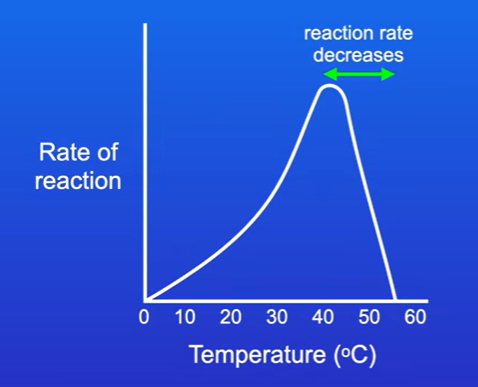
Whats optimum temp
Max number of collisions between substrate and active site, for humans it is around 40 degrees.
What happens if temp reaches past optimum
As temp increases past the optimum , rate of reaction decreases, this is because at higher temps, enzyme molecule vibrates more rapidly, causes bonds within enzyme to break, and so tertiary structure of enzyme molecules changes.
As shape of active site changes, its no longer complementary to substrate, and so enszyme denatured and doesnt function
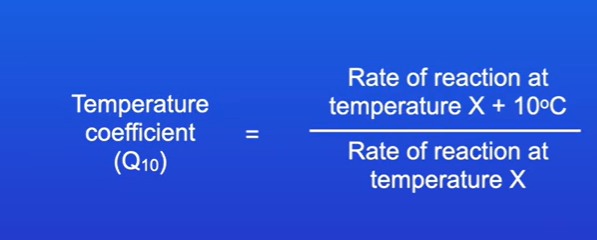
Whats the temperature coefficient (Q10)
Temp coefficient (Q10) = Rate of reaction at temp X + 10 degrees / Rate of reaction at temp X