Module 9: Diencephalon- Thalamus
 Call Kai
 Learn
Learn Practice Test
 Spaced Repetition
 Match
Match Flashcards
 Knowt Play
1/24

There's no tags or description
Looks like no tags are added yet.
Name | Mastery | Learn | Test | Matching | Spaced | Call with Kai |
|---|
No analytics yet
Send a link to your students to track their progress
25 Terms
which structure is one of the main structures comprising the diencephalon?
thalamus
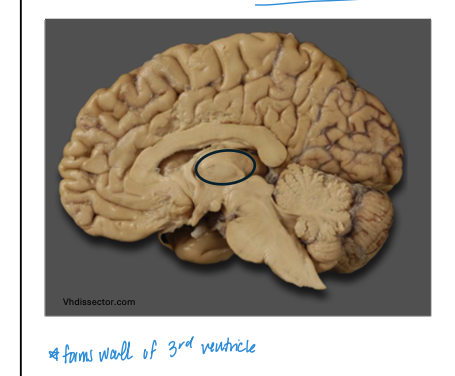
what are the boundaries of the thalamus?
anterior end forms the posterior boundary of the intraventricular foramen
posterior end overhands the superior colliculus of the midbrain
inferior surface is continuous with the tegmentum of the midbrain
medial surface forms the lateral wall of the 3rd ventricle
what connects the two thalamic hemispheres?
the interthalamic connection
what is the functional role of the thalamus?
is considered the relay station to the cerebral cortex, relays sensory info (VPL, VPM) motor info (VA, VL), and plays a role in memory and emotional functions of motor control through connections with the limbic system
what is the vascular supply of the thalamus?
originates from posterior circulation, the medial, lateral and posterior thalamic regions are supplied primarily by branches of the posterior cerebral artery and posterior communicating arteries
what is the primary neurotransmitter of the thalamus?
glutamate, which has excitatory influences on structures within the CNS
the thalamus receives direct input from every sensory system except which one?
the olfactory sense
which thalamic nuclei receive motor signals (including from the basal ganglia and cerebellum)?
the ventral anterior (VA) and ventral lateral (VL) nuclei
how is the thalamus subdivided by location?
divided into three major groups of nuclei: anterior, medial, and lateral groups
what is the role of the anteiror group?
receives info from the limbic system structures so has a role in attention, alertness, and memory acquisition
what is the role of the medial group?
integrates sensory, motor, visceral, and olfactory information and relates it to the person’s emotional state, functions similar to the pre-frontal cortex- affect and foresight
what is the role of the lateral group?
receives sensory and motor information
how is the thalamus subdivided by function?
three general functional groups:
relay nuclei (majority of thalamus)
association nuclei
nonspecific nuclei
what is the role of the association nuclei (pulvinar, anterior nucleus, and dorsal-medial nucleus)?
receive inputs from and transmit information back to the sensory and motor association areas of the cerebral cortex
what is the role of the nonspecific nuclei?
believed to be involved in general functions of consciousness and attention, limbic pathways and memory, and help our nervous system decide what to focus on amongst all signals being received
what is the primary function of the pulvinar nucleus?
processes visual information
what are the characteristics of the pulvinar nucleus?
largest and pillow shaped nuclei comprising of the posterior thalamus, receives input from the superior colliculus, hippocampus, and mammillary bodies, projects tot he visual cortex and visual association areas, and areas of temporal, parietal, and frontal lobes associated with visual function and eye movements
what group do the most clinically relevant nuclei fall into?
lateral nuclear group, these include VA, VL (for motor) and VPM, VPL, and lateral and medial geniculate nuclei for sensory
what information do the VPM and VPL relay?
somatic sensation, VPM receives somatosensory from the face via the trigeminal nerve, and VPL from the rest of the body
where are the medial and lateral geniculate nuclei located?
posterior portion of the thalamus
what is the function of the medial geniculate?
processes auditory information (input from inferior colliculus and outputs to the auditory portion of temporal lobe)
what is the function of the lateral geniculate?
processes visual information (input from superior colliculus and outputs to occipital lobe)
what is the role of the ventral lateral nucleus (VL)?
relaying motor feedback from the cerebellum to motor areas (important for coordination, timing, scaling of movement), and believed to be responsible for mild motor weakness and ataxic movements with thalamic strokes (L = cerebeLLum)
what are the inputs and outputs of the VL nucleus?
inputs from the cerebellum (dentate nucleus) and outputs to M1, PMA, SMA
what is the role of the ventral anterior nucleus (VA)?
modulates and relay signals between the BG and the PMA, plays a role in planning and initiating movement (ABG- asian baby girl)