H&M CH 7: External Forced Convection
 Call Kai
 Learn
Learn Practice Test
 Spaced Repetition
 Match
Match Flashcards
 Knowt Play
1/35

There's no tags or description
Looks like no tags are added yet.
Name | Mastery | Learn | Test | Matching | Spaced | Call with Kai |
|---|
No analytics yet
Send a link to your students to track their progress
36 Terms
Q: What is free-stream velocity?
A: The velocity of fluid far upstream from a body, unaffected by the presence of the body.
Q: What happens to fluid velocity at a solid surface?
A: It becomes zero due to the no-slip condition.
Q: What is drag?
A: The force exerted by a fluid on a body in the direction of flow.
Q: What are the two main components of drag?
A: Friction drag (skin friction) and pressure drag.
Q: What causes friction drag?
A: Shear stress along the surface due to viscosity.
Q: What causes pressure drag?
A: Pressure differences between the front and back of a body.
Q: Drag force acting on a flat plate parallel to the flow depends on…
wall shear only
Q: Drag force acting perpendicular/normal to the flow depends on…
pressure only
Q: What factors affect drag force?
A: Fluid density, velocity, and body size, shape, and orientation.
What is drag coefficient?

A: A dimensionless number representing drag characteristics of a body.
What is the relation between friction drag and pressure drag to get the drag coefficient?
The part of drag that is due directly to wall shear stress tw is called the skin friction drag (or just friction drag) since it is caused by frictional effects, and the part that is due directly to pressure P is called the pressure drag.

Q: What type of drag dominates at low Reynolds numbers?
A: Friction drag.
Q: What type dominates at high Reynolds numbers?
A: Pressure drag.
Q: What is a separated region?
A: A low-pressure region behind a body where flow recirculates.
Q: What is a wake?
A: The region behind a body where velocity is disturbed.
Q: Where are viscous effects most significant?
A: In the boundary layer, separated region, and wake.
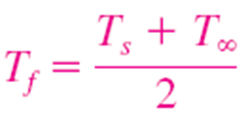
Q: What is film temperature?
A: The average of surface and free-stream temperatures used for property evaluation. It is used to find table A-15 Values to complete problems in chapter 6 and 7.
Q: What determines flow regime over a flat plate?
A: The Reynolds number
Q: What is the typical critical Reynolds number range for a flat plate?
A: Between 105 and 3 × 10⁶ and the generally accepted value for the Critical Reynold number is 5 X 10⁵
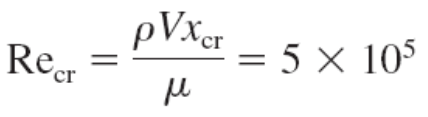
To use laminar flow equations, Reynolds number should be…
Re < 5 × 10⁵, w
To use turbulent flow equations, Reynolds number should be..
5 × 10⁵ ≤ Re ≤ 107
Q: How do heat transfer coefficients compare between laminar and turbulent flow?
A: They are higher in turbulent flow.
Q: How does heat transfer coefficient change along a flat plate?
A: It decreases with distance from the leading edge.
Q: How does uniform heat flux affect heat transfer compared to isothermal surfaces?
A: It increases values (~36% for laminar, ~4% for turbulent).
Q: What is an unheated starting length?
A: A region at the beginning of a plate where no heat transfer occurs.
Q: What complicates analysis of flow over cylinders and spheres?
A: Flow separation and wake formation.
Q: What contributes to drag on cylinders and spheres?
A: Both friction and pressure drag.
Q: When is friction drag dominant for cylinders?
A: At very low Reynolds numbers (Re < 10).
Q: How does surface roughness affect drag?
A: It generally increases drag in turbulent flow.
Q: Where is cross-flow over tube banks commonly used?
A: In heat exchangers.
Q: What are the two main tube bank configurations?
A: In-line (square arrangement) and staggered (equilateral arrangement).
Q: What is the characteristic length for tube banks?
A: The outer tube diameter.
Q: What affects heat transfer in tube banks?
A: Tube arrangement and turbulence created by upstream tubes
Q: When is a correction factor needed in tube banks?
A: When the number of tube rows is less than 16.
Q: What determines pressure drop across tube banks?
A: Friction factor and correction factors for geometry.
What is log mean temperature difference used for?

Calculating heat transfer in heat exchangers.