Systemic Lab Final
 Call Kai
 Learn
Learn Practice Test
 Spaced Repetition
 Match
Match Flashcards
 Knowt Play
1/103

Earn XP
Description and Tags
Something to look at
Name | Mastery | Learn | Test | Matching | Spaced | Call with Kai |
|---|
No analytics yet
Send a link to your students to track their progress
104 Terms
What are the reference ranges (i.e. normal ranges) for temperature, heart rate (also called pulse rate), and respiratory rate in an adult horse? In a foal?
Adult: 99-101.5 oF, 28-44 bpm, 8-15 brpm
Foal: 99-102 oF, 50-70 bpm, 20-40 brpm
What are the reference ranges (i.e. normal ranges) for temperature, heart rate (also called pulse rate), and respiratory rate in a young adult human?
Temp: 97.8 - 99.1 oF
HR: 60 - 100 bpm
RR: 12 - 18 brpm
What are the reference ranges (i.e. normal ranges) for temperature, heart rate (also called pulse rate), and respiratory rate in a Labrador Retriever-sized dog? A domestic cat?
Med dog: 100 - 102.8 oF, 60 - 100 bpm, 10 - 30 brpm
Domestic cat: 100 - 102.5 oF, 100 - 140 bpm, 20 - 30 brpm
What is capillary refill, and how is it assessed? What physiological information does it give you? Be prepared to demonstrate.
Capillary refill measures blood flow to tissues (peripheral perfusion), performed by pressing on an animal’s gums until they turn white and count how long it takes for the pink color to return. This assesses the efficiency of O2/nutrient delivery to tissues, blood pressure, reflecting the ability of the heart to pump blood, and a helpful indicator of hydration status.
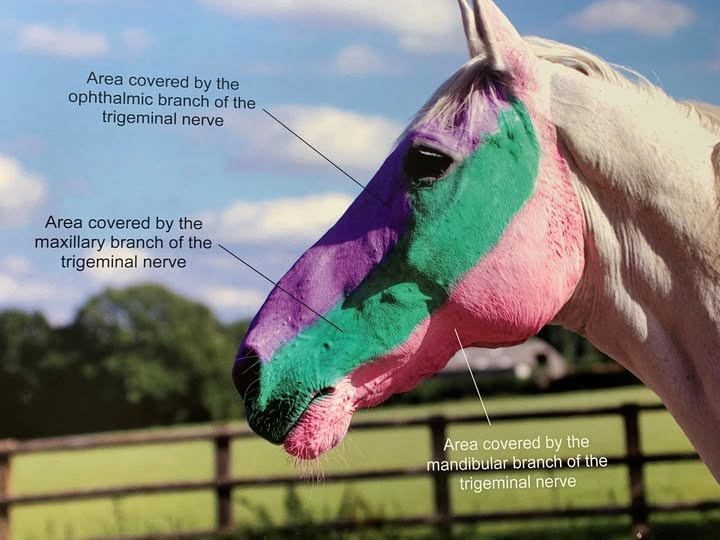
What are the 3 regions of trigeminal?
What is skin turgor, and how is it assessed? What infromation does it yield?
Skin turgor is the skin’s elasticity (ability to change shape and return to to normal), an important indicator of hydration status in an animal, one can assess skin turgor by pinching/lifting skin at scruff, then releasing it. Healthy skin returns to normal immediately. Skin that remains in the tent shape longer indicates dehydration.
What is the medical term for an abnormally high heart rate? A low rate?
Abnormally high HR = Tachycardia
Abnormally low HR = bracycardia
What is the medical term for a high respiratory rate
Tachypnea
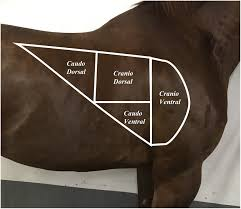
Sketch a horse and indicate the fields where one auscults the lungs. Cave art is fine!
Area inside the triangle formed by the should, loin, and elbow
What is sensorium? How do we asses it?
The parts of the brain or the mind that receive, process, and interpret sensory stimuli. To assess this we look for any abnormalities in alertness.
What is the first step of any examination?
Observe the animal from a short distance away, before you capture and halter it. Watch for any abnormalities in alertness, gait, and behavior
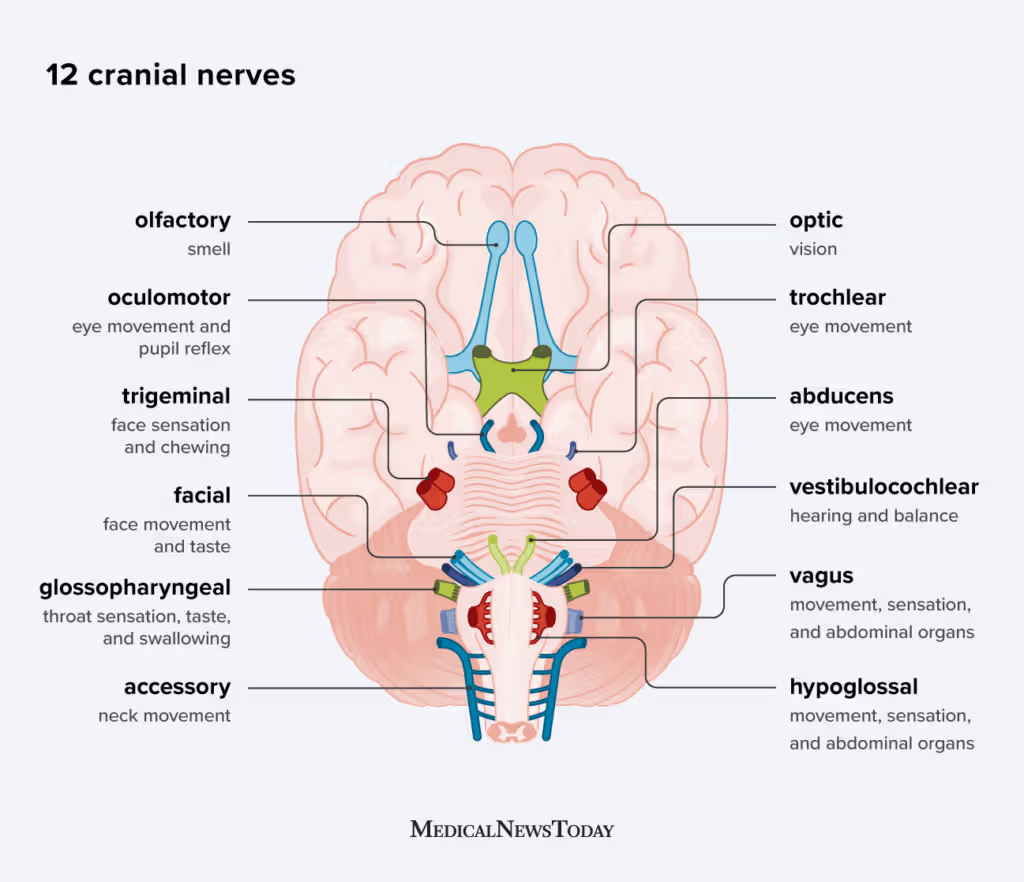
Label the 12 cranial nerves
What is the function for nerve I?
Olfactory nerve function:
Sensory - nose/smell
What is the function for nerve II?
Optic:
Sensory - eye sight
What is the function of nerve III?
Occulomotor
motor: All eye muscles excepth the ones supplied by IV and VI
What is the function of nerve IV?
Trochlear
Motor - Eye movement from the superior oblique muscle
What is the function of nerve V?
Trigeminal
Sensory - face, sinuses, teeth
Motor - jaw muscles
What is the function of nerve VI?
Abducent
Motor - Eye movement from the external rectus muscle
What is the function of nerve VII?
Intermediate/Facial nerves
Motor - submaxilary and sublingual gland
Sensory - Front of tongue and soft palate
Motor - muscles of the fact (Specifically facial??)
What is the function of nerve VIII?
Vestibulocochlear
Sensory - hearing and balance
What is the function of nerve IX?
Glassopharyngeal
Motor - swallowing with pharyngeal musculature
Sensory - Taste and sensation on back part of tongue, tonsil, and pharynx
What is the function of nerve X?
Vagus
Motor - heart, lungs, bronchi, and gastrointestinal tract
Sensory - heart, lungs, bronchi, trachea, larynx, pharynx, gastrointestinal tranct, and external ear
What is the function of nerve XI?
Acessory
Motor - shoulder muscles
What is the function of nerve XII?
Hypoglossal
Motor: muscles of the tongue
What are the three parts that make up the brain stem?
Midbrain
Pons
Medulla Oblongota
How are the 3 parts of the brainstem arranged from rostral to caudally? Label them.
Rostral - Towards the nose
Caudal - Towards the tail
Rostral to Caudal:
Midbrain
Pons
Medulla oblongota
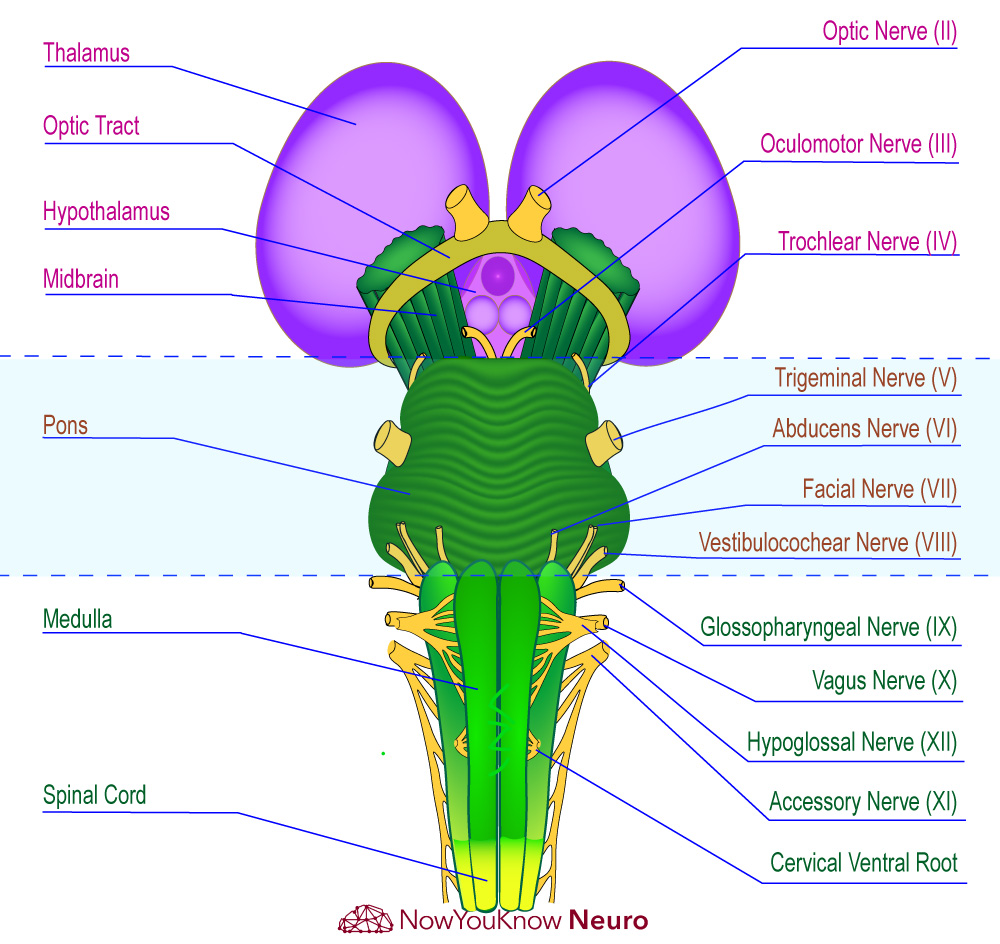
Why is the way the cranial nerves are arranged important?
Since the nose is the foward-most structure in the body, the nerves supplying it are the forward-most in the brainstem. As you work caudally along the face and gead, the corresponding cranial nerves supplying the various areas of the face and head will arise at progressively caudal points along the brainstem.
True or False: The Cranial nerves are part of the central nervous system
False; the crainial nerves are a part of the the peripheral nervous system even though they supply sensory and motor function to structures on the cranium.
What makes up the central nervous system?
The brain and spinal cord
Where do the cranial nerves arise from?
Brainstem/ventral surface of the brain
How do you evaluate the mental status of a horse?
Evaluate for normal and abnormal behavior such as head pressing, manic circling, depression, lethargy, stupor, or coma
If the horse is in good mental health what would we wrte?
BAR, normal behavior
What does BAR stand for?
Bright
Alert
Responsive
How do we evaluate CNI?
Take a cotton swab soaked in rubbing alcohol and place next to nostril with horse’s eyes covered; observe behavioral response of the horse. See if it could smell it.
True or False: CN I cam be easily assessed.
False; the olfactory nerve can be difficult to reliably assess as its function is a special sense, and evaluation of smell is subjective.
How do we assess CN II?
Take an object such as a horse treat or a handful of hay and drop it to the ground with the horse watching. Each optic nerve can be tested using a blindfold (Cover an eye). Record response.
Perform the menace response test by abruptly flashing your hand toward the eye of the horse, and observe withdrawal of the head and blinking. Record response
Perform the pupillary light response by shining a light in the eye and observing the pupils on both the eye that you tested (direct) and the contralateral (the opposite side of the body) pupil (indirect). Record response.
True or False: An optic nerve assessment of vision can be unreliable to assess the health of CN II.
True; optic nerve assessment of vision can be unreliable because of the subjective nature of evaluation.
Whar other CNS structure is evaluated when a horse blinks its eyes and moves its head away during a menace response?
Motor cortex
Cerebellum
How do you evaluate CN III?
Occulomotor nerve assessment
Record function using the pupillary light reflex, as well as pupil size, eye position, and eye movement. Evaluate eyelid position as normal, or ptosis.
What are somes ways we could describe the pupil size?
Mydriatic - Dilated pupils that are abnormally large or wide
Miosis - Constricted pupils that are abnormally small or narrow
Anisocoria - Pupils are not of the same size
Normal
What are some ways we can describe eye position?
Central
Dorsal - Top of the eye
Ventral - Bottom of eye
Medial - Close to nose
Lateral - Towards the ears/side
What ways do we describe the eyelid?
Normal
Ptsosis - Drooping eyelid
Write out your assessment for this patient: Dilated pupils, pupil in center of the eye, droopy left eyelid, normal eye movement when head was moved from side to side
Patient _ was determined to have central, mydriatic eyes that exhibited normal eye movement response. Patient also has ptosis in OD.
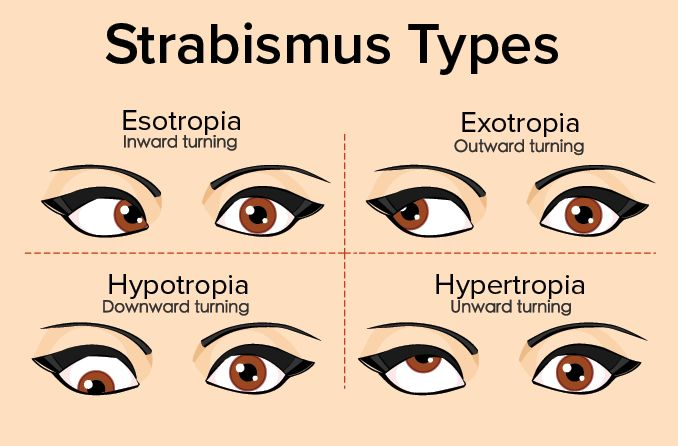
Define strabismus and sketch one example:
Eye misalignment
What extraocular muscle/s does CN IV supply?
Superior oblique muscle
How do you recognize dysfunction of CN IV?
If you move the head and the eyes don’t follow then CN IV is not in-tact.
How do we assess CN V?
The trigeminal nerve can be assessed by testing cutaneous sensation of the head and motor function to the chewing muscles
Sensory assessment is performed by the palpebral blink response to touch at the medial canthus of the eye; observe the blinking and record.
Motor function is assessed via observation of chewing and the size & symmetry of the masticatory muscles on the cheek. Record whether your patient’s muscles of mastication are symmetric, asymmetric, and normal or decreased in size.
If the CN V was in-tact was assesment should we get from the cutaneous sensation test.
Palpebral reflex present
Successful and symmetrical mastication of hay
Normal mastication with related muscles
How do we assess CN VI?
Assess whether there is no lateral movement of the eye (globe). Move horse head away from you while stationary and watch the position of the globe carefully.
Eye posisrion is also judged with respect to abnormal protursion e.g. bulging, normal, or withdrawn into the depths of the bony orbit. Record results
True or False: Assessing the abducent nerves with a lateral movement test takes some close observation and practice.
True
What muscle does CN VI innervate?
External rectus muscle
If you exhibited normal activity during CN VI testing what should you write.
CN VI intact
Lateral movement of globe in response to head movement
No abnormal protrusion/withdrawing
How do we assess for CN VII?
Assess the horse’s face from a head-on position for symmetry of the horse’s facial expression, ear position and movement, blink response, and muzzle movement. Does one eyelid droop lower than the other, when the horse is viewed from a cranial perspective? Are the ears held equally erect? Is muscle tone in both side of the upper lip equal?
If the CN VII was intact what would we write?
Bilateral symmetry
How do we assess CN VII?
The vestibulocochlear nerve is evaluated by challenging and observing posture, balance, and hearing.
Make a loud noise from a few feet away by clapping or shaking a key chain, and observe the horses response. Record result
Evaluate position of the head as normal or tilted to one side
Evaluate eye position as normal or displaced and describe direction
Push your horse and see if balance is recorrected
Attempt to have horse follow a movement from left to right with just its eyes
What is nystagmus?
Shifting of the eye back and forth
True or False: Physiological nystagmus is normal and necessary for normal ocular function.
True; Physiological nystagmus is normal while spontaneous nystagmus in an animal is neurologically abnormal.
How do we look at nystagmus in humans?
Tell a person to follow this pen with just there eyes moving it left and right or up and down
If the horse has an intact CN VIII what would you write?
Responsive to noise
Corrects posture when pushed
normal head position
Normal eye position
How do we assess CN IX?
The glossopharyngeal nerve is assessed by observing motor and sensory functions of the pharynx and larynx
Observe the horse chewing and swallowing of food or swallowing water. Record as normal or unable to swallow
Listen to voice to determine if it is altered (whinny)
Listen for abnormal airway noises when horse is exercised
What is the medical term for difficulty in swallowing?
Dysphagia
Why can you hear abnormal airway noises if you observe a horse at exercise with a damage CN IX?
When CN IX is damaged the arytenoid cartilages will not fully abduct and a loud rattling or roaring sound is heard during breathing.
True or False: Observing chewing and swallowing only assesses CN IX.
False; this actually aseesses a combination of cranial nerves.
If you horse had an intact CN IX what would you write?
Normal chewing, swallowing, no abnormal airway noises
How do we assess CN X?
Assessment is performed via the feeding test as described for CN IX.
What does CN X do unlike any other CN?
The vagus nerve sends many branches outside the cranium to multiple structures in the thorax and abdomen, thereby providing the parasympathetic nerve supply to most of the body.
Larynx and Pharynx are the local functions of the vagus nerve.
If you horse had an intact CN X what would you write?
Normal chewing and swallowing, HR, RR, and normal GI noises.
How do we assess CN XI?
The spina accessory nerve is assessed through observation of cervical muscles and upper shoulder musculature as judged by the presence or absence of atrophy or assymetry. Record.
If you horse had an intact CN XI what would you write?
No asymmetry or atrophy of cervical and upper shoulder musculature
How do we assess CN XII?
The hypoglossal nerve is assessed by observation or manipulation of the tongue
Gently grasping the tongue, pull it to ones side of the mouth and then the other gently. Judge whether the muscle strenth is normal or abnormal (e.g. paralyzed).
When the tongue is pulled to the side of the mouth, does the horse retract in instantly
How do you safely put your hand into the horse’s oral cavity?
Enter from the side, in the area of the diastema
If you horse had an intact CN XII what would you write?
Upon pulling the tongue, the horse tried to retract it. Normal muscling
Immediate retraction upon release of tongue
How do we evaluate general body muscle tone and spinal reflexes?
Cutaneous trunci response
Tail tone check
Perineal tone check
Stimulate horse’s skin with a pen/blunt object on one side, starting at the head, moving along to the neck, and down along the side until you reach the tail.
Evaluate the panniculus reflex
How do you do assess specifically tail tone?
Evaluate tail tone by manipulating the tail with your hand (warn horse before doing). Record the tail tone as normal or flaccid
Hoe do you evaluate the panniculus reflex?
Skin movement over the shoulders and back in response to a touch stimulus
How do you evaluate the perineal response
Touch the butt (a***) and observe for a constriction response. Record.
If you horse had good general body muscle tone and spinal reflexes what would you write?
Normal tail tone, perineal response. Panniculus reflex present
How do we evaluate the gait and posture of the horse?
Make note of head position. Normal or displaced
Do a basic gait analysis by walking the horse in a straight line, circle on a short lead in both directions, and then perform foot placement tests.
Try picking up the left forelimb and crossing it over in front of the right forelimb and record the response. Did the horse replace the limb back to normal position promptly
Test for proprioception, which refers to position sense, an awareness of where the limbs are in relation to the trunk
What is the term for an incoordinated gait with sloppy limb placement?
Ataxia
How do we test for propioception?
Test for propioception include the limb placement test, circling to assess for circumduction, walking with the head elevated, and tail-pull test. Perform these assessments in your horse and record observations.
If the horse has a normal gait and posture what would you write.
Tail pull test: Muscles engaged, remained general balanced
Replaced feet back in place during limb placement test (both forelimb/hindlimb)
Define sinus rhythm
A sinus rhythm is the normal, healthy rhythm of the heart, where electrical impulses originate in the sinoatrial (SA) node (the heart's natural pacemaker) and travel in an organized, predictable pathway
Normally a steady, consistent sequence of “lub-dup-lub-dup”
What does the sinus rhythm indicate?
Sinus rhythm indicates that the SA node is setting the tempo, as is normal
How do we assess sinus rhythm?
Listen carefully to your horse for 10 to 15 seconds or longer and ascertain whether you hear anything different from this rhythm.
True or False: Some levels of heart block is common in horses because they have relatively high resting vagal tone
True;
What effect does a relatively high resting vagaltone have on the SA node?
High vagal (parasympathetic) tone significantly slows the SA node's intrinsic pacemaker rate and can intermittently stop its firing entirely. This overdrive of the vagus nerve leads to sinus bradycardia (a slower resting heart rate) and frequently causes temporary pauses in SA node activity, manifesting as first- or second-degree atrioventricular (AV) block.
What is a common finding in most animals when it comes to sinus rhythm?
Most animals have a rhythm called normal sinus arrhythmia where during the inspiratory phase of breathing, the heart rate speeds up slightly, and then slows during expiration.
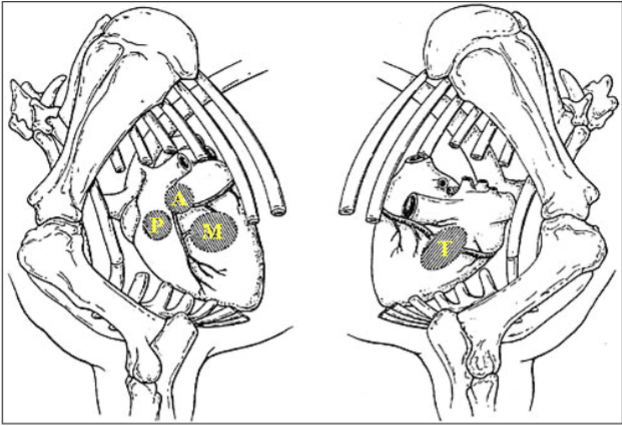
If you heard a murmur, how would you determine which valve might be involved?
Left side of the horse, auscult the pulmonic valve in intercostal space 3, the aortic valve in intercostal space 4, and the mitral valve in intercostal space 5.
On the right side, auscult the tricuspid valve in the 3rd intercostal space.
The horse heart is large enough that murmurs involving one valve can be correctly ascribed to the correct site and differentiated from murmurs in another valve by careful auscultation.
Identify the the intercostal spaces and their associated valves
Intercostal space: Spaces between ribs starting from most cranial rib
Intercostal space 3 - Pulmonic valve (Left side), Tricuspid valve (Right side)
Intercostal space 4 - Aortic valve
Intercostal space 5 - Mitral valve
What is the Lub sound associate with? The Dub sound?
Lub - AV valve closure (during ventricular contraction - systole)
Dub -Semilunar valve closure (During ventricular relaxation - diastole)
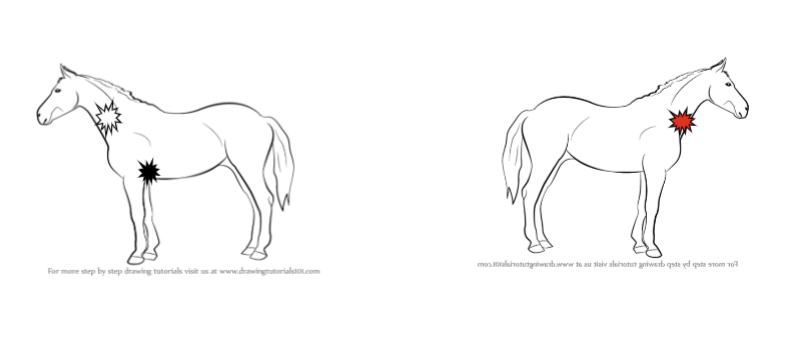
Map where the black, red, and white ECG leads go on your horse on the figures below
Two on the left
White on the ventral groove
Black by heart
One on the right side
Red on ventral groove
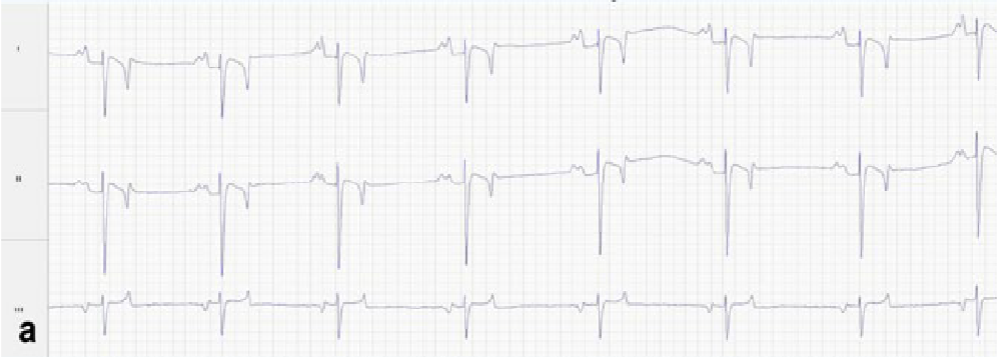
Label the P wave, QRS complex, and T wave. Explain what each wave represents.
p-wave: Represents atrial depolarization (interatrial flash of depolarization + flash to AV node), caused by firing of the SA node
QRS Complex - Represents ventricular depolarization (atrial repolarization also takes place here but is masked by the larger ventricular depolarization)
T wave - Represents ventricular repolarization following depolarization
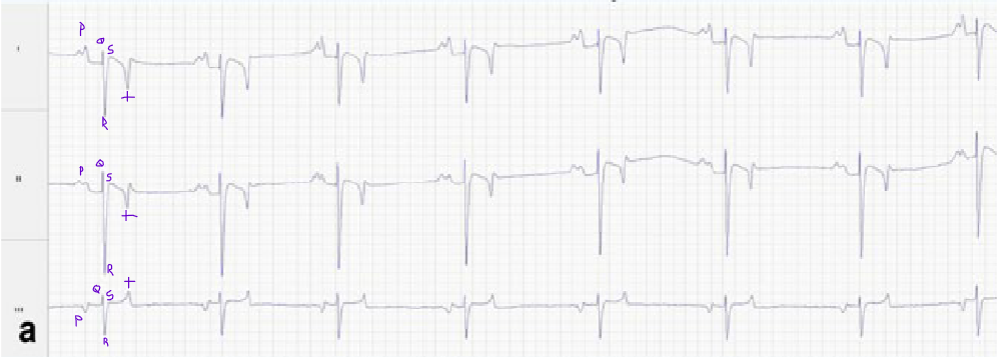
What should you paper speed be when doing an EKG for a horse?
25 mm/sec
What is detomidine?
Detomidine is a potent, non-narcotic (does not induce sleep) a2-adrenergic agonist used in veterinary medicine as a sedative and analgesic (pain reliever). It is primarily prescribed for horses and cattle to facilitate minor surgical, diagnostic, and routine grooming procedures.
In the Brain and Spinal Cord (Central Nervous System): It inhibits the release of norepinephrine. This suppression decreases the firing rate of neurons, producing profound sedation, pain relief (analgesia), and muscle relaxation.
In the Heart and Blood Vessels (Peripheral Nervous System): It decreases sympathetic nervous system output, which temporarily raises blood pressure and then causes a steady decline, while significantly slowing the heart rate.
Where do you administer detomidine?
Intravenously in the jugular vein
What occured a couple minutes after the detomidine injection?
Dropped QRS value
Transient AV node block becomes more pronounced upon sedation, heard on stethoscope and confirmed on eCG (p-wave has two bumps instead of one incline
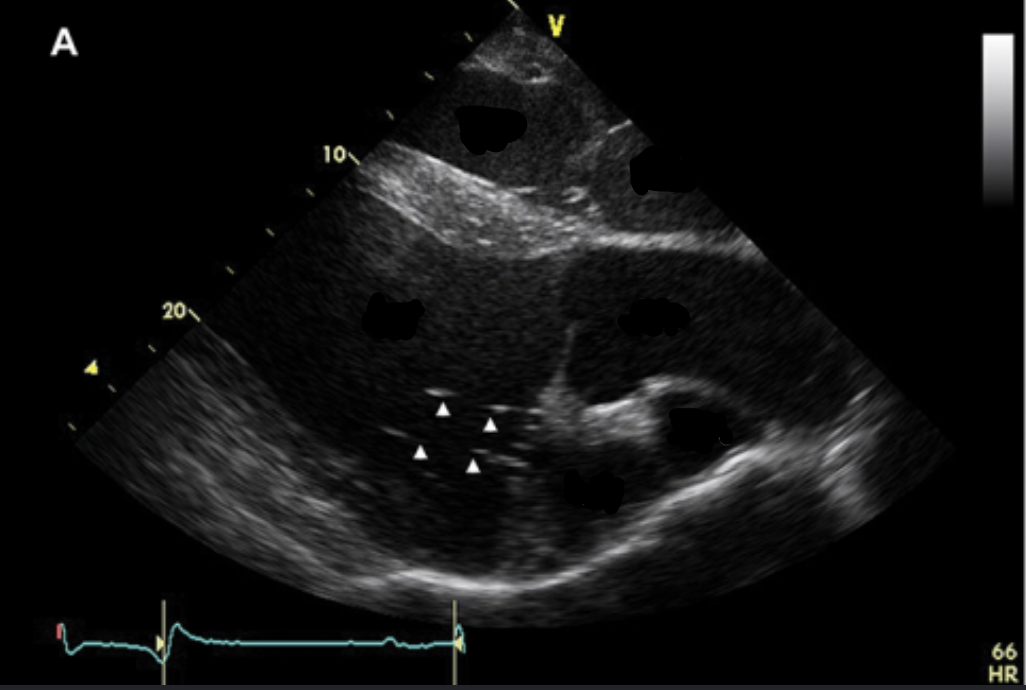
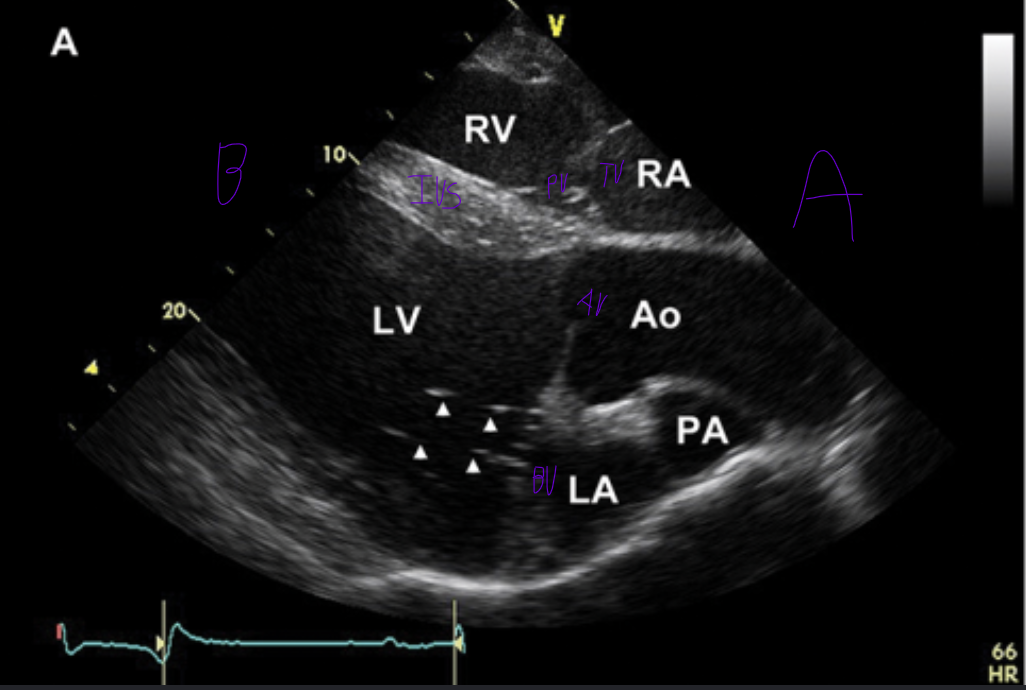
Label the for chambers of the ultrasound image, the AV valves, the cardiac base, and the apex
Briefly describe the autonomic dual innervation of the heart. How is the sympathetic input carried to the SA node, and how is PSNS input carried there? (i.e. which nerves, and from where in the CNS do they originate?)
Nerves T1-T5 (from thoracic section, cell bodies in lateral horns of cord, of spinal cord) - SNS input to SA node
Medulla oblongata of brainstem → Vagus nerve (CNX) - PSNS input to SA node
Define inotropy and Chronotropy
Inotropy - Contraction force
Chronotropy - Contraction speed
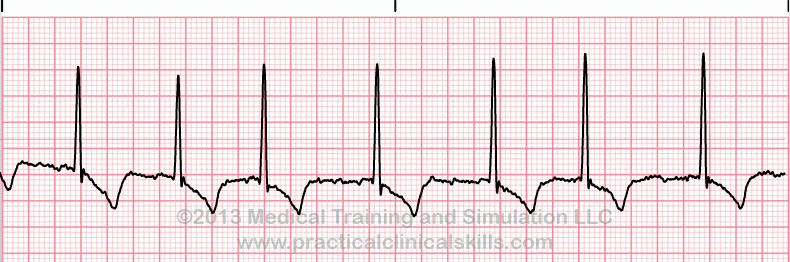
Make a sketch of an ECG from a patient with atrial fibrillation (it looks the same in all species). How does this trace differ from one of normal sinus rhythm?
No p-wave visible
Replaced by rapind, chaotic fibrillatory (F) waves
Due to the chaotic, disorganized beating of the atria depolarization occurs