Eukaryotes Fungi, Algae, Protozoa Ch. 12 PART 2
 Call Kai
 Learn
Learn Practice Test
 Spaced Repetition
 Match
Match Flashcards
 Knowt Play
1/30

There's no tags or description
Looks like no tags are added yet.
Name | Mastery | Learn | Test | Matching | Spaced | Call with Kai |
|---|
No analytics yet
Send a link to your students to track their progress
31 Terms
Taxonomy of Algae
Unlike many of the microbial groups we've seen, the algae are not strictly a taxonomic group.
• Rather they are any organism (unicellular or otherwise) that are photoautotrophs that live in aquatic environments …..basically, not trees and land plants….
• They need water for their growth and reproduction.
• They lack roots, stems, and leaves.
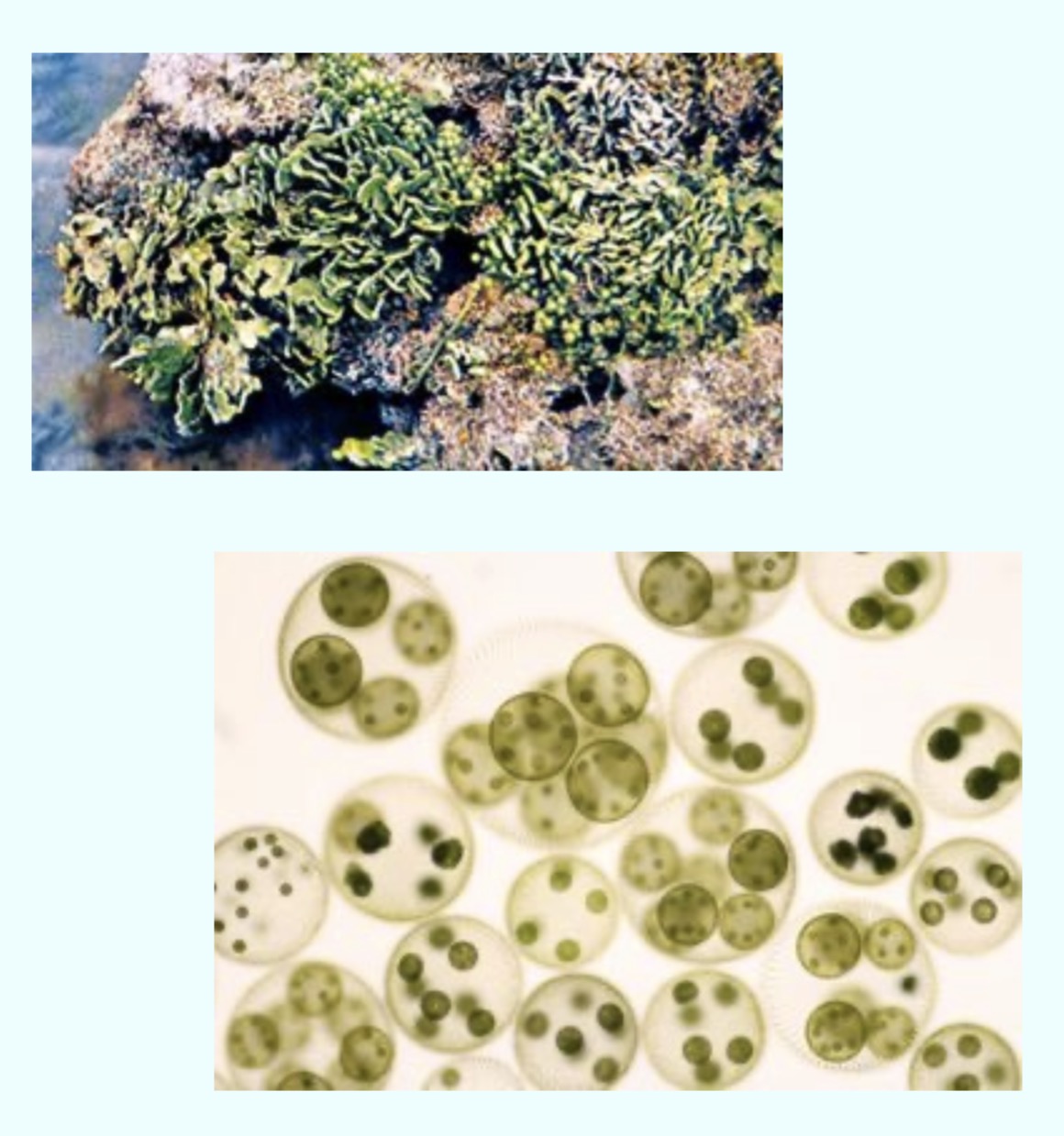
What is this?
Algae
What does algae include?
• Given this broad definition algae include things like seaweeds + microscopic algae.
• The seaweeds include members of the: Phaeophyta (brown), Rhodophyta (red), and Chlorophyta (green)
• In general algae are found throughout the photic zone of aquatic habitats.
• Photic zone = top layer of water that receives enough light for photosynthesis. - may be found anywhere above minimum part where there is no light
• They also have various molecules for harvesting light E.g. chlorophyll a and other pigments.
• Their pigment composition often reflects where they occur within the photic zone.
Sunlight in Aqueous Ocean Environments
Blue colours can penetrate deeper- blue microbes can be found in open ocean
In the costline- greener light can penetrate more
Algae…Remote Sensing
• Scientists also use pigments/colors to remotely monitor algae.
A limit of this technology is clouds blocking the areas
Select Algae Phyla
focus is on the microscopic algae
Some of the common microscopic algae that one is likely to encounter are:
• Chlamydomonas: model organism (often found in freshwater, damp soil, ocean)
• Euglenoids; for e.g. Euglena and Eutreptiella: common in the environment
• Have an 'eyespot' and flagellum to seek out light.
• Not all euglenoids have eyespot though.
• Some are non-photosynthetic protists.
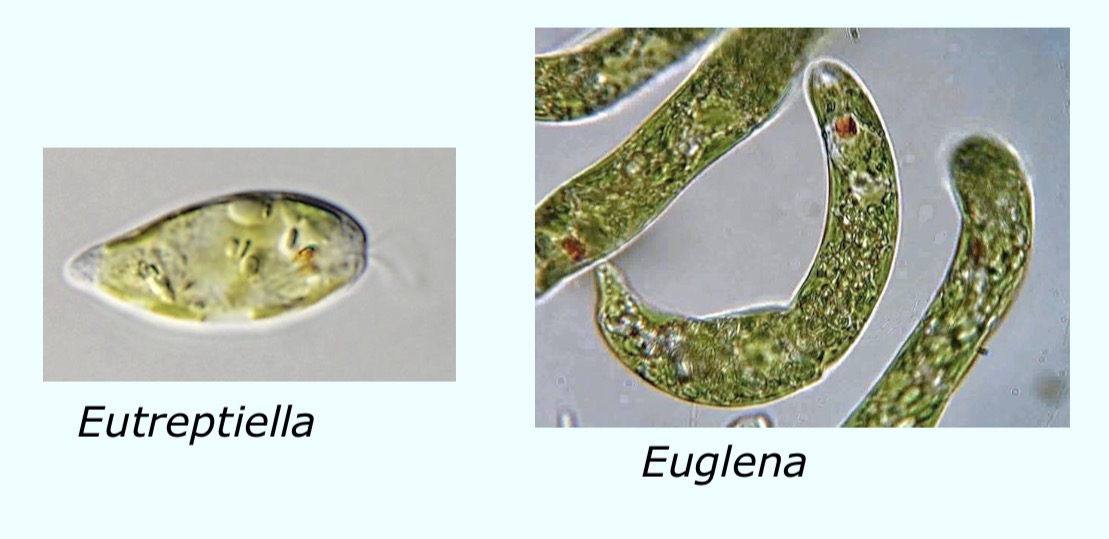
What are these?
Euglenoids; for e.g. Euglena and Eutreptiella: common in the environment
• Have an 'eyespot' and flagellum to seek out light.
• Not all euglenoids have eyespot though - you can see eyespot in the first photo
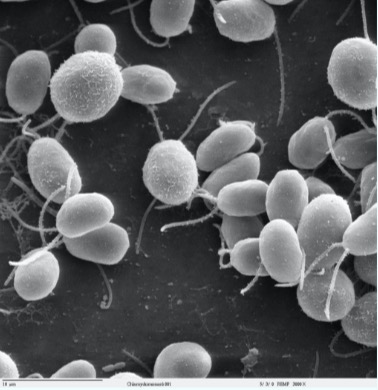
What is this?
Chlamydomonas: model organism (often found in freshwater, damp soil, ocean)
Diatoms
Microscopic algae
Have silica in their cell walls
Use this feature to form shells (frustules)
Common diatoms in the ocean include: Chaetoceros, Fragilariopsis, & Minidiscus
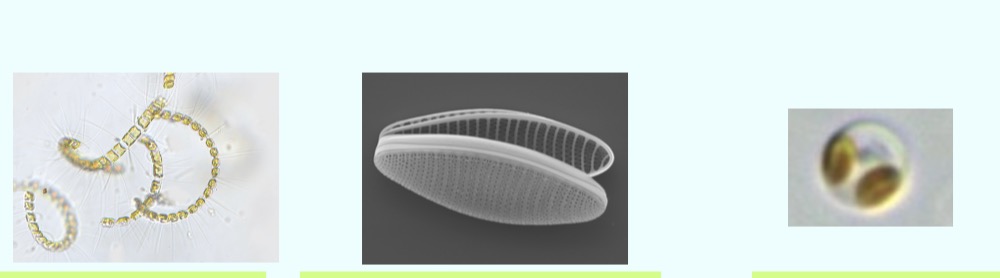
What are these?
Common diatoms in the ocean: Chaetoceros (chain is green from chlorophyl), Fragilariopsis, & Minidiscus (teenytiny)
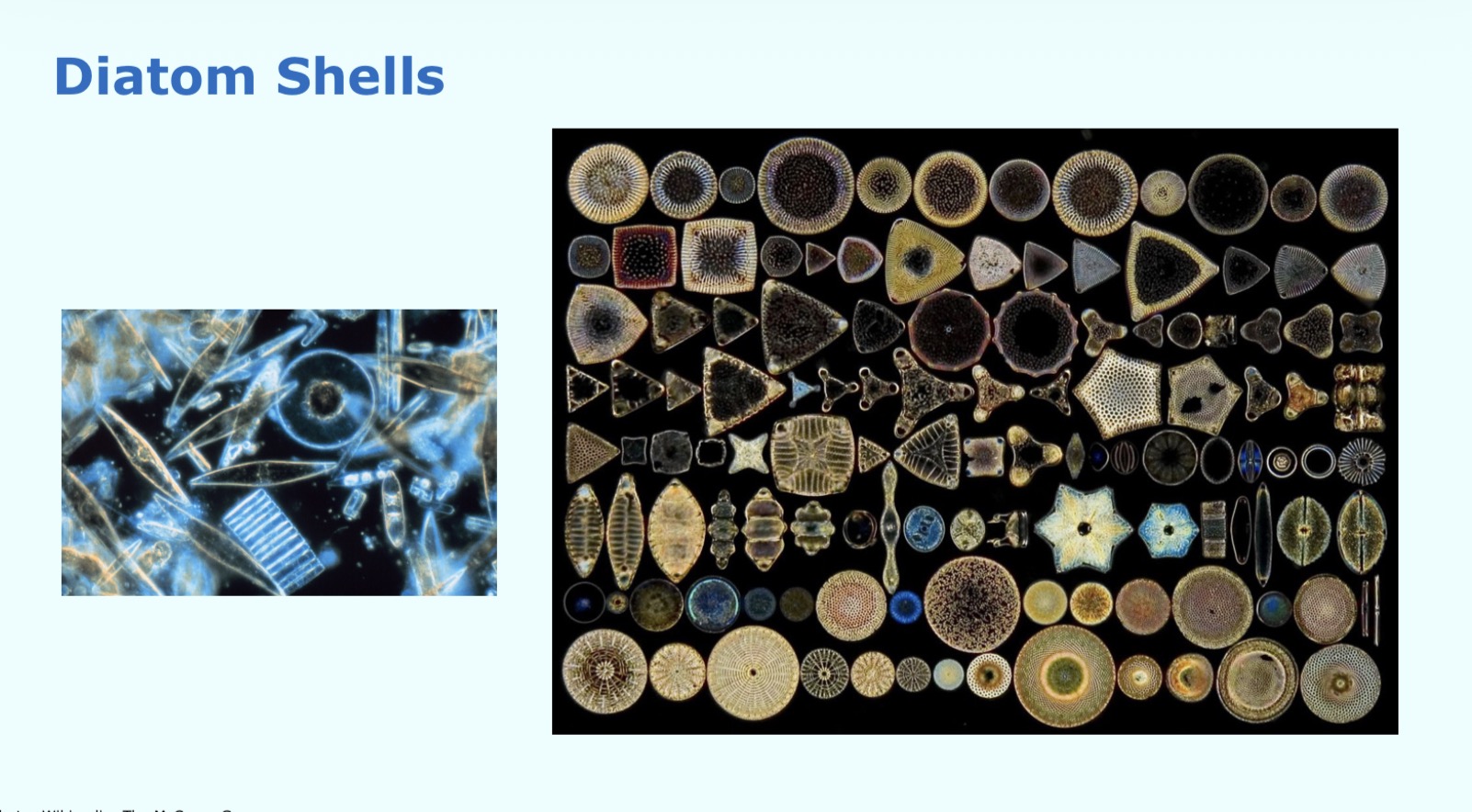
Explain this
Diatom shells
dinoflagellates.
Another common group are the dinoflagellates.
• These are also unicellular….however, note that not all are photosynthetic.
• Those that are motile typically have two flagella.
• Some dinoflagellates also generate neurotoxins (saxitoxins) that can cause paralytic shellfish poisoning.
• Common dinoflagellates include: • Ceratium: widespread • Dinophysis: linked to HABs
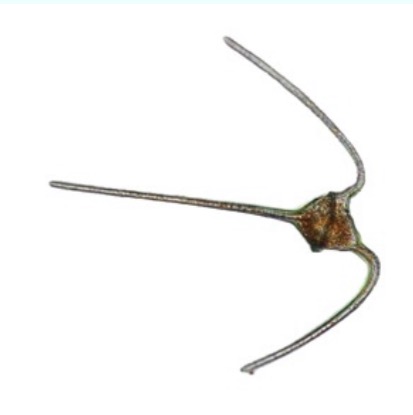
What is this:
Common dinoflagellate • Ceratium: widespread
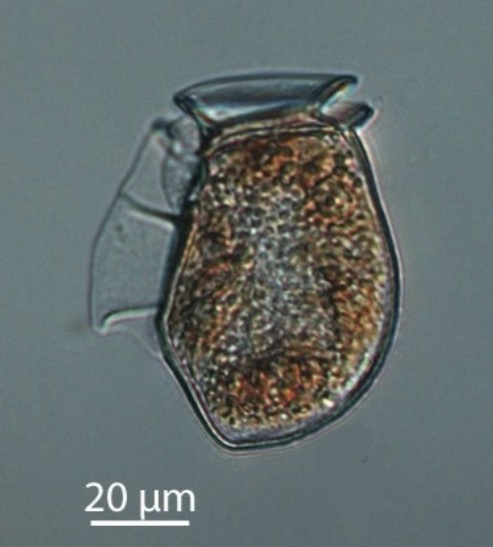
Common dinoflagellate
• Dinophysis: linked to HABs, Harmful algae blooms
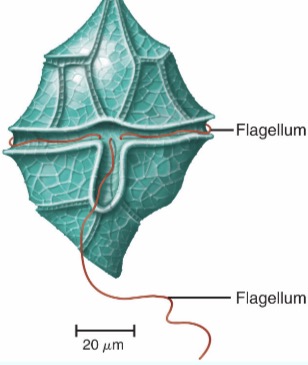
What is this?
Dinoflagellates: Those that are motile typically have two flagella.
Roles of Algae in Nature
Overall algae are critical to life on earth
• Fix CO2 into organic molecules
• Produce ~80% of Earth's O2
• Algal blooms [high increases in planktonic (free floating) algae] can result in:
• Toxin releases
• When blooms die…massive oxygen consumption by heterotrophic microbes can occur…this leads to 'dead zones' with little to no oxygen.
• In less extreme cases…their growth + death can generally lead to an influx of nutrients. E.g., this happens in the spring in temperate environments • Overall, they help support the base of the aquatic food webs
The Protozoa
Are unicellular eukaryotes
• They lack cell walls, have nuclei, and have 'animal-like nutrition' -They hunt down food, ingestion
• Are heterotrophic mainly and can have complex life cycles.
• Some algae belong in this group. e.g mixotrophs -different types of metabolism
• There are over 50,000 species!
• Some inhabit water and/or soil
• Some are part of the normal microbiota in animals - Termites have lots of protozoa
• Some cause diseases in humans and animals
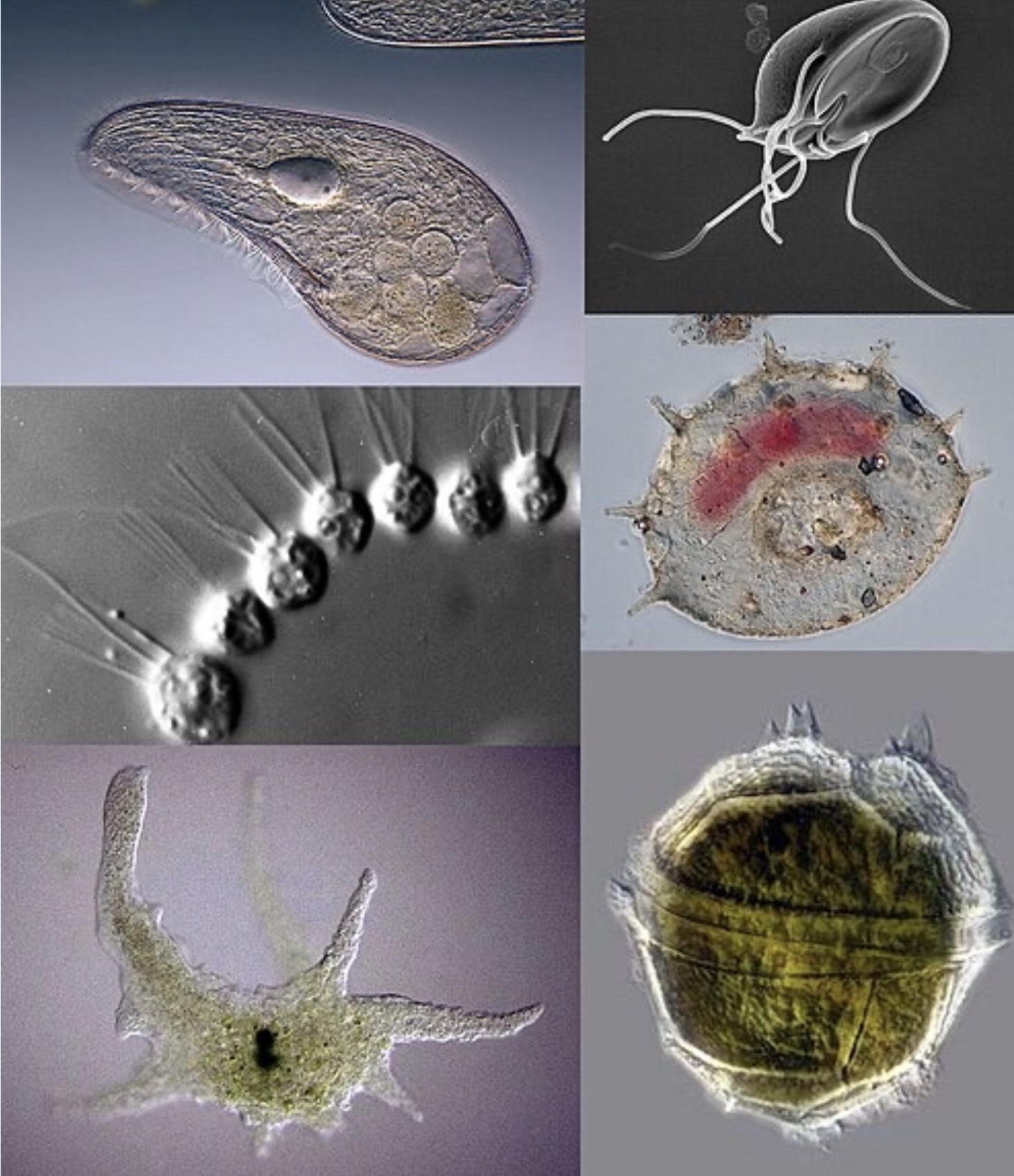
What are these?
Protozoa
Lifecycle of protozoa
• As mentioned, the lifecycle of protozoa can be rather complex.
• However, oftentimes it involves two life stages, including:
• A feeding and growing stage = called the trophozoite form
• A dormant resting stage = called the cyst form
General Characteristics of Protozoa
Overall, the protozoa are rather diverse and often get divided based on how they move around: • Excavata move using flagella (flagellates) or by undulating their cell membrane
• Amoebozoa move using pseudopods ('false feet')
• Apicomplexa are non-motile (also known as Sporozoa)
• Ciliates move using cilia
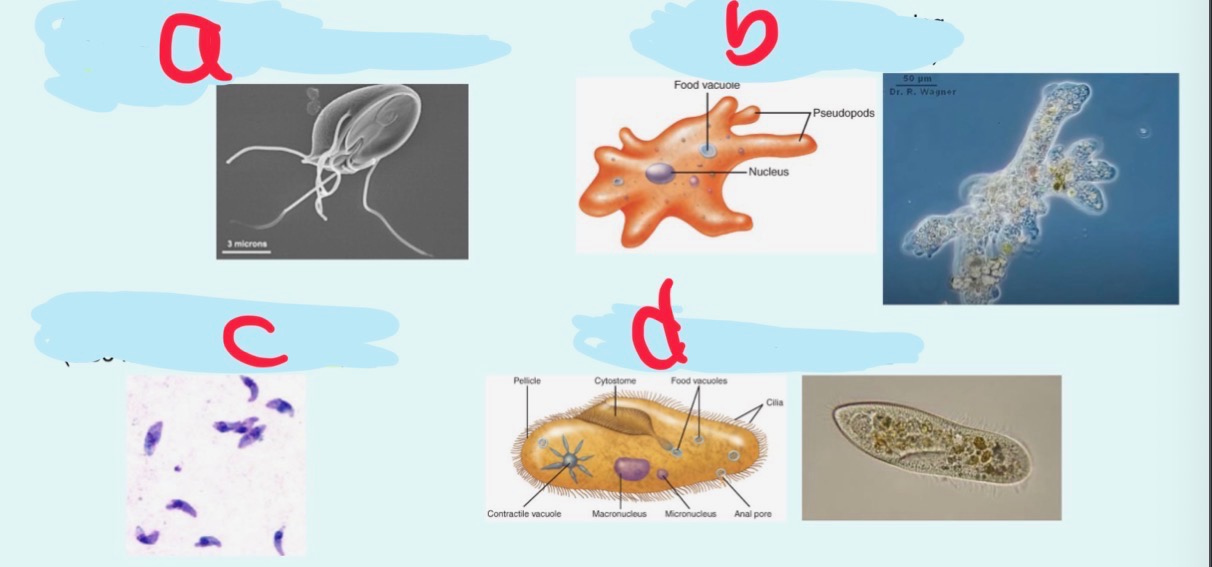
Label these
a)Excavata move using flagella or undulating their membrane (flagellates)
B)Amoebozoa move using pseudopods ('false feet')
C)Apicomplexa are non-motile (also known as Sporozoa)
D)Ciliates move using cilia
How do how protist cells 'eat'
• There are also some differences in how protist cells 'eat'
• Ciliates wave their cilia towards a mouthlike cytosome
• Amebae phagocytize their food
• In both cases the food is digest in a vacuole
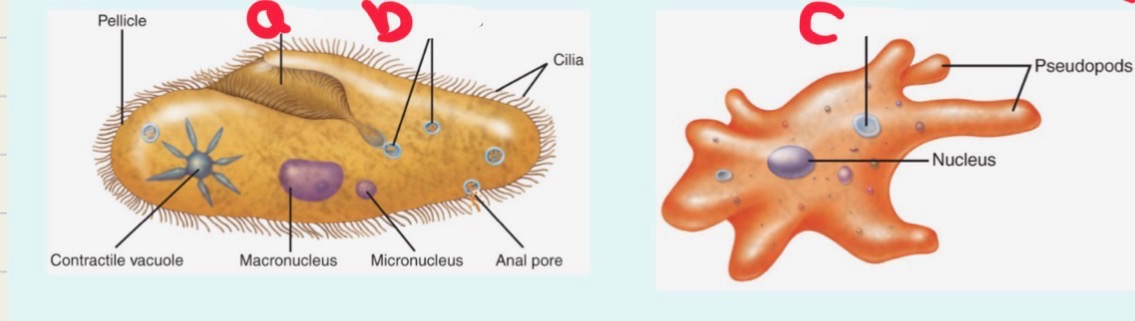
Label and classify these
A) ) Cytosome B) Food vacuoles Ciliates wave their cilia towards a mouthlike cytosome
C) Food vacuole Amebae phagocytize their food
Amebae phagocytize their food
In both cases the food is digest in a vacuole
Various Protozoa are Pathogens
Some of the common protozoal pathogens include:
• Giardia intestinalis: causes giardiasis (a type of diarrheal infection)
• Entamoeba: can cause amebic dysentery (a type of severe intestinal infection)
• Plasmodium: causes malaria (infects and destroys RBCs and Liver cells)
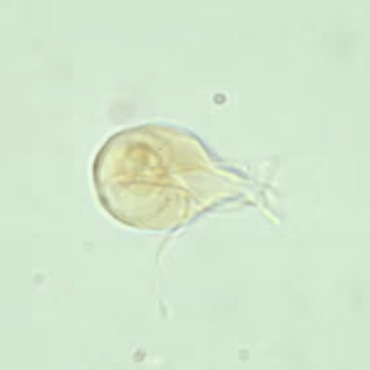
What is this?
Giardia sp. (causes a type of diarrheal infection)
Protist with two life stages
Belongs in Excavata… flagellate…whip like tail
trophozoite = motile, feeding, dividing stage. cyst = nonmotile, dormant, survival stage.
What is this
Giardia life cycle
A) cysts b)trophozoite]
Contamination of water food, hands, or fomites with cysts → Cyst get ingested by human →Triphozites are also passed in stool but do not survive in the environment
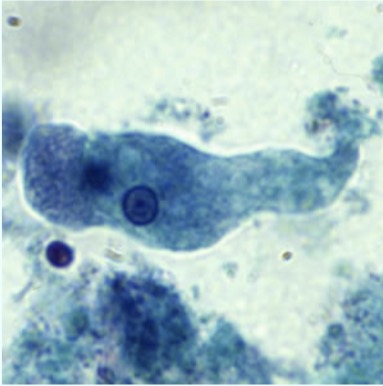
What is this?
Pathogenic protozoa
Some amoebas, for example Entamoeba spp., can cause… Amebic dysentery
trophozoite = motile, feeding, dividing stage. cyst = nonmotile, dormant, survival stage
note flase feel= pseduopodia
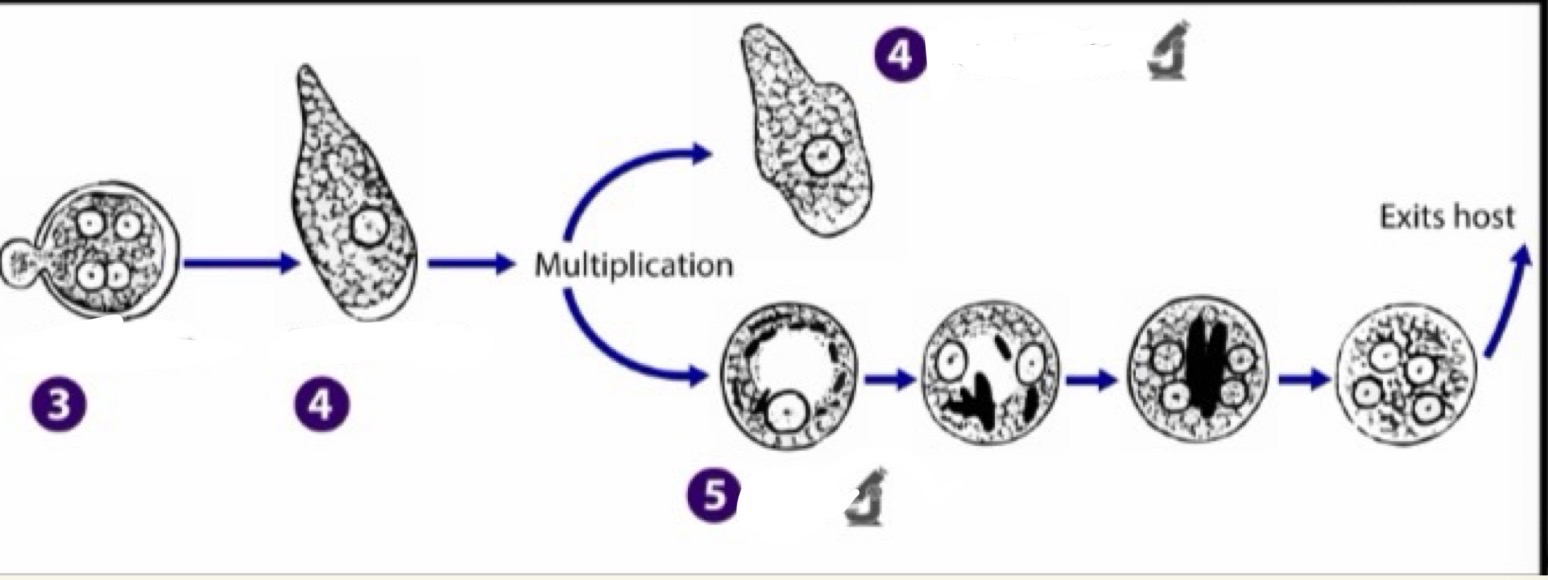
What is this?
Entamoeba spp., can cause… Amebic dysentery
Excystation
trophozoite
Cysts
Life cycle = Mature cysts ingested, cysts and trophozites passed in feces
Malaria
Protozoa don't only infect the digestive system… E.g., Malaria Caused by Plasmodium spp. Infects blood cells via pathogen life stages that involve the liver and a mosquito vector
Malaria cycle
Plasmodium (parasite) infects → Female Anopheles mosquito →Bites and infects humans (The microbe itself causes malaria)→ After mosquito bites human sporozoates form and attck liver → Ruptured schizont →Merozoites from liver get into bloodstream → Merozoites infect RBC and turn into trophozoite → Free Merozoites or Sexual life cycle → Form gameotyctes →Mosquito takes blood meal (ingests gametocyytes) → oocyst in mosquioto → ruptured oocysts and release of sporozites→ mosquito bites human and restarts cycle
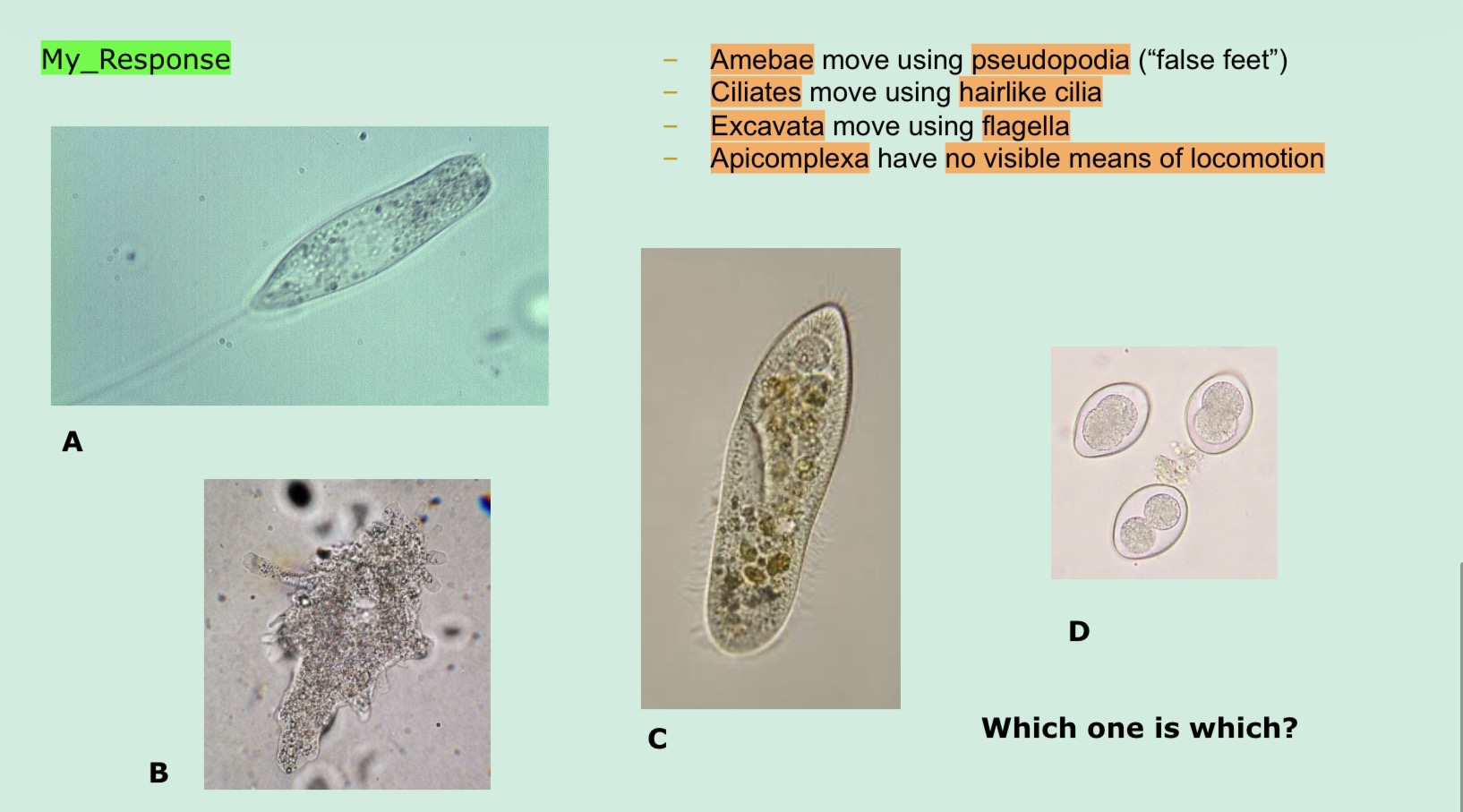
Anser dis
A) Excavata
B) Ameba
C) Ciliate
D) Apicomplexa or sporozoa