AP Physics 1 ALL UNITS
 Call Kai
 Learn
Learn Practice Test
 Spaced Repetition
 Match
Match Flashcards
 Knowt Play
1/95

Earn XP
Description and Tags
Units 1-8
Name | Mastery | Learn | Test | Matching | Spaced | Call with Kai |
|---|
No analytics yet
Send a link to your students to track their progress
96 Terms
Vector
A quantity described by both magnitude and direction
What are the conventional positive and negative directions for vectors?
Positive is north or east. Negative is south or west.
Examples of vector quantities
Position, displacement, velocity, acceleration
Scalar
A quantity described by magnitude only that will always be positive
Examples of scalar quantities
Mass, distance, speed, volume, temperature, energy
Describe how vectors can be modeled as arrows
The length represents magnitude and the direction represents the vector’s direction
What is the tail of a vector arrow?
The straight line of an arrow, whose length represents magnitude
What is the tip of a vector arrow?
The head of an arrow, whose direction represents the vector’s direction
How do vector directions correspond to signs?
Opposite directions = opposite signs
Vector notation options
Vectors can be noted with an arrow above the variable symbol
Vector notation is not necessary when you specify an axis, like x or y, with a subscript
How to add vectors visually
Align the tip of one arrow with the tail of the second. The vector sum is the arrow from the tail of the first to the tip of the second.
How to add vectors algebraically
Length = sqrt (X2+Y2)
Direction = tan-1(Y/X)
How to subtract vectors visually
Make one vector negative by keeping its length and changing its direction. Align the tip of one arrow with the tail of the second. The vector sum is the arrow from the tail of the first to the tip of the second.
How to subtract vectors algebraically
Make one vector negative by keeping its length and changing its direction.
Length = sqrt (X2+Y2)
Direction = tan-1(Y/X)
Resolving
Breaking a vector down into its horizontal and vertical components, which allows for 2-D motion to be analyzed with 1-D equations
How to resolve a vector into its components
Cos (𝛳) = RX/vector length
RX= Cos (𝛳) * vector length
Sin (𝛳) = RY/vector length
RY= Sin (𝛳) * vector length
How to build a vector from its components
Vector length = sqrt (RX2+RY2)
Angle = tan-1 (RY/RX)
What are the signs of vector components for each quadrant of a graph?
I: RX= + RY= +
II: RX= - RY= +
III: RX= - RY= -
IV: RX= + RY= -
Distance
The total path taken
Distance: Symbol, unit, and scalar/vector
d, meter (m), and scalar
Displacement
Change in position
Displacement equation
Δx = x – x0
Displacement: Symbol, unit, and scalar/vector
Δx (or Δy for vertical displacement), meter (m), and vector
Position
Location relative to a chosen frame of reference
Position: Symbol, unit, and scalar/vector
Final position = x, initial position = x0
Meters (m), vector
Average speed
Distance/time
Speed: Symbol, unit, and scalar/vector
No symbol, meters/second (m/s), scalar
Instantaneous speed
The speed at a particular moment in time
Average velocity
Change in position over change in time
Average velocity equation
Δx /Δt (calculated using initial and final states of the object)
Average velocity: Symbol, unit, and scalar/vector
v, meters/second (m/s), and vector
Instantaneous velocity
The velocity at a particular moment in time
How to find instantaneous velocity (two ways)
Average velocity over a very small time interval is close to the instantaneous velocity
An object’s instantaneous velocity is the slope of a line tangent to a point on the graph of the object’s position as a function of time
How to find instantaneous acceleration (two ways)
Average acceleration over a very small time interval is close to the instantaneous acceleration
An object’s instantaneous acceleration is the slope of a line tangent to a point on the graph of the velocity as a function of time
Acceleration
Change in velocity over change in time
Acceleration: Symbol, units, vector/scalar
a, m/s/s or m/s2, vector
Acceleration equation
Δv /Δt
Relationship between v and a when speeding up
Same sign
Relationship between v and a when slowing down
Opposite signs
An object is accelerating if…
The magnitude and/or direction of the object’s velocity are changing
Find signs of a and v: traveling left and speeding up
v is negative, a is negative
Find signs of a and v: Traveling left and slowing down
v is negative, a is positive
Find signs of a and v: Traveling right and speeding up
v is positive, a is positive
Find signs of a and v: Traveling right and slowing down
v is positive, a is negative
Relative motion / Galilean Relativity
The motion of one thing relative to another
Reference frame
A set of coordinates that can be used to determine the position (or change in position) of objects
Inertial reference frame
A reference frame experiencing constant velocity
Choice of reference frame will determine…
The direction and magnitude of quantities observed
What property of motion of an object stays the same in all inertial reference frames?
Acceleration
From one reference frame to another, measurements can be…
Converted
Observed velocity results from…
The object’s velocity and the velocity of the reference frame (means vector addition or subtraction is needed)
Object model
When the quantities of interest are not affected by the object’s size, shape, or internal structure, the object can be represented by a single dot
What properties of an object are retained when using the object model?
Mass and charge
What properties of an object are NOT retained when using the object model?
Size, shape, internal configuration
Particle diagram / Oil Drop Diagram
Uses a dot to show the position of an object at regular intervals of time
What does it mean when a particle diagram / oil drop diagram depicts dots clumped together and then spreading apart?
The object is speeding up because later, it is covering more distance in the same amount of time
Motion Diagrams
The combination of particle diagrams with vector arrows
Slope of a position vs time graph
Velocity
Meaning of a horizontal line on a position vs time graph
Constant position (v=0 m/s)
Slope of a velocity vs time graph
Acceleration
Area under a velocity vs time graph
Change in position
Meaning of a horizontal line on a velocity vs time graph
Constant velocity
g
9.81 m/s2
Near the surface of the Earth, the vertical acceleration caused by the force of gravity is… (direction) (constant or changing) (value)
Downward, constant, and approximately 9.81m/s2
Area under an acceleration vs time graph
Change in velocity
How to interpret a curved position vs time graph
Decide if v is + or - (positive is bottom to top, negative is top to bottom)
Decide if it is speeding up or slowing down (steep to shallow = slowing down, shallow to steep = speeding up))
Decide on sign (slowing down = v and a are opposite signs, speeding up = v and a are the same sign)
How to interpret a curved velocity vs time graph
Decide is a is + or - (positive is bottom to top, negative is top to bottom)
Decide if a is increasing or decreasing (steep to shallow = decreasing, shallow to steep = increasing)
Decide if acceleration is zero (horizontal line = acceleration is 0)
Linearization
A technique in physics to make a non-linear graph linear by plotting one quantity against another in a specific way that resembles y=mx+b
How to linearize…
y= x2, y = 1/x, y = sqrt(x)
Plot y as a function of x2
Plot y as a function of 1/x
Plot y as a function of sqrt(x)
Uniformly Accelerated Motion (UAM)
Situations in which acceleration is constant
UAM equation without displacement/position
vx= vx0+ axt
UAM equation without final velocity
x = x0 + vx0t + ½ axt2
UAM equation without time
vx2 = vx02 + 2ax(x - x0)
Free fall
When an object is only acted upon by gravity
Acceleration during free fall is…
Constant and always down
g on the Moon
1.63 m/s2
Describe v and a for an object at all points in free fall
Going up: v= +, a = - (slowing down)
At the top: v = 0, a = - (no motion for an instant)
Going down: v = - a= - (speeding up)
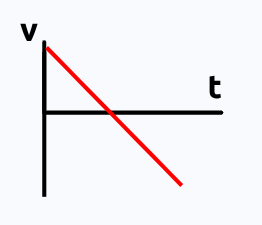
What does the graph of velocity vs time look like for an object thrown up and coming down?
Positive velocity then negative velocity, constant negative slope means constant negative acceleration
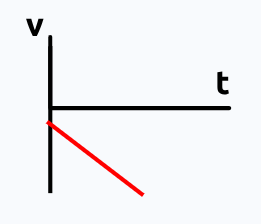
What does the graph of velocity vs time look like for an object thrown straight down?
Starts with nonzero negative velocity, constant negative slope means constant negative acceleration
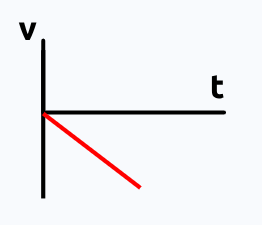
What does the graph of velocity vs time look like for an object dropped straight down?
Starts with zero velocity, constant negative slope means constant negative acceleration
If a projectile lands at the same height it started with, and there is no air resistance, the time it takes to get to the top height equals…
½ of the total time
Projectile motion
A special case of two-dimensional motion that has zero acceleration in one dimension and constant, nonzero acceleration in the second dimension
What is the only value that is the same for the horizontal and vertical directions in projectile motion?
Time
Describe vx, vy, ax, and ay for projectile motion when the object is going up
vx = +
vy = +
ax = 0
ay = -9.81
Describe vx, vy, ax, and ay for projectile motion when the object is at the top
vx = +
vy = 0
ax = 0
ay = -9.81
Describe vx, vy, ax, and ay for projectile motion when the object is going down
vx = +
vy = -
ax = 0
ay = -9.81
What does v0x affect for a projectile?
YES: Displacement
NO: Flight time
What value affects the displacement of a projectile?
v0x
What value affects the flight time of a projectile?
v0y
Trajectory
The pathway that a moving object follows through space
What shape is the trajectory of a 2d projectile?
Parabola
Angle between velocity and acceleration at the top of projectile motion’s trajectory
90 degrees (perpendicular), because the only velocity is horizontal and the only acceleration is vertical
Two projectiles fired at different angles will have the same range if…
They are fired at complementary angles
Range
The horizontal displacement of a projectile
If an object is fired horizontally and another, identical object is dropped vertically…
They will hit the ground at the exact same time, but the launched object is faster
The range of a projectile is maximized when the angle is equal to…
45 degrees