Chapter 37: Endocrine System
 Call Kai
 Learn
Learn Practice Test
 Spaced Repetition
 Match
Match Flashcards
 Knowt Play
1/40

There's no tags or description
Looks like no tags are added yet.
Name | Mastery | Learn | Test | Matching | Spaced | Call with Kai |
|---|
No analytics yet
Send a link to your students to track their progress
41 Terms
What is the primary function of the endocrine system?
To produce hormones that help maintain homeostasis in multicellular animals.
What are some examples of peptide hormones?
Oxytocin, growth hormone, and follicle-stimulating hormone
How do the nervous and endocrine systems differ in their speed of response?
The nervous system responds in milliseconds via nerve impulses, while the endocrine system responds in seconds to days via hormones.
Up-regulation
An increase in the number of hormone receptors.
Down-regulation
A decrease in the number of hormone receptors in response to cellular activity.
Where do lipophilic (lipid-derived) hormones bind to their receptors?
They bind to intracellular receptors, often within the cytoplasm or nucleus.
Hormone response element (HRE)
A DNA sequence that the hormone-receptor complex binds to in the nucleus to trigger gene transcription.
Antidiuretic Hormone (ADH)
A hormone that regulates water excretion by the kidneys and helps maintain blood pressure.
Aldosterone
A steroid hormone that regulates water and electrolyte (sodium/potassium) balance.
Insulin (beta cells)
A hormone involved in blood glucose regulation that lowers blood sugar.
Glucagon (alpha cells)
A hormone involved in blood glucose regulation that raises blood sugar.
Where are insulin and glucagon found?
Pancreas
What are the primary hormones that determine basal metabolic rate?
Thyroxine (T4) and triiodothyronine (T3), released from the thyroid gland.
Which two hormones act as antagonists to regulate blood calcium levels?
Parathyroid hormone (PTH) increases blood calcium, while calcitonin decreases it.
Growth Hormone (GH)
This hormone stimulates growth, cell reproduction, regeneration, protein synthesis, and is glucose sparing.
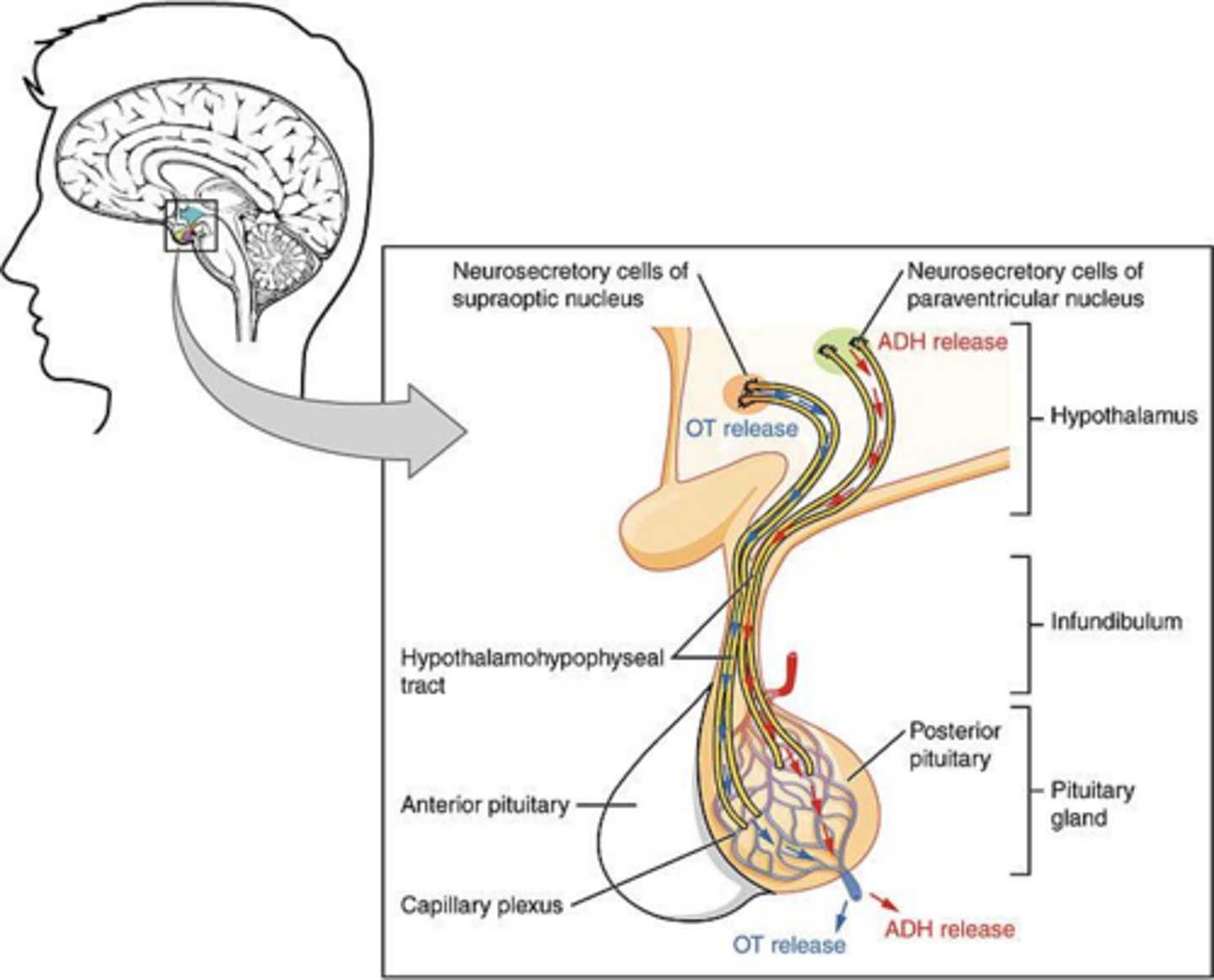
What is the structural difference between the anterior and posterior pituitary?
The anterior pituitary is glandular tissue, while the posterior pituitary is neural tissue containing axons from the hypothalamus.
Which two hormones are stored and released by the posterior pituitary?
Antidiuretic hormone (ADH) and oxytocin.
What is the function of the second messenger system in hormone signaling?
It allows hydrophilic hormones (which cannot cross the plasma membrane) to initiate a signaling pathway inside the cell.
What is the role of cAMP in the second messenger system?
cAMP acts as a second messenger that mediates a cell-specific response after being activated by adenylyl cyclase.
What is the effect of oxytocin in the reproductive system?
It stimulates uterine contractions during childbirth.
What is the primary difference between diabetes insipidus and diabetes mellitus?
Diabetes insipidus is caused by an underproduction of ADH, whereas diabetes mellitus is related to insulin deficiency or resistance.
Follicle-stimulating hormone (FSH)
This stimulates the development of egg cells in ovarian follicles in females.
Luteinizing hormone (LH)
A surge in this causes ovulation in females
Hypothyroidism
The thyroid gland doesn't produce enough hormone, causing low metabolic rate, weight gain, sensitivity to cold, and lethargy.
Hyperthyroidism
The thyroid gland produces too many hormones, causing high metabolic rate, weight loss, irritability, and increased heart rate.
Why are amino acid-derived and peptide hormones unable to cross the plasma membrane?
They are hydrophilic and must bind to receptors on the outer surface of the plasma membrane.
Hormones
Regulatory chemicals secreted into extracellular fluid and carried by the blood
Lipid-derived hormones
Derived from the cholesterol molecule
Epinephrine
Amino acid-derived hormone that arises from tyrosine
Melatonin
Amino acid-derived hormone that arises from tryptophan
Nervous system
controls through nerve impulses conducted by axons
Endocrine system
controls through hormones transported in the blood
C cells (a.k.a. clear cells)
Made by the thyroid gland
Adrenal medulla
Epinephrine for "fight or flight" response is released from here
Adrenal cortex
Cortisol for long-term stress is produced from here
Hypothalamus
Creates and synthesizes hormones that it stores in the posterior pituitary gland
The Anterior Pituitary Gland
Produces essential hormones such as peptide hormones, protein hormones, prolactin, glycoprotein hormones, and thyroid-stimulating hormone.
The Posterior Pituitary Gland
Produces antidiuretic hormone and oxytocin.
Testosterone
Lipid-derived hormone, abundant in males
Estrogen
Lipid-derived hormone, abundant in females
True or false: the anterior and posterior pituitary glands synthesize their hormones on top of storing and releasing them.
False
2 multiple choice options