4: predicitng unaided distance vision in eyes with different types and amounts of uncorrected refractive error
 Call Kai
 Learn
Learn Practice Test
 Spaced Repetition
 Match
Match Flashcards
 Knowt Play
1/17

There's no tags or description
Looks like no tags are added yet.
Name | Mastery | Learn | Test | Matching | Spaced | Call with Kai |
|---|
No analytics yet
Send a link to your students to track their progress
18 Terms
impacts of uncorrected refractive error on distance vision
accom doesnt help myopes see more clearly in distance
uncorrected hyperopia may or may not reduce distance vision, depends on accom which depends on the age of the px . if theres enough accom distance vision will be good
does astigmatism reduce distance vision
always reduces distance vision but to a lesser extent than myopia and hyperopia that cant overcome by accom
accom helps distance vision but doesnt overcome astigmatism
eg of when / why we need to predict uncorreccted refractive error from distance vision
we conduct a refraction and find the eye to be myopic by -1.00 DS ubt when do an unaided vision check we find that itd 6/4.8 VAR 105
eye is myopic so there shoud be a reduction in VA
or when we conduct a refraction and find the eye hyperopc by +1.00DS by a px aged 10 and when we do unaided va it is 6/12 VAR 85. shouldnt be so low as theyre young so should be accomodating
predicting unaided distance vision from uncorrected refractive error
for spherical ametropia eg -3.00DS myopia
can predict the unaided vision as every 0.25 dioptres is a reduction of 1 line
so 0.25 × 3 = 12 lines reduction
5 letters is 1 line
12 lines is 60 VAR reduction
so 110 ( starting VAR) -60 = 40 VAR
predicting unaided vision from sph/cyl refractive error
S + C/2
sphere equivalent refractive error
or second method (pic)
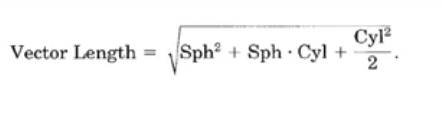
what is the sphere equiv and vector length of -3.00/-1.50 × 180
sphere equivalent
-3.00 + -0.75 = -3.75D
vector length = -3.82D
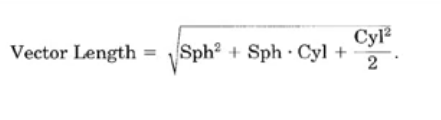
2 approaches for relating unaided vision and refractive error
spherocylindrical refractive errors and visual acuity. Thomas W. Raasch
relation between spherical refractive error and visual acuity . George Smith
Raaschs approach for predicting VA from refractive error
unaided vision when we plug values into the equation
plugging in the vector length
if refractive error was -2.00/-1.00 × 180 the vector length would be 2.55D
when this entered the raaschs equation we get a predicted unaided vision of logMAR 0.99
VAR= 100-50 . LogMAR
VAR= 50 × 0.99 = 50
vector must be positive in equation egif vector length is -3.00, it would be entered as +3 in equation
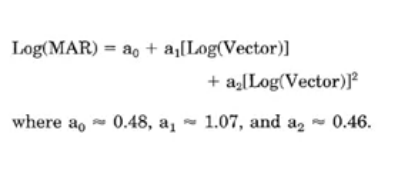
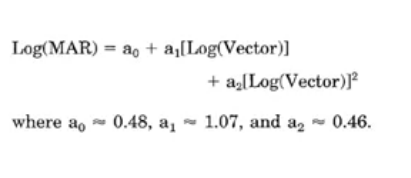
for emmetropia vector value is 0.1
this gives a LogMAR score of -0.13
equivalent to a VAR of
( 100-50 ) x 0.13 = 106.5
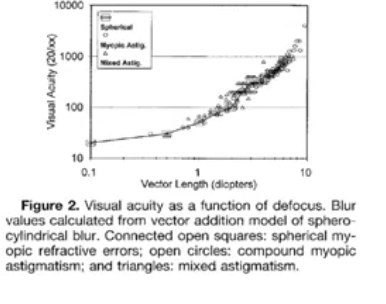
data points if Raaschs approach
0.1 where eyes is emmetropic, expect the eye to achieve high VA score 20/20
when vector length gets bigger, refractive error increases
eg a vector length of 8 gives an unaided VA of 20/1000
each data point represents data from at least 50 points
hyperopia and hyperopic astigmatism were not plotted as accom is an unknown
myopia, myopic astigmatism and mixed astig plotted
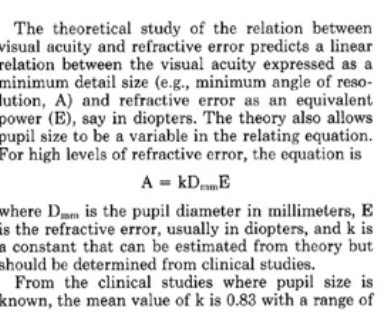
Smiths approach for predicting unaided vision from refractive error
it is in MAR minimum angle of resolution
A= refractive error
E= power in dioptres
Dmm= pupil diameter
k= constant estimated from theory 0.83
E could be the spherical equivalent refractive error or the vector refractive error
advantage of smiths is that is includes pupiil diameter
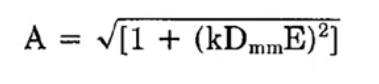
another version of smiths approach
only used when the refractive error is very close to 0
comparing raasch and smiths
less defocus means better VA or slightly better VA : not directly proportional
with a cylinder prescription, use the vector length not spherical equivalent
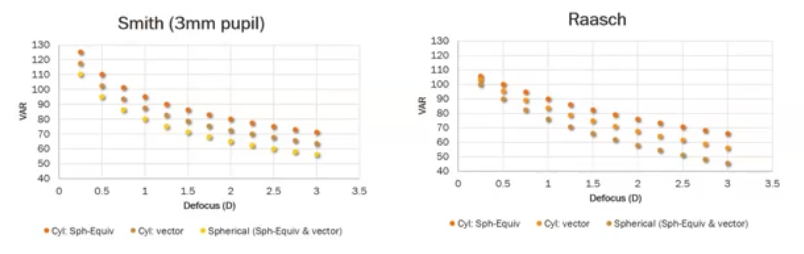
spherical defocus
smiths: -1D myopia predicts a var reduced to 80 compared to 75 with Raasch
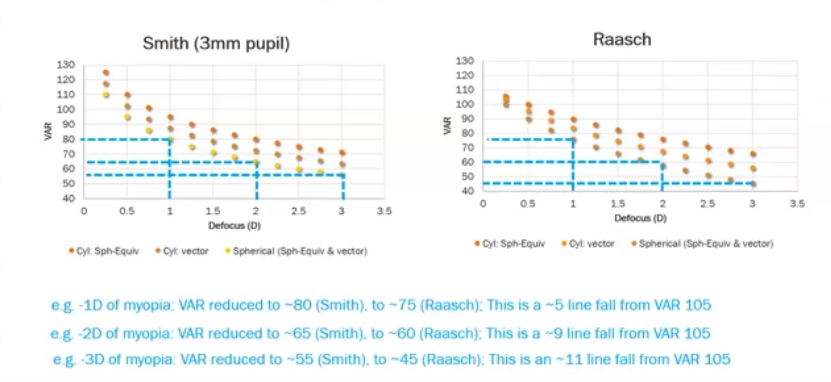
what can we conclude from the approaches with the n0 lines lost
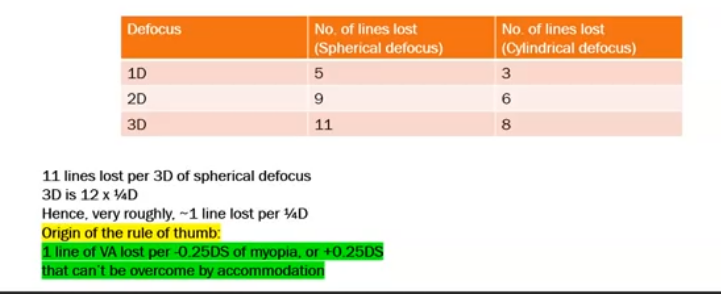
astig affects va
said that every 0.50D cylinder reduces A by 1 line
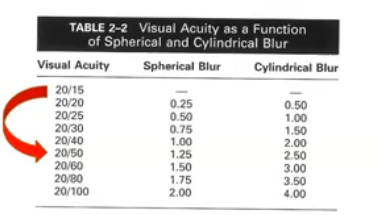
what would you expect the unaided vision to be in an eye with -1.00 /-0.50 × 80
4 lines lost since there is 1D of myopia
extra 1 line lost as theres 0.50D astigmatism
so 5 lines lost in total approx
5 × 5 = 25
105-25 = 80
predict the unaided vision with eye of -1.50 /-1.00 × 45
6 line reduction for the -1.50 myopia
2 line reduction for the cylinder
8 lines x 5 letters on each line = 40
105-40 = 65 VAR