Biology Exam 4 Ramesh
 Call Kai
 Learn
Learn Practice Test
 Spaced Repetition
 Match
Match Flashcards
 Knowt Play
1/35

There's no tags or description
Looks like no tags are added yet.
Name | Mastery | Learn | Test | Matching | Spaced | Call with Kai |
|---|
No analytics yet
Send a link to your students to track their progress
36 Terms
Amino acids that cannot be synthesized by the human body, but that have to be supplied in their diet are called ______________.
Essential amino acids
Based on how they obtain food nutrients, mammals belong to the category of ___________.
Bulk Feeders
The specialized cells called choanocytes are present in the body walls of sponges which trap food ingested through the pores in their body walls. True or False?
True
2 multiple choice options
The organ which is involved in mechanical processing of food in annelids such as earth worm is _____________.
Gizzard
Name the 4 fat-soluble vitamins
Vitamin A, D, E and K
The vitamin which is a component of the visual pigment in the photoreceptor cells in the eyes is ____________.
Vitamin A or retinol
The vitamin which is involved in the synthesis of blood clotting proteins in the liver is ____________.
Vitamin K
Scurvy is a disease caused by the deficiency of _______________.
Vitamin C
The vitamin essential for the synthesis of blood clotting factors is _______________.
Vitamin K
Pick the two fat soluble vitamins from the options below. Choose the best option.
Vitamin E and vitamin K
3 multiple choice options
The mineral that is involved in thyroid hormone formation is ____________.
Iodine
The trace mineral that is a component of the electron carrier proteins in the mitochondria is __________________
Iron (Fe)
3 multiple choice options
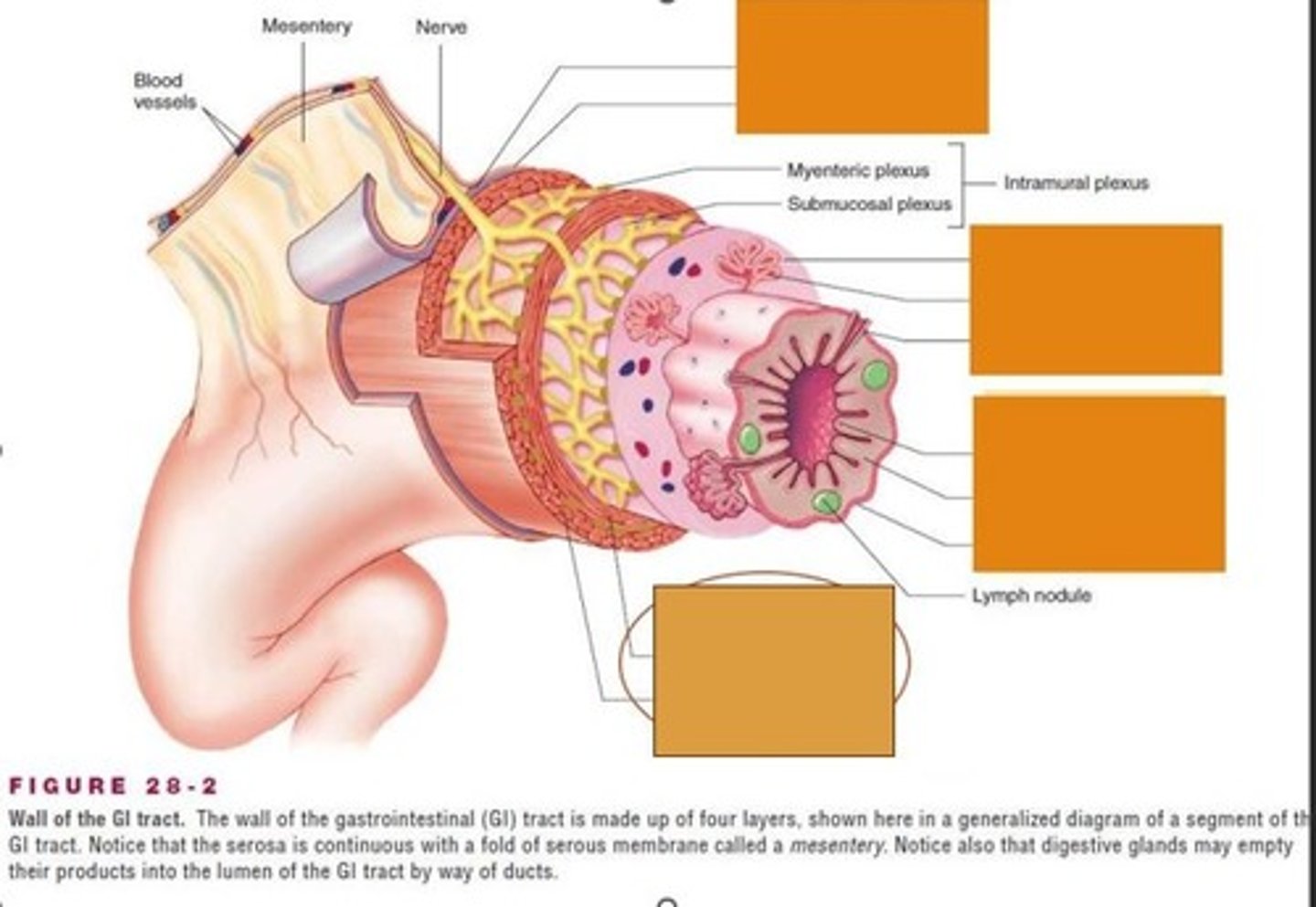
In Descending Order:
Serosa:
-Connective Tissue Layer
-Peritoneum
Submucosa:
-Glands in Submucosa
-Dust from gland
Mucosa:
-Mucous epithelium
-Lamina propria
-Muscularis mucosae
Muscularis:
-Circular muscle layer
-Longitudinal muscle layer
What are the 4 main layers of GI Tract and what do they contain?
The enzyme responsible for digestion of complex starch in the oral cavity is _____________.
Salivary amylase
The muscle that is weakened and due to which leads to the imperfect closure of the passageway to the movement of bolus from the esophagus to the stomach, leading to acid reflux is called ___________________.
Gastroesophageal sphincter
The cells that secrete pepsinogen in the stomach are __________ .
Chief cells
The cells that secrete H+ and Cl- ions in the stomach are ______________.
Parietal cells
The hormone that is responsible for the stimulation of insulin release by the pancreas is _______________.
Glucose-dependent insulinotropic peptide (GIP)
Match the following with the correct options in the bottom column
1. Pyloric sphincter
2. Submucosa
3. Intestinal villi
4. Bilirubin
5. Gastric pits
--------------------------------------------------------------------------------------
A. Enteric nervous system
B. Breakdown product of hemoglobin
C. Mucosal layer of the stomach
D. Brush border
E. Junction between stomach and duodenum
F. Junction between stomach and esophagus
G. Contains epithelial and glandular cells
Match the following with the correct options in the bottom column
B 1. Pyloric sphincter
A 2. Submucosa
D 3. Intestinal villi
C 4. Bilirubin
E 5. Gastric pits
Epithelial surfaces are protected by antimicrobial peptides called ______.
Defensins
The saliva and tear contains the enzyme ___________________ that act to protect by breaking the _____________________.
lysozyme, bacterial cell wall
The process by which a cell engulfs bacteria and other cellular debris is called ___________.
phagocytosis
The complement system proteins are activated by surface molecules on pathogens, and they assemble to form __________.
membrane attack complex
Match the following with the correct options from the bottom column
1. Pyrogens
2. Programmed cell death
3. Membrane attack complex
4. Epithelial cells of the mucous membrane
5. Big eaters
---------------------------------------------------------------------------------
A. Complement system
B. Defensins
C. Macrophages
D. Stimulate prostaglandin release
E. DNA degradation
F. Necrosis
G. Pinocytes
Match the following with the correct options from the bottom column
D 1. Pyrogens
E 2. Programmed cell death
A 3. Membrane attack complex
B 4. Epithelial cells of the mucous membrane
C 5. Big eaters
Programmed cell death is popularly known as __________ involves _____________ .
apoptosis, DNA degradation
Natural killer cells destroy target cells by releasing _________________.
Perforins
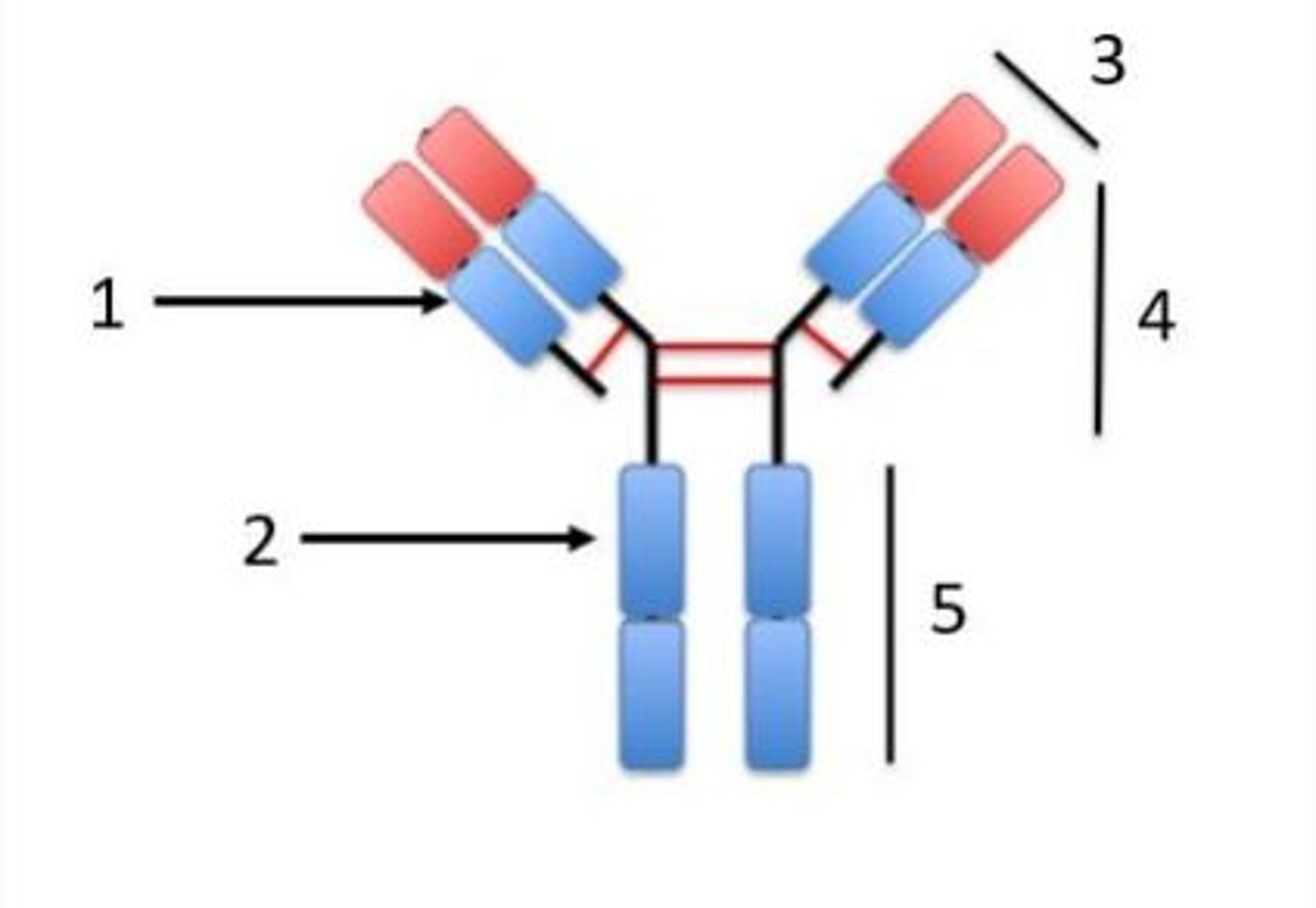
Using the figure shown above match with the correct letters as labeled in the right-hand column. (Please understand the options carefully. The right most column contains the numbers denoted in the figure. 3, 4 and 5 represent the entire region spanned by the black straight lines. Please take these into your kind consideration and select the correct choice.)
1. Antigen-binding site
2. Fab or Variable region
3. Fc or constant region
4. Light chain
5. Heavy chain
A. 1 (4. Light chain)
1. B. 3 (1. Antigen-binding site)
2. C. 4 ( 2. Fab or Variable region )
5. D. 2 (5. Heavy chain)
3. E. 5 (3. Fc or constant region )
Using the figure shown above match with the correct letters as labeled in the right-hand column. (Please understand the options carefully. The bottom column contains the numbers denoted in the figure. 3, 4 and 5 represent the entire region spanned by the black straight lines. )
1. Antigen-binding site
2. Fab or Variable region
3. Fc or constant region
4. Light chain
5. Heavy chain
A. 1
B. 3
C. 4
D. 2
E. 5
The first antibody isotype found during the primary immune response is IgG. True or False?
False
2 multiple choice options
Antigen presenting cells interact with ____________________ during an antibody- mediated immune response, whereas they interact with ________________ during cell-mediated immune response.
CD4+ T-cells; CD8+ T-cells
The long-lived immune cells that can respond to a later challenge by the same antigen are called _______________.
Memory B cells
The innate immune system recognizes specific structures on the cell surface of the pathogenic microorganisms called ________________. The corresponding structures on phagocytic cells that recognize these structures on the pathogenic microorganisms are called ______________.
pathogen-associated molecular pattern
Vaccinations introduce antibodies into the body to stimulate immune response. True or False?
False
2 multiple choice options
Monoclonal antibodies are produced by ___________________ and they react against _____________________.
Hybridoma Technology; Antigenic determinant
Immunological tolerance refers to ___________________.
Protection of body's own molecules from attack by the immune system.
Match the following with the correct options from the bottom column
1. Multiple sclerosis
2. Lupus
3. Rheumatoid arthritis
4. Histamine
5. Allergy
--------------------------------------------------------------------------
A. IgE
B. Myelin sheath
C. Mast cells
D. Blood platelets
E. Connective tissues
F. Basophils
G. Macrophages
5. A. IgE
1. B. Myelin sheath
4. C. Mast cells
2. D. Blood platelets
3. E. Connective tissues
Correct Order from 1- 10
1 = J
2 = D
3 = B
4 = A
5 = F
6 = E
7 = C
8 = I
9 = G
10 = H
Match the terms in the right order
1. Differentiation of B-lymphocytes expressing immunoglobulins into plasma cells and memory B cells
2. The APCs interact with CD4 receptors on their cell surface
3. Degradation of proteins expressed on the pathogen cell surface by lysozyme
4. A phagocytic cell such as a dendritic cell engulfs a pathogen such as bacteria
5. The activated CD4+ T cells secrete cytokines that promote differentiation onto helper T cells and effector T cells
6. The APCs once bound to T cells secrete cytokines that activate CD4+ T cells
7. The peptide fragments resulting from enzymatic digestion are presented as antigens on APCs such as dendritic cells
8. The helper T cells that interact with B cells secrete cytokines which stimulate proliferation of B cells
9. Antigens are presented on the surface of B cells in complex with class II MHC molecules
10. B cells with displayed antigen on the cell surface encounter and interact with helper T cells.