Physics Part 2
 Call Kai
 Learn
Learn Practice Test
 Spaced Repetition
 Match
Match Flashcards
 Knowt Play
1/86

There's no tags or description
Looks like no tags are added yet.
Name | Mastery | Learn | Test | Matching | Spaced | Call with Kai |
|---|
No analytics yet
Send a link to your students to track their progress
87 Terms
Fluoresencece
Light is emitted when a substance is exposed to electromagnetic radiation. EXAMPLE : Light bulb
Phospherence
The ability to absorb energy from another source of light and then slowly emit it over a long period of time. EXAMPLE: Glow in the dark
Incandescence
Light that is produced by an object, such as a metal, that is at a very high temperature. EXAMPLE: Light bulb
Electric Discharge
Light is produced when a electric current passes through the air or passes through a gas like neon EXAMPLE: Street signs
Bioluminescence
Light is produced by a plant or animal. EXAMPLE: Angler Fish
Triboluminescence
Light produced from friction when crystals are rubbed or crushed. EXAMPLE: Sugar crystal
How does a glow stick produce chemiluminescence
A glow stick is separated by a glass vial until you are ready to use
When you bend it, the glass breaks, which allows the two chemicals to mix together
The mixture causes a chemical reaction that makes the liquid glow.
Telescope - Types of Lens, Size, Type, Orientation
Converging and Diverging
Larger
Virtual
Inverted
Magnifying glass
Converging
Larger
Virtual
Upright
Camera - Types of Lens, Size, Type, Orientation
Converging
Larger
Real
Inverted
Projector - Types of Lens, Size, Type, Orientation
Converging
Larger
Real
Inverted
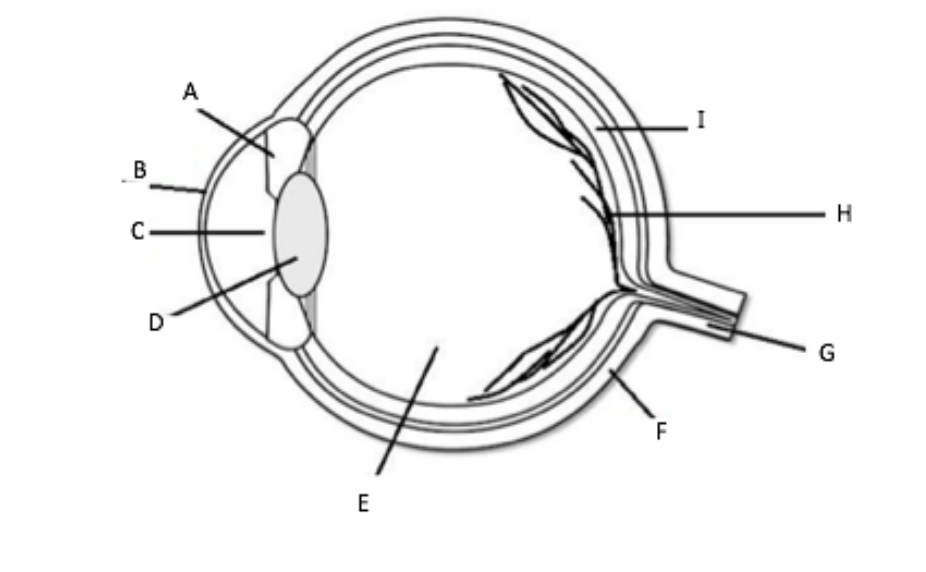
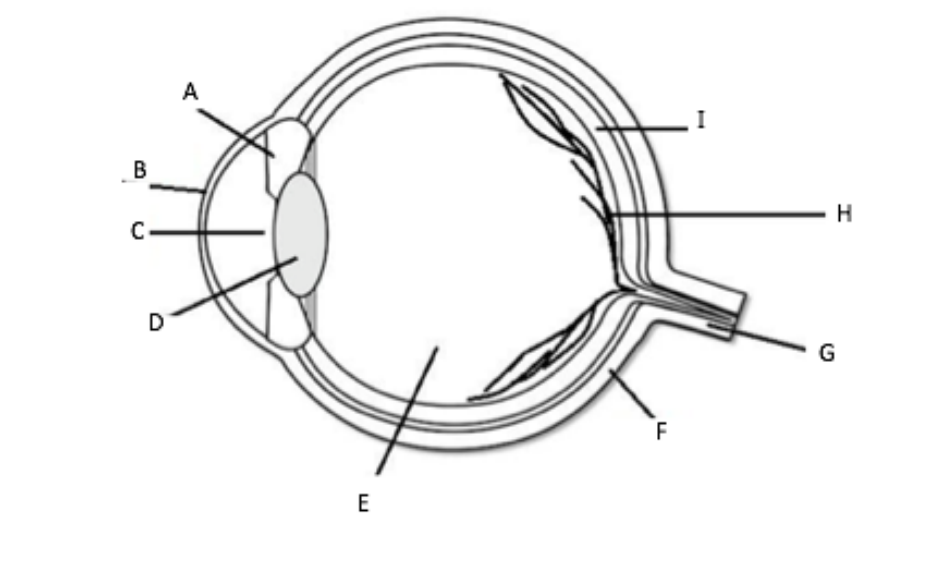
A?
Iris
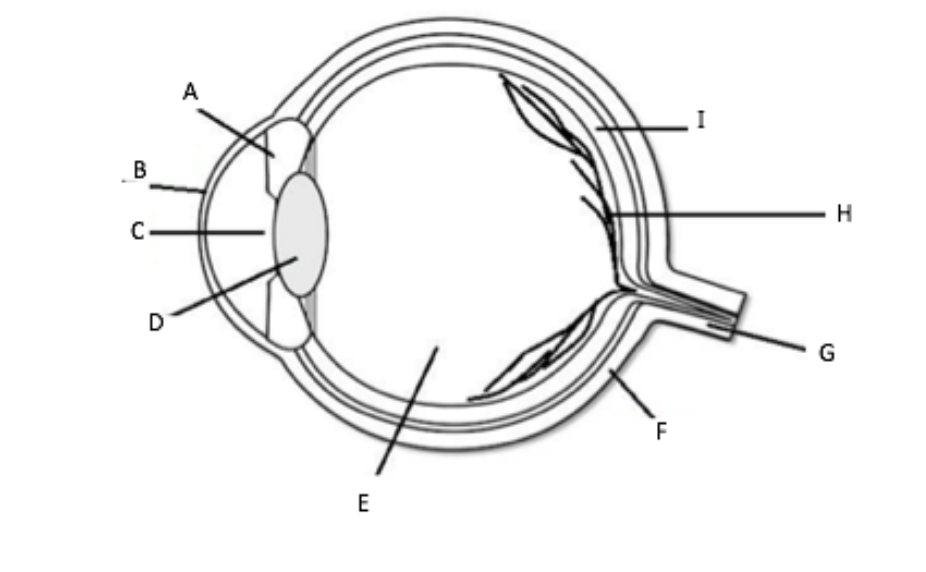
B?
Cornea
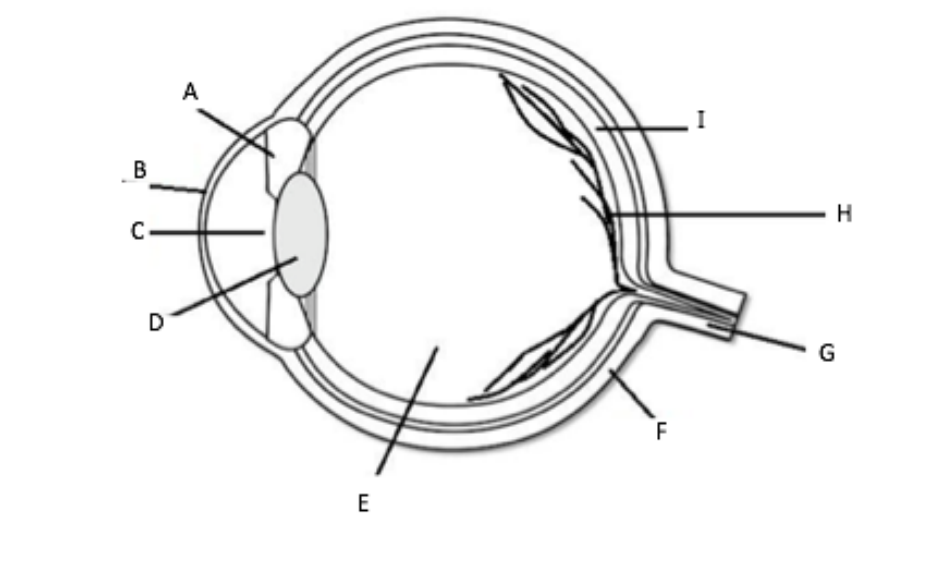
C
Pupil
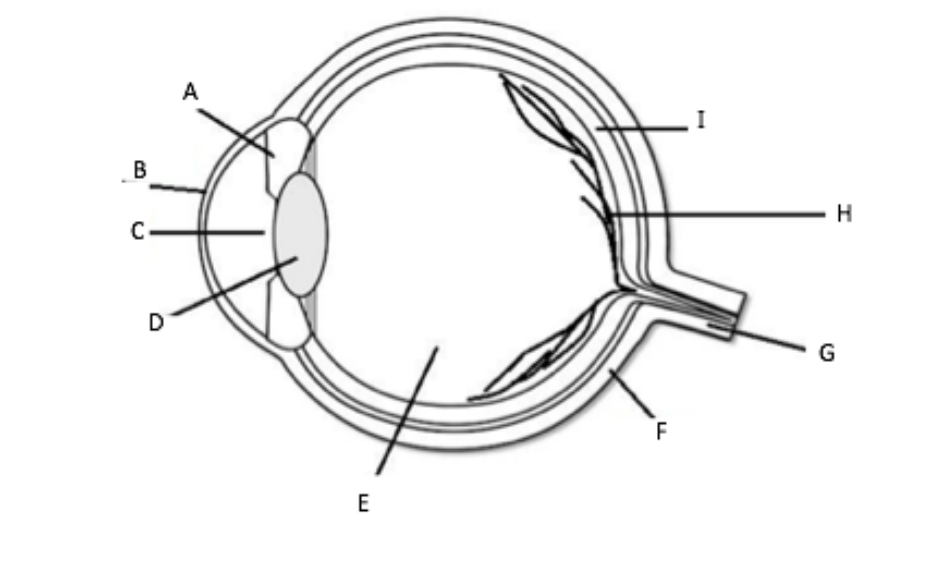
D
Lens
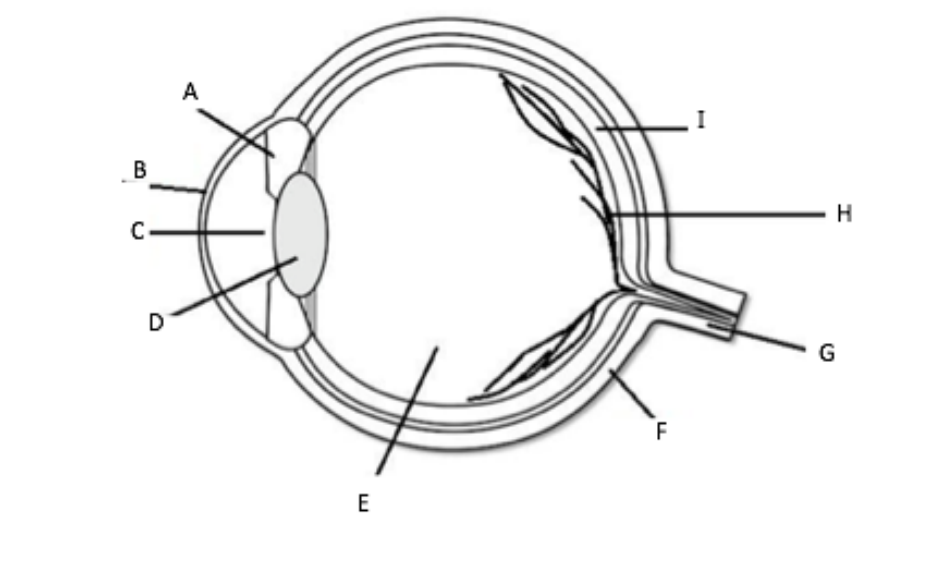
E
Vitreous Humor
F
Sclera
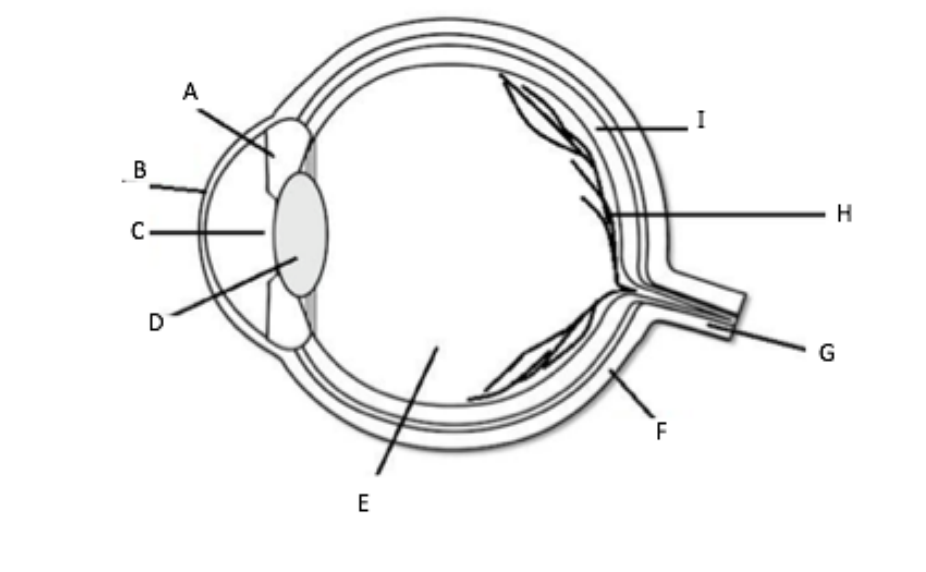
G
optic nerve
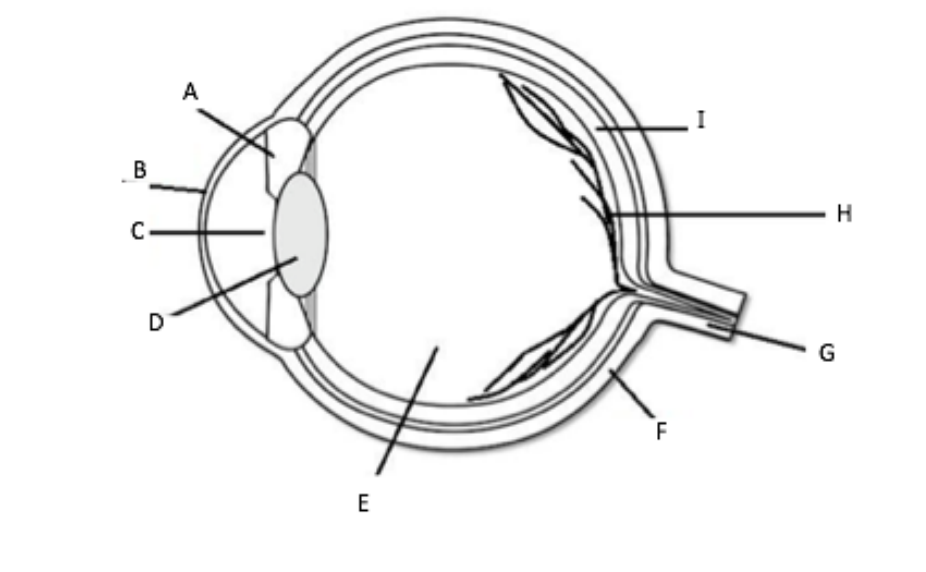
H
Blood Vessels
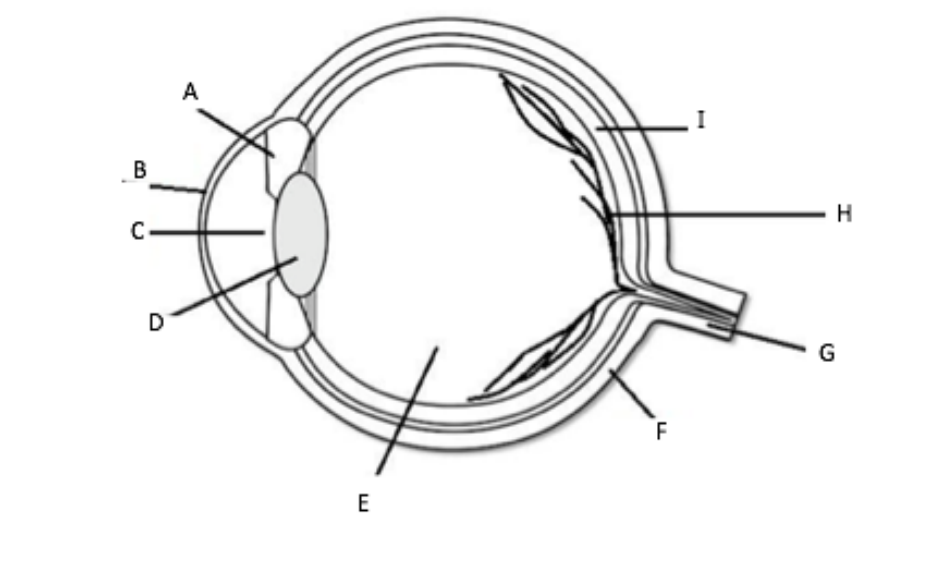
I
Retina
Iris
Automatically controls how much light enters the eye
Cornea
Eyes outermost lens to focus incoming light and serving as a shielf against dirt, germs and harmful UV rays
Pupil
Adjustable that controls the amount of light entering the eye
Lens
To bend and focus incoming light rays precisely onto the retina to create clear, sharp images
Retina
Convert light into electrical signals and sends them to the frame which translates those signals into the images you see
Vitreuos Humor
Jelly. Maintains the eyes round shape
Sclera
Acts as a protective shield for the internal eye tisse
Optic Nerve
Carries visual information from your eyes to your brain
Blood Vessels
Delievers oxygen and essential nutrients to support metabolic demands
Do you see with your eyes?
No. We “see” with our brain. The eye just transfers information to the brain
Hyperopia
Far sighted
No diffuclty seeing distant objects
Light from all nearby objects focuses behind the retina
Myopia
Near sighted
No difficulty seeing nearby objects
Light from distant objects is brought to focus in front of the retina
Where does light bend when entering a denser medium
Closer to medium
Where does light bend when entering a less dense medium
Further from the normal
What is n. in n=c/v
Index of refraction
What is c. in n=c/v
Constant. Speed of light in vaccum. 3.00×10⁸
Apparent Depth
Our brain automatically assume that light always travel in a perfectly straight line
Your brain traces the incoming light rays straight backward into the water instead of following the bend
Mirage
On a sunny day, the asphalt gets hot, it warms the layer of air just above it so the cool air sits on top of a layer of very hot air
As light from the sky travels down through the cool air and hits the hotter air, it begins to bend. Hot air has a lower index of refraction so the light bends so sharp that it goes through total internal reflection which means its bouncing back up toward your eyes like a mirror
Total Internal Reflection
The angle of refraction is always larger than the angle of incidence
If you increase the angle of incidence past the critical angle, it will reflect back into the medium.
In other words, there is no refracted ray, only a reflected ray
For example, critical angle is 48.8 but the incident angle is 60.
Conditons of total internal reflection
Light is travelling more slowly in the first medium than in the second
The angle of incidence is large enough that no refraction occurs in the second medium. Instead the rat is reflected back into the first medium.
Dispersion
White light separating into continuous sequence of colours in a glass prism
Each colour of visible light travels at slightly different speeds
Violet light slows down more than red light when entering the prism
Violet light is being refracted more than any other colour.
Converging Lens (convex)
Type of lense that is widest at the center
Example : magnifying glass, camera, reading glasses
Diverging Lens (concave)
Type of lens that is the narrowest in the middle
Example: Eye glasses, telespcope
Refraction in Lenses
Light rays gets refracted two times. Once when entering the lense and another when leaving the lense