Atomic structure
 Call Kai
 Learn
Learn Practice Test
 Spaced Repetition
 Match
Match Flashcards
 Knowt Play
1/19

There's no tags or description
Looks like no tags are added yet.
Name | Mastery | Learn | Test | Matching | Spaced | Call with Kai |
|---|
No analytics yet
Send a link to your students to track their progress
20 Terms
excitation
an electron absorbs electromagnetic radiation and moves to a higher energy level (orbital)
deexcitation
the electron emits electromagnetic radiation and moves to a lower energy level (orbital)
Background radiation
nuclear radiation that exists all around us
natural – rocks, radon(carbon based organisms), food and air
man-made – nuclear weapons, medical uses and nuclear power plants
alpha decay
nucleus is too heavy (unstable)
too many protons and neutrons in nucleus
emits (drops) 2 protons and 2 neutrons
properties of alpha decay
can’t travel far ~ 2cm in air
can be blocked (absorbed) by paper/skin
extremely ionising - can knock electrons out of atoms
beta decay
an electron from a nucleus
nucleus isn’t balanced
a neutron turns into a proton and an electron
this electron shoots out of the nucleus
properties of beta decay
can travel a few m in air
absorbed by a few mm of aluminium
e.g Sr90 - beta emitter
Gamma decay
after emitting an alpha/beta particle, the nucleus will often still be ‘excited’ and will need to lose energy.
emits high energy electromagnetic wave from unstable nuclei to release energy
Gamma decay properties
0 protons and neutrons are lost
element doesn’t change
Examples of radioactive tracers
geiger counter
medical uses
traces radioactive fertiliser
most common tracer Technetium-99
Radioactive tracers
emits gamma rays that easily pass through the body to a detector outside the body,
isotope can be followed as it flows through a particular organ in the body
have very short half-lives
not be poisonous.
Sterilising
kills bacteria, mould and insects in food
prolongs shelf life of food
gamma rays
cancer cells can be killed
smoke detection
weak source of Americium-241
emits alpha particles
alpha particles pass between charged metal plates
electrical currents sound alarm
Thickness control
radioactive isotopes act as emitter
placed on either side of a sheet
beta source used as it can penetrate paper
amount of penetration varies on thickness
detecting faulty pipe welds
build up of gamma emission can be found using a geiger muller tube
Half life (of a radioactive source)
time taken for its activity to fall to half of the original activity
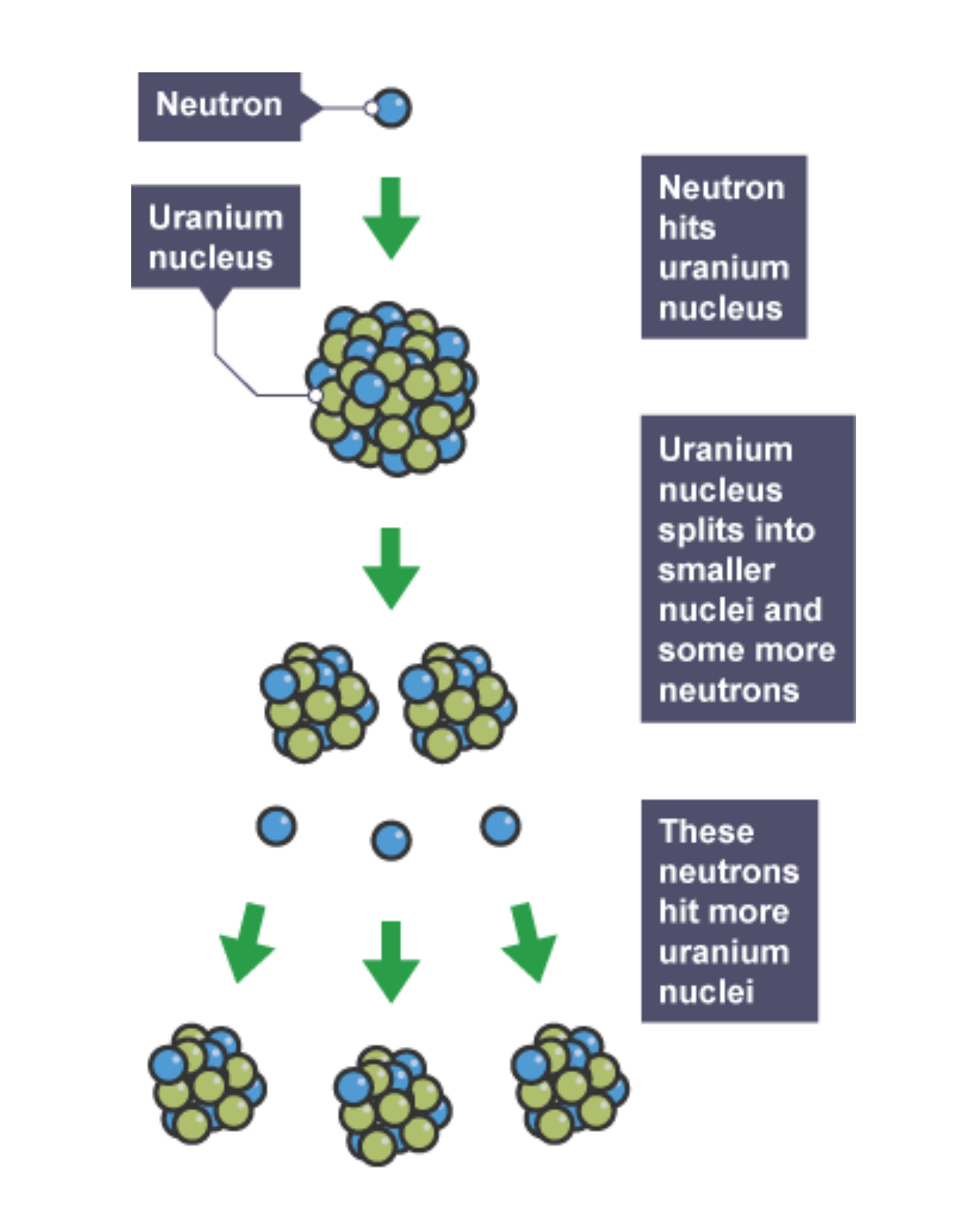
nuclear fission
the splitting of a nucleus into smaller fragments by the release of neutrons and lots on energy
fission releases which hits other fissionable atoms producing more neutrons which can react with even more fissionable atoms
chain reaction
How is nuclear fission controlled?
control rod made of boron
pushed into reaction to absorb energy
pulled out and slows reaction down
nuclear fusion
two or more nuclei combine to create a nucleus of greater mass

What condition does it have to be for nuclear fusion to occur?
high pressure & high temperature
naturally in the core of stars (mainly the sun)