Edelman Physics Ch 7-9
 Call Kai
 Learn
Learn Practice Test
 Spaced Repetition
 Match
Match Flashcards
 Knowt Play
1/79

There's no tags or description
Looks like no tags are added yet.
Name | Mastery | Learn | Test | Matching | Spaced | Call with Kai |
|---|
No analytics yet
Send a link to your students to track their progress
80 Terms
Time of Flight
The elapsed time from pulse creation to pulse reception is called 'time-of-flight' or the 'go-return time'
Range Equation
Depth = 1.54 x go-return time/2
Range
The distance from the transducer to an echo-generating structure
Speed of Sound in Soft Tissue
1.54 mm/µs is the average speed.
13 Microsecond Rule
Time-of-flight doubles as depth doubles.
PRP (Pulse Repetition Period)
Go-return time for one pulse cycle.
PRF (Pulse Repetition Frequency)
Inversely related to imaging depth.
Imaging Depth
Depth determined by PRP and time-of-flight.
Piezoelectric Effect
Voltage generated by mechanical deformation of materials.
Reverse Piezoelectric Effect
Material changes shape when voltage is applied.
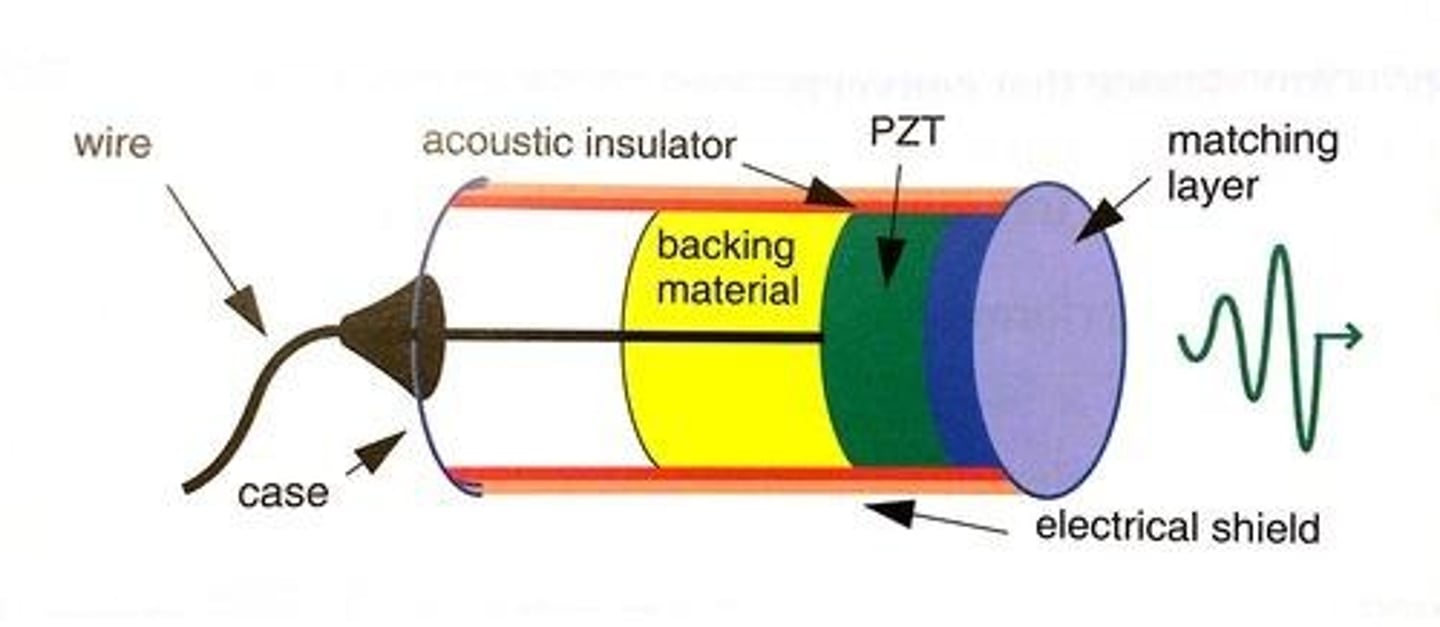
PZT
Lead Zirconate Titanate, a piezoelectric material.
Acoustic Insulator
Reduces interference in transducer performance.
Matching Layer
Enhances sound transmission between transducer and tissue.
Backing Material
Dampens vibrations to improve image resolution.
Crystal/Active Element
Converts electrical energy to sound and vice versa.
Electrical Shield
Prevents electrical interference in transducer.
Reflector Depth Calculation
Depth = 0.77 x Time(µs) for soft tissue.
Speed Calculation Example
Speed = distance/time; 10 cm/2 sec = 5 cm/s.
Impedance Difference
Larger reflections occur with greater impedance differences.
Transducer Functions
Converts energy during transmission and reception.
PZT Impedance
Impedance is 20 times greater than skin.
Wave Reflection
Direct wave travel causes significant intensity reflection.
Matching Layer
Designed between PZT and skin to improve transmission.
Ultrasound Gel Impedance
Impedance lies between matching layer and skin.
Matching Layer Thickness
Thickness is 1/4 wavelength of sound in layer.
Backing Material
Essential for pulse creation in transducers.
Pulse Duration
Without backing, pulse length increases due to ringing.
Axial Resolution
Enhanced by limiting PZT ringing and shortening pulse.
Sound Absorption
Backing material has high sound absorption characteristics.
Acoustic Impedance
Impedance similar to PZT for effective transmission.
Sensitivity Decrease
Reduced crystal vibration affects signal reception quality.
Wide Bandwidth
Range between highest and lowest frequencies in pulse.
Resonant Frequency
Main frequency emitted, also called center frequency.
Natural Frequency
Another term for resonant frequency of transducer.
Vibration Restriction
Backing material limits PZT vibration, causing frequency variation.
Brake Pedal Analogy
Backing material restricts vibration like a brake pedal.
Bandwidth
Range of frequencies in ultrasound signals.
Narrow Bandwidth
Smaller range of frequencies utilized.
Wide Bandwidth
Larger range of frequencies utilized.
Quality Factor (Q-factor)
Main frequency divided by bandwidth, unitless.
Low-Q
Indicates low sensitivity and wide bandwidth.
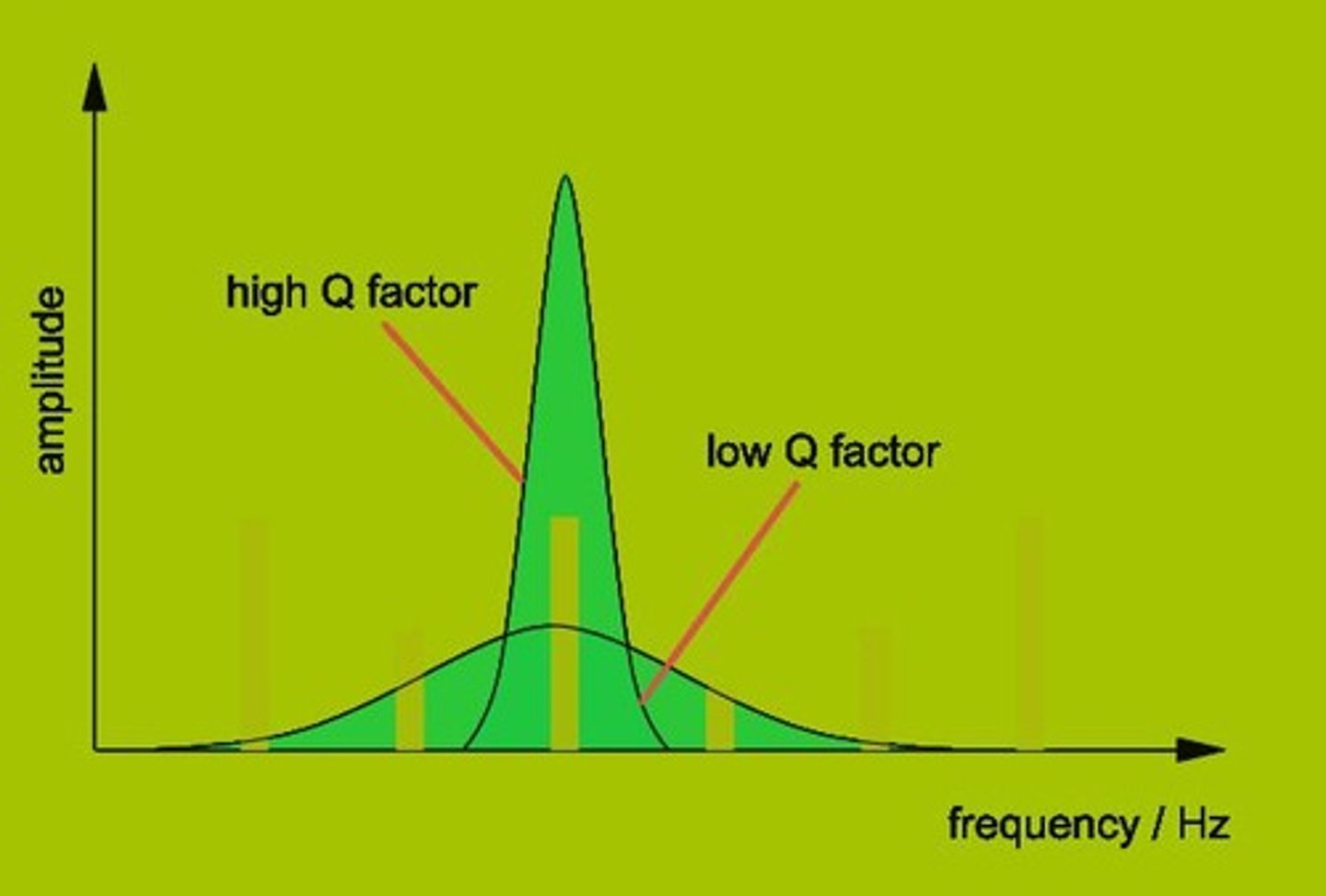
High-Q
Indicates high sensitivity and narrow bandwidth.
Imaging Probes
Short pulse, wide bandwidth, low-Q characteristics.
Non-imaging Probes
Long pulse, narrow bandwidth, high-Q characteristics.
PZT
Ceramic material used in transducers.
Polarization
Creating piezoelectric properties via heat and electric field.
Curie Temperature
Temperature at which PZT is polarized.
Depolarization
Loss of piezoelectric properties when heated above Curie.
Sterilization
Destruction of all microorganisms using heat or chemicals.
Disinfection
Reduction of infectious organisms on an object.
Cleaning Protocols
Use CidexTM for disinfection, avoid extreme temperatures.
Continuous Wave Frequency
Electrical frequency equals acoustic frequency in CW mode.
Pulsed Wave Frequency
Short electrical spike excites the crystal.
PZT Speed
Directly related to frequency; faster equals higher frequency.
PZT Thickness
Inversely related to frequency; thinner equals higher frequency.
High Frequency PW Probes
Thinner PZT crystals with higher speeds.
Low Frequency PW Probes
Thicker PZT crystals with lower speeds.
Sound Beam Focus
Narrowest beam diameter location in ultrasound.
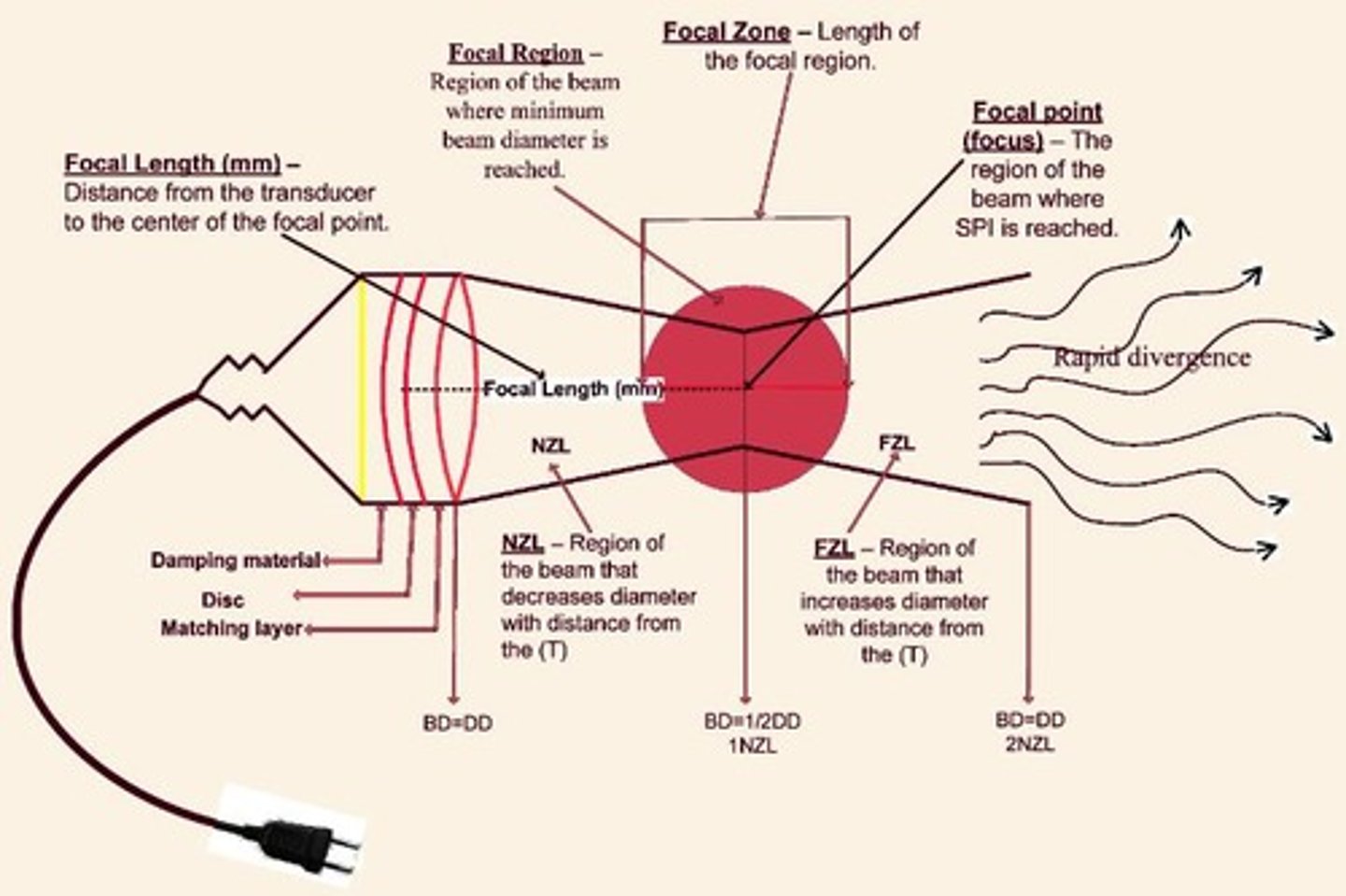
Near Zone (Fresnel Zone)
Region from transducer to focus in ultrasound.
Far Zone
Region where sound beam diverges after focus.
Fraunhofer Zone
Another term for Far Zone in acoustics.
Focal Zone
Area around focus with narrow beam.
Focal Length
Distance from transducer to focus point.
Focal Depth
Distance from transducer to focal point.
Transducer Diameter
Size of the crystal affecting focal depth.
Frequency of Sound
Rate of sound wave oscillation impacting focus.
Beam Divergence
Gradual spread of beam in far field.
Shallow Focus
Focus achieved with smaller diameter and lower frequency.
Deep Focus
Focus achieved with larger diameter and higher frequency.
Less Divergence
Occurs with larger diameter and higher frequency.
More Divergence
Occurs with smaller diameter and lower frequency.
Diffraction Pattern
V-shaped divergence from small sound sources.
Huygen's Principle
Large element acts as many tiny sound sources.
Constructive Interference
Waveforms combine to enhance sound intensity.
Destructive Interference
Waveforms combine to reduce sound intensity.
Lateral Resolution
Ability to distinguish two structures side by side.
Clinical Dilemma
High frequency probes provide shallow focus imaging.
Active Element
Part of transducer that generates sound waves.
Sound Beam Shape
Influenced by crystal size and frequency.
High Frequency Crystals
Used for shallow focus in imaging.