N162B- Med Surg B Final Review
 Call Kai
 Learn
Learn Practice Test
 Spaced Repetition
 Match
Match Flashcards
 Knowt Play
1/70

There's no tags or description
Looks like no tags are added yet.
Name | Mastery | Learn | Test | Matching | Spaced | Call with Kai |
|---|
No analytics yet
Send a link to your students to track their progress
71 Terms
Chvostek Sign
Tapping the cheek over the facial nerve causes twitching of the facial muscles on that side; a positive sign indicating hypocalcemia
Trousseau Sign
Inflating a blood pressure cuff above the systolic baseline for at least 3 minutes causes carpopedal spasms in the arm; a positive sign indicating hypocalcemia
Post Thyroidectomy and Hypocalcemia
The parathyroid glands may be removed or may atrophy, reducing PTH secretion. PTH is responsible for calcium resorption, and its loss can lead to hypocalcemia. The patient may present with positive Chvostek and Trousseau signs
Sodium Imbalances and the Brain
Both hyponatremia and hypernatremia cause fluid shifts between the intracellular fluid (ICF) and extracellular fluid (ECF). These shifts are especially dangerous in the brain, making seizure precautions a priority nursing intervention
Normal Sodium Level
135 to 145 mEq/L
Normal Potassium Level
3.5 to 5 mEq/L
Hyperkalemia: Causes
Renal failure is a primary cause. Since potassium is mostly excreted through the kidneys, renal failure prevents adequate excretion and causes a dangerous buildup of potassium in the blood
Hypokalemia: Causes
Thiazide diuretics, loop diuretics, laxatives, and prolonged nasogastric tube drainage can all cause hypokalemia
Hyperkalemia: EKG Changes
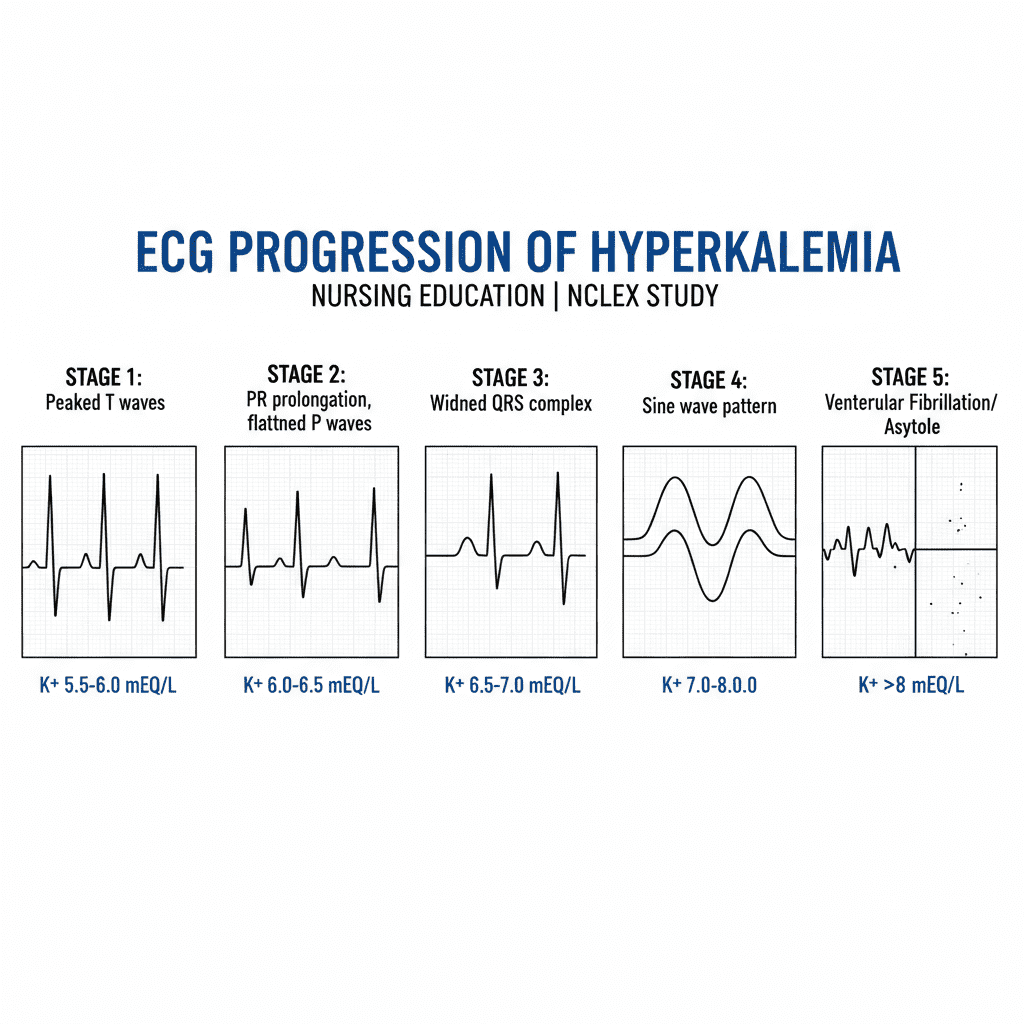
Peaked (tall, tent shaped) T waves, widened QRS complex, and in severe cases a sine wave pattern; these changes indicate dangerously elevated potassium levels
Hypokalemia: EKG Changes
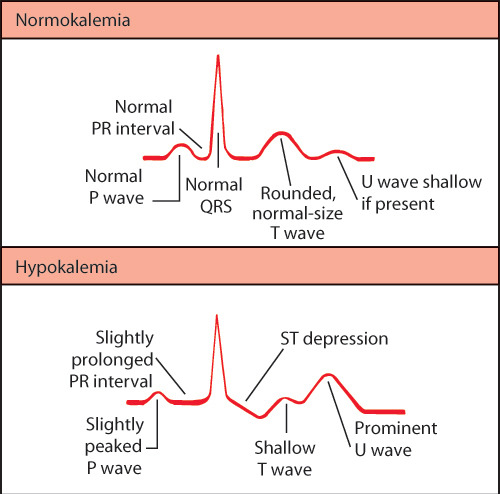
Flattened or inverted T waves, the presence of U waves (a small wave appearing after the T wave), and possible ST segment depression
EKG in Potassium Imbalances: Nursing Action
In both hypokalemia and hyperkalemia, an essential nursing intervention is to obtain an EKG and promptly report the results to the physician
Cholelithiasis
The presence of gallstones in the gallbladder. A key lifestyle modification to manage symptoms is decreasing fat consumption
Ascites
Abnormal accumulation of fluid within the peritoneal cavity; commonly associated with liver disease and cirrhosis
Paracentesis: Goal in Ascites Treatment
A primary goal of paracentesis is to relieve respiratory distress caused by excess abdominal fluid pressing upward against the diaphragm
Elevated Ammonia and its Effects on the Body
Elevated blood ammonia (60 to 80 umol/L or higher) is a risk factor for hepatic encephalopathy. Ammonia acts as a toxin in the CNS, causing the patient to become increasingly lethargic with a declining level of consciousness. The specific threshold varies by individual and underlying liver condition
Neomycin Sulfate and Ammonia
Neomycin sulfate is used to reduce ammonia forming bacteria in the gut, which lowers serum ammonia levels. As ammonia decreases, the patient shows improvement in level of consciousness
Hepatitis: Types with Vaccines
Hepatitis A and Hepatitis B have available vaccines
Hepatitis: Types that Can Become Chronic
Hepatitis B and Hepatitis C are the types that can progress to chronic infection
Hepatitis A: Transmission
Spread through the fecal to oral route, commonly through contaminated food or water
Hepatitis B: Transmission
Spread through blood, sexual contact, and from mother to child during childbirth (perinatal transmission)
Hepatitis C: Transmission
Spread primarily through blood to blood contact, such as sharing needles or contaminated medical equipment
Hepatitis E: Transmission and Pregnancy Risk
Spread through the fecal to oral route via contaminated water. Associated with high maternal mortality
Hepatitis B: Post Exposure Prophylaxis
Administer Hepatitis B Immune Globulin (HBIG) and initiate the Hepatitis B vaccine series as soon as possible after exposure
Dehydration: Lab Changes
Dehydration causes hemoconcentration, which leads to elevated hematocrit levels along with hypernatremia
Pancreatitis: Dietary and Lifestyle Precautions
Patients with pancreatitis must avoid all alcohol consumption. They should also avoid even the smell of food, as this can trigger overexcretion of pancreatic enzymes
Steatorrhea
Fatty, frothy, and foul smelling stools caused by the inability of lipase to be released into the intestines to help digest fat; a common sign of pancreatitis
Cullen Sign
Periumbilical ecchymosis, meaning bruising or discoloration around the belly button; a clinical finding that may be present in acute pancreatitis. Named after physician Thomas Stephen Cullen
Acute Pancreatitis: Common Causes
Gallstones and chronic alcohol use are the most common causes. Other causes include medications, trauma, and hyperlipidemia
Fluid Volume Deficit
Insufficient fluid in the body caused by hemorrhage, burns, vomiting, diarrhea, or excessive sweating. Signs include tachycardia, hypotension, dry mucous membranes, decreased urine output, and elevated hematocrit
Fluid Volume Excess
Too much fluid in the body. Signs include edema, crackles in the lungs, elevated blood pressure, bounding pulse, and sudden weight gain
Jaundice and Bilirubin
Occurs when the liver cannot conjugate bilirubin, causing it to accumulate in the blood and tissues. The skin and sclera become yellow and stools may become clay colored. The nurse should assess the sclera and oral mucosa, particularly in darker skinned patients
T Tube After Open Cholecystectomy
A T tube may be placed during open cholecystectomy to assist with bile drainage from the common bile duct during the healing period
Post Hip Replacement Flexion Precaution
Patients must not flex the hip beyond 90 degrees, such as by sitting low in a chair and reaching below waist level. This position places the joint at risk for dislocation
RICE for Soft Tissue Injuries
Rest, Ice, Compression, and Elevation; the standard treatment approach for sprains and other soft tissue injuries
Homans Sign
Pain in the calf upon dorsiflexion of the foot; historically associated with deep vein thrombosis (DVT)
Burns Emergent Phase: Hematocrit Changes
Massive fluid shifts from the vascular space to the interstitial space cause hemoconcentration, which results in elevated hematocrit levels
Large Burns and Fluid Loss
Burns covering more than 30 percent of total body surface area cause massive fluid loss; this is the priority nursing concern in large burn patients
Inhalation Injury in Burn Patients
Coughing during the immediate post burn phase may indicate an inhalation injury, which is a major predictor of mortality in burn patients
GERD Pathophysiology
Gastroesophageal reflux disease occurs when stomach acid flows back into the esophagus, causing irritation and inflammation of the esophageal lining. Over time this can lead to complications such as esophageal erosion
GERD Treatment: Antacid Patient Education
Should not take other medications for at least 2 hours before or after the dose, because some medications require an acidic environment for proper absorption
Escharotomy
A surgical incision made through burn eschar to relieve pressure and prevent burn induced compartment syndrome, used specifically in circumferential burns
Post Burn Pain Management
Administered via the intravenous route to ensure a rapid and reliable therapeutic effect
Compartment Syndrome
A condition in which increasing pressure within a fascial compartment compromises blood flow and nerve function. The fascia does not expand, so any buildup of pressure from bleeding or swelling will compress circulation and nerves. A hallmark sign is pain unrelieved by appropriate medication. The nurse monitors for the 6 Ps: Pain, Pallor, Paralysis, Paresthesia, Pulselessness (late sign), and Poikilothermia
Cast Care During Drying
The cast must always be repositioned using the palms of the hands and never the fingertips during the drying period. Fingertip pressure creates dents in the cast that can lead to the formation of pressure ulcers under the skin
Severe Anemia: Compensatory Responses
The heart develops compensatory tachycardia, increasing its rate to pump more blood and compensate for the lack of oxygen carrying cells. The patient also experiences dyspnea for the same reason
Pagophagia and Pica
Craving to eat ice (pagophagia) or clay (pica) are characteristic signs of iron deficiency anemia
Hospice Care
A type of care offered to patients with a life expectancy of 6 months or less. It focuses on comfort and support rather than curative treatment, emphasizing quality of life for both the patient and their family
Radiation Therapy: Skin and Rest Education
Monitor their skin closely for the effects of external radiation beams, and prioritize getting adequate rest throughout their course of treatment
Diabetes Type I vs Type II Pathophysiology
Type I is an autoimmune disease in which the pancreas produces little or no insulin. Type II involves insulin resistance or insufficient insulin production. Both result in elevated blood glucose but through different underlying mechanisms
Diabetic Ketoacidosis (DKA)
A life threatening complication primarily of Type 1 Diabetes. Severe insulin deficiency causes the body to break down fat for energy, producing ketones that lead to metabolic acidosis. Characterized by hyperglycemia, ketones in blood and urine, and acidosis
Hyperosmolar Hyperglycemic
A serious complication primarily of Type 2 Diabetes characterized by extremely high blood glucose, severe dehydration, and hyperosmolarity without significant ketoacidosis. Often triggered by illness or infection
Hypoglycemia
Abnormally low blood glucose; a complication seen in both types of diabetes, often caused by excess insulin, inadequate food intake, or excessive exercise. Symptoms include shakiness, diaphoresis, confusion, and palpitations
Addison Disease
Primary adrenal insufficiency in which the adrenal glands do not produce adequate cortisol and aldosterone. Treatment requires lifelong corticosteroid replacement therapy
Cushing Syndrome
A condition caused by prolonged excess cortisol exposure. Treatments aim to identify and reduce or eliminate the source of excess cortisol, such as surgical removal of a causative tumor or tapering of exogenous steroids
Glucocorticoid Tapering
When weaning a patient off glucocorticoids such as prednisone, the dose must always be reduced gradually and must never be stopped abruptly. Abrupt discontinuation can trigger an adrenal crisis because the adrenal glands have been suppressed by long term steroid use
Hypothyroidism Presentation
Caused by underproduction of thyroid hormones leading to a slowed metabolism. Signs include fatigue, weight gain, cold intolerance, constipation, bradycardia, dry skin, and hair loss
Hyperthyroidism Presentation
Caused by overproduction of thyroid hormones leading to an accelerated metabolism. Signs include weight loss, heat intolerance, tachycardia, increased appetite, anxiety, and diaphoresis
Graves Disease
The most common autoimmune cause of hyperthyroidism. Distinct signs include exophthalmos (protruding eyes), goiter, heat intolerance, weight loss, tachycardia, and anxiety
Glasgow Coma Scale
A neurological assessment tool that evaluates level of consciousness across three categories: Eye Opening, Verbal Response, and Motor Response. Normal flexion in the motor category means the patient withdraws from pain. An eye score of 2 means the patient opens eyes only to painful stimuli
Cushing Triad
Three classic signs of increased intracranial pressure: Hypertension with widening pulse pressure (rising systolic BP), Bradycardia, and Irregular respirations such as Cheyne Stokes breathing
Embolic Stroke
A type of ischemic stroke caused by a blood clot or debris that forms elsewhere in the body and travels to the brain, obstructing a cerebral artery. Common sources include atrial fibrillation and cardiac thrombi
Ischemic Stroke
The most common type of stroke; caused by a blockage of a cerebral artery that reduces blood flow to brain tissue. The blockage may be caused by a local thrombus or an embolus traveling from elsewhere in the body
Myasthenia Gravis
A chronic autoimmune neuromuscular disorder characterized by weakness and fatigability of skeletal muscles. The Tensilon (edrophonium) test can be helpful in diagnosing this condition
Amyotrophic Lateral Sclerosis
A progressive neurodegenerative disease affecting motor neurons in the brain and spinal cord. There is no definitive diagnostic test; diagnosis is based on patient history, neurological exam, signs and symptoms, and lab tests that rule out metabolic conditions
Multiple Sclerosis
A chronic autoimmune neurological disease in which the immune system attacks the myelin sheath in the central nervous system, disrupting nerve signal transmission. There is currently no cure for MS
Severe Hyponatremia: Priority Nursing Intervention
Patients must be placed on seizure precautions and side rails must be padded. Severe hyponatremia causes fluid to shift into brain cells, significantly increasing the risk of seizures
Dementia
A general term for the progressive loss of the ability to remember, think, and make judgments that interferes with daily activities. Alzheimer disease is the most frequent form. It is not a normal part of aging, although it often affects older people
Delirium
An acute state of confusion that develops over hours to days. The patient has decreased ability to direct, focus, sustain, and shift attention and awareness. Deficits in memory, orientation, language, visuospatial ability, or perception may be present. The patient may be hypoactive or hyperactive. Treating the underlying cause can reverse it
Delirium vs Dementia
Delirium develops acutely over hours to days and can often be reversed by treating its underlying cause. Dementia develops gradually over time and is generally not reversible
Delirium: Nursing Management
Identify and treat the underlying cause, administer the Confusion Assessment Method (CAM), check comorbidities and diagnostic tests, reorient patient to person, place, time and purpose, use distraction for agitated behavior, manage fever, pain and nausea, encourage early mobility, encourage use of sensory aids such as eyeglasses and hearing aids, implement measures to promote sleep, provide a safe environment, and teach the patient and caregivers about causes and manifestations of delirium
Electrolytes
Active chemicals that carry positive (cations) or negative (anions) electrical charges when dissolved in water. Major cations: sodium, potassium, calcium, magnesium, and hydrogen ions. Major anions: chloride, bicarbonate, phosphate, sulfate, and albumin. Concentration is expressed in mEq/L and differs between fluid compartments