Theories
 Call Kai
 Learn
Learn Practice Test
 Spaced Repetition
 Match
Match Flashcards
 Knowt Play
1/19

Earn XP
Description and Tags
Unit 1 Theorists and their theories
Name | Mastery | Learn | Test | Matching | Spaced | Call with Kai |
|---|
No analytics yet
Send a link to your students to track their progress
20 Terms
Attachment
An attachment is a strong emotional bond between an infant and their primary caregiver.
Mary Ainsworth Strange Situation Classification - Types of Attachment
Secure Attachment
Insecure Avoidant
Insecure Abivalent
What is secure attachment?
Securely attached children feel that their caregivers will meet all of their needs. Securely attached children become distressed when the caregiver leaves, and calm down when the caregiver returns. The child does not find comfort from strangers when the caregiver leaves.
What is insecure avoidant?
Insecure avoidant children are very independent and do not gravitate towards the caregiver when investigating their environment. They show little stranger anxiety and are accepting of the stranger. The child will show little interest when the caregiver returns.
What is insecure ambivalent?
The child will display clingy behaviour and be dependent on the caregiver. They will reject the caregiver when they engage in interaction. The child does not have any feelings of security from the caregiver and finds it difficult to investigate the environment alone as they do not want to move away from the caregiver. When they suffer with distress, the caregiver will find it difficult to calm them down. The reason for this is because the caregiver is inconsistent in their responses to the child.
How many years is it critical to form attachment in according to John Bowlby?
2 years
Some possible effects of disruption to attachment include:
Individual may experience anxiety.
Difficulty in forming relationships in later life.
Becoming a parent who struggles to establish attachments with their own children.
What are Piaget’s stages of Intellectual development?
Sensorimotor stage (0-2 years)
Pre-operational (2-6 years)
Concrete operational (7-11 years)
Formal operational (11+ years)
What is the Sensorimotor stages (0-2 years)?
Here children explore through direct sensory and motor contact
Object permenanence is developed (3 months)
What is the Pre-operational stage (2-6 years)?
Children will use symbols to represent objects but do not think logically. They have the ability to pretend and think egocentrically
What is the meaning of Egocentric?
Only understand the world from their point of view
What is the Concrete operational stage (7-11 years)?
Children can think logically about concrete objects
Understand conservation
What is the Formal Operational stage (12+ years)
Here the adolescent can reason abstractly and think hypothetically
Erik Erikson’s Psychosoical stages
Trust vs Mistrust (Infancy)
Autonomy vs shame + doubt (Early childhood)
Initiative vs guilt
Industry vs Inferiority
Identity vs Role confusion (Adolescence)
Intimacy vs Isolation (Early Adulthood)
Generativity vs stagnation (Middle Adulthood)
Ego Integrity vs Despair
What is a schema?
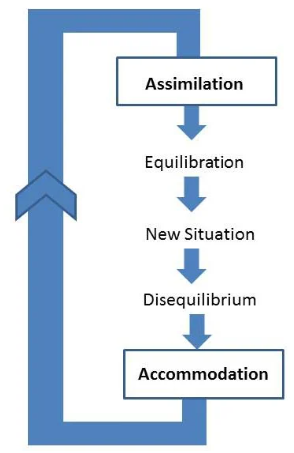
A schema is a pattern of learning, linking perceptions, ideas and actions to make sense of the world.
Schema
Assimilation - new information absorbed
Equilibration - organise current information along with understanding
Accommodation - modify their understanding
Activity Theory - Havighurst
Suggests individuals in later adulthood are most fulfilled and at their happiest when they participate in social interactions and remain active
Social Disengagement Theory - Cummings & Henry
Suggests that as people move into later adulthood they begin to withdraw from roles that were once important in their lives and start to disengage from social relationships too
What is Roper and Tierney Model of nursing?
A Holistic, patient-centered framework commonly used in UK health and social care to assess an individual’s needs.
Name the 12 Activities of Living (ALs)
Breathing
Maintaining a safe environment
Being able to communicate
Eating and drinking
Elimination of bodily waste
Washing and dressing
Controlling temperature
Getting around independently
Working and playing
Sleeping
Expressing sexuality
Death and dying