SUSTOUR: CHAPTER 6 (FINAL)
 Call Kai
 Learn
Learn Practice Test
 Spaced Repetition
 Match
Match Flashcards
 Knowt Play
1/31

There's no tags or description
Looks like no tags are added yet.
Name | Mastery | Learn | Test | Matching | Spaced | Call with Kai |
|---|
No analytics yet
Send a link to your students to track their progress
32 Terms
Responsible Tourism
was defined in Cape Town in 2002 alongside the World Summit on Sustainable Development. This definition, the Cape Town Declaration is now widely accepted and was been adopted by the World Travel Market in 2007 for World Responsible Tourism Day.
Responsible Tourism
is about "making better places for people to live in and better places for people to visit." It requires that operators, hoteliers, governments, local people and tourists take responsibility, take action to make tourism more sustainable.
Responsible Tourism
The World Travel Market has adopted the Cape Town Declaration definition of Responsible Tourism for its World Responsible Tourism Day which encourages the industry to take responsibility for making tourism more sustainable and demonstrate their responsibility.
The Global Code of Ethics
The UNWTO adopted the _____________ for Tourism in 1999, which is a comprehensive set of principles designed to guide the actions of governments, the private sector, communities, and tourists alike in order to maximize tourism’s benefits and minimize its costs on destinations.
Article 1: Tourism’s contribution to mutual understanding and respect between peoples and societies
Tourism is a vehicle for peace. This article emphasizes that tourism activities should be conducted in harmony with the traditions of host regions.
Article 1: Tourism’s contribution to mutual understanding and respect between peoples and societies
Travelers should learn about their destination's customs before arrival, and host communities should show hospitality while respecting the diversity of their visitors.
Article 2: Tourism as a vehicle for individual and collective fulfillment
Tourism should promote gender equality, human rights, and personal growth.
Article 2: Tourism as a vehicle for individual and collective fulfillment
It emphasizes that travel is an irreplaceable factor of self-education. It also strictly condemns the exploitation of any vulnerable group, particularly children.
Article 3: Tourism, a factor of sustainable development
Tourism must safeguard the natural environment and resources for future generations.
Article 3: Tourism, a factor of sustainable development
Priority should be given to tourism products that save rare and precious resources (like water and energy) and protect biodiversity.
Article 4: Tourism, a user of the cultural heritage of mankind and a contributor to its enhancement
Tourism policies should be conducted with respect for artistic, archaeological, and cultural heritage.
Article 4: Tourism, a user of the cultural heritage of mankind and a contributor to its enhancement
Resources from tourism visits should be used for the upkeep and protection of the monuments, shrines, and museums being visited.
Article 5: Tourism, a beneficial activity for host countries and communities
Local populations should be associated with tourism activities and share equitably in the economic, social, and cultural benefits.
Article 5: Tourism, a beneficial activity for host countries and communities
Tourism professionals should give priority to local manpower and avoid the "leakage" of profits where money leaves the destination instead of helping the local economy.
Article 6: Obligations of stakeholders in tourism development
Tourism professionals have an obligation to provide tourists with objective and honest information on their destinations.
Article 6: Obligations of stakeholders in tourism development
This includes transparency in contracts and ensuring traveler safety, health, and insurance. Governments must provide protection for foreign tourists, especially those who may be vulnerable.
Article 7: Right to Tourism
The prospect of direct and personal access to the discovery of the planet's resources is a right open to all.
Article 7: Right to Tourism
This promotes "Social Tourism" and accessibility, ensuring that persons with disabilities, families with low incomes, and seniors can also enjoy travel.
Article 8: Liberty of tourist movements
Tourists and visitors should benefit from the liberty to move within their countries and from one State to another.
Article 8: Liberty of tourist movements
This encourages the simplification of administrative formalities (like visas) and grants tourists access to health and legal services if needed.
Article 9: Rights of the workers and entrepreneurs in the tourism industry
The fundamental rights of salaried and self-employed workers in the tourism industry must be guaranteed.
Article 9: Rights of the workers and entrepreneurs in the tourism industry
Given the seasonal nature of the industry, particular care should be taken to ensure job security, fair pay, and continuous training for workers.
Article 10: Implementation of the principles of the Global Code of Ethics for Tourism
The final article focuses on the "World Committee on Tourism Ethics.
Article 10: Implementation of the principles of the Global Code of Ethics for Tourism
The public and private stakeholders in tourism development should cooperate in the implementation of these principles and monitor their effective application.
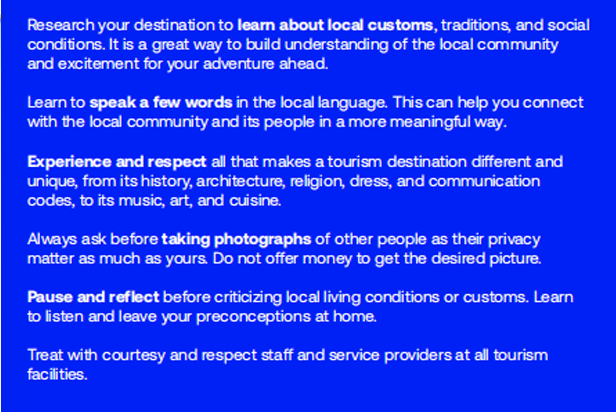
Honor your hosts and our common heritage
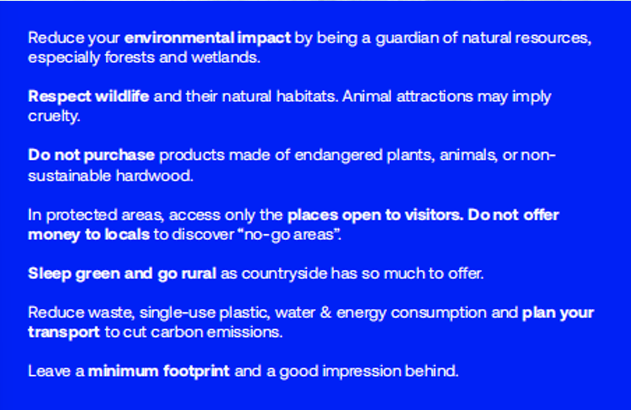
Protect our Planet
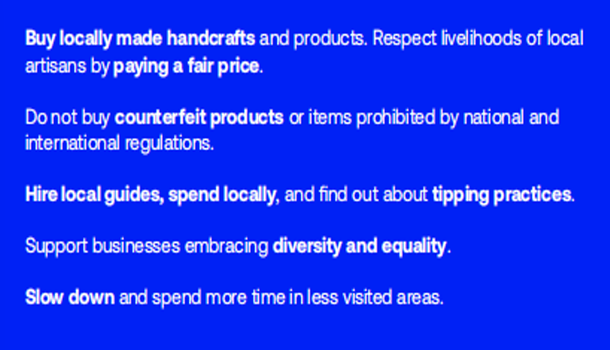
Support the local economy
Travel Safety
Be an informed traveler
Use digital platforms wisely
Make tourism a force for good and set a good example for other travelers
7 Tips for Responsible Traveler
Honor your hosts and our common heritage
Protect our Planet
Support the local economy
Travel Safety

Be an informed traveler
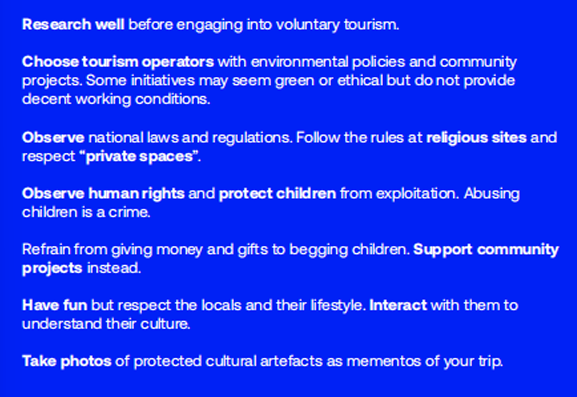
Use digital platforms wisely
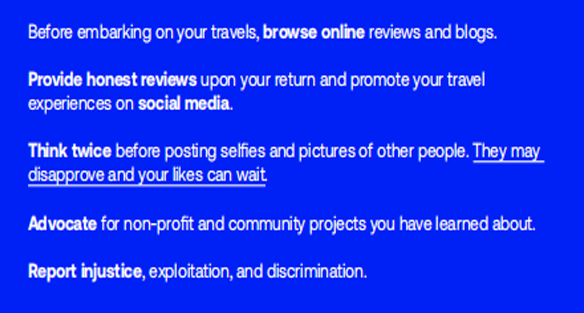
Make tourism the force for good and set a good example for other travelers