4. LOPHOTROCHOZOA Superphylum
 Call Kai
 Learn
Learn Practice Test
 Spaced Repetition
 Match
Match Flashcards
 Knowt Play
1/29

Earn XP
Name | Mastery | Learn | Test | Matching | Spaced | Call with Kai |
|---|
No analytics yet
Send a link to your students to track their progress
30 Terms
LOPHOTROCHOZOA Characteristics (5)
Triploblastic
Bilateral
Cephalization Beginning
Evolution of concentration of nervous tissues and sensory organs in head of organisms
Protostomes
Acoelomate, pseudocoelomate, and eucoelmoate phyla
Lophophore
Crown of ciliated tentacles that function in feeding
Feeding apparatus/trochophore larva
PLATYHELMINTHES Phylum (Flatworms)
Flatworms
Acoelomate
Free-living and parasitic
Lophophore/trochophore larvae absent
Spiral cleavage
Rhabditophora
Rod-like structures discharged in mucus produced by free-living flatworms
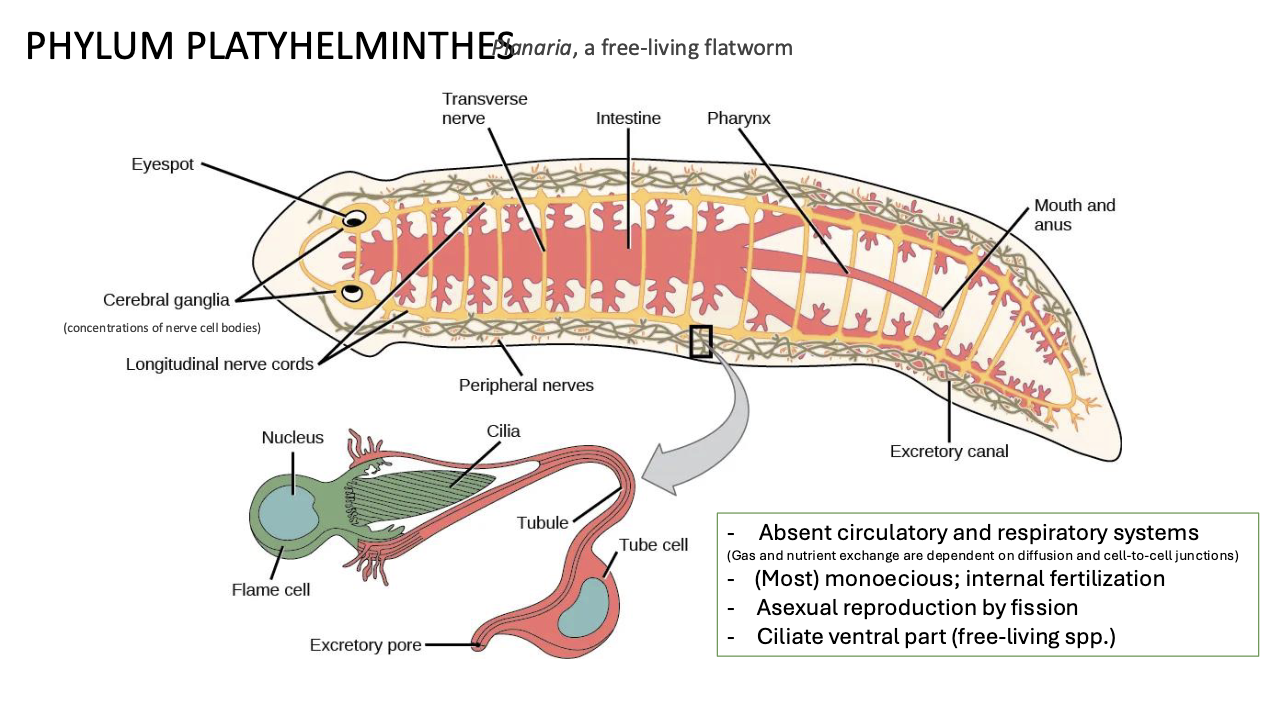
PLATYHELMINTHES (Flatworms) Anatomy
ABSENT Circulatory and Respiratory systems
Gas and nutrient exchange dependent on diffusion and cell-to-cell junctions
Monoecious, internal fertilization
Asexual reproduction by fission
NERVOUS SYSTEM
Cerebral Ganglia
Eyespots
Longitudinal Nerve Cords
Transverse Nerves
Peripheral Nerves
DIGESTIVE SYSTEM
Mouth and Anus
Pharynx
Intestine
EXCRETORY SYSTEM (Protonephridia)
Protonephridia: Primitive network-like excretory organs
Flame Cell
Tubule/Tube Cell
Excretory Canal
Excretory Pore
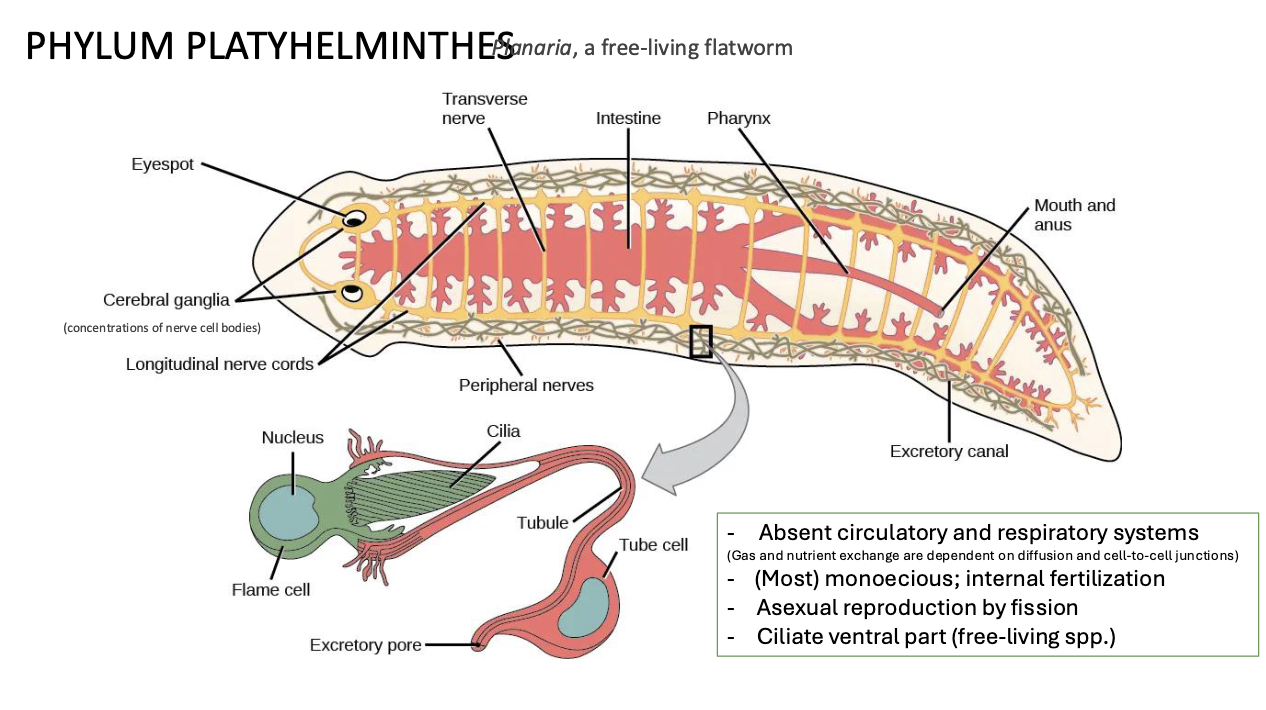
PLATYHELMINTHES (Flatworms) Nervous System (5)
NERVOUS SYSTEM
Cerebral Ganglia
Concentrations of nerve cell bodies
“Brain-like”
Eyespots
Sensory organs for detecting light
Longitudinal Nerve Cords
Main nerves running length of body
Transverse Nerves
Connect longitudinal cords in ladder-like structure
Peripheral Nerves
Branching nerves extending to body wall
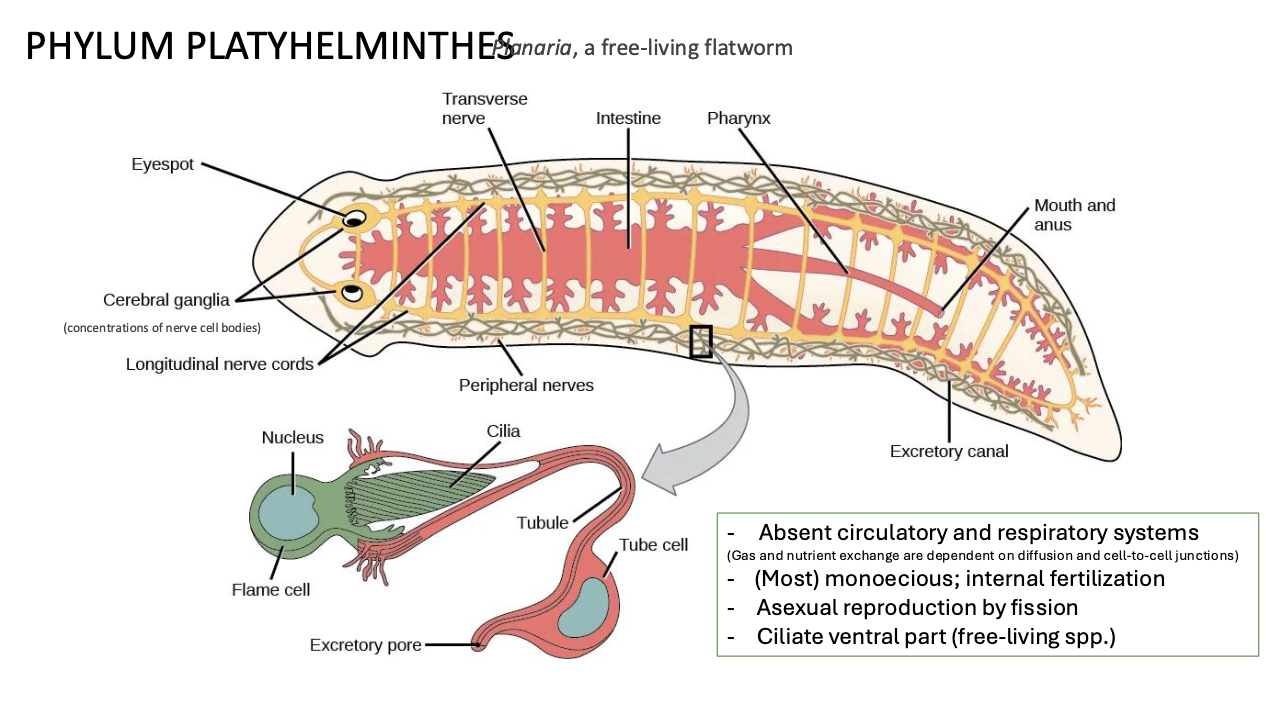
PLATYHELMINTHES (Flatworms) Digestive System (3, 1 contains 2)
DIGESTIVE SYSTEM
Mouth and Anus
Single opening to take both food in and expel waste out
Pharynx
Muscular tube to pull food into body
Intestine
Branched gastrovascular cavity that digests and distributes nutrients
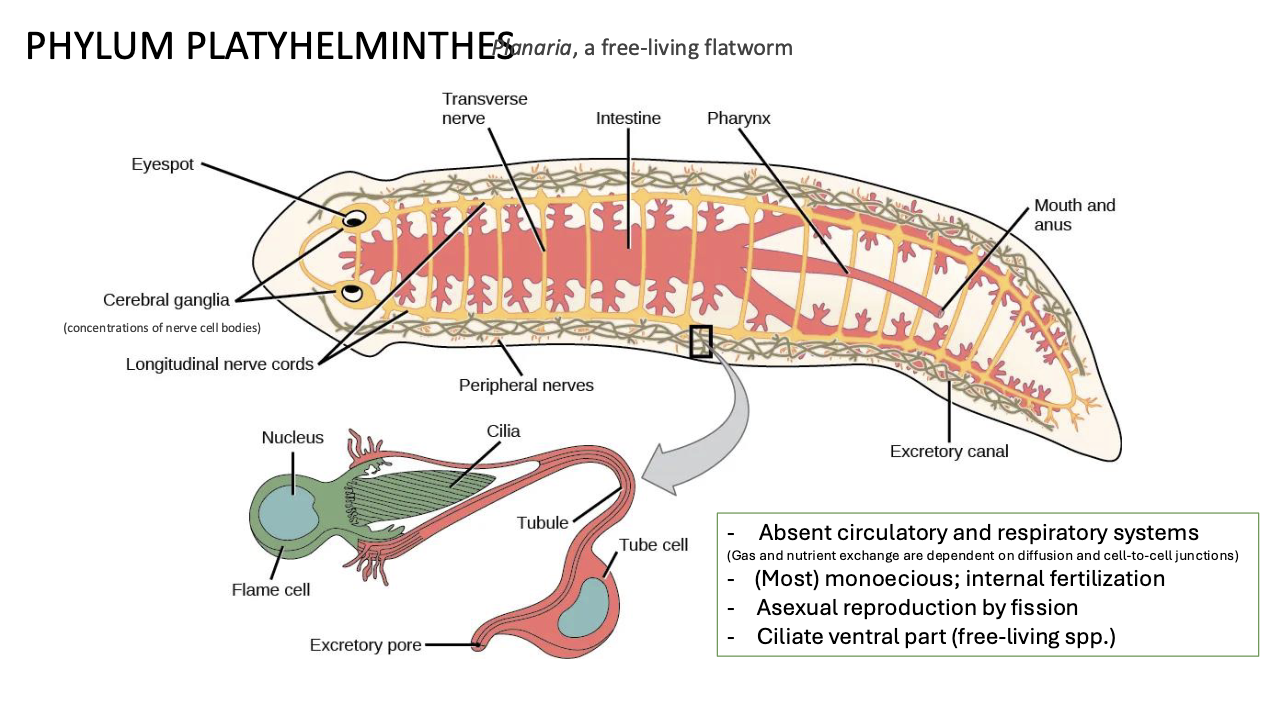
PLATYHELMINTHES (Flatworms) Excretory System (PROTONEPHRIDIA)
EXCRETORY SYSTEM (Protonephridia)
Protonephridia: Primitive network-like excretory organs
Flame Cell
Filters waste
Contains nucleus and cilia to propel fluid
Tubule/Tube Cell
Channels that transport filtered fluid
Excretory Canal
Main duct for waste transport
Excretory Pore
Opening where waste exits body
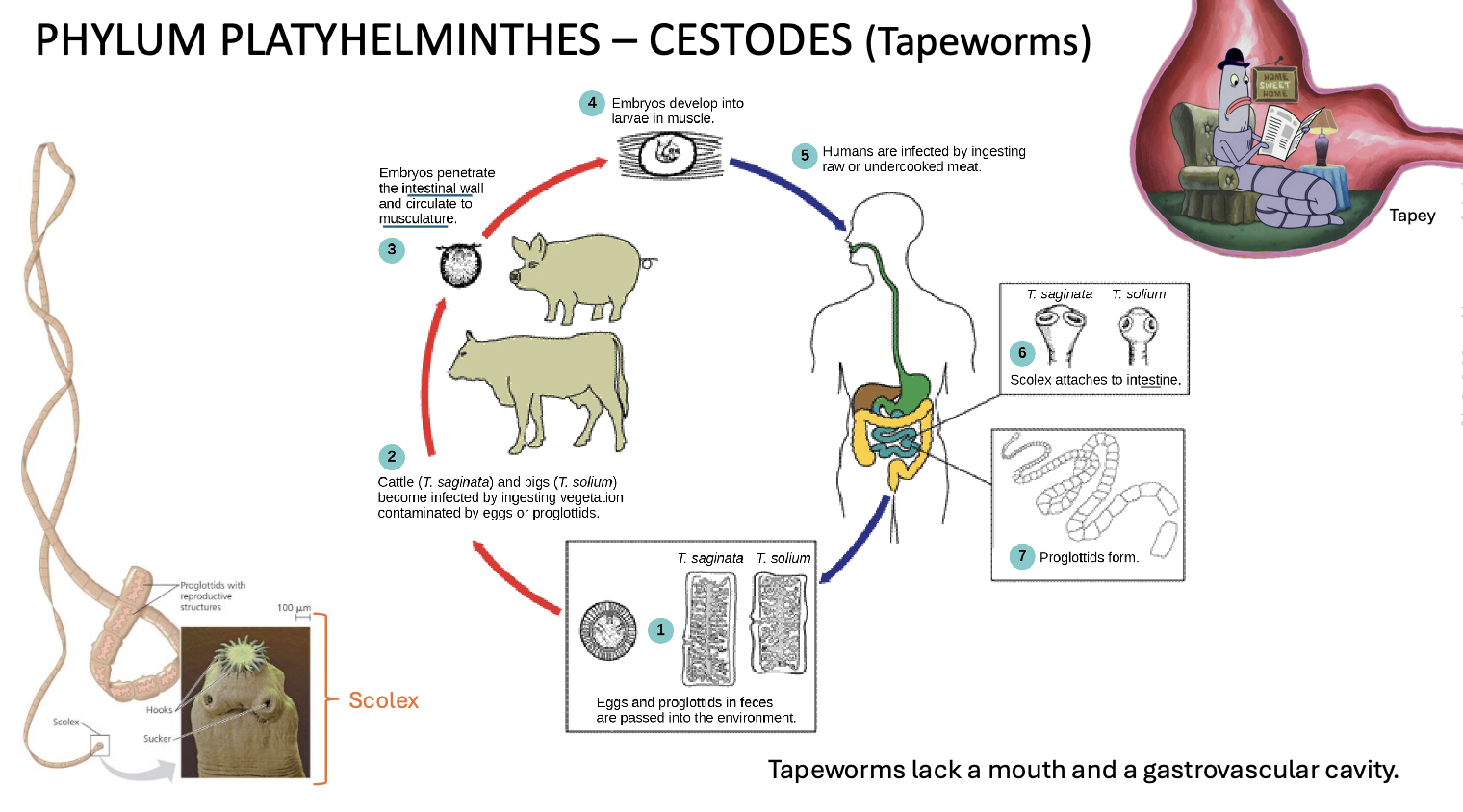
CESTODES (Tapeworms)
Lack a mouth and gastrovascular cavity
ROTIFERA Phylum (“Wheel-bearer”) Characteristics
Pseudocoelomates
Corona (feeding structure)
Filter-feeders
Dioecious
Microscopic
Free-swimming/planktonic
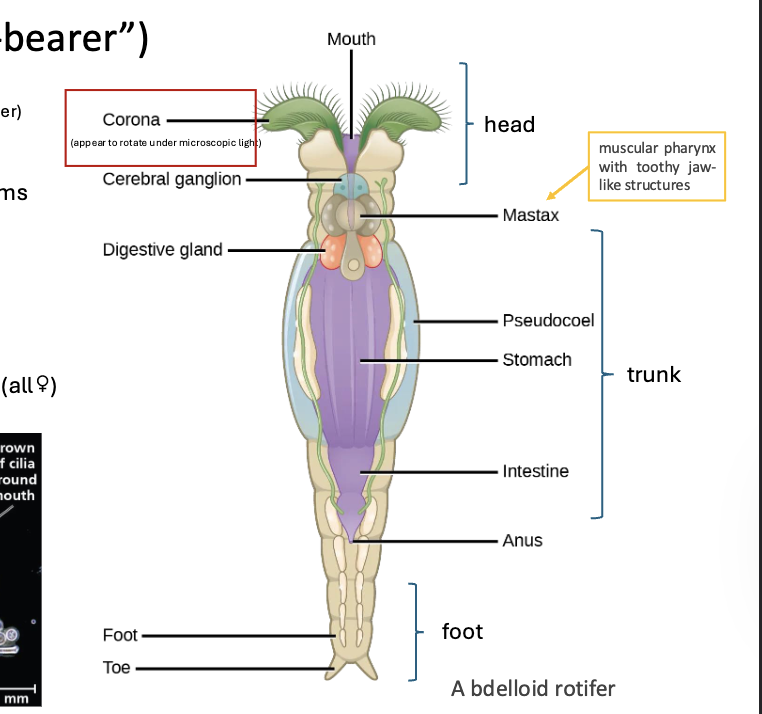
ROTIFERA Anatomy (3 Regions, 9 Parts, 3-5-1)
3 Body sections
Head, Trunk, Foot
Reproduction: Parthenogenesis
Parthenogenesis = Development from unfertilized eggs
HEAD REGION:
Corona
Mouth
Cerebral ganglion
TRUNK REGION:
Mastax
Digestive gland
Pseudocoel
Stomach & Intestine
Anus
FOOT REGION:
Foot & Toe
ROTIFERA Head Region (3)
HEAD REGION:
Corona
Food and locomotion
Mouth
Opening for food ingestion
Within corona
Cerebral ganglion
“Brain”
Central concentration of nerve cells
ROTIFERA Body Region (5)
BODY REGION:
Mastax
Muscular pharynx
“Toothy” jaw-like structures
Grind food
Digestive gland
Secretes enzymes to break down food
Pseudocoel
Fluid-filled body cavity that provides structural support
Stomach & Intestine
Primary sites for digestion and nutrient absorption
Anus
Opening for waste elimination
ROTIFERA Foot Region (1)
FOOT REGION:
Foot and Toe
Posterior end used for attachment onto surfaces
NEMERTEA Phylum (Ribbon worms)
Bilateral
Coelomic/Acoelomates
Dioecious/monoecious
Fragmentation
Marine
Carnivore
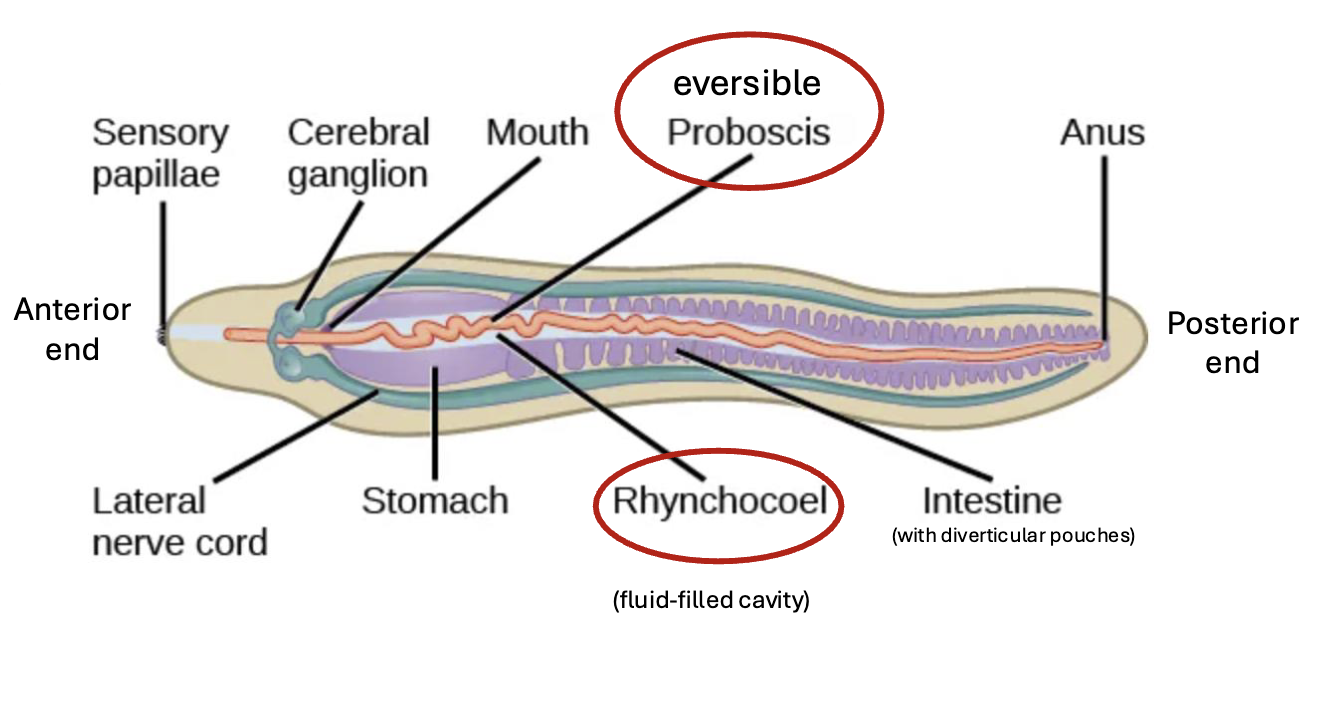
NEMERTEA Phylum (Ribbon worms) Anatomy
KEY SPECIALIZED STRUCTURES:
Proboscis
Long, muscular everisble tube to capture prey
Within rhynchocoel
Rhynchocoel
Fluid-filled cavity that houses proboscis
NERVOUS SYSTEM (3):
Cerebral ganglion
Lateral nerve cord
Sensory papillae
DIGESTIVE SYSTEM (4):
Mouth
Stomach
Intestine
Anus
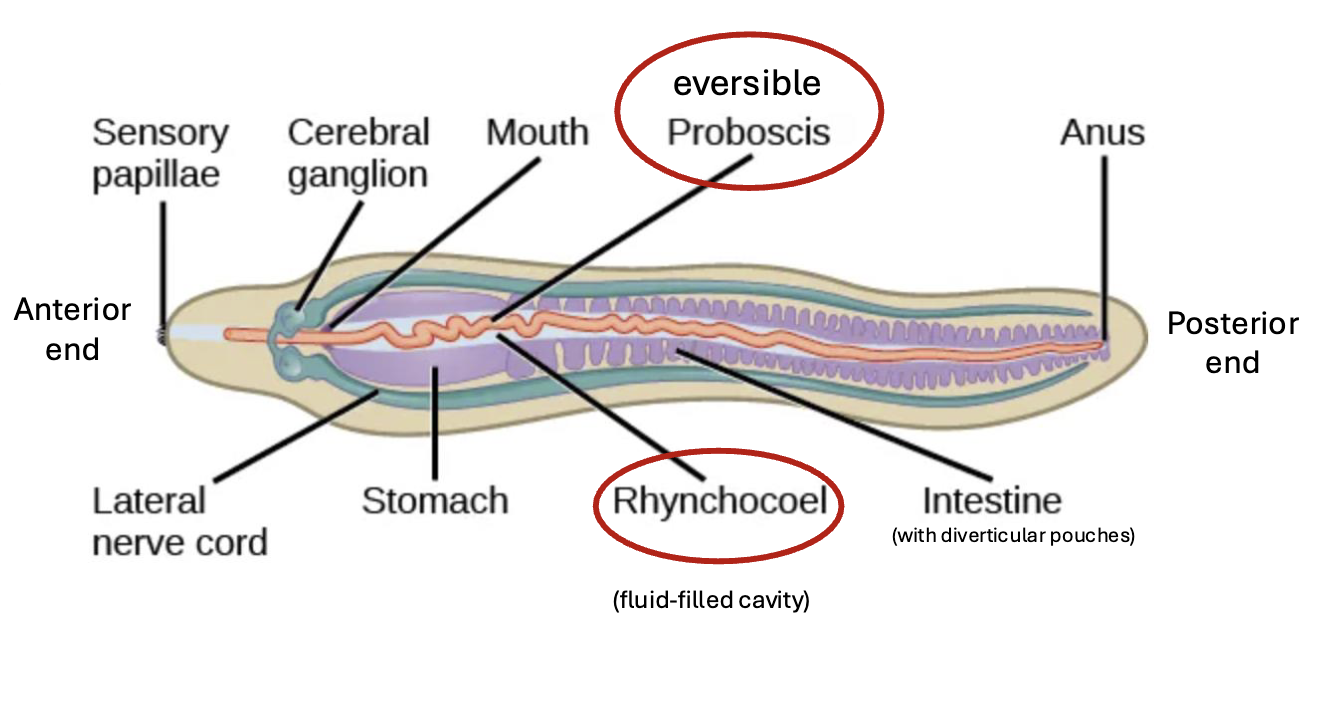
NEMERTEA (Ribbon worms) NERVOUS SYSTEM (3)
NERVOUS SYSTEM (3):
Cerebral ganglion
“Brain”
Lateral nerve cord
Two main nerve cords
Along sides of body
Sensory papillae
Small sensory organs, anterior tip
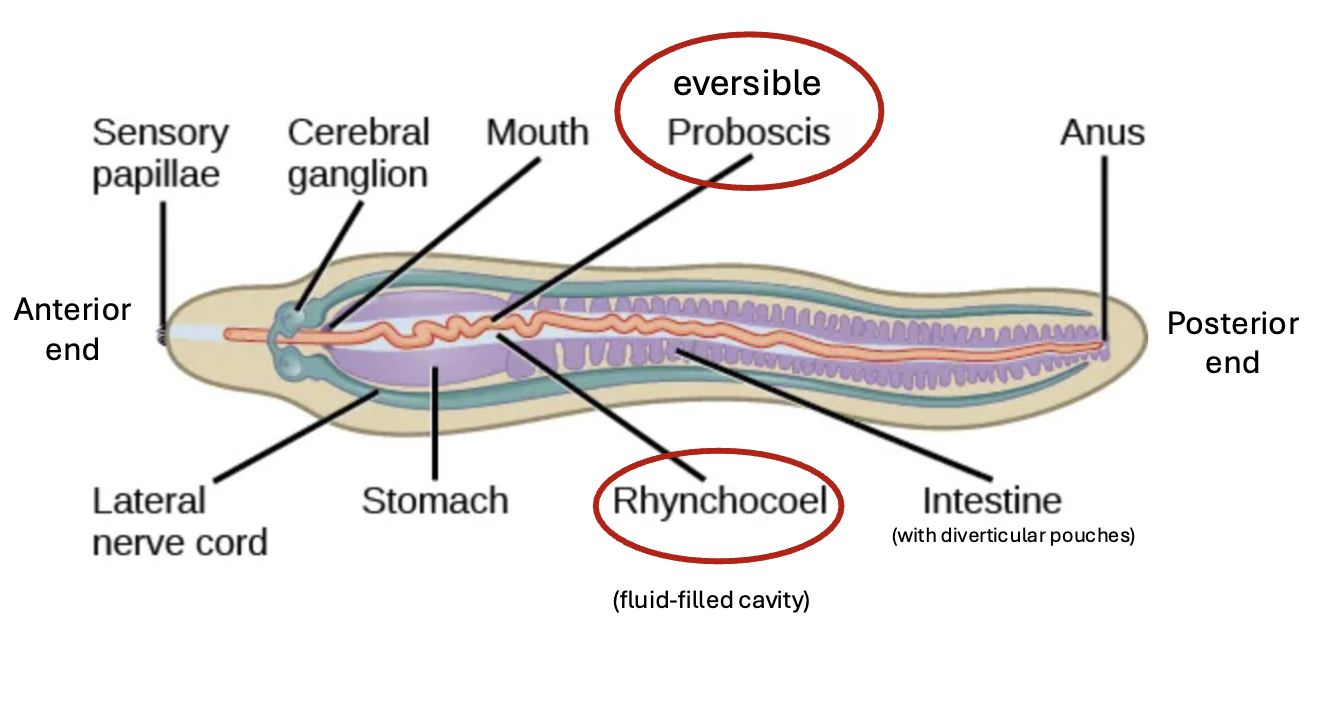
NEMERTEA (Ribbon worms) DIGESTIVE SYSTEM (4)
DIGESTIVE SYSTEM (4):
Mouth
Opening for food intake
Stomach
Initial processing chamber for food
Intestine
Long tube with diverticular pouches to increase surface area for nutrient absorption
Anus
One-way digestive system
MOLLUSCA Phylum Characteristics
Snails, slugs, squids, octopuses, clams, oysters
Soft body
Bilateral
Cephalized
Sensory, feeding, neural organs concentrated at anterior
Forming distinct head and brain
Triploblastic
Protosomes
Mouth first
Eucoelomates
Have a coelom completely lined by mesoderm
Dioecious
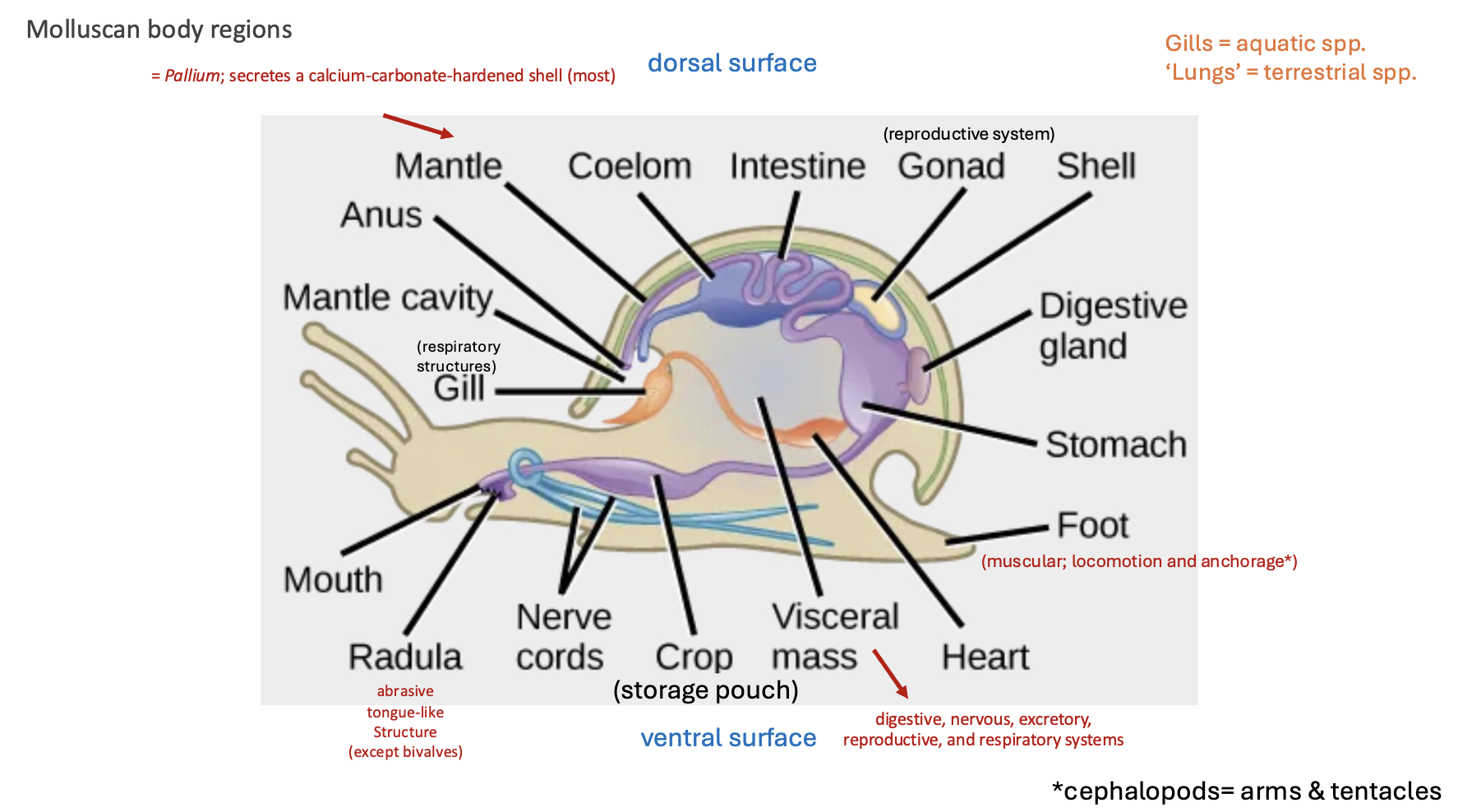
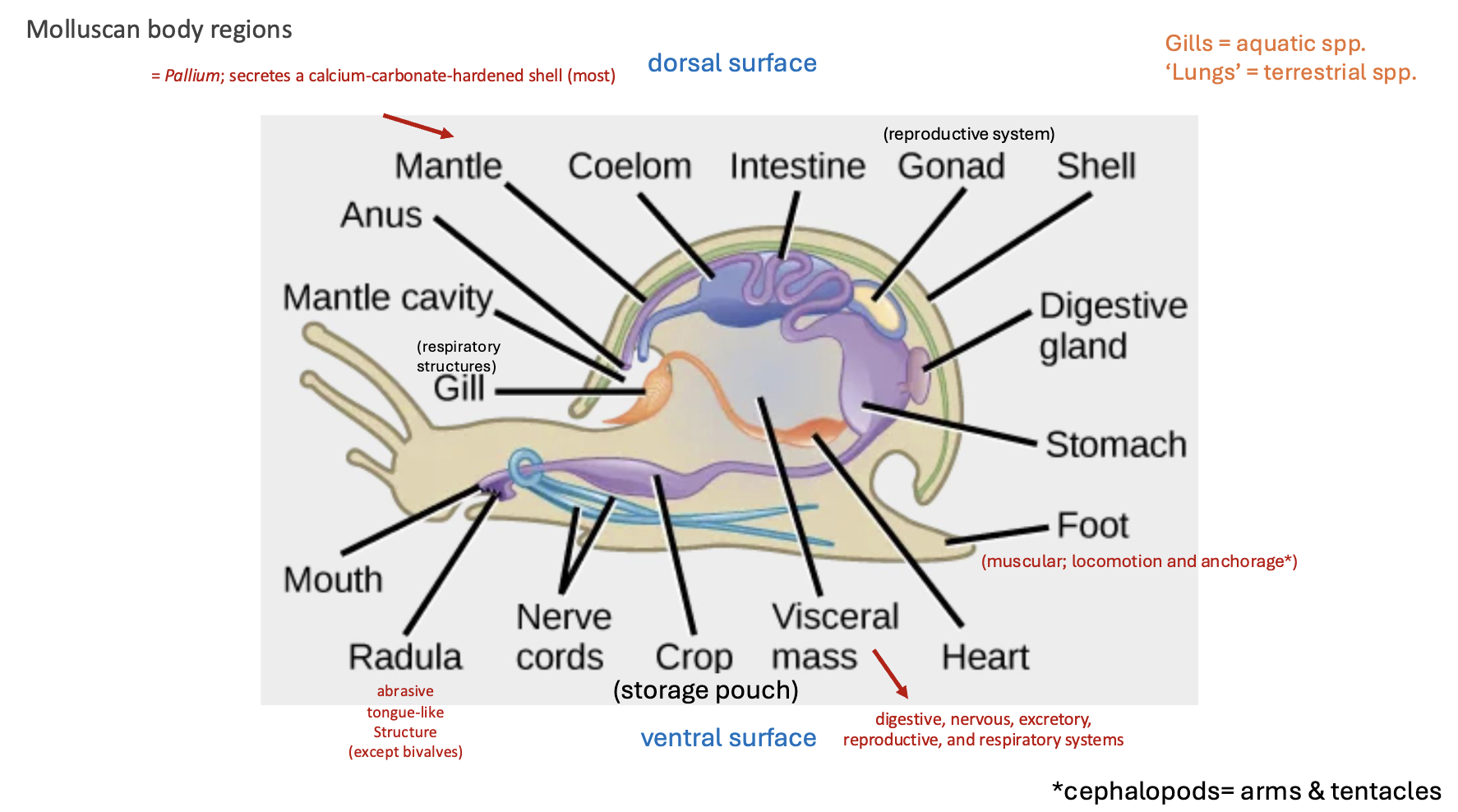
MOLLUSCAN BODY REGIONS (3 Sections, 5-4-4)
PRIMARY BODY STRUCTURES (5):
Mantle
Mantle Cavity
Visceral Mass
Foot
Shell
DIGESTIVE SYSTEM (4):
Radula
Crop
Stomach & Digestive Gland
Intestine & Anus
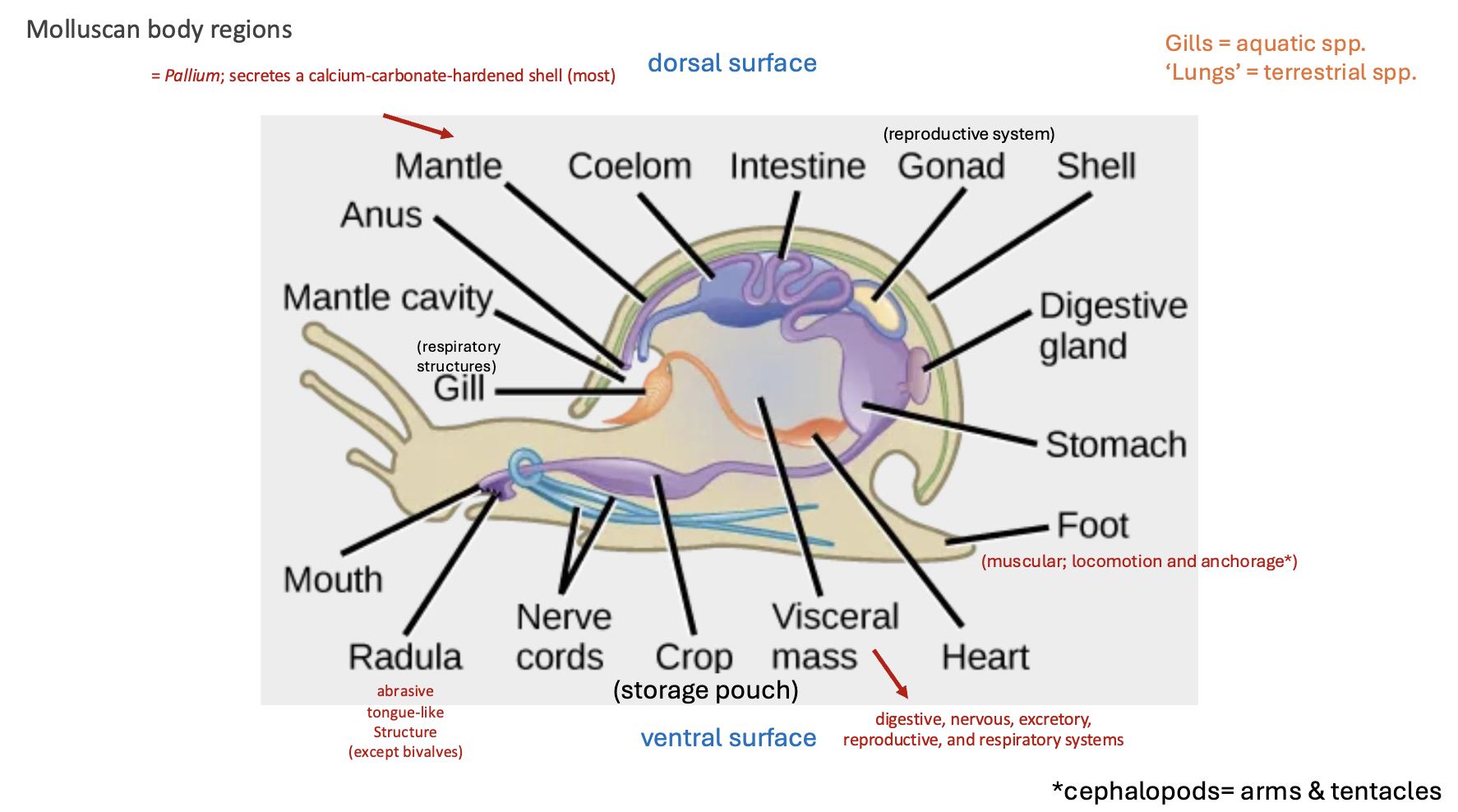
NERVOUS SYSTEM (4):
Heart
Coelom
Nerve Cords
Gonad
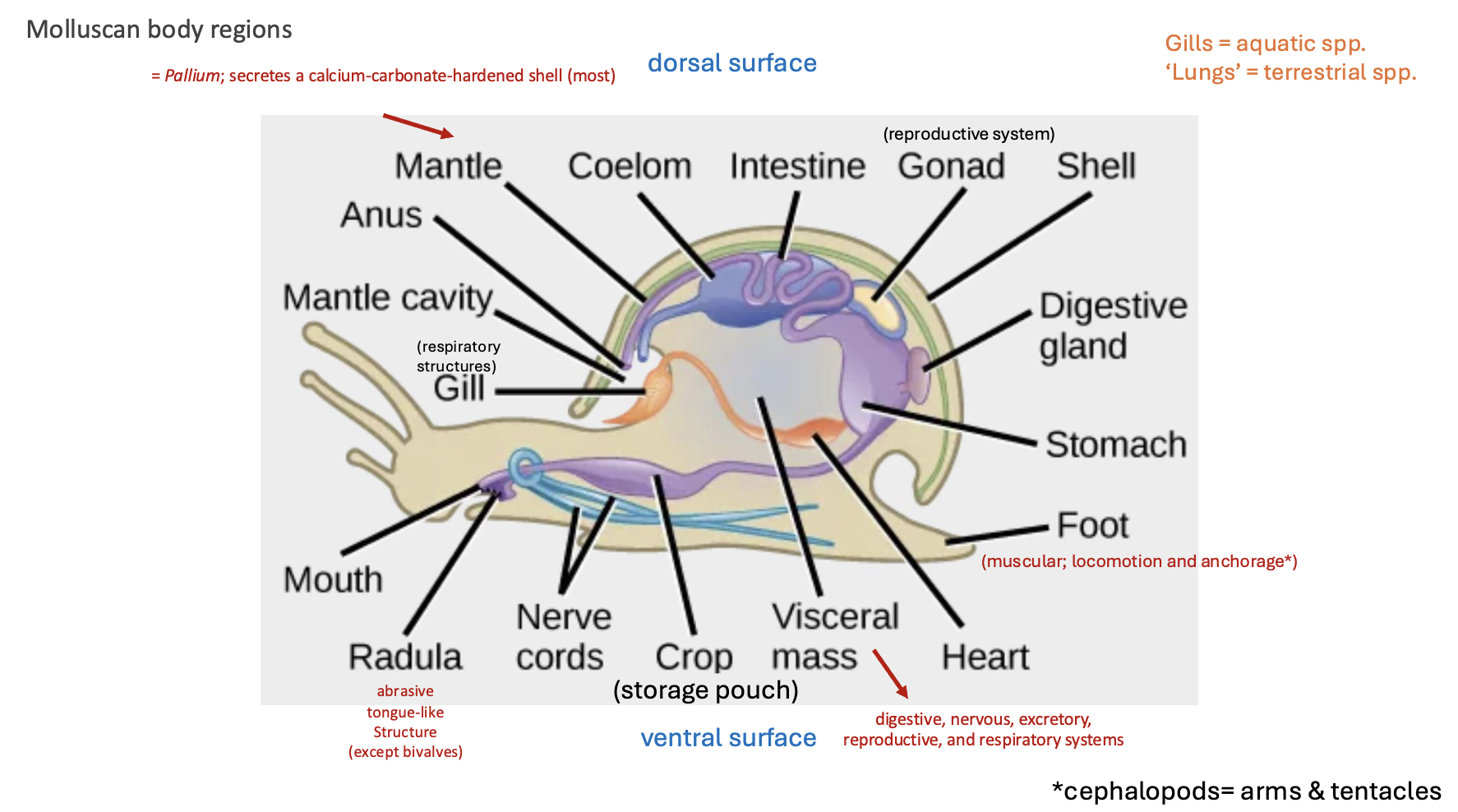
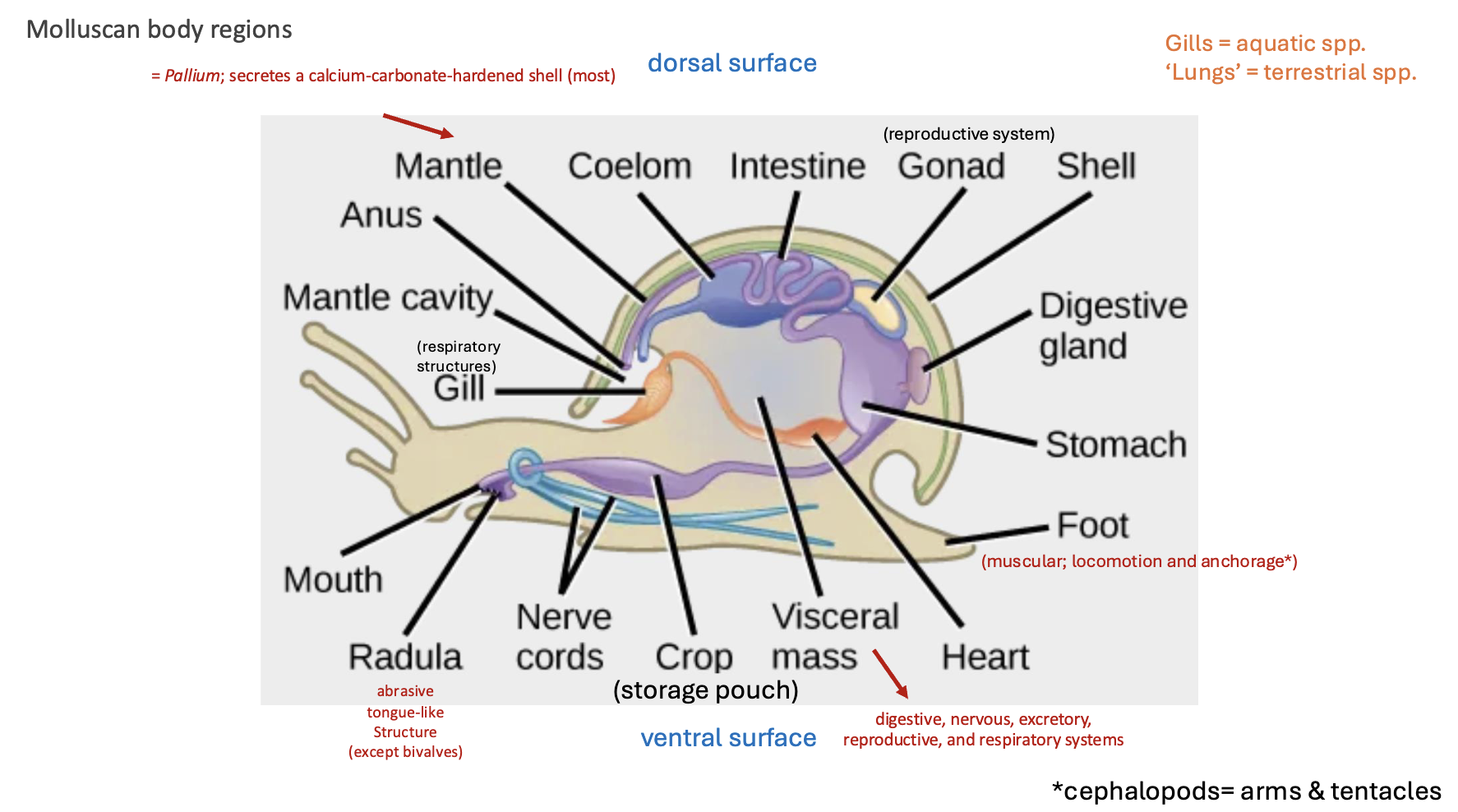
MOLLUSCAN PRIMARY BODY STRUCTURES (5)
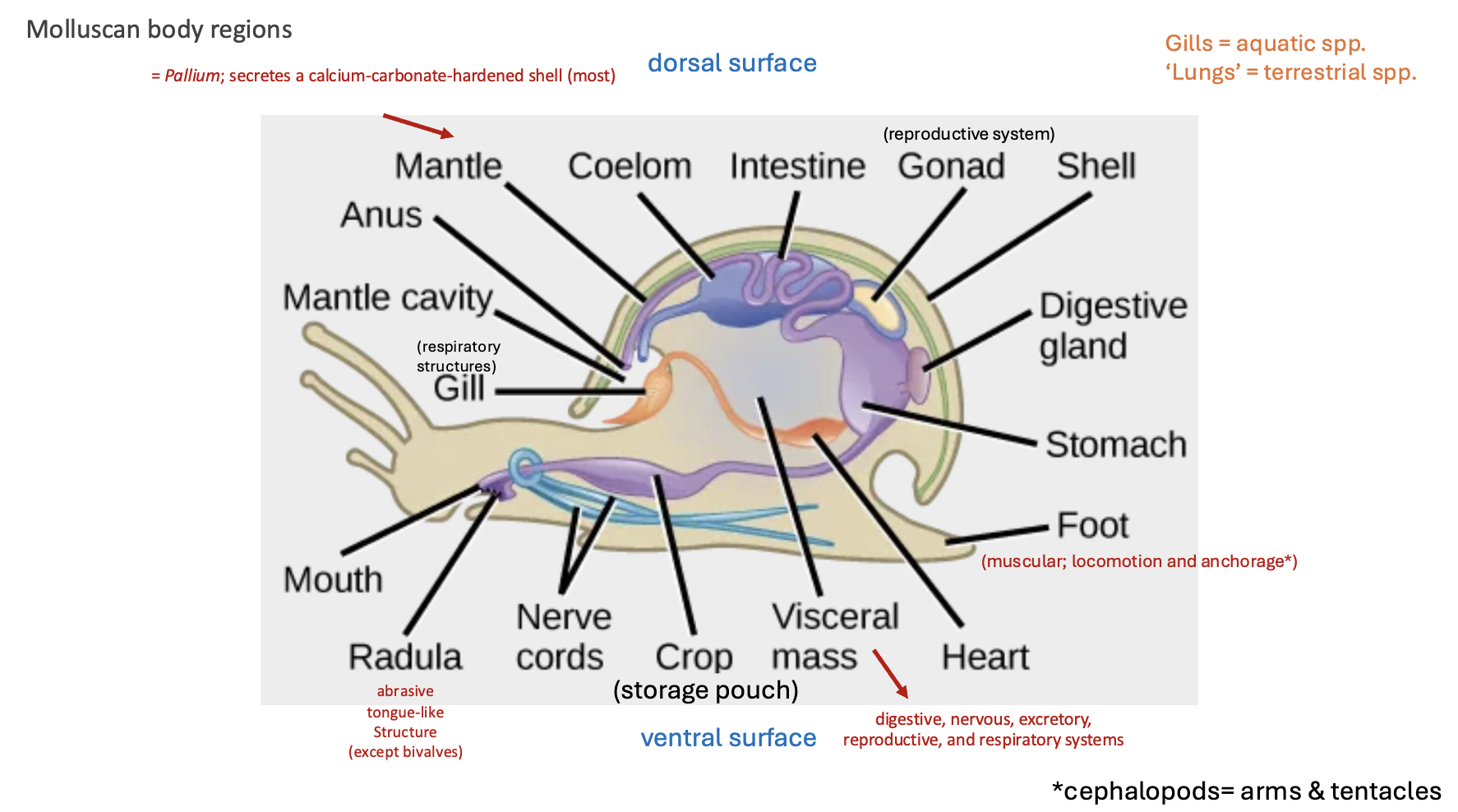
PRIMARY BODY STRUCTURES:
Mantle
Secretes calcium-carbonate-hardened shell
Mantle Cavity
Houses respiratory structures
Gills or Lungs
Visceral Mass
Digestive, nervous, excretory, reproductive, respiratory systems
Central region
Foot
Locomotion and anchorage
Muscular organ
MODIFIED FOOT IN CEPHALOPODS = ARMS & TENTACLES
Shell
Protective Outer Layer
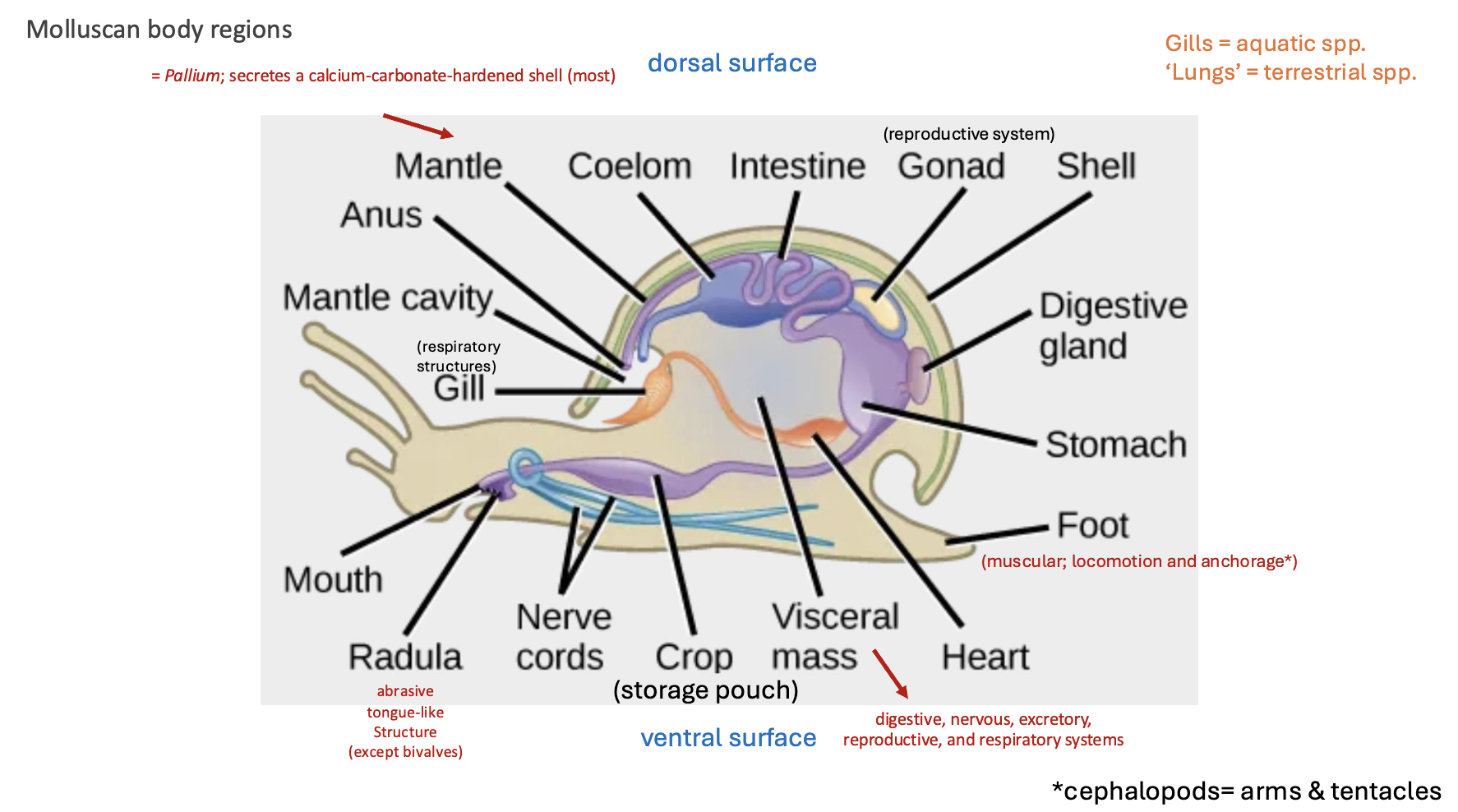
MOLLUSCAN DIGESTIVE SYSTEM (4)
MOLLUSCAN DIGESTIVE SYSTEM:
Radula
Abrasive, tongue-like
Feeding
Crop
Storage pouch for food before digestion
Stomach & Digestive Gland
Primary sites of digestion and enzyme secretion
Intestine & Anus
Processes waste for elimination
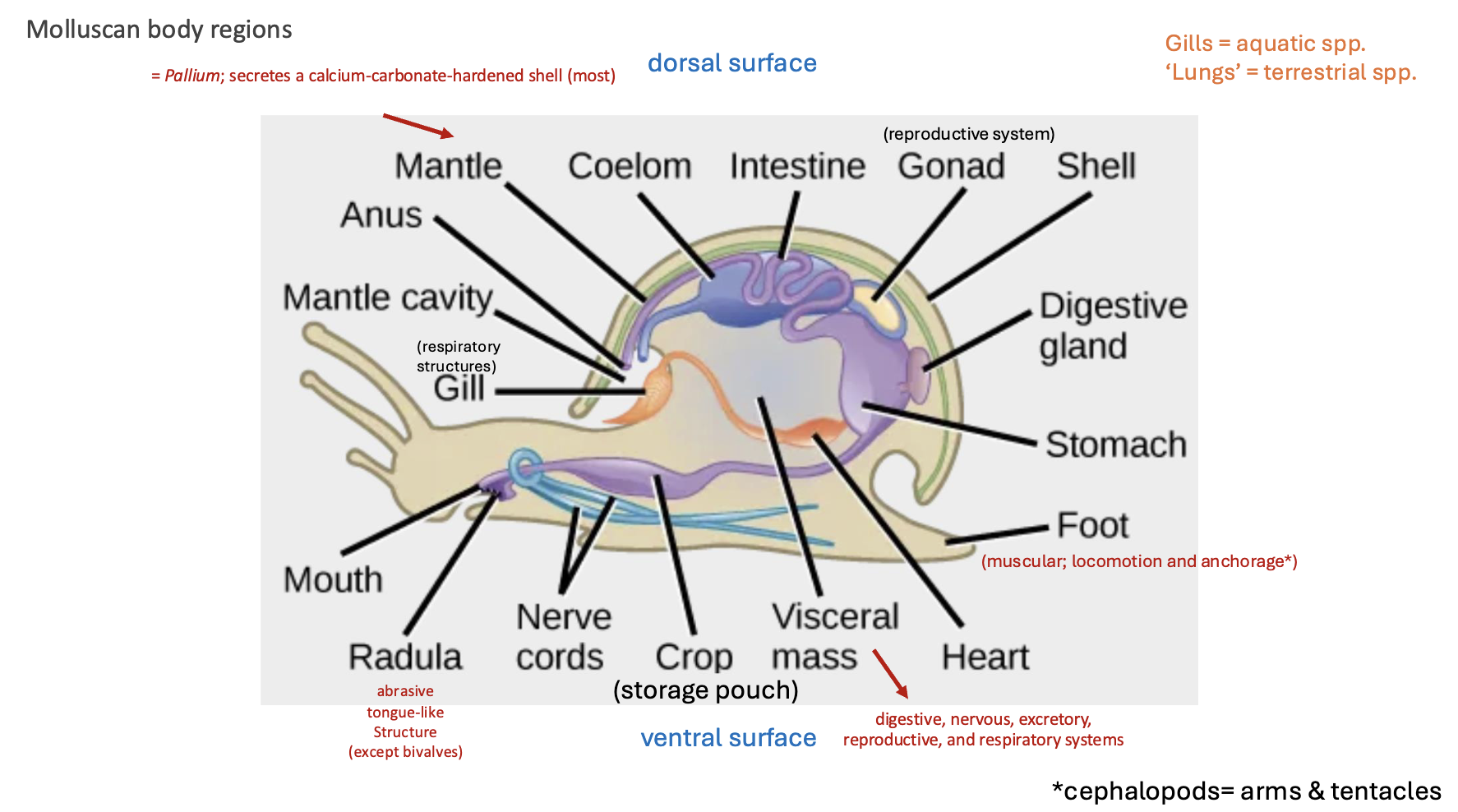
MOLLUSCAN OTHER INTERNAL SYSTEMS
MOLLUSCAN OTHER INTERNAL SYSTEMS:
Heart
Central organ of circulatory system
Coelom
Main body cavity
Nerve Cords
Components of nervous system extending throughout body
Gonad
Reproductive organ
MOLLUSCA IMPORTANT CLASSES (3)
Gastropoda
Cephalopoda
Bivalvia
GASTROPODA CLASS (Stomach Foot)
“Stomach foot” (based on muscular foot placement
Flat stomach on foot
Snails
Torsion embryonic development
Counterclockwise rotation of embryo
50% of aquatic and terrestrial mollusks
Asymmetrical with coiled shells
CEPHALOPODA CLASS (Head Foot)
“Head foot”
Modified foot (arms & tentacles) that connect to head
Octopuses/squids/nautilus
Bilateral
Highly developed nervous system
Jet propulsion
Carnivores, predators
Beak-like jaw + radula
Water/gas chambers for buoyancy
Rapid color changing
Dioecious
Lays eggs after mating
No larvae formation
BIVALVIA CLASS (2 Valves)
“2 Valves”
Flattened body, no conspicuous head or mouth
Filter feeders
Absent radula
ANNELIDA Phylum (“Little Rings/Segmented”) (2)
“Little Rings”
SEGMENTED
Metamerism = True segmentation
TWO TYPES:
Polychates
MARINE annelids with MULTIPLE appendages
PARAPODIA
Fleshy bristle-bearing appendages
Well-developed head with sensory organs
Oligochaetes
TERRESTRIAL
POLYCHATES
Annelida
Marine
Bristle worms
Multiple appendages
PARAPODIA
Fleshy bristle-bearing appendages
Well-developed head with sensory organs
OLIGOCHAETES
Annelida
Terrestrial
Earthworms
ANNELIDA CHARACTERISTICS
Teloblastic Growth
Growth BEHIND head
Setae
Forms parapodia/pairs
Hair-like bristles
Traction, anchoring, preventing backsliding
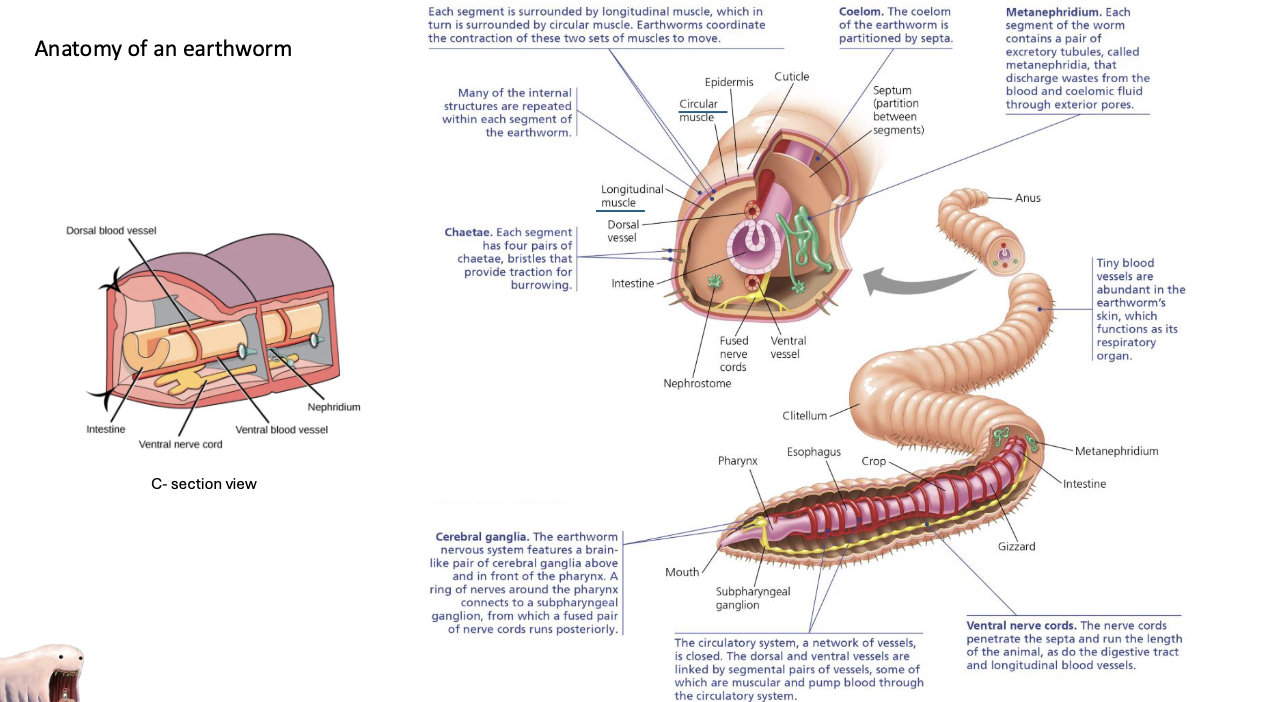
Well-developed and COMPLETE digestive system
2 Separate Openings
Simple respiratory system
Gas exchange across moist surface
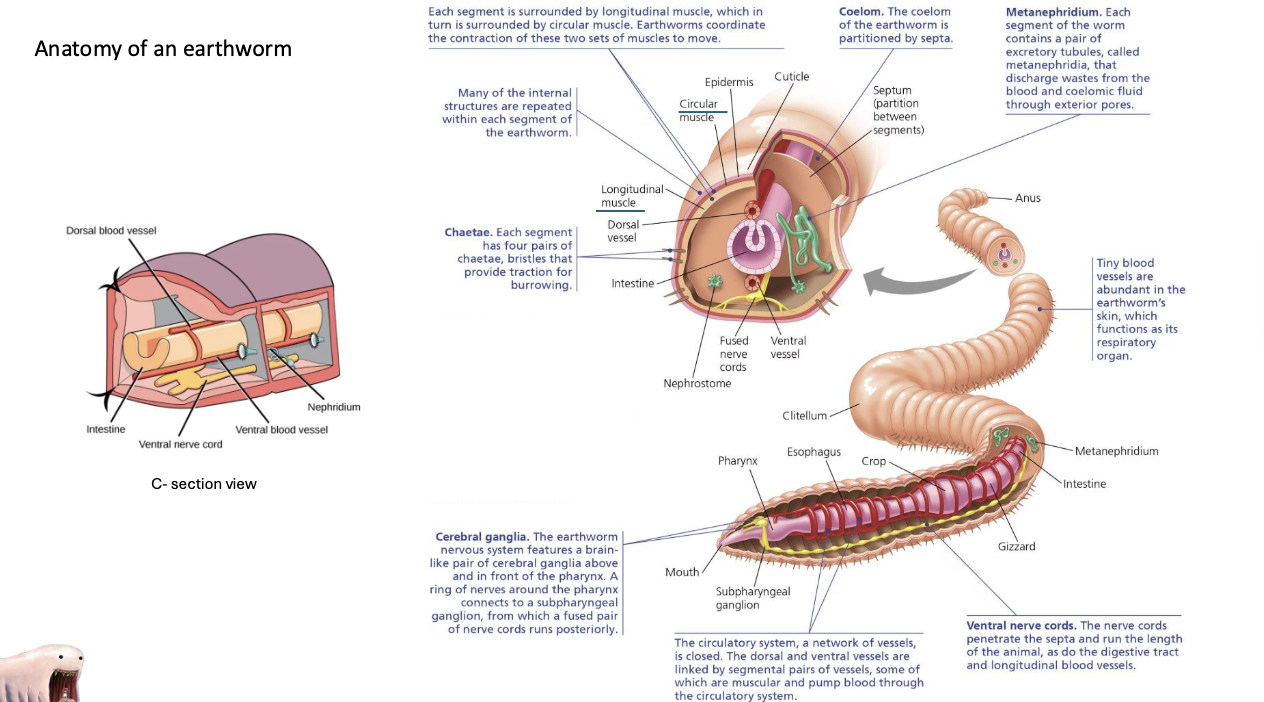
EARTHWORM ANATOMY