predicted psychology paper 1
 Call Kai
 Learn
Learn Practice Test
 Spaced Repetition
 Match
Match Flashcards
 Knowt Play
1/48

There's no tags or description
Looks like no tags are added yet.
Name | Mastery | Learn | Test | Matching | Spaced | Call with Kai |
|---|
No analytics yet
Send a link to your students to track their progress
49 Terms
🧡 SPE procedure (7)
24 🙋🏻♂️, 🇺🇸 college students
Assessed before the study to make sure they were mentally and physically healthy
Randomly assigned
Took place in the basement of Stanford Uni psychology department → turned into a simulated prison
Not allowed to use physical violence
Arrested at 🏡 by real police
uniform, id, strict routines : whistles, nightsticks, reflective sunglasses, number = deindividuation
🧡 SPE findings (12)
Prisoners resistance faded
They became anxious, withdrawn and passive
5 released early → severe mental breakdowns
Guards adapted rapidly to their roles
Imposed increasingly harsh punishments
Removed privileges & tightened control
Harassed prisoners
Punished small disobedience
2 week study had to be stopped after 6 days
Guards became increasingly cruel and sadistic
Guards were disappointed when ended early → enjoyed having power
Revealed how strongly social roles can influence behaviour → its not just who we are (our personality) but the situations we’re placed in
🧡 5 evaluation points for the SPE
(help q → the prisoners were asking for help + q is p backwards)
✅ 🎮High level of control over variables
Participants were carefully screened before → ensure emotional stability + free from psychological issues → reduces risk of individual differences
Random allocation → helps reduce participant bias → behaviour is due to role assigned and not personality type
Good internal validity
Behaviour confidently linked to influence of social roles + simulated prison environment
❌ Ethical issues
While they gave informed consent → could not have fully anticipated the intensity and emotional strain involved
Raises questions about whether their consent was truly informed
Caused significant psychological harm → several experienced extreme emotional distress
Some reported that they felt they were unable to leave, compromising their right to withdraw
❌ 🌍Lack of generalisability
Male 🇺🇸 college students
Findings may not reflect how individuals from different backgrounds, cultures or age groups would behave in a similar situation
❌ Presence of demand characteristics
Since participants were aware that they were taking part in a study → may have altered their behaviour to fit in with what they thought was expected of them rather than acting naturally
This concern is heightened by the fact that Zimbardo himself conformed to a role → failed to maintain objective researcher
❌ Questioned in terms of ecological validity
Although environment was designed to resemble a real prison, it remained an artificial simulation
Participants were aware that it was a study and could technically withdraw at anytime → unlike the inescapable long term nature of actual prisons
Raises questions about how far the findings can be applied to real life
(PP) A group of employees were attending a team meeting at a large company. During the meeting, most of the team agreed with the management that working overtime at weekends was necessary to meet the project deadline. Sam refused to agree and stated that working overtime at the weekend was unfair and he said he would not be working the additional shifts.
Outline two reasons why Sam may have resisted social influence in this situation. Refer to Sam in your answer. (4)
One reason Sam may have resisted social influence is because of internal locus of control. People with an internal locus of control believe that their behaviour is determined by their own decisions rather than by external pressures. This means Sam may have felt personally responsible for his actions and so was more confident in refusing to work unpaid weekend shifts
A second reason is social support. Social support means that the presence of other people who do not conform reduces the pressure to conform. As the question says that “most” employees agreed, this suggests that not everyone agreed, so Sam may have gained confidence from knowing that some others also disagreed with management. This would reduce the effect of NSI
❤ Resistance to social influence
D: ability to withstand, or hold out against , the pressure from others
👯♀Social support
The presence of other people resisting can help you do the same
They act as models to show us that resistance is possible
Asch 1951:
when Asch added just 1 dissenter: 32% → 25% (whether they gave the right or wrong answer)
Unanimity was broken
Gave participants more confidence to trust their own judgement + freed them from the fear of standing alone
Milgram 1963:
When participants sat with 2 disobeying confederates: 65% → 10%
🎛 Locus of control
The amount of control we perceive to have over situations in our lives
Internal LOC: believe they are in control for what happens to them, believe they can succeed in difficult situations (self confident, less need for approval)
External LOC: believe that things are outside of their control, feel helpless in difficult & challenging situations (less likely to resist, more likely to give in)
Holland 1967:
Replicated Milgram’s experiment, but before he measured whether participants had an internal/ external LOC (i: 37%, e: 23%)
Oliner & Oliner 1988:
Interviewed people who had lived through Nazi Germany during holocaust
2 groups: 406 people who actively helped rescue Jews / 126 who did not get involved → rescuers were much more likely to have an internal LOC
❌ Critisism in the way it is measured
Measured using questionnaires
Rotter’s scale: participants pick between 2 statements
These self-report methods can be effected by social desirability bias, people answer in ways they think is socially acceptable rather than giving true thoughts
Although research is supportive we should remain cautious about how accurately we’re measuring LOC and how valid the findings are
(PP) Following the meeting, a psychologist wanted to investigate employees’ behaviour in the workplace. The psychologist asked employees to estimate how many days over the last six months they had worked weekend overtime. The psychologist compared the responses of full-time employees with those of part-time employees.
Identify a suitable statistical test for this study. Explain three reasons for your choice in the context of this study. (4)
a suitable statistical test is the Mann-Whitney U test
One reason is that the psychologist is looking for a difference between two groups, not a correlation
A second reason is that the study uses an independent groups design, because the full-time and part-time employees are two separate groups of people
A third reason is that the data can be treated as ordinal, because employees estimated how many days they worked over time, so the data can be ranked but the intervals between values cannot be assumed to be equal
(PP)
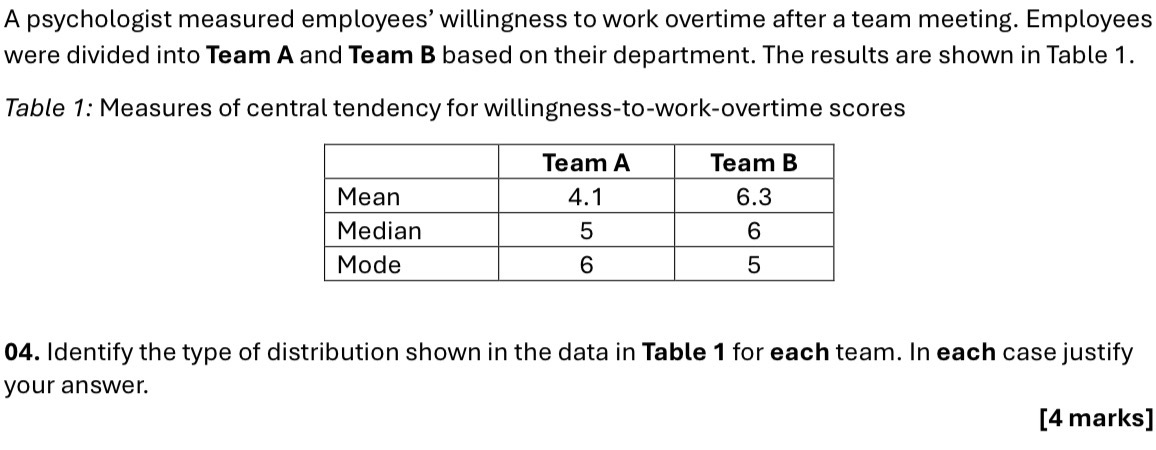
Team A shows a negatively skewed distribution because the mean and median are lower than the mode
Team B shows a positively skewed distribution because the mean and median are higher than the mode
💚 Conformity and the factors affecting conformity (procedure and findings)
(Background knowledge on baseline study)
123 🇺🇸 male college students
Gave wrong answers 12/18 trials
75% conformed at least once
32% conformed on critical trials
NSI, knew the correct answer
Variations
😣 Task difficulty:
Conformity shot up
Situation became more ambiguous, we naturally look to others for answer
👯♀ Group size:
With just 1-2 confederates participants stuck to their own views
By adding a 3rd confederate → conformity jumped significantly to about 32%
Increasing group beyond 3 barely made a difference
🫱🏼🫲🏾Unanimity:
One confederate gave different answer, correct or incorrect
Social support: even a single ally → makes it easier to resist pressure to conform
💚 Conformity and factors affecting conformity AO3 (evaluation of Asch’s research)
CLEPT
✅ 🎮Conducted in a highly controlled environment
He could carefully control variables such as the number of confederates/ order of responses
This control made it possible to replicate the study reliably + isolate specific factors that affect conformity
Allows researchers to establish cause and effect in a scientific way → boosting studies internal validity
❌ 🥼Low ecological validity
The situation in the experiment is simple + artificial
Lacks complexity & emotional stakes in real life social pressures
Irl, conformity involves meaningful decisions such as yielding to peer pressure related to drugs + bullying → these situations carry real consequences and emotional involvement
Findings may not be applicable outside lab environment
❌ Ethical issues
Participants were misled to believe that the study was about visual perception
This prevented them from fully giving informed consent → did not know true purpose
Some argue this level of deception was necessary to maintain the study’s integrity → if participants knew the true aim they may have altered their behaviour → undermines validity of findings
Asch did debrief
❌ 🌍Population bias
All participants were male American students
Cannot confidently assume that the findings would apply to women, older adults or individuals from different cultural backgrounds
Research has indicated women may be more focused on social relationships → show conformity in different ways compared to men
Therefore… generalisability
❌ 🕰Temporal validity
Conducted in the 1950’s → results could reflect the social attitudes of that time period
Eg: pressure to conform may have been higher after WWII with a cultural emphasis on cooperation and agreement
Some have argued that since then social norms have shifted towards greater individual expression + skepticism of authority
Asch’s findings may not fully represent how people conform today
💚 The agentic state ao1+ao3
DIC
When we act as an ‘agent’ for someone else, seeing them as the authority
Agentic shift → when we perceive someone as a legitimate authority figure
Binding factors: remain obeying/ in the agentic state
→ fear of disrupting the social order, fear of judgement or negative punishment, gradual escalation
❌ Cannot explain disobedience
Does not fully account for the variation in obedience between individuals
In Milgram’s original study → 35% did not obey up to 450v → despite being under the same situational pressures
This suggests that factors beyond entering an agentic state may also influence behaviour
→ the AS explanation alone cannot fully explain why obedience levels vary
❌ Ignores dispositional factors
Such as personality traits that contribute to obedience
Theory focuses on situational pressures → evidence from Adorno suggests certain individuals are more likely to obey authority figures due to traits shaped by upbringing
Indicates that any explanation of obedience needs to consider that some people may be predisposed to obedience (regardless of situation)
Offers partial explanation
❌ Difficult to measure
… or distinguish between the reasons why obedience occurs
Challenging to tell whether someone is obeying because they are in an agentic state, because they are genuinely respecting authority or due to personality factors
These explanations often overlap making it hard to pinpoint exactly what causes obedience
Lack of clear measurement reduces the scientific validity of the explanation
💚 Authoritarian personality AO1
Highly respectful and submissive towards authority figures
Harsh, hostile or prejudiced towards people they see as lower in status
Contempt for those seen as inferior
Dogmatic: see the world in ⬛-and-⬜ terms
Rigid and conformist: valuing order, tradition and discipline above all else
Causes:
Grow up with parents who are very strict and controlling, demand absolute loyalty, set impossibly high standards, critical when child fails, parental love is often conditional
→ creates a deep inner conflict, child feels 😡 and resentment towards parent
→ 😡 is repressed + displaces repressed hostility onto weaker/lower status people
Adorno et al. 1950:
Surveyed over 2,000 white, middle-class 🇺🇸 → using F-scale (questionnaire)
Participants rated agreement with statements
Findings: higher F-scale scores correlated with higher prejudice against minority groups
Elms and Milgram 1966:
Followed up with participants
One group that had obeyed up to 450V and another group who had not
They completed Adornos F-scale
Found that obedient participants scored higher
💚 Authoritarian personality AO3
(OCG)
❌ Overlooks situational variables
Eg: Milgrams own studies showed that obedience changed dramatically depending on factors such as uniform
Reduces overall explanatory power of AP as it fails to account for the full range of factors that influence obedient behaviour
❌ 📈Correlational data
Both adorno + elms/milgram only identified a relationship between authoritarian traits + obedience without proving causation
Cannot be certain that an authoritarian personality causes obedience
Possible that other factors are influencing: some studies found that people with lower levels of education score higher on authoritarianism + more likely to obey → 3rd variable could be responsible for link
Weakens AP as an explanation as evidence lacks experimental control needed to establish clear cause and effect relationship
❌ Greenstein (1969)
Argued that F-scale suffers from serious methodological flaws
Pointed out issues such as response bias: many of the items on F-scale were worded in the same direction making it a leading questionnaire
People who agree with statements in general (acquiescence bias) are more likely to score as authoritarian regardless of actual beliefs
Undermines F-scales validity as it may not be accurately measuring authoritarianism but rather a general tendency to agree
F-scales lack of scientific rigour cast doubt on adorno’s conclusions → weakening the credibility of the authoritarian personality as a reliable explanation of obedience
🧡 Minority influence (AO1) not for research
Consistency:
🕰 Diachronic: holds same position over time
👯♀Synchronic: all members share the same view
→ this draws attention + creates doubt in the minds of the majority + challenges the majority to reconsider their views
Commitment:
How dedicated the minority is to their position, often demonstrated through personal sacrifice
→ when people see someone willing to suffer for their cause, they are more likely to take that person seriously
🤸🏼Flexibility:
Too rigid or dogmatic → likely to be ignored
Persuasive minority strikes a balance, standing firm but open to dialogue
☃ Snowball effect: how small actions or events can initiate a process where they grow increasingly larger + more significant over time
🧡 Minority influence (AO3) not for research (NoW - not instant)
✅ Nemeth 1986⛷
Explored the role of flexibility in a more realistic context
Participants in a group of 4 had to decide how much compensation to award victim of ski-lift accident (one member was a confederate)
Flexible condition: confederate was flexible and offered a compromise → more influential
Inflexible condition: confederate stuck rigidly to low amount → less influential
Supports the idea that flexibility is crucial in minority influence
✅ Wood et al 1994🪵
Meta-analysis of nearly 100 studies: minorities who were consistent in their views were significantly more influential than those who were inconsistent
Suggests consistency is a key factor in successful minority influence → signals confidence + commitment
🧡 Minority influence research + AO3
🟦Moscovici et al 1969: Effects of consistency
36 slides, different shades of blue
Each group had 2 confederates + 4 participants
Consistent condition: said slides were ‘green’ on all 36 slides = 8% of participants were influenced
Inconsistent condition: green x24, blue 12x = only 1% gave the same answer
❌ Lacks population validity
Sample consisted of entirely 🙋🏻♀️ students → findings may not generalise to other groups such as males or people from different age ranges, cultures or educational backgrounds
Therefore, study may not accurately represent how minority influence operates in wider population → reducing external validity
❌ Lacks ecological validity
Task used of identifying slides is highly artificial → bears little resemblance to the emotionally and socially complex issues involved in real life minority influence
Minority often face personal risk when challenging the majority
Undermines minority influence research as it may not accurately explain how MI operates in real world
❤ The cognitive interview (AO1)
Questioning technique designed to improve the information that an eyewitness can retrieve about crime
🌳 Reinstate the context:
Based on the encoding specificity principle: cues available at recall need to be similar to the cues that were there when the memory was encoded
Cues can trigger recall of certain memories
Emotional and environmental
Report everything:
Anything and everything they can recall from the event should be described
Smaller, seemingly irrelevant details could trigger the recall of other more important memories
🔄 Reverse the order:
Schema can lead to errors with our memories → what we say we remember happening may actually have been altered or changed to fit in with what we expected to happen
Change perspective:
Also designed to disrupt the affect of schemas + provide cues for the recall of other information
Enhanced cognitive interview - Fisher & Geiselman 2010
Police interviewers must invest time at the outset of the interview to develop meaningful, personal rapport with the witnesses
❤ The cognitive interview (AO3) SKR (car crash + EWT)
SKR (car crash + EWT)
✅ Supporting evidence
Geiselman et al 1985 → participants watched police training films of simulated violent crimes + interviewed 48 hrs later using either the standard or cognitive interview
Significantly higher difference in the average number of correct items recalled + no significant difference in number of incorrect items recalled
Fisher et al 1989 → 7 experienced detectives were trained to use the cognitive interview, compared with 9 untrained detectives
All interviews that took place were tape recorded and analysed → they found that detectives trained in CI produced 63% more information than untrained detectives with over 90% accuracy
Demonstrate how CI can lead to better memory recall in eyewitnesses over standard interview
❌ Kohnken et al 1999
Although the Cognitive Interview is designed to enhance the accuracy of eyewitness testimony, research suggests it may also increase the production of incorrect details
Köhnken et al. (1999) conducted a meta-analysis of 55 studies and found that whilst the CI produced more correct information than standard interviewing, it also generated a significantly higher amount of inaccurate information
This is problematic because in real police investigations, officers may struggle to distinguish between accurate and false details provided by a witness, potentially leading to unreliable evidence being used in court
Therefore, the Cognitive Interview cannot be considered a fully reliable investigative tool, as the increase in overall recall comes at the cost of also increasing errors, which may ultimately compromise rather than support the justice system.
❌ (really)Time-consuming
Not only does it take much longer to conduct than a standard police interview due a need to built up a rapport, it also requires time to train the police officers
A study found that many officers do not have time to conduct a full cognitive interview
Time pressure + limited resources of police can mean the full CI is rarely used → limiting its application
❤ The WMM
Baddeley & Hitch 1974
👂🏽Phonological loop
Responsible for processing sound-based information
Articulatory control process: inner voice → rehearses sound information
Phonological store: inner ear → stores sound information
👁Visuospatial sketchpad
Responsible for processing visual/ spatial info
👨🏿💼CE
In control of PL + VSS
Decides what we pay attention to
🏪 Episodic buffer
Added by Baddeley in 2000
Thought to act as a backup store
Integrates information from all the components of working memory as well as from LTM
Can store both visual + verbal STM
❤ WMM (AO3)*
(CCP) Chanel pls - work
✅ Case study of KF + other supporting evidence (visual/verbal)
Accident resulted in damage to his STM → specifically with 👄l recall
He was able to recall 👁 information but showed poor recall for 👄 information
Suggests WM may have separate components; one for 👄 + one for 👁
PPP: paulesu et al (1993) put volunteers in PET scan to measure 🩸 flow whilst they perform some memory tasks → different parts of the PL activated different 🧠 areas
Suggests that WM contains separate components within phonological loop
Dual task studies: many studies into working memory have found that if you carry out two 👁 or two 👄 tasks at the same time → you do them less well then if you did them alone
However if you carry out one 👁 and one 👄 tasks → you do them as well as when you do them separately
Provides support for separate components for WM
❌ Problems with research
However, research behind the WMM can be criticised in a few ways → many of the dual task studies into WM are carried out in highly 🎮 settings + involve memory tasks that are artificial
Do not reflect typical memory tasks
Demand characteristics → know they are taking part in a study + wanting to perform really well in tests of their memory
People behave in a different way then they normally would
Weakens evidence for working memory model
❌ Criticisms of CE
Despite it being the most important, little is known about the CE
Its role in terms of attention and decision making in WM appears to be vague and untestable
It has been suggested by some psychologists that CE could be divided into separate parts
Therefore, the limited understanding of the CE suggests the working memory model is incomplete, weakening its validity as a full explanation of memory
🧡 Multi-store model AO1
Atkinson and Shiffrin 1968
Separate stores for 3 types of memory: sensory register, STM, LTM
Info by the 🌳 is received by the SR
This info is then passed to our STM but this only happens when you pay attention
If info is rehearsed we can temporarily keep it in our STM = maintenance rehearsal
For info to go to LTM it needs prolonged rehearsal
If we were then asked about the info we would retrieve it from LTM → STM for it to be temporarily used
Linear model: processing of the memory happens sequentially, in a series of stages
💚 Coding, duration and capacity: sensory register
Coding: transforming incoming info into a form that can be stored in memory
Duration: length of time memory lasts for/ how long it is kept in that store before it is forgotten
Capacity: amount of information stored can hold
Sensory register:
Coding: modality specific (according to the sense/mode it is received)
Duration: iconic: ¼ seconds
Capacity: potentially unlimited
💚 Coding, duration, capacity: STM (+research)
STM capacity: Jacobs (1887)
Participants were presented with a digit span task → required them to repeat back a series of numbers with length increasing by one each time
Letters = 7.3
Numbers 9.3
Miller (1956) proposed 7±2 items
🔼 STM duration: Peterson & Peterson (1959)
Participants given a trigram → asked to count backwards in 3s from a given number (prevent rehearsal) → recalled at intervals
18-30 seconds
STM coding: Baddeley (1966)
Participants were presented with a list of words: acoustically similar/ dissimilar, semantically similar/dissimilar
Acoustically similar group recalled the worst
Predominantly coded acoustically
💚 Coding, duration, capacity: LTM (+research)
LTM coding: Baddeley 1966
Same participants recalled same list but 20 minutes later
Semantically similar group performed the worst
Predominantly encoded semantically
🏫 LTM duration: Bahrick et al (1975)
Photo recognition
Graduated within last 15 years: 90% accuracy
Graduated 48 years ago: 70% accurate
Lifetime
LMT capacity:
Unlimited
MSM AO3
POSS (🐱 the worse one)
✅ Supporting evidence
Researchers found that when people are presented with a list of items to recall in order → begin by recalling items at the end of the list known as the recency effect because these items are still in STM
Then people remember items at the beginning of the list known as the primacy effect → thought to have been transferred to LTM (some rehearsal)
Primacy and recency effect demonstrates the idea of separate stores for STM/LMT + thus support the MSM
HM: after an accident → hippocampus removed → unable to form any new LTM, STM was fine but he could not transfer info to LTM
Provides further support for MSM
❌ Problems with research
Can be criticised because of 🦾 tasks often used in lab experiments
In trying to study memory in a way that is measurable and 🎮 → means tasks participants are given are often very different from how our memory typically functions (P+P)
Limits the extent to which research can be generalised
MSM could be questioned because its based on research that lacks ecological validity
❌ Oversimplifies LTM
Presents LTM as a unitary store
Criticised for being oversimplified as further research has demonstrated that there are separate parts to LTM: procedural, episodic, semantic
Therefore, bc it lacks detail about separate types of LTM → ability to fully explain how memory works can be questioned
❌ Oversimplifies STM
Case study of KF shows that there are separate components of STM
💚 Types of LTM (AO1)
Procedural (knowing how)
Memories for motor skills and actions
❌👄
Unavailable for conscious inspection
🎞 Episodic (knowing that)
Memories relating to a specific episode or event that happened in your life
Have a particular time and place
👄
Can be consciously 🧐
Semantic (knowing that)
Fact-based memories for meaningful info
General knowledge about the 🌍
No reference to time and place
👄
Types of LTM (AO3)
✅ Supporting evidence
Tulving et al (1994) reported data from studies that used PET scans
Participants asked to think of a specific memory whilst blood flow in 🧠 was being measured
When participants thought of episodic memories a different part of the brain was activated compared to when participants thought of semantic memories
Demonstrated how there are different types of LTM that activate different areas of the 🧠
🦛 HM: anterograde amnesia → loss of ability to form new memories
Had problems forming some types of memory but not all
Studies found that he was able to store procedural LTMs but not episodic LTMs (Milner 1957)
🎼 Clive wearing (1985): anterograde and retrograde amnesia
Lost episodic memory but his procedural memory remained intact as he could still perform complex 🎹 pieces
3rd piece of evidence
💚 Retrieval failure AO1
Tulving proposed encoding specificity principle
→ cues available at recall need to be same specific cues that were there at learning when encoding memory
Context-dependant forgetting: lacking external cues
State-dependant forgetting: lacking internal cues (physiological or psychological)
💚 Retrieval failure AO3
(SIP - 🥂changes internal state)
✅ Supporting evidence
🤿 Godden and Baddeley (1975) (context)
Found recall was best when 🌳 was the same at learning and at recall + worst when context was different
💊 Carter and Cassady (1998)(state)
They wanted to see if taking an antihistamine (which would change internal state) would affect memory recall
Had participants free-recall a list of 20 words/ short passage of information
Amount participants could recall was affected by the state they were in (recall was higher when they were in the same internal state at learning and at recall)
❌ Issues with research
Dramatic difference → unlike many of the day-to-day experiences of forgetting
Does not account for why we might forget in circumstances that aren’t so dramatic
Limits ecological validity + reduces confidence in findings
✅ Practical application
👮Has also been applied to help improve EWT
Now know that having same cue at encoding+recall → led to an improvement in the way police interview EW through CI
Involves reinstating the context → helps to increase amount + accuracy
💚 Learning theory of attachment AO1
Attachment is learned through the environment
Baby learns to love whoever feeds them
🔔 Classical conditioning
Infants learn to associate the caregiver with the satisfaction of their basic needs
🥇 Operant conditioning
➕ Infant: receive food → brings a feeling of pleasure
➖mother: crying stops
💚 Learning theory of attachment AO3
(CBA - cba to learn anymore)
✅ Based on an established theory
Behaviourism is very well research and based on scientific principles
Eg work of BF Skinner on OC was conducted in highly 🎮 settings so that cause+effect could be established
Applying this to attachment behaviour is seen as a plausible explanation
Additionally focus of stimulus+response allows it to be easily investigated/ observed
→ clear, straightforward explanation, 📈 confidence in findings
❌ Challenging evidence
Schaffer+Emerson: one of the 🔑 findings from this study was that the person the child formed an attachment with wasn’t the person who spent the most 🕰, instead it was the caregiver who was most interactive/ sensitive
Undermines the learning theory → not about who 👨🏾🍼 but the quality of interaction
Harlow🐒
❌ Overemphasis on the role of nurture 🌳
Learning theory ignores how 🧬 factors might be involved in forming attachment
Eg Bowlby’s monotropic theory outlines how attachments are formed due to innate factors
Suggests learning theory is limited in its ability to explain the formation
🧡 Bowlby’s monotropic theory of attachment AO1
ASCMI
🧬 Adaptive
Bowlby sees 🔗 as an evolutionary behaviour that helps with survival
Innate
Eg rooting reflex
😊 Social releasers
Behaviours or signals from the infant that draw in adult to give them attention
Cooing, gripping ✋🏼
⏳Critical period
The idea that there is a set 🕰 frame for a 👶🏽 to form attachment with 👩🏻
Up to 2.5 yrs old
If 🔗 is not formed during this 🕰 → lasting consequences for 👶🏽 development (s,e,i)
🥇Monotropy
Bowlby puts a lot of emphasis on the importance of the 👶🏽 attachment to one 👩🏼
More significant than the 🔗 they may form with other people
IWM
As a result of the monotropic relationship that is formed with 👩🏾 → 👶🏽 forms a template for future 👩🏽❤️👨🏾, 🧑🧒
🧡 Bowlby’s monotropic theory of attachment AO3
SSoCial (ly sensitive)
✅ Supporting evidence
Hazan & 🪒- 🩷 quiz (1988): ❓💨, measured current relationships and past 🔗 history
They found a 📈 between 🔗 type and later 🩷experiences
Eg those with secure 🔗 → relationships marked by trust, friendship, ➕ emotion | insecure avoidant → relationships marked by fear and lack of trust
Support IWM
❌ Challenging evidence
Shaffer + Emerson (1964): idea of monotropy is not evident
Bowlby’s theory does not account for how babies formed multiple attachments
Additionally, some cultures parent in such a way that multiple 👩🏻👩🏾👩🏼 are the norm from the moment 👶🏽 is born
❌ Socially sensitive
Emphasises the importance of the formation of an 🔗 to one significant 👩🏾
Arguably adds a terrible burden of responsibility to mothers to form 💪🏽 relationship with 👶🏽 + sets them up to take the blame for anything that goes wrong in the rest of 👶🏽 life
Also underestimates the role of 💁♂
❤ The strange situation - procedure + findings
Ainsworth
SS → designed to assess the quality of the child’s attachment to their caregiver
100 🇺🇸 infants, 12-18 months
Procedure:
Infants behaviour was observed using behavioural categories: proximity seeking, exploration + secure base behaviour, stranger/ separation anxiety, response to reunion
8⃣ episodes in total, each lasting 3 minutes
Mother and child enter playroom
Child encouraged to explore and play with toys
Stranger enters the room and attempts to interact with the child
Mother leaves whilst stranger is present
Mother reenters, stranger leaves
Mother leaves again
The stranger returns
Mother returns and interacts with child
Attachment types
Secure attachment
Child uses mother as a safe base from which to explore the unfamiliar environment, checking in with her regularly
Insecure avoidant
Explores but does not return to mother → does not use her as safe base
Low separation and stranger anxiety
Response at reunion: no joy, indifferent
Develops from caregivers not responding to a childs attempt to seek comfort during times of distress → child learns to avoid seeking comfort from them
As an adult: emotionally distant + avoiding intimacy in relationships
Insecure resistant
Little willingness to explore, tend to stay close to mother (clingy)
High separation + stranger anxiety
Little joy, not easily comforted by the mother BUT also reject mothers attempt to comfort = ambivalent
Develop from inconsistent behaviours from the caregiver
Unpredictability of caregivers behaviour towards them makes it hard for them to know when they will receive/ be neglected
As an adult: needy of affection from a partner, overly distraught when a relationship ends
Ainsworth findings:
70% securely attached
15% insecure resistant
15% insecure resistant
❤ The SS AO3
(mary✝, cruc)
✅ 🎮 observation
Enables procedure to be standardised, including the episodes, timing and strangers behaviour
This means that it can be easily replicated
Bc conditions remain the same, researchers are able to make direct comparisons between cultures
This makes it a particularly useful tool for cross-cultural research into attachment
✅ Reliability
Bick et al. (2012) assessed inter-rater reliability by having multiple observers independently code the same footage, finding a correlation coefficient of 0.94 between raters
This high level of agreement indicates that different observers consistently reach the same conclusions when classifying infants’ attachment behaviour, meaning the results are not dependent on the subjective judgement of one individual
Therefore, the Strange Situation can be considered a reliable tool for assessing attachment quality, which strengthens confidence in the findings it produces
❌ Unfamiliar room
Childs behaviour is observed in a highly 🎮, unfamiliar room
Behaviour may not represent attachment type they display when the infant is at home, may act differently
Study might not generalise to other situations → lacks ecological validity
❌ Cultural issues
SS was a way of measuring attachment designed in 🇺🇸, by 🇺🇸 researcher, studying 🇺🇸 infants
Raises questions about how well it applies to other cultures + whether it is culturally relative
Eg children in 🇩🇪 are encouraged to be more independent, in 🇯🇵 children rarely separated from mother
Argued that the SS is limited to a specific part of westernised culture
Limiting its validity as a universal measure of attachment quality and meaning findings cannot be generalised across all cultures
❤👩🏽🍼 Stages of attachment AO1
Schaffer and Emerson (1964)
Observed 60 infants, 🏴
Recorded attachment behaviours between 6 weeks + 18 months
Asocial stage (0-6 weeks)
Can form bonds with anyone
Reacts similarly to 🧸 + 💁🏼♀️
Indiscriminate (6 weeks-7 months)
Preference for 💁🏽♀️ company
Still respond positively to strangers who show them attention
Specific (7-9 months)
💪🏽 bonds with specific individuals (usually primary caregivers)
Show stranger/ separation anxiety
Multiple (10-18 months)
Form attachment to multiple individuals
❤👩🏽🍼 Stages of attachment AO3
CRRD
✅ Carried out by parents at home
observation did not take place in controlled, lab conditions
this means that babies were not distracted by the presence of unfamiliar researchers
this means that its more likely that the infants were acting naturally
high external validity of the research
✅ Real-world application
stages of attachment can be applied practically to daycare settings such as nurseries/ preschools
parents can use stages of attachment to help understand the development of their child
they may avoid starting their child in daycare during specific or multiple stage to avoid stranger and separation anxiety
❌ Relied on mothers making observations
mothers were unlikely to be objective observers
for example: some mothers may be less sensitive to their childs distress and so report findings differently with less accuracy
some mothers may have under-reported what they perceived to be the less positive aspects of the child’s experience
data may be unreliable
❌ Data collected was from a biased sample
S + E only used families from a working class population from Glasgow (individualistic culture)
findings may not apply to other socioeconomic and cultural groups
findings may not be generalisable beyond the immediate demographic
(PP)
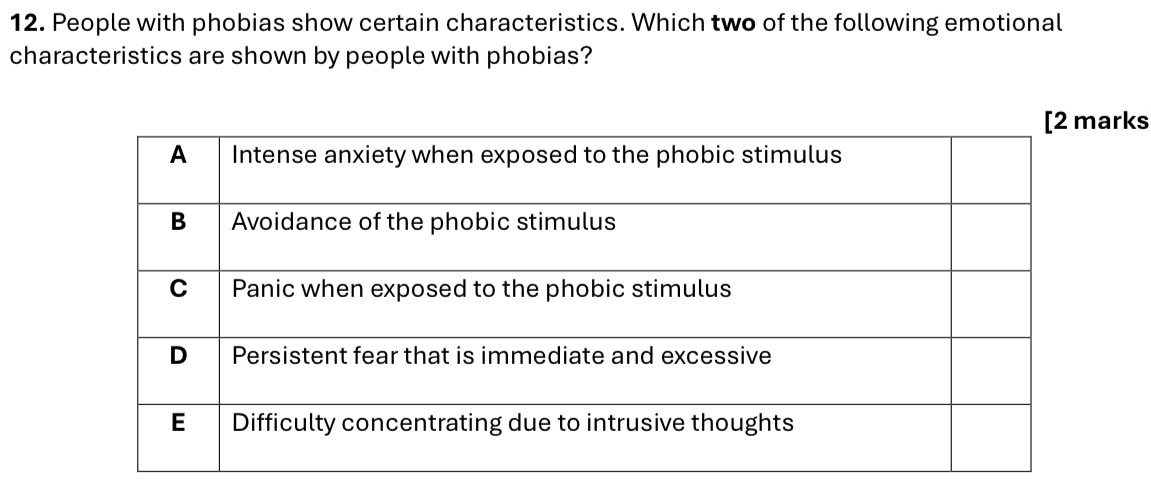
A and D
🧡 🌎Cultural differences in attachment AO1
Van Ijzendoorn & Kroonenberg - Meta-Analysis (1988)
Analysed 32 studies, from 8 countries, with 1990 participants → all made use of SS to measure 🔗
Secure 🔗 was the most common
Higher rates of insecure avoidant 🔗 in 🇩🇪→ value independence
Higher rates of insecure resistance 🔗 in 🇯🇵🇨🇳🇮🇱→ prioritise groups
Difference within cultures were 1.5x greater than the variation between cultures
🇺🇸 46% securely 🔗 + 90% securely 🔗
🧡 🌎Cultural differences in attachment AO3
(SUE - 🇯🇵will sue bc of high levels of stress)
✅ Standardised methodology
All 32 studies included in the meta-analysis used the SS → highly 🎮 observation that uses same 8 🎞 and clear set of behavioural categories
Researchers can accurately compare 🔗 behaviours across different cultures without issue of extraneous variables messing with way 🔗 was studied
Increases reliability
❌ Unrepresentative samples
Eg 🇯🇵= very large country with many sub-cultures
Ijzendoorn & Sagi (2001) found differences in attachment types between city of🗼+ rural parts of 🇯🇵
Suggests that you cannot make comparisons between countries if you do not know the specific culture of the sample being studied
Limits 🌍
❌ Ethnocentric
SS was used to access quality of 🔗 but this was designed in 🇺🇸 (westernised, individualistic) using entirely 🇺🇸👧🏽
When researchers observe behaviour of children they are using a set of behavioural categories that were created through the 🔍 (l,p) of 🇺🇸 set of values
Takahashi: when 👩🏻 left they had to stop study for 90% of 👧🏼 because of how extreme anxiety became →💪🏽 suggests high levels of insecure resistant seen in 🇯🇵may be due to rare separation
Using SS outside of 🤠 cultures means it’s hard to know what it is measuring + more culturally relative measurement of 🔗 are needed
❤🕷: characteristics and explanation + AO3
SPID - 🕷)
Characteristics
Behavioural: 😱 + 🏃🏽♂️
Emotional: 🥺 + fear → intense persistent dread or worry
Cognitive: irrational beliefs + selective 🚨
2⃣ process model
→ acquired through 🎻 conditioning
A person associates a NS with a UNS → UNR of fear
Previously NS → now triggers fear, becomes CR
→ maintained through 🏃🏽♂️ behaviour
When a person 🏃🏽♂️ feared object/ situation, they experience relief (➖reinforcement for 🏃🏽♂️)
✅ Supporting evidence from Watson & Raynor 1920
Study of Little Albert
Exposed to ⚪🐀(NS) 🫱🏼🫲🏾 with 💥(UNS resulted in fear)
Developed fear of ⚪🐀 → CR
Showing how 🕷can be acquired through association
well 🎮 increases validity
✅ Practical application
Systematic desensitisation → treatment for 🕷, involves 😎ation training + gradual exposure
Over 🕰, this process helps replace the fear association with a 😎ing one
Shows real life value
❌ Does not account for the fact that not all 🕷 are learned
🧬 explanations → Seligman’s 🧬preparedness suggests that we may be predisposed to develop certain 🕷 due to genetic factors
Challenges 2⃣ process model, highlighting that some 🕷may have a 🧬 basis rather than being solely the result of experiences
Reduces explanatory power
❌ Ignores 🧠⚙ factors
🧠⚙ explanations highlight the role of irrational💭 (over-generalising or catastrophising)
Distorted 💭 patterns can crease excessive 🥺 and reinforce fear response
Suggesting 🧠⚙ factors play a crucial role in 🕷 which 2⃣ process model doesn’t account for
Reductionist, more complex
❤🕷 treatment + AO3
(SEC)
SD
Counter-conditions 🕷 by gradually exposing a person to their fear while teaching them to stay 😎, associating fear with 😎 over 🕰
😎ation: person learns techniques such as deep 😮💨
🥺 hierarchy: step by step list of fear triggering situations ranked from ⬇ to ⬆ scary → gradual exposure process
Gradual exposure: 🐌 works through 🔼, facing each fear level while staying relaxed, until 🕷 weakens
🌊 Flooding
Immediate intense exposure → exposed to most frightening version of it right away
No escape: stay in the situation until their 😱 response naturally fades
Body can’t stay in a high-anxiety state forever, over 🕰 realise that nothing 👎 happens
Extinction of fear: fear response is weakened because feared object no longer leads to danger
✅ Supporting evidence
Lang & Lazovik (1963): participants who underwent SD for a 🐍 phobia → showed ⬇ fear compared to control group, improvement was still present after 6 months suggesting LT effectiveness
Shows effectiveness in real life cases
❌ Ethical issues
⬇ traumatic than 🌊, gradual exposure at patients pace + allows them to feel in 🎮
⬆ accessible for wider range of people
🌊 can cause significant emotional distress + may reinforce 🕷 if not conducted properly
❌ Comparison with 🧬 treatments
🧬 treatments provide quick, ST relief by reducing the body’s physiological fear response BUT do not address root cause of 🕷 + side effects
Combined approach may be ⬆ effective
💚 depression: Beck’s 🔼, 💊 (treatment)
Beck’s 🧠⚙ theory of depression
➖🪞🖼: ➖view of 🪞based on past experiences (cause 🧠⚙ distortions)
🧠⚙ distortions: create cognitive biases (eg overgeneralisation & catastrophizing) → ➖ interpretations of life events
➖🔺: ➖view of the 🌍, 🪞, 🔮
Beck’s treatment
Focuses on identifying & changing ➖💭 patterns that contribute to depression
💭 catching: identifying & ❓irrational beliefs → replacing them with more realistic + ⚖ 💭
Patient as 👩🔬: generates hypothesis to test how accurate their irrational 💭 are
Behavioural activation: encouraging engagement in activities that improve mood (hobbies/ social interaction)
Homework assignments: keeping 💭 📒 or testing ➖beliefs in real-life situations to develop more ➕💭 patterns
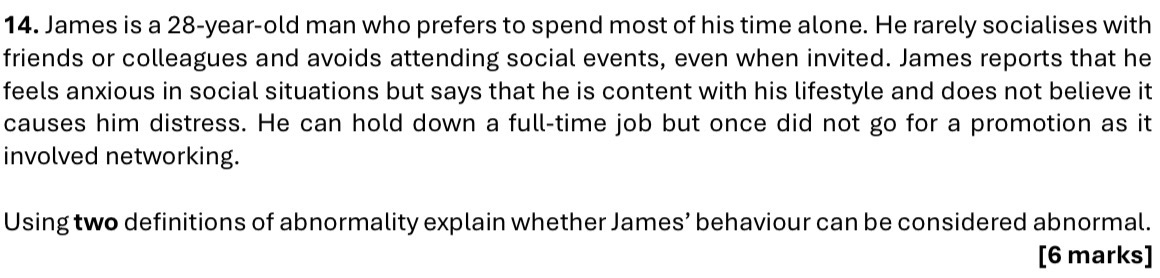
One definition of abnormality is failure to function adequately, which means a person is unable to cope with the demands of everyday life. James may not be considered abnormal by this definition because he can hold down a full-time job and says he is content with his lifestyle. However, the fact that he did not go for a promotion because it involved networking suggests that his anxiety does affect his functioning to some extent.
A second definition is deviation from ideal mental health, which is when a person does not meet criteria such as coping with stress, forming positive relationships and self-actualisation. James may be considered abnormal by this definition because he feels anxious in social situations, avoids socialising and may not reach his full potential if he avoids promotion opportunities.

Outline two ethical issues which researchers must consider when studying patients with mental health disorders and what researchers must do when considering the issue (6)
One ethical issue is informed consent
This is important because patients with mental health disorders may not always fully understand the study
Researchers should explain the study clearly and make sure participants have the capacity to consent, or get consent from a guardian if needed
Another ethical issue is protection from harm
People with mental health disorders may be more vulnerable to distress during research
Researchers should reduce the risk of harm, monitor participants carefully and provide support or debriefing if necessary
💚 🧬 explanations of OCD - AO3
One strength of the biological explanation of OCD is supporting evidence from twin and family studies. Research has shown that CR for OCD are higher among identical twins than non-identical twins, and that OCD runs in families. This suggests that there is a genetic component to OCD, as individuals who share more DNA are more likely to develop the disorder. Therefore, this supports the biological explanation for OCD and increases its validity as an explanation of the disorder
A further strength of the biological explanation of OCD is the effectiveness of drug therapy. SSRIs, which work by increasing serotonin levels in the brain, have been shown to significantly reduce OCD symptoms in many patients. If biological treatment targeting serotonin is effective in reducing symptoms, this suggests that low levels play a role in causing OCD. Therefore, the effectiveness of SSRIs provide indirect support for the biological explanation, increasing its credibility
One limitation of the biological explanation of OCD is that it is reductionist. It reduces a complex disorder to biological factors such as genetics or neurotransmitter levels, ignoring psychological and environmental factors such as traumatic life events or learned behaviours that may also contribute to OCD. This means that the biological explanation may only provide a partial account for OCD. Therefore, this limits the explanation as it is unlikely that biology alone can fully account for such a complex disorder
💚 statistical infrequency, deviation from ideal mental health, failure to function adequately
📊 INFREQUENCY
Behaviours or traits that are rare or uncommon
Found at the edges of distribution curves, x2 standard deviations away from the mean
✅ Objective → relies on clear numerical cut-off points rather than personal opinions, ensuring all mental health professionals use the same standardised measurements
❌ Desirable behaviour seen as abnormal → can label desirable traits, like high IQ as abnormal, despite not being linked to psychological distress
DEVIATION FROM IDEAL MENTAL HEALTH
A person is considered abnormal if they lack certain characteristics associated with psychological wellbeing
Jahoda’s criteria for ideal mental health: (ASPEAR) accurate perception of reality, self-actualisation, ➕ view of oneself, 🌳 mastery, autonomy, resistance to stress
✅ Comprehensive: outlines wide range of criteria that help identify mental health issues, set treatment goals, & provide support for individuals
❌ Culturally relative: ethnocentric as it reflects Western, individualistic values like personal growth & autonomy, making it less applicable to collectivist cultures that prioritise community and group well-being
FAILURE TO FUNCTION ADEQUATELY
Refers to individuals who are unable to cope with the demands of everyday life
Rosenhan & Seligman identified characteristics such as: personal distress, irrationality, inability to perform certain tasks
✅ Subjective experiences → considers an individuals subjective experiences, unlike si, which reduces people to numbers on a distribution without accounting for personal distress
❌ Misses some abnormal behaviour → fails to identify abnormal behaviour that does not cause distress (e.g. psychopathic behaviour) who function normally
💚 types of LTM AO3
Supporting evidence
HM →🦛 was removed → anterograde amnesia
This impaired his ability to form new episodic and semantic memories
However, still able to form new procedural memories such as learning motor skills ⭐️
Provided evidence that episodic, semantic and procedural memories are separate systems
+ Clive Wearing
Generalisability
Research supporting the different types of LTM can be criticised for being based on individual cases which may not be representative of the general population
💚 studies of retrieval failure
Godden and Baddeley (1975) - context dependant forgetting
Investigated by having scuba divers learn and recall words either underwater or on land
They found that recall was better when the learning and retrieval context matched
Lowe (1983) - state dependant forgetting
Participants had to memorise a map and directions and follow either in a drunk or sober state
Study found that recall was better when participants were in the same state at encoding and retrieval
Process of systematic desensitisation [6]
Systematic desensitisation is a behavioural therapy based on the principles of classical conditioning
It aims to reduce phobic anxiety by replacing the fear response with a relaxation response through counterconditioning
This works through reciprocal inhibition, where it is not possible to experience anxiety and relaxation at the same time
The therapist and client work together to create an anxiety hierarchy, ranking feared situations from least to most anxiety-provoking
The client is taught relaxation techniques, such as deep breathing or muscle relaxation