Biology: Topic 6: Photosynthesis
 Call Kai
 Learn
Learn Practice Test
 Spaced Repetition
 Match
Match Flashcards
 Knowt Play
1/13

There's no tags or description
Looks like no tags are added yet.
Name | Mastery | Learn | Test | Matching | Spaced | Call with Kai |
|---|
No analytics yet
Send a link to your students to track their progress
14 Terms
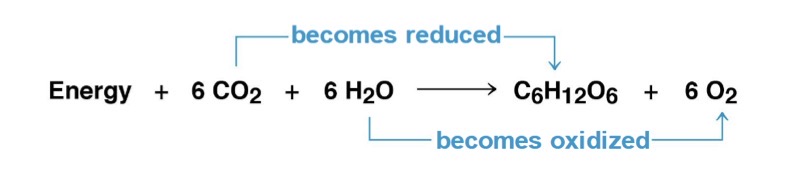
What is the equation for photosynthesis?
Light energy + 6 CO2 + 6 H2O → C6H12O6 (chemical energy) + 6 O2 + Heat
electrons flow upward towards a higher level of energy
This is an endergonic reaction powered by light
Autotrophs vs heterotrophs
phototrophs - get energy from sunlight
Chemotrophs - get energy from chemical compounds
autotrophs - carbon from inorganic sources (CO2)
Heterotrophs - carbon from organic compounds
Photoautotrophs - use light as a source of energy and CO2 as a source of carbon
Chemoheterotrophs - use organic compounds as source of energy and carbon
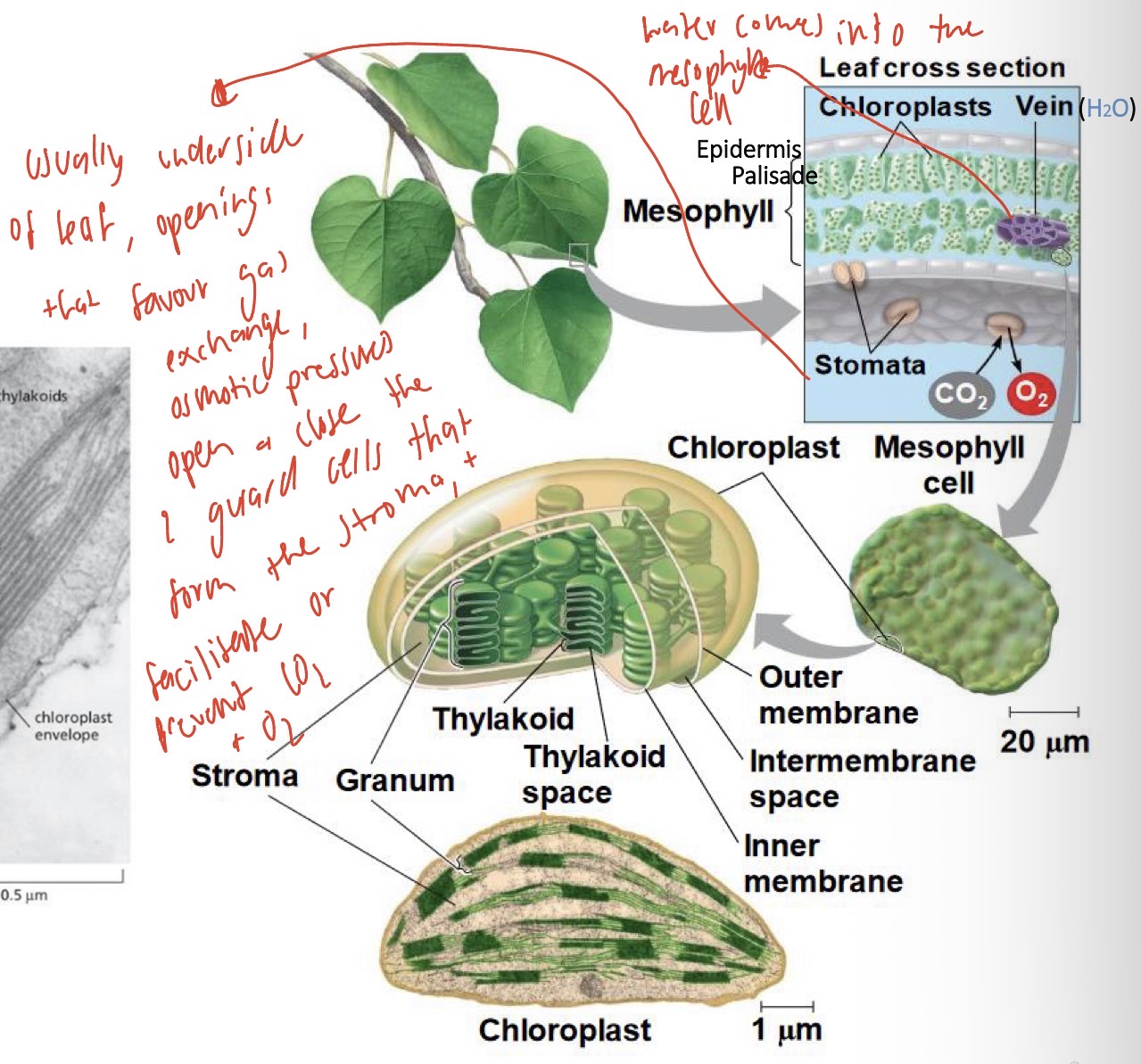
What is the structure of a chloroplast
Chlorophyll is located in the thylakoid membrane
Explain engelmann’s experiment
determined which wavelengths of light drive photosynthesis
He passed white light through a prism to split it into a rainbow spectrum and illuminated algae with it
He added bacteria that need oxygen to survive, and he found the bacteria accumulated in massive clusters in the violet/blue and red light regions - and very few in the green and yellow
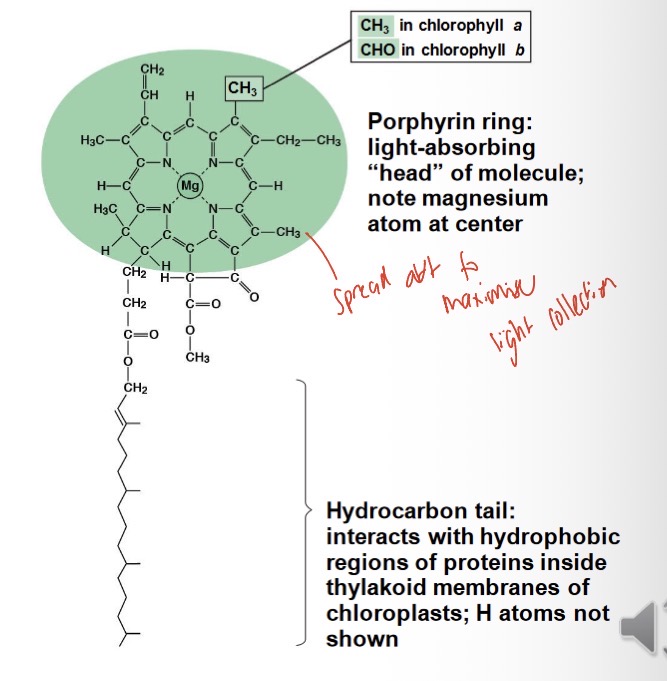
What are the photosynthetic pigments?
Chlorophyll a and Chlorophyll b - most efficient in violet/blue and red light
Carotenoids - help broaden the useful spectrum and/or protection against excessive light (photo protection)
What are the main steps of photosynthesis?
Light dependent reactions in the thylakoid membrane
Calvin cycle in the stroma
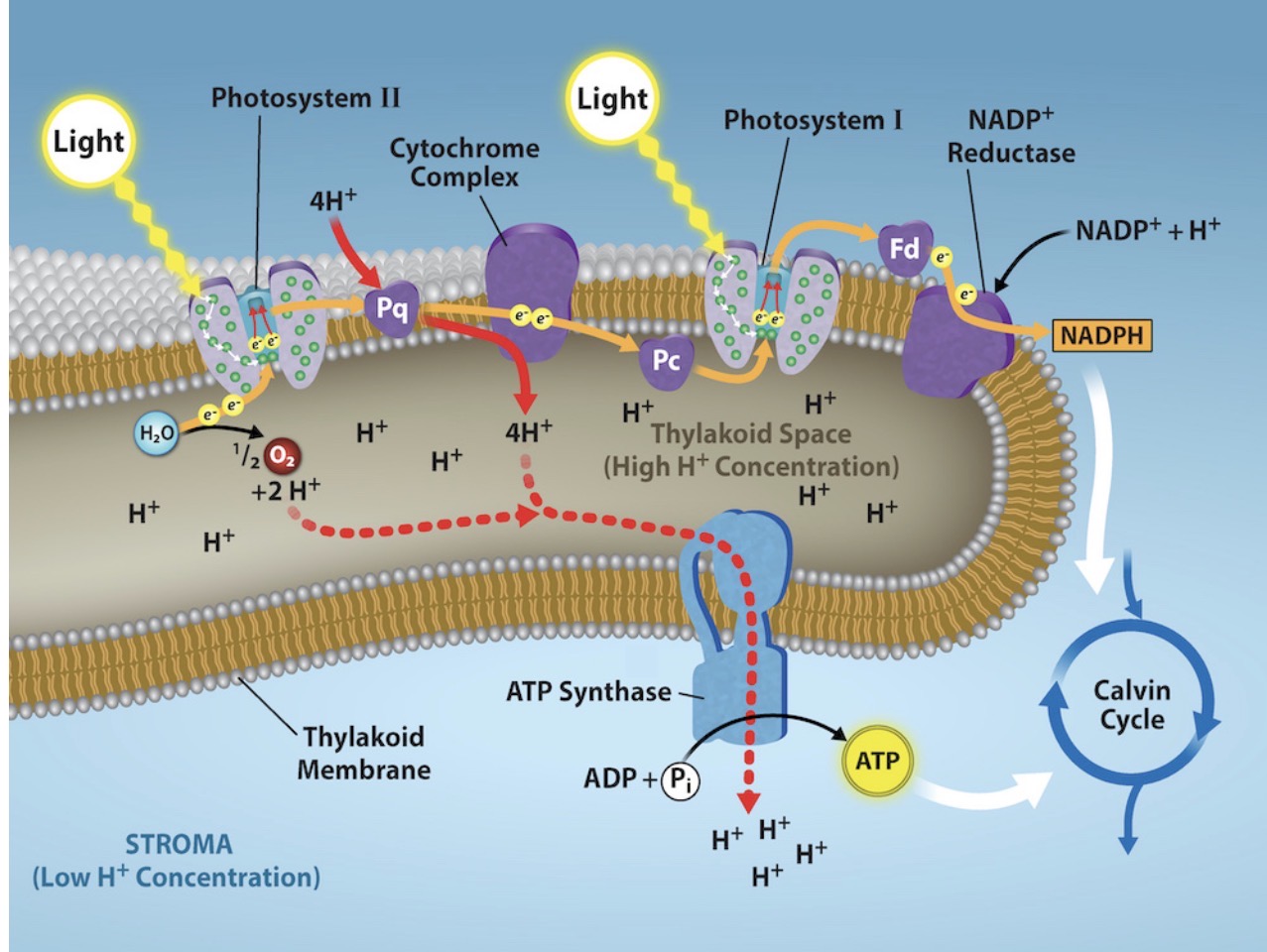
Explain the light dependent reactions in photosynthesis
Photons from light are captured by pigments present in the light harvesting complexes
Photons are funnelled down to a special pair of chlorophyll a molecules in the reaction centre of photosystem II
The chlorophyll a molecules donate electrons to the primary electron acceptor
In the lumen of the thylakoid - water is split into H+ and O2 - and gives the chlorophyll a molecules electrons to replace the ones they lost
The electrons in the primary electron acceptor travel down the ETC from photosystem II, Pq (transport), cytochrome complex, Pc (transport) to photosystem I - losing energy at each step
This energy is harnessed by the cytochrome complex to pump 4H+ against its conc gradient from the stroma into the thylakoid lumen
H+ uses ATP synthase to diffuse back into the stroma, rotating the motor, and adding a P to ADP to generate ATP through photophosphorylation
When the electrons reach the end of the ETC at photosystem I they are passed to chlorophyll b
A boost of light energy excites the electrons again, which pass them again to a primary electron acceptor
They travel down another ETC from PS I, Fd (transport) to NADP+ reductase, which reduces NADP+ to NADPH
Explain cyclic electron flow
At the end of PS I sometimes the electrons choose not to go down the 2nd ETC and instead use ferredoxin (Fd) to travel back to the cytochrome complex
This means that H+ is getting pumped into the lumen by cytochrome complex to drive ATP synthase to generate ATP through photophosphorylation
But this doesn’t create NADPH
Plants need a bit more energy than they need a source of electrons in the NADPH
Explain the Calvin cycle
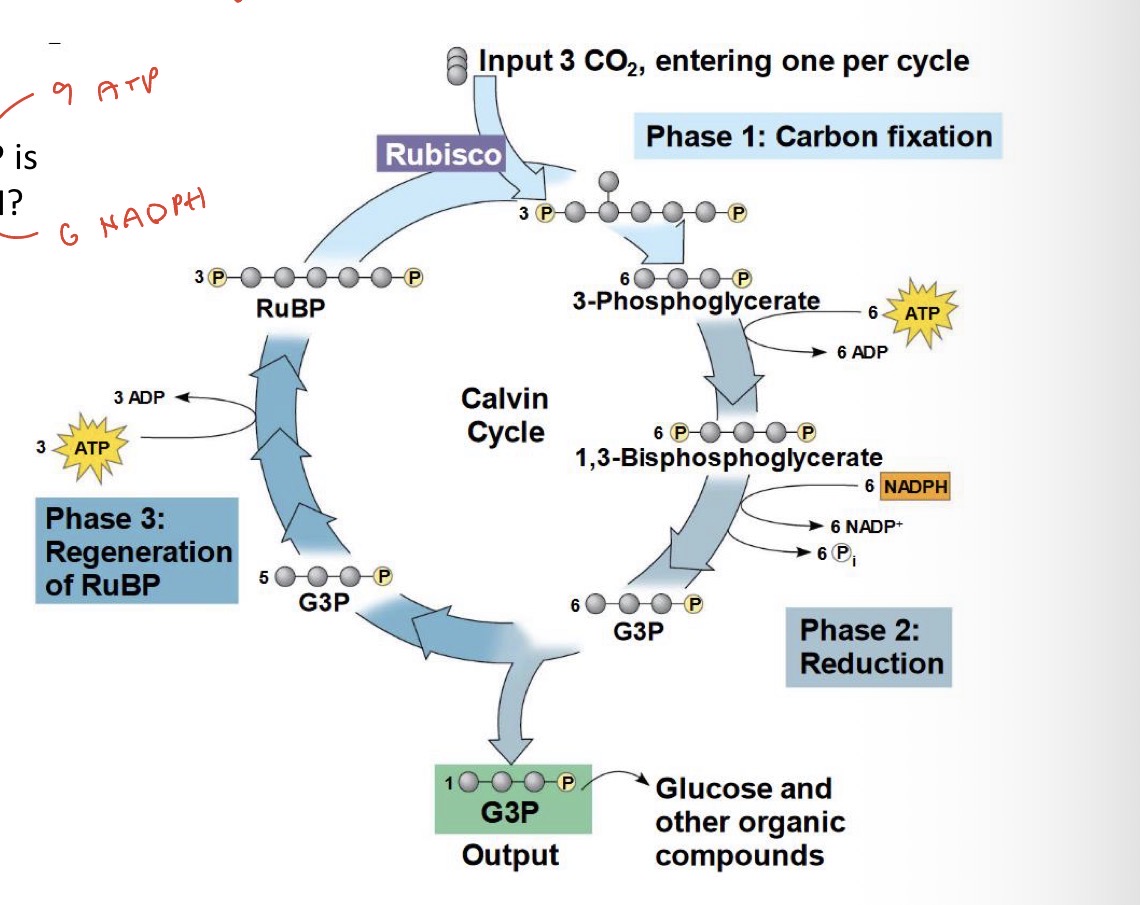
Phase 1: carbon fixation
Rubisco catalyses the fixation of atmospheric C (CO2) to 5C Ribulose bisphosphate (ruBP) creating a 6C molecule which is unstable and instantly splits into 2× 3-phosphoglycerate (3C)
Phase 2: reduction
6 ATP and 6 NADPH from the light reactions are used in a series of reduction reactions to convert the 2x 3-phosphoglycerate to glyceraldehyde 3 phosphate (G3P) - OUTPUT OF CALVIN CYCLE - one leaves per cycle
ATP reoxidised to ADP, NADPH is reoxidised to NAD+
Phase 3: regeneration phase
The other G3P molecules continue on and 3 ATP is used to re-generate RuBP
Input: 3CO2, 6 NADPH, 9 ATP
Output: 1 G3P, 6 NADP+, 9 ADP
technically 3 CO2 are added to 3 RuBP - which overall results in 6 G3P (1 leaves - 5 re-enters) - so output is 1 G3P molecule - which required 9 ATP and 6 NADPH
Links back to plants needing more ATP than NADPH from cyclic electron flow
What is the most abundant protein / enzyme on earth?
Ribulose bisphosphate carboxylase oxygenase
(Rubisco)
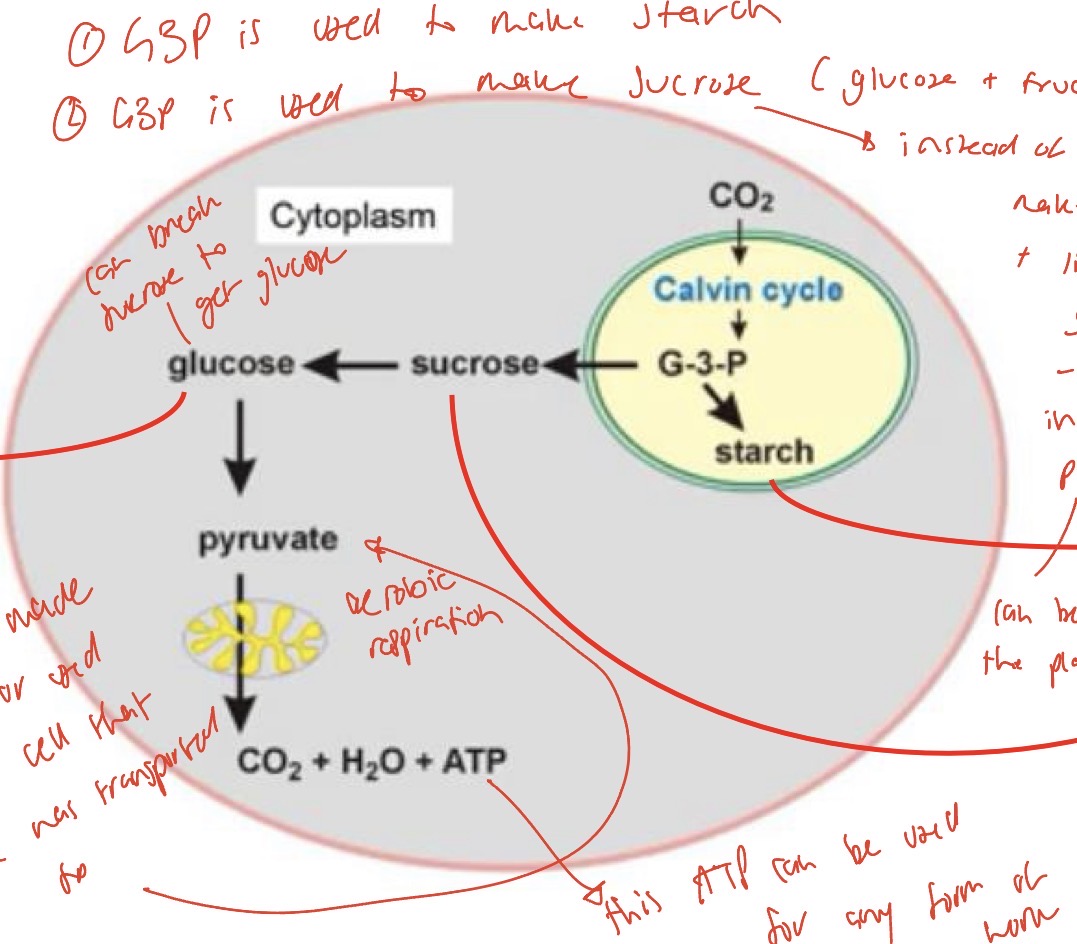
What happens to G3P after it leaves the CC?
Is used to make starch - stored in the leaves as granules
Used to make sucrose (links glucose and fructose)
Sucrose is transported in the vasculature in the phloem vessels - can be distributed all around the plant
Sucrose can be broken down again into glucose - used as an energy source for aerobic respiration to generate ATP that can actually be used to do work
Explain photorespiration
in hot/dry conditions - the stomata close and CO2 cant enter while O2 accumulates in the leaf (as respiration still occurs)
With a high conc of O2 and low conc of CO2, rubisco uses O2 in the Calvin cycle
Huge problem for the plant - eats up energy but not much is gained - a couple G3P but not enough, and creates weird molecules that the chloroplast has to use energy to deal with
What is an example of an anatomical adaptation to minimise photorespiration
rubisco cant be replaced - it is used in all plants at the start of the Calvin cycle
Corn
Sugar cane
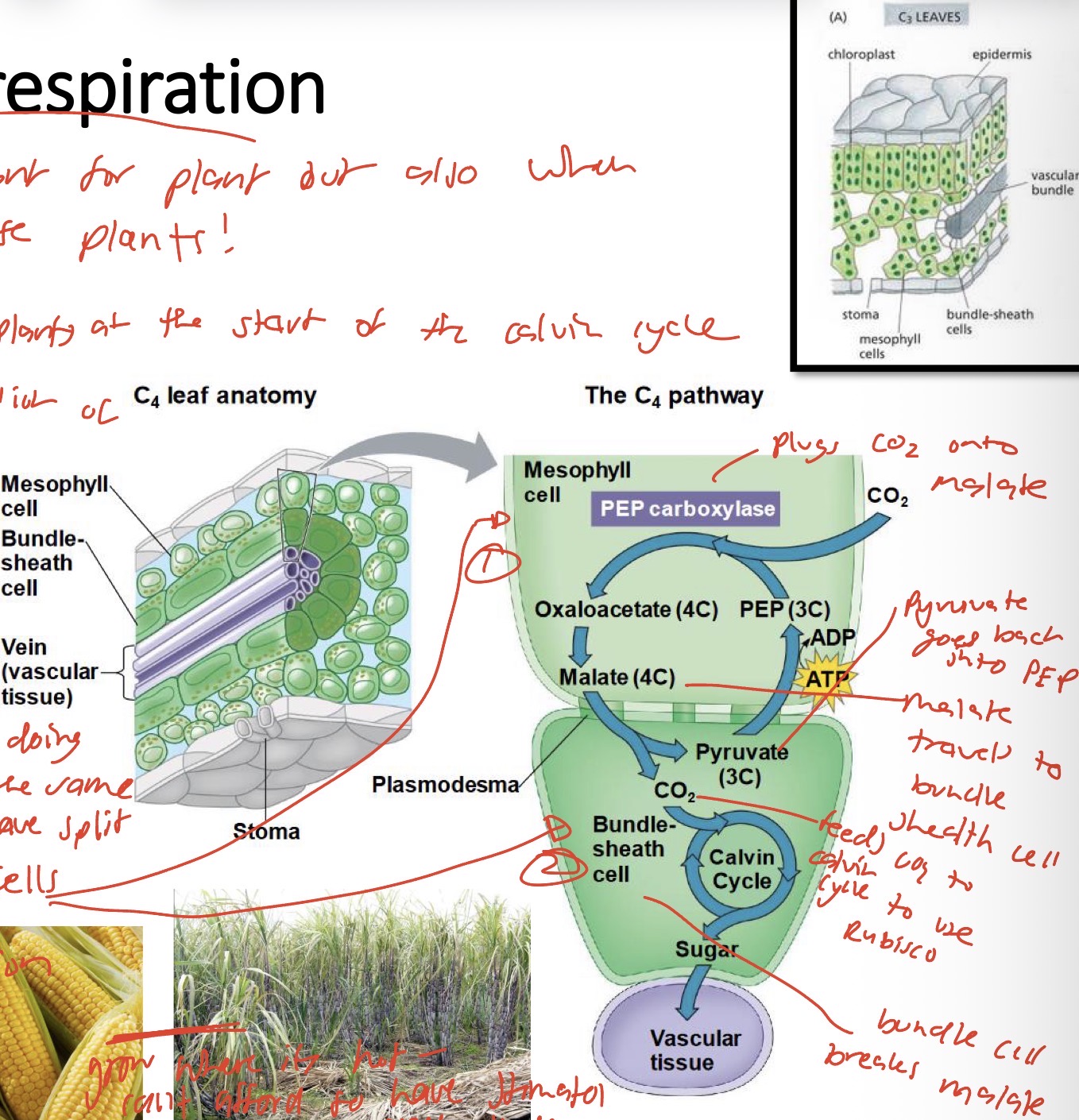
Anatomical adaptation in C4 plants
split into two cells - mesophyll cells and bundle sheath cells
Mesophyll cells have enzyme PEP carboxylase which as a high affinity for CO2 and none for O2 - and it fixes the C to PEP to make malate
Malate travels to the bundle sheath cell and is broken down into 3C pyruvate - which releases C and keeps the conc of CO2 high in the bundle sheath cells for rubisco
It uses a little bit of ATP but its much better than photorespiration
What is an example of temporal adaptations for photorespiration?
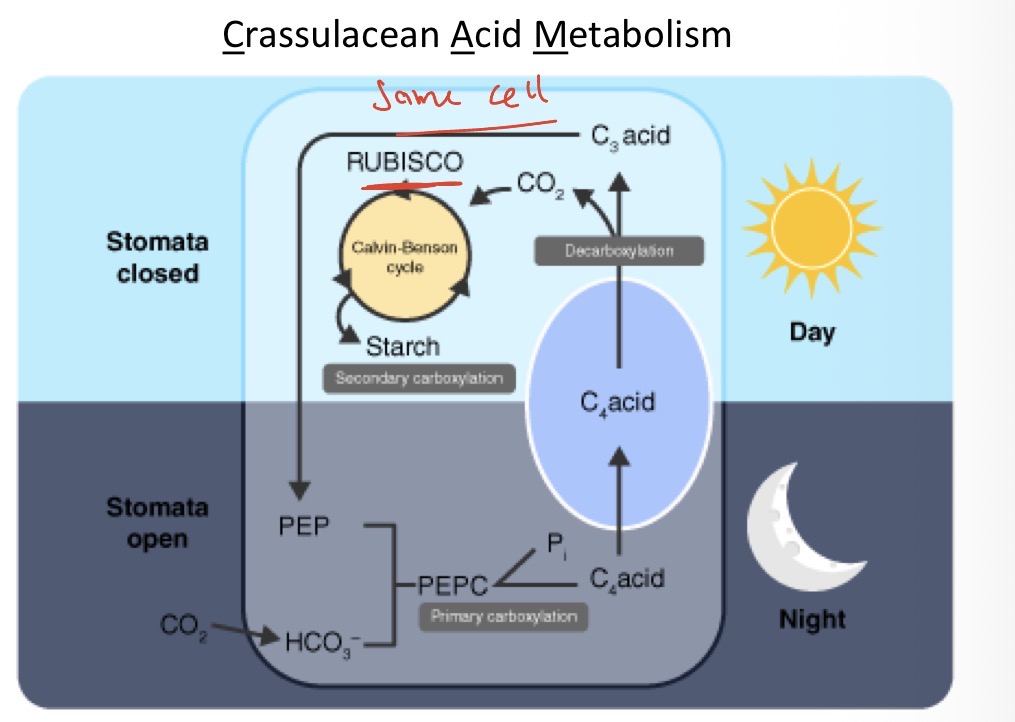
cacti
Pineapple
Temporal adaptation in CAM plants
during the night
Stomata opens
Initial CO2 fixation takes place to form malate - still done by PEP carboxylase
Malate is stored
During the day
Stomata close as its hot and dry
CO2 is released from malate
Calvin cycle takes place to form
ATP is used but its better than photorespiration