W5 O&S
 Call Kai
 Learn
Learn Practice Test
 Spaced Repetition
 Match
Match Flashcards
 Knowt Play
1/9

There's no tags or description
Looks like no tags are added yet.
Name | Mastery | Learn | Test | Matching | Spaced | Call with Kai |
|---|
No analytics yet
Send a link to your students to track their progress
10 Terms
Trade-off (danh doi) & risks
Supply chain decisions often invole trade-off, how do these choice affect risk exposure
Lean | Agile |
Low cost, low invenrory | flexible |
Risk of disruption | Higher operating cost |
In-house | Outsourcing |
Better control | Saves cost, expertise access |
Higher fixed-cost, less scalability (mo rong0 | Risk of loss of control, IP. Leakage, dependency |
Single sourcing | Multisourcing |
simplicity | Resilience- ben vung |
Risk of supplier failure | Risk of complexity, inconsistent (k dong deu) quality |
Near sourcing | Off sourcing |
Lower cost | |
Risk of long lead times, geopolitical issues, currency volatility (ty gia) | |
Sources of supply chain disruption
a) External risks
- Natural disasters
- Geopolitical events (chien tranh thuong mai – trade war, sanctions)
- Pandemics (covid 19 -> gobal shutdowns)
b) Internal risks
- Supplier failure or bankruptcy (pha san)
- Quality issues in production
- IT system outages
c) Strategic risks
- Over-reliance on single supplier
- Aggressive cost-cutting (lean system)
- Outsourcing critical processes
Risk analysis & contingency (ung pho) planning process
B1: indentify risks
B1a: external risks
B1b: internal risks
B2: Analyse&prioritze risks Xác suất xảy ra, Mức độ ảnh hưởng → Risk probability matrix
B3: Plan risk responses
What is inventory management, why is it important?
APICS defines inventory as those stocks or items used to support production (raw materials and work-in process/WIPitams) supporting MRO activities (maintenance repair. and operating supples and customer service (finishad goods and spare parts)
Inventory decisions drive other business activities like warehousing & transportation.
Main Points:
What? Raw materials, WIP, finished goods, MRO;
Why? Buffer against uncertainty, economies of scale, decoupling processes;
Trade-oft: Inventory as a cost vs. cushion. APICS defines inventory as those stocks or items used to support production (raw materials and work-in procass/WIPitams) supporting MRO activities (maintenance repair. and operating supples and customer service (finishad goods and spare parts)
Trade-off: inventory as a cost vs cushion (cuu canh)
"Many managers have a love-hate relationship with inventory."
It helps to limit the risk of stockouts and inaccurate records, allow for efficient order fulfillment, it "enables smooth operations and buffers against uncertainty."
But too much inventory...
•Ties up capital: Money spent on inventory cant be used elsewhere:
•Consumes space: Storage could be used more productively:
•Risk of obsolescence (loi thoi): Especially in fast-moving industries.
Inventory Types
Cycle stock: tồn kho theo chu kỳ đặt hàng
Safety stock: tồn kho an toàn (phòng rủi ro) “save it for a rainy day”
Transportation / Pipeline stock: hàng đang vận chuyển
Hedge (Speculative) stock: mua trước do dự đoán tăng giá
Anticipation stock: chuẩn bị cho mùa cao điểm
Smoothing stock: ổn định sản xuất
Stockout: hết hàng
Inventory costs:
OỎderings + holding/carrying +managing the inventory/ sgortage or stock out costs
a) orderings + holding/carrying costs
Ordering | Carrying |
Administrative costs (hanh chinh) • Costs of receiving an order (wages) • Conducting a credit check (kiem tra tin dung) • Verifying inventory availability • Entering orders into the system (nhap don vao he thong) • Preparing invoices, payment • Receiving and inspection • Shipping costs per order only it its Fixed | •Obsolescence (Spoilage) (hu hong/loi thoi) • Shrinkage (hao hut) • Storage & Handling • Insurance (bao hiem) • Taxes • Interest |
B) the saw tooth profile ( mo hinh rang cua)
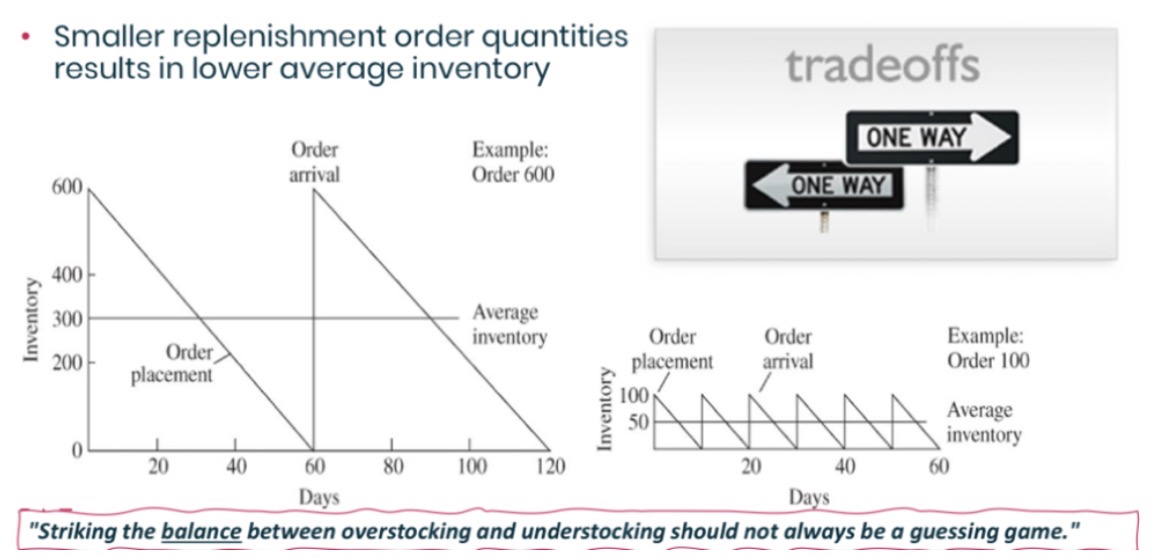
When to order: Reorder point (ROP)
In a “continous review system” Reorder point is the minimum unit quantity that a company should have, hay noi canh khac “when the inventory level reaches the point where there are just enough units left to meet requirements until the next order arrives”
ROP = d x L + SS
d= constant demand per period (in days) => based on ur historical demand or forecast
L= leadtime (indays) => typically given by ur supplier
SS = safety stock (not always calculated; more so when demand uncertain – k chac chan)
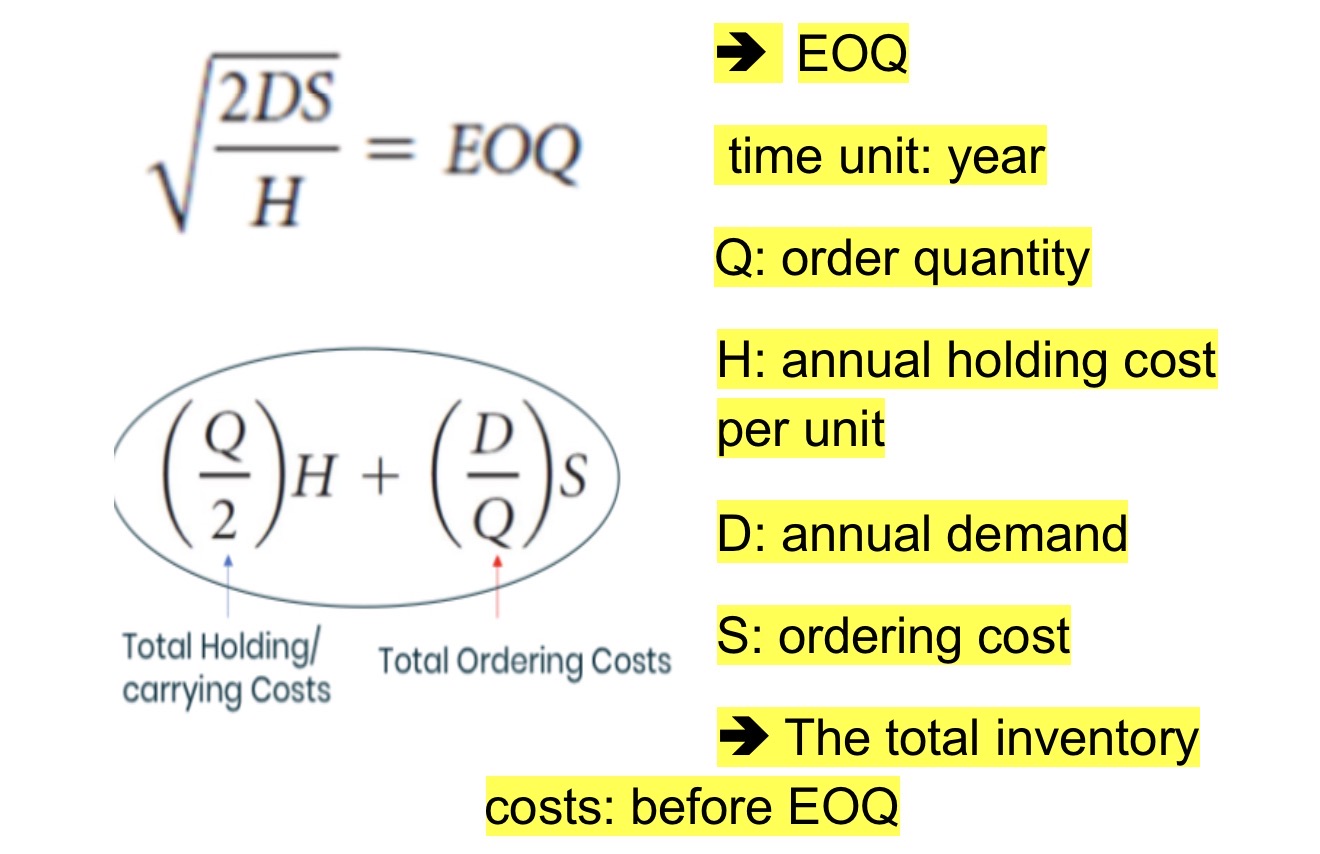
How much to order: Economic order quantity (EOQ)
The EOQ deals with calculating the proper order size with respect to 2 costs:
- The cost of carring/holding the inventory
- The cost of ordering the inventory
EOQ determines the order quantity at which the sum of carrying costs and ordering costs is minimized, other way is the carrying and ordering costs are equal