BI301 Final Exam
 Call Kai
 Learn
Learn Practice Test
 Spaced Repetition
 Match
Match Flashcards
 Knowt Play
1/70

There's no tags or description
Looks like no tags are added yet.
Name | Mastery | Learn | Test | Matching | Spaced | Call with Kai |
|---|
No analytics yet
Send a link to your students to track their progress
71 Terms
The Biological Species Concept
Two organisms are different species if they cannot or will not produce viable offspring together
Homologous traits
Traits that appear similar but serve a different function, evolved from a recent common ancestor
Analogous traits
Traits that serve the same function but may appear different in different organisms evolved due to similar selection pressures, not from a recent common ancestor
What are the two classes within Phylum Porifera
Demospongiae, hexactinellida, and calcarea
What are the defining features of Phylum Porifera?
Porous body (ostia)
Have choanocytes (specialised cells)
Lack symmetry, true tissues, organs, and nervous systems
Skeletons made of spicules, spongin, or calcium carbonate
What are the defining features of Phylum Porifera, Class Demospongiae?
Spongin skeletons
All leuconoid body type
Most have spongin skeletons
Tend to have chemical defenses
What kinds of specialised cells do organisms in Phylum Porifera have?
Choanocytes
Pinocytes
Amoebocytes
What are the defining features of Phylum Porifera, Class Hexactinellida?
6-rayed spicules
“Glass sponges” with silica skeletons
Syconoid or leuconoid body type
What are the defining features of Phylum Porifera, Class Calcarea?
Calcium carbonate spicules
Smaller in size
All 3 body types present
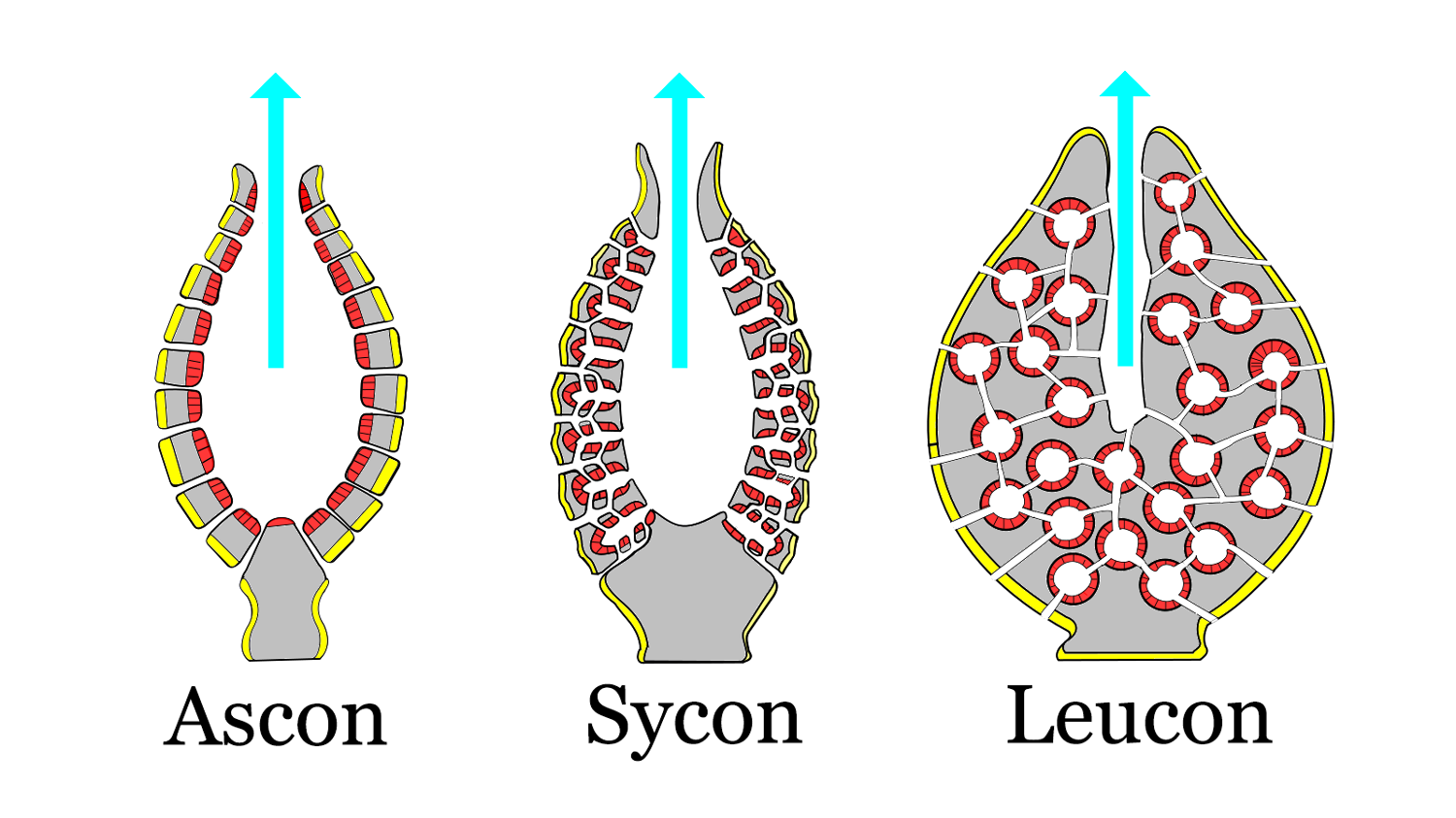
What are the three body types of Phylum Porifera?
Asconoid, syconoid, and leuconoid
Cephalisation
The evolutionary trend of concentrating sense organs, nervous tissue (brain), and feeding mechanisms at the anterior (front) end of an animal, forming a head
What kind of body forms are found in Phylum Cnidaria?
Polyp and medusa
What are the defining features of Phylum Cnidaria?
Radial symmetry
Eumetazoan (true tissues)
Diploblastic (2 embryonic germ layers)
Ring nerves but lack of cephalisation
Statocysts and ocelli cells
What are the defining features of Phylum Cnidaria, Class Hydrozoa?
Alternate between polyp and medusa for reproduction but polyp stage dominates
Muscular velum during medusa stage
Mostly marine and colonial
What are the defining features of Phylum Cnidaria, Class Cubozoa?
Medusa-stage dominant
Cube shaped
Include cube jellies and sea wasps
What are the defining features of Phylum Cnidaria, Class Anthozoa?
NO medusa stage
All marine
Sea anemones and corals
What are the defining features of Phylum Cnidaria, Class Scyphozoa?
No true velum
Thick mesoglea
Dominated by the medusa form
What are some causes of coral bleaching?
Cold shock
Decrease in salinity
UV exposure
Increased water temperature
Turbidity
Pollution
Sunscreen
What are the defining features of Phylum Platyhelminthes?
Lophotrochozoan
Acoelomate
Triploblastic
Polarised nervous system
What are the defining features of Phylum Platyhelminthes, Class Turbellaria?
Free-living
Mouth is ventral
Cilliated epidermis
What are the defining features of Phylum Platyhelminthes, Class Trematoda?
Parasitic flukes (endoparasites)
Multiple hosts during life cycle
Specialised suckers for attachment
What are the defining features of Phylum Platyhelminthes, Class Cestoda?
Parasitic tapeworms
Always have 2 hosts (1 invert. and 1 vert.)
Microtrix for nutrient absorption
Scolex for attachment
Proglottids for reproduction
What are the defining features of Phylum Nematoda?
Thick collagen cuticle
Hydrostatic skeleton
Only longitudinal muscles
Complete gut
Aflagellate sperm
Hydrostatic skeleton
A cavity filled with pressurised fluid that provides structural support and enables movement when muscles contract around it
What are the defining features of Phylum Annelida?
Metamerism
Chaetae
Peristaltic contractions
True coelom
What are the defining features of Phylum Annelida, Class Sedentaria?
Tube or burrow dwellers
Some have a clitellum
What are the defining features of Phylum Annelida, Class Errantia?
Parapodia for locomotion and respiration
No clitellum ever
Trochophore larva
What is the first major change in body plan on the phylogeny we talked about?
Parazoan vs. eumetazoan
Parazoan
Lacking true tissues
Eumetazoan
Having true tissues
What is the second major change in body plan on the phylogeny we talked about?
Radiata vs. bilateria
Radiata
Having radial symmetry
Bilateria
Having bilateral symmetry
What is the third major change in body plan on the phylogeny we talked about?
Protostomia vs. deuterostomia
What is the fourth major change in body plan on the phylogeny we talked about?
Only under protostomia, it is lophotrochozoan vs. ecdysozoan
Lophotrochozoa
Do not molt a cuticle
Ecdysozoa
Having a cuticle
What are the 4 (3.5?) ways protostomes differ from deuterostomes?
Cleavage pattern
Cell fate
Coelom formation
Blastophore fate
Deterministic cell fate
A cell’s function is completely predetermined and if a blastomere is somehow removed, development is arrested because the cell will no longer be able to do its job
Indeterminate cell fate
Like stem cells, a cell’s fate is not set in stone, so removing blastomeres will still lead to healthy cell development
What are the 4 classes of Phylum Mollusca?
Bivalvia
Gastropoda
Polyplacophora
Cephalopoda
What are the defining features of Phylum Mollusca, Class Bivalvia?
Divided in 2 halves
NO head
NO radula- they are filter feeders
Foot is a hydrostat
What are the definitive characteristics of Phylum Mollusca?
Muscular foot for locomotion and attachment
Mantle and cavity
Radula- rasping tongue
What are the definitive features of Phylum Mollusca, Class Gastropoda?
Operculum
Coiling and torsion
Eyes at tips of tentacles
What are the definitive features of Phylum Mollusca, Class Polyplacophora?
Flattened oval shape
8 dorsal plates
Well-developed radula
Gills in mantle cavity
What are the defining characteristics of Phylum Mollusca, Class Cephalopoda?
Reduced or absent shell
Highly derived eyes
Jet propulsion
What are the benefits of having an exoskeleton?
Protection → insoluble in water
Prevent dessication
Muscle attachment and movement
What are the 4 steps of ecdysis?
Pre-molt: old cuticle is digested away
Underlying endocuticle begins to grow
Old cuticle splits
New cuticle is inflated with air or water
What are the definitive characteristics of Phylum Arthropoda?
Ecdysis
First flight
Segmented with somites, which fuse to form tagmata
Exoskeleton
What are the defining characteristics of Phylum Arthropoda, Subphylum Trilobita?
Lack mandibles
Are extinct
What are the defining characteristics of Phylum Arthropoda, Subphylum Chelicerata?
Only have 2 tagmata
No mandibles
No antennae
What are the defining characteristics of Phylum Arthropoda, Subphylum Chelicerata, Class Arachnida?
Book lungs
Pumping stomach
Malphigian tubules
What are the defining characteristics of Phylum Arthropoda, Subphylum Myriapoda, Class Diplopoda?
Herbivorous
2 pairs of walking legs per trunk segment
What are the defining characteristics of Phylum Arthropoda, Subphylum Myriapoda, Class Chilopoda?
Terrestrial carnivores
1 pair of walking legs per trunk segment
What are the defining characteristics of Phylum Arthropoda, Subphylum Hexapoda, Class Insecta?
3 tagmata
3 pairs of uniramous appendages on the thorax
2 pairs of wings
Diapause
Metamorphosis
What are the defining characteristics of Phylum Arthropoda, Subphylum Crustacea?
2 pairs of antennae
Carapace
Swimmerets
What are the defining characteristics of Phylum Echinodermata?
No ability to osmoregulate
Pentaramous symmetry as adults, bilateral as larvae
Calcareous endoskeleton
Water vascular system
What are the defining characteristics of Phylum Echinodermata, Class Ophiuroidea?
No pedicellarie
No anus, madreporite on oral surface instead
5 movable jaw-like plates
No suckers on tube feet
Bursae
What are the defining characteristics of Phylum Echinodermata, Class Echinoidea?
Dermal ossicles make up endoskeleton
Herbivorous
No arms
ARISTOTLES LANTERN
What are the defining characteristics of Phylum Echinodermata, Class Holothuroidea?
Soft, leathery bodies
Secondarily bilateral
Oral tentacles
Respiratory tree
What are the defining characteristics of Phylum Echinodermata, Class Crinoidea?
Leathery body disc
Flexible, branched arms
Osmoregulation
The physical ability to maintain a stable water balance in the body
Water vascular system
Hydraulic network in echinoderms made up of canals and tube feet that functions for locomotion, feeding, respiration, and sensory processing
What are the 5 defining characteristics of Phylum Chordata?
Notochord
Dorsal, hollow nerve chord
Muscular post-anal tail
Endostyle/thyroid gland
Pharyngeal pouch or slits
What are the defining characteristics of Phylum Chordata, Subphylum Urochordata?
Marine
Sessile
Non-living tunic that surrounds the body
What are the defining characteristics of Phylum Chordata, Subphylum Cephalochordata?
Filter feeders
Segmented muscles
Closed circulatory system lacking a heart
What are the defining characteristics of Phylum Chordata, Subphylum Vertebrata?
A CRANIUM
Vertebral column in some
What are the defining characteristics of Phylum Chordata, Subphylum Vertebrata, Class Chondrichtheyes?
Secondarily cartilaginous skeleton
Carnivorous
Placoid scales
Lack a swim bladder
Lateral line system
Spiracle
What are the defining characteristics of Phylum Chordata, Subphylum Vertebrata, Class Actinopterygii?
Ossified calcareous skeleton
Operculum covers gills
Swim bladder
Complex osmoregulation
What are the defining characteristics of Phylum Chordata, Subphylum Vertebrata, Class Amphibia?
Ectotherms
No scales, moist skin
What are the defining characteristics of Phylum Chordata, Subphylum Vertebrata, Class Reptilia?
Waterproof skin
Negative pressure respiration
Amniotic egg