biology - topic 6: global challenges
 Call Kai
 Learn
Learn Practice Test
 Spaced Repetition
 Match
Match Flashcards
 Knowt Play
1/60

There's no tags or description
Looks like no tags are added yet.
Name | Mastery | Learn | Test | Matching | Spaced | Call with Kai |
|---|
No analytics yet
Send a link to your students to track their progress
61 Terms
How can we measure the approximate population size of an animal in a habitat?
Quadrats
Transect Lines
What are the different types of sampling when measuring population size?
Random Sampling: Uses random number generators to find a set of coordinates without the effects of bias.
Stratified: Take samples from each ‘zone
Systematic: Take samples every x metres.
What method can we use to eliminate the risks of double-counting?
Capture Re-Capture
What are the four methods of capturing live animals?
Pooters: A device with two tubes (one is sucked, which causes the other to vacuum the invertebrate) and a plastic container.
Pitfall Traps: A hole filled with leaves, which causes organisms to fall inside.
Nets: Swept along a tree’s leaves to capture organisms inside the tree.
Kick Sampling: Stand in a stream and use your feet to gently agitate the bed, and a net downstream captures organisms that were disturbed.
What are hydroponics?
The process of growing plants without soil. Plants are planted in a solution containing the nutrients they need for growth, contained within a greenhouse. However this is costly and disease can easily spread.
Define genetic engineering.
A process which involves modifying the genome of an organism to introduce desirable characteristics that wouldn’t be inherited naturally.
How are genes transferred in genetic engineering?
The gene we want is isolated via restriction enzymes. it is referred to as having ‘sticky ends’.
This is inserted into a vector (virus or plasmid) with ligase.
This causes it to produce the protein we want.
The transgenic organism is grown and success can be tested via antibiotic resistance.
Define vector.
An organism (such as a plasmid) that transmits pathogens between hosts.
Define healthy.
Being free from disease.
What are communicable diseases?
Diseases that can be spread, e.g. athletes foot or chickenpox.
What are the four pathogen types and an example of a disease caused?
Virus- HIV/AIDS
Bacteria- TB
Protoctist- Malaria
Fungi- Athletes Foot
How can you decrease the risk of inheriting a non-communicable disease?
Healthy diet and exercise
Lack of stress
Quality of healthcare
Not smoking/drinking
Little exposure to ionising radiation e.g. X Rays
What is a pathogen?
Any microorganism causing disease in an organism.
What do plants have that protect them from disease?
Cell wall (physical barrier)
Waxy cuticle stops pathogens entering plant
Callose production (reinforces cell wall)
What is a lymphocyte?
Specific white blood cells that defeat pathogens.
Produce memory cells which make you ‘immune’.
Cause pathogens to stick together by the antibodies binding with the antigens.
What is a phagocyte?
Non-specific white blood cells that engulf pathogens.
The pathogen is engulfed and digested via digestive enzymes.
This is known as phagocytosis.
What are platelets?
Cells that are responsible blood clotting.
How do platelets help cuts heal?
When the skin is broken, platelets arrive to stop the bleeding
Platelets help form insoluble fibrin that form an insoluble mesh across the wound, trapping red blood cells and therefore forming a clot
The clot eventually dries and develops into a scab
This protects the wound from bacteria entering
What are some examples of non-specific defences in the human body?
Skin
Nasal hair
Tears/sweat
Mucus
Stomach acid
What are antibodies?
Proteins that compliment the antigens on the surface of a pathogen.
What are antigens?
A marker found on the surface of a pathogen, stimulating an immune response when detected.
How does your response to disease change over-time?
The pathogen enters the body and is detected
Lymphocytes produces specific antibodies to the antigens
This causes the pathogens to clump up
Phagocytes engulf and digest it
The antibodies specific to the disease are retained as memory cells to the pathogen
If the same disease is encountered again, the antibodies are released, making recovering much faster
Note: less symptoms will be seen on the second infection.
What is herd immunity?
When the majority of a population is immune to a disease.
How do vaccines prevent disease?
Contain a dead/weakened version of the pathogen
The antigens within the vaccine are recognised by lymphocytes causing antibodies to be produced
An immune response is triggered
Memory cells are produced which means long term immunity
What are pros and cons of vaccinations?
pros | cons | |
herd immunity | side effects e.g. swelling | |
epidemics can be prevented | doesn’t always result in immunity |
Who discovered penicillin?
Alexander Fleming
How was penicillin discovered?
Fleming left some petri dishes that had been contaminated with mould from the air
He found that bacteria would not grow near the mould
He discovered that the mould was releasing a chemical (penicillin) that killed the bacteria surrounding it
What are the three things that need to be considered when developing a new medicine?
Toxicity - harmful side effects?
Efficacy - does it work?
Dosage - min/max amount?
What are the stages of drug development?
The drug is tested in a lab on human cells with computers
The drug is then tested on animals such as fruit-flies or mice
It is then tested on human volunteers, with the dosage slowly increasing to ensure it is safe in the human body
The drug is tested on a large group with the specific disease it is targeting
It is then approved
How do scientists ensure that the results from a clinical test are accurate?
Placebo Effect:
The volunteers are split into two groups.
The control group receive a placebo - an identical looking drug with no effects
The tests are either blind or double blind
The results are taken and compared for patterns
How do humans interact with the environment? (5 points)
More raw materials to meet human demand
More energy from manufacturing
Waste causes sewage pollution and toxic gases
Hunting (e.g. rhinos for their horns)
Fertilisers pollute rivers
How can we conserve biodiversity?
Ecotourism
Sustainable fish farming with quotas, catch inspection, or sonar radars instead of nets
Protected areas e.g. nature reserves
Preventing introduction of harmful species that could threat another population
Hydroponics
Why is maintaining biodiversity difficult?
Involves countries working together - countries may not be willing
People may not be keen if it lowers their income
Keeping track of fishing quotas is tricky
Why is global warming getting out of hand?
More greenhouse gases are re-radiating energy back towards the earth, so our average temeprature is increasing.
What are the consequences of global warming?
Rising in sea levels due to glaciers melting
Changes in migration patterns e.g. birds
Reduction in biodiversity - species are unable to survive a change of climate
What is bioaccumulation?
When persistent toxins build up in an organism’s tissues
What is biomagnification?
When toxins are passed down trophic levels.
What is an example of bioaccumulation/biomagnification?
DDT
Insecticide sprayed on crops
Animals ingested it by eating contaminated plants
Affected organism’s reproductive ability due to biomagnification
What is the definition of food security?
The ability to access affordbale food of sufficient quantity and quality.
What factors threat food security?
Increasing population
More land use
Change of diet - people in wealthier countries eat more meat, which is expensive
Climate change can affect crops
Pests and pathogens
How can we increase crop yield to reach food security?
Hedgerows - act as windshields so topsoil can’t blow away
Natural fertilisers e.g. manure - won’t cause crop decay
Free range animals - lower chance of pathogens to evolve
Crop rotation - soils remain fertile
What is selective breeding?
The process of breeding organisms with desired characteristics
What is a gene pool?
All genetic material in a population
What are the pros and cons of selective breeding?
Pros:
Higher crop yields
Helps feed the growing population
Cons:
Reduces alleles and therefore variation
Increases chances of genetic disease
Undesired organisms may become extinct
What is the aseptic technique?
The maintaining of a sterile environment
How do we maintain the aseptic technique?
Disinfect work surfaces regularly (e.g. with ethanol - flammable)
Sterilise equipment (e.g. inoculating loop through flame)
Use a Bunsen burner - causes a convection current
What is a monoclonal antibody?
Identical copies of an antibody that target one specific antigen.
How are monoclonal antibodies produced?
A mouse lymphocyte fuses with a tumour cell to create a hybridoma.
The hybridoma cells reproduce and clone. They all produce the same antibody.
These can be harvested.
What are some uses of monoclonal antibodies?
Pregnancy testing - they bind to a pregnancy hormone, causing a colour change reaction
Detecting disease - bind to an antigen and confirm its presence
Treating cancer - can kill target cells and carry drugs to a cancer cell
What is cancer? What factors can cause it?
A group of diseases characterised by uncontrollable cell growth and division into surrounding tissue.
Development factors:
Tobacco use
Poor diet and obesity
Alcohol
UV exposure
Genetic
What are the differences in benign and malignant tumours?
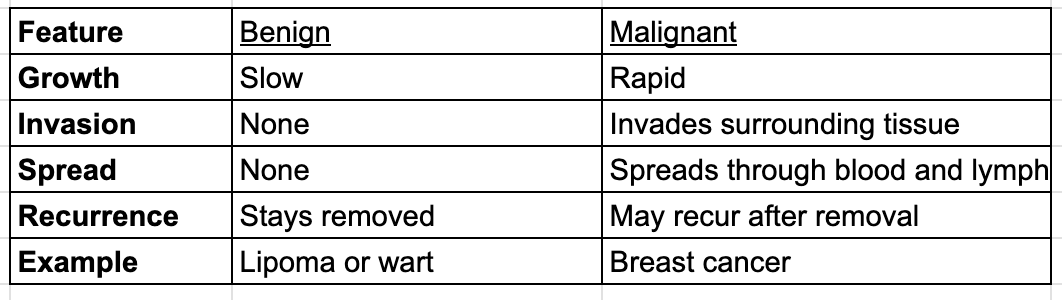
What is the treatment for cancer?
Chemotherapy (via chemicals) and radiotherapy (via x-rys)
What is cardiovascular disease?
Diseases that affect your heart and blood vessels.
What is an example of a CVD?
Coronary Heart Disease (CHD) - when there is a build up of fatty plaques containing cholesterol in your cornorary arteries. These take blood into the heart muscle.
How can we treat cardiovascular disease?
Healthy lifestyle
Statins - reduces cholesterol in the bloodstream which reduces risk: can cause aching muscles
Anticoagulants - reduce likeliness of blood clots: can cause excessive bleeding if hurt in an accident
Antihypertensives - reduce blood pressure and therefore blood clots: can cause fainting
Surgery (e.g. a donor heart)
What are stents?
Tubes inserted into arteries so blood can pass through. However over time, stents can irritate the artery and make scar tissue grow.
What are stem cells? What are the types?
Cells that differentiate into a specific specialised cell.
Adult - Limited range of cells
Embryonic - Most cells
Meristems - In plants
What are the ethical concerns of stem cells?
Stem cells can mutate - functions are unknown.
Embryos have right to live.
What is gene therapy? How does it work?
A technique to replace faulty alleles and treating disorders.
The gene is isolated and replicated and placed into a vector that infects the target tissue. This is repeated throughout treatment.
What are some problems with gene therapy?
Therapy is short-lived
Condition can still be passed onto offspring
Healthy alleles may not go into every target cell.
What was the Human Genome Project?
An international consortium of scientists mapped out an entire genome. This means that we know the location of all alleles which makes their identification easier. Medicine can be tailored to individual needs.