Chapter 11: Relationships and Families
 Call Kai
 Learn
Learn Practice Test
 Spaced Repetition
 Match
Match Flashcards
 Knowt Play
1/16

There's no tags or description
Looks like no tags are added yet.
Name | Mastery | Learn | Test | Matching | Spaced | Call with Kai |
|---|
No analytics yet
Send a link to your students to track their progress
17 Terms
What is homogamy?
Marriage with people who are similar to each other on a range of important dimensions like class, education, race, religion or political views
Group pressures prevent people from crossing socially recognized boundaries, like pressure to not marry outside of your religion or race, or pressure against “dating down” with someone from a lower socioeconomic status.
We are more emotionally attached to “sameness,” perhaps because people similar to us share our values and attitudes.
Homogamy preserves group identity and values and prevents economic loss.
Mate Selection- How do we choose our romantic partners?
How do we choose our romantic partners?
For heterosexual women, studies indicate that men who show more dominance, and who are taller and stronger partners—those who are better able to protect mates and accrue and defend resources—are viewed as more attractive
For heterosexual men, fertility is a key biological and evolutionary factor. Youth, lustrous hair, good teeth, smooth skin, a curvy figure, and good muscle tone are outward indicators of fertility and genetic suitability for mating.
Mate selection can be tied to biology, cultural, psychological, and social factors are equally, if not more, important.
Romantic Love
Love often frames what an ideal intimate relationship should look like: closeness, intense feelings, sexual attraction, and monogamy
While scholars have found that feelings of intense love, desire, longing, and infatuation exist across cultures and times and while many Canadians expect to be “in love” with the person with whom they form lasting relationships, these feelings have only recently formed the basis of mate selection
Previously, mate selection was beholden to traditional family and economic structures, and romantic love was a deviation from traditional norms. Only since the late 18th century has romantic love become a central feature of private relations between people in Western society
Autonomy from parents and family and greater personal independence, the rise of individual family homes with the husband and wife at the centre, and the near permanence of marriage (divorces were, for decades, very difficult to obtain) further shifted cultural norms around love and mate selection
Today, for many, relationships are founded on love and resemble what sociologist Anthony Giddens calls “pure relationships”—relationships defined by the interests and needs of each partner rather than by laws, traditions, or necessity
Social Factors- What is assortive mating? What is the mere-exposure effect?
Culture, socioeconomic resources, race, status, and group membership are all important factors that determine your partners
Homogamy is typically the result of assortive mating: the non-random matching of people into relationships.
Similar in terms of age, race, education,
We typically prefer partners who are similar on important social and demographic dimensions like age, race, education, social class, religion, and even height and income
Much of the research on relationships confirms the importance of homogamy.
People tend to select others based on their educational and economic attractiveness because of the similar resources they bring to the relationships
People tend to form relationships with those of their own racial & ethnic background, and who share their religious orientation
Less similarity between partners has been shown to lead to lower quality and shorter relationships
Marrying someone with similar education is one of the strongest & most consistent findings around the world
Mere exposure effect: simply being more exposed to a person can elicit more positive feelings about them
One study found that half of the assortive mating based on education is due to proximity—you form relationships with the people you’re around, and if you’re attending university you are more likely to form relationships with others in university
You are more likely to be attracted to someone simply because you are around them more frequently and are more exposed to them. And this exposure is often controlled by geographic or social arrangements that favour homogamy.
Opinions of friends & parents
The opinions of your friends and parents matter for your relationship choices.
This is largely due to homogamy—those close to you discourage you from crossing socially recognized boundaries, like “dating down” in terms of social class, marrying outside of your religion, or, for some, interracial dating.
Hookups
A culture of hooking up has emerged where sexual intimacy and pleasure have become the main objective of the relationship rather than love, intimacy, or emotional connection
When people do engage in hookups, their partners are often friends rather than strangers, and repeated hookups are usually with the same person rather than with different people, what some call “friends-with-benefits.”
About one-third of people who engage in sexual intercourse in a hookup report that it makes their relationship closer, and a similar proportion hopes that the hookup will lead to a more conventional dating relationship, particularly those hooking up with friends
We often think that women are more likely to connect sex with love, but there are few differences between men and women, and most men also connect sex with love
A third of young men who have had sexual experiences outside of a relationship express a desire for their partners to become their girlfriends
Online Dating
For most of the 20th century and part of the 21st century, the most popular way for heterosexual couples to meet in North America was through friends and family who acted as important intermediaries to vet romantic partners.
Recently, however, online dating through apps and sites like Tinder and eHarmony have surpassed friends and family as the primary way in which heterosexual couples meet
In studies that traced how U.S. couples met, meeting through friends went from 21% in 1940 to almost 40% in 1990, before sliding back to 20% in 2017, having been eclipsed by online meetings at 40%
People have turned to online dating for many reasons. Technology, like the widespread adoption of the smartphone, increases the odds of meeting strangers who are not known by family, friends, or acquaintances
Online environments permit people to control their profile and the selection process, rather than rely on, or have to divulge information to, friends or family
Meeting online is far more efficient and convenient. Dating apps are capable of connecting more people in particular geographic areas more efficiently than meeting through daily routines, by chance, or in venues like bars.
As more people use dating apps, the pool of potential partners grows
Who we Meet Online
According to U.S. data, almost 50% of younger people (aged 18–29) have used online dating, including 22% of those in high school or lower
Among groups with much thinner dating pools, such as middle-aged singles or those seeking same-sex relationships, online dating rates have skyrocketed and have eclipsed all other ways of meeting partners.
Nearly 40% of those aged 30–49 have used online dating, and those from the LGBTQ community are twice as likely to have used online dating compared to straight people
Friends, family, or coworkers have never been reliable sources for meeting partners for gays and lesbians, and while bars provide an important venue for same-sex dating, they are not always safe or discrete. Dating apps provide a richer dating pool in a generally safe and more discrete environment. Indeed, gays and lesbians have long relied on media to form relationships.
How we Online Date
Scholars have shown that some online daters suffer from choice overload—when confronted with an array of choices, individuals will experience greater difficulty with making a decision, which, in turn, leads to poor-quality decisions.
When there is so much variety, there is little incentive to be careful about what or who you choose since you can always return to choose again.
A study found that too much choice distracted users leading them to make poorer, less selective choices about their partners
Other researchers, however, are critical of the idea that online dating produces choice overload
Similar to dating scripts for traditional, face-to-face settings, women online continue to adhere to gender scripts around passivity and dating, sending fewer messages to prospective dates than men and often waiting to be “approached” online with messages
Many women report more satisfaction with online platforms because they are safer and offer more control over partner selection
Women can review profiles in relative safety and control with whom they initiate conversations. This sense of empowerment allows women to shape the nature and direction of their dating, and in doing so has reversed some gender scripts.
Dating apps give women the time and space to exert more control over dating and to shape the encounter they want, including encounters involving casual sex.
What is a family?
A family is a social institution consisting of socially recognized & intimate primary groups usually joined by blood, marriage, cohabitation or adaption that serves as a cooperative & economical unit
What is a Kinship?
Kinship is a web of social relations that are important to peoples lives
Kinship is one of the most fundamental human relationships and often centres on the family.
In general, we establish kinship ties in three ways: through blood, such as the kinship between a parent and child, through affinities, such as kinship ties with people not related by blood, like partners or spouses, and through social ties with those not connected through blood or partnership, such as through religious affiliation or community membership
Kinship is an essential part of the social fabric that ties families together: it creates cooperative social relations, identifies how we are related to others, which is especially important for marriage and procreation, defines legal and social obligations, like obligations to children, and it helps people relate to one another in society as family, friends, neighbours, or even outsiders.
Nuclear Family
Many Canadians consider the nuclear family of a mother, father, and children to be the “ideal” family structure.
The traditional nuclear family—one with a husband in the labour force and a wife at home with children—is the product of cultural, social, and economic forces.
The prominence of the nuclear family model also ignores and diminishes a variety of family types in Canada. Indigenous families, for example, often have unique and varying family and household structures that may seem ambiguous to non-Indigenous people, reflecting cultural nuances and different childrearing practices
Trends in Canadian Families- Children Living at Home
About 1.9 million people in Canada aged 25–64 years (9% of Canadians) lived with one or more parents in 2017, which is more than double the number from just two decades earlier
Just over one-third of young adults specifically—those aged 20–34 years—live with their parents, a number that has been steadily climbing with each census
Who lives at home?
Students account for a significant share of adults living with parents; among those aged 25–64, 12% are attending school.
More men (24%) than women (19%) live at home, though the proportion of women living with their parents has risen twice as quickly as men over the last 15 years due to ever-increasing commitments to education and fewer marriages at a younger age
In addition, adults living with parents are about as likely to be employed as those not living with their parents (74% compared to 80%).
The lower figure may be due to the higher proportion of students among those living with parents, or because they provide care for family members or have health issues or disabilities that limit employment.
Finally, among those aged 25–34, adults living at home are more than three times more likely to be single compared to similarly aged young adults who do not live at home.
Why are children choosing to live with their parents?
Some young adults live at home for logistical and financial support during postsecondary education or when looking for full-time work after returning home from school. Some remain in the home as a strategy to deal with low employment earnings and the high cost of living in some regions.
Others remain in the home out of cultural preferences, like valuing intergenerational living arrangements.
Overall, more children are moving back in with their parents as young adults, and an even greater proportion of young adults are staying in their parent’s home longer
Marital Satisfaction
Happy marriages are often measured by assessing how satisfied each person is with their marriage
Research shows that same-sex and opposite-sex couples are more similar than different when it comes to relationship satisfaction, with a notable difference that lesbian couples report greater emotional intimacy and more satisfying shared activities.
Be similar: More homogamy means higher marital satisfaction, particularly in terms of race, education, income, and religion.
Be conscientious, and don’t be neurotic: Personality traits can predict marital satisfaction. Conscientiousness (diligent, motivated, careful) leads to high satisfaction. Neuroticism is associated with lower marital and sexual satisfaction. Some marriages that end in divorce started with low marital satisfaction due to the personality traits that partners brought into the relationship.
Be a man: Husbands report higher marital satisfaction than wives. Women are often more invested in relationships, do more of the emotional work, are more likely to be aware of and identify marital problems, and are more likely to seek marital therapy or initiate divorce. These factors contribute to lower reported marital satisfaction among women compared to men.
Be a good communicator: More satisfied couples have more open communication, and use more positive rather than negative (aversive, dismissive, critical) communication. However, some research shows the reverse to be true—good communication does not predict higher satisfaction, but instead satisfaction predicts better communication.
Be sexually active, and be good at satisfying one another: Having open, fulfilling, and frequent sexual relations contribute significantly to marital satisfaction. Lack of sexual fulfillment, passion, openness, or support of spousal desires can lead to divorce.
Get past the honeymoon period: Nearly every couple experiences a decline in satisfaction over time. The early honeymoon period of excitement and passion eventually fades into years of blandness and routine for some (though certainly not all) couples.
Share the housework: A more egalitarian division of housework leads to high marital satisfaction.
Have money, or at least agree on how to spend what you have: Debt and financial stress can decrease marital satisfaction because of the ensuing conflicts and because debt limits your life and leisure options. Problems with how money is spent and who controls the spending also reduce satisfaction
If your #1 goal is satisfaction, do not have children: Most research shows that the presence of children decreases marital satisfaction. Arguments about how to raise children, jealousy over split attention, and the costs associated with children can cause conflict between spouses. This is more pronounced during adolescence as the issues facing their children become more impactful.
What is Structural Functionalist Perspective on Family?
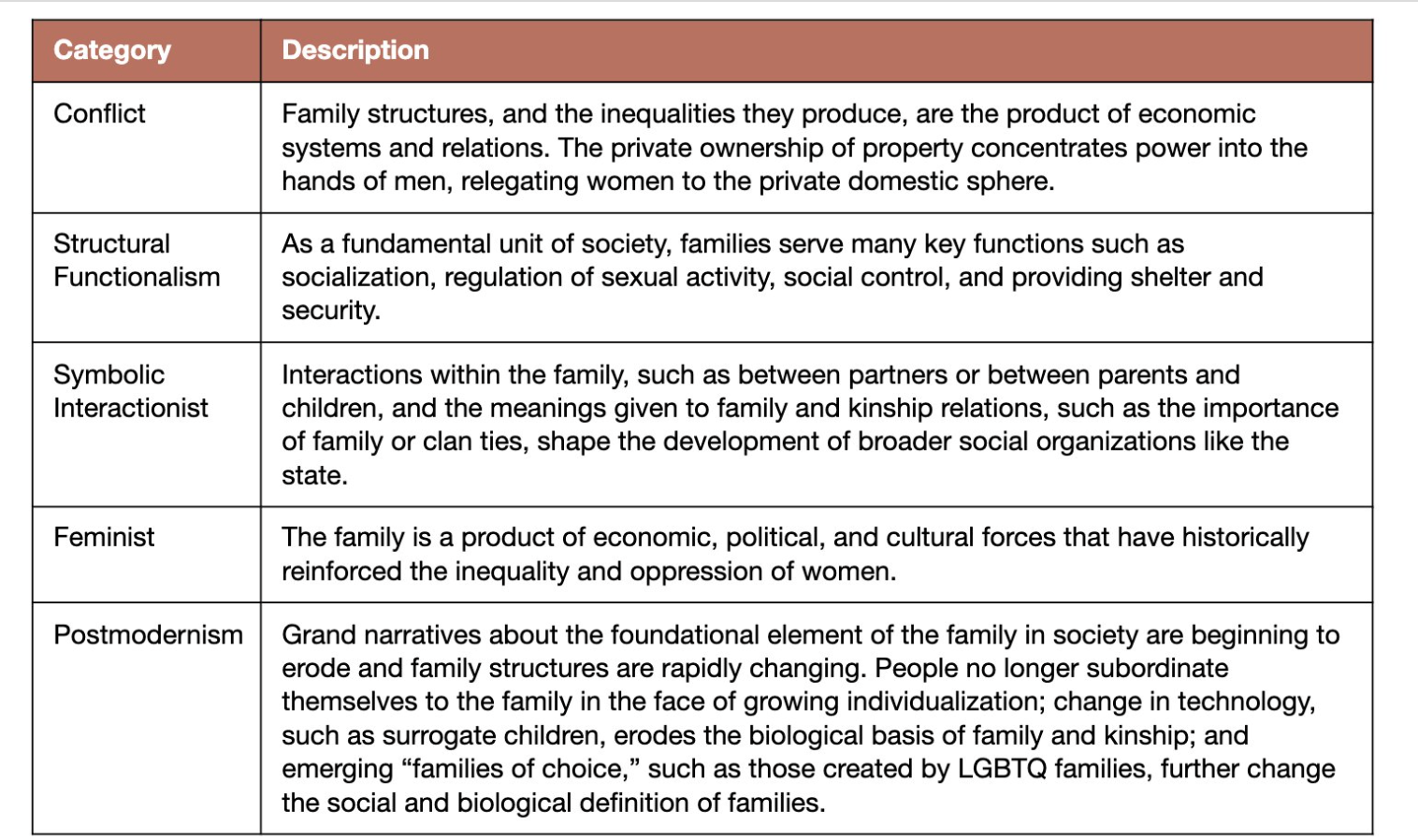
Functionalists see the family as a critical component of society that ensures social order and coordination
For many scholars, the family, not the individual, is the fundamental unit of society from which all social structures derive.
Families socialize children and prepare them to thrive as members of society, they pass on culture, and they are largely responsible for reproduction as most children are born to families. Families, therefore, are critical units for maintaining social coordination and order
Families function as agents of coordination and management, such as by managing school obligations and coordinating extracurricular activities, and as agents of social control, such as by regulating exposure to potentially harmful media, especially online
Reproduction
Families serve as the legitimate social unit for reproducing offspring. While children have always been born outside of families, most were not, and in many cases, these births were stigmatized. Families also reproduce social identities, like social class and status, race, religion, and so on.
Sexual regulation
Sexual activity is regulated in the interests of kinship and inheritance. For example, families control legitimate forms of sexual relationships to maintain social order and to avoid reproductive problems associated with incest.
Socialization
Families are the site for primary socialization, and parents are the most important agent for socialization until adolescence. Families prepare children to be functioning members of the social and economic system
Economic
At one time, families were a prime unit of economic activity, for example with home industries, apprenticeships, or farms. The family remains the site of some economic activity, like child and elder care, and it prepares children to become future workers and taxpayers, but families today have shifted from production to key sites of consumption.
Shelter & security
Families provide physical shelter and basic nutritional needs and ensure the physical health of their members. Families also provide material/financial support and emotional support. Modern families also often provide long-term care to ailing or elderly family members.
Belonging
Families serve many affective functions in society. Within families, children learn to love and be loved, and they learn attachment and trust. Families also contribute to personality development, though this task is shared with genetics, schools, peer groups, and employers.
What is Conflict Perspective on Family?
Argued that the organization of social life & family structure are tied to the organization of economic systems
With the advent of private ownership of property (by men) and the idea that family life is private and distinct from public life, women lost power and control inside and outside of families because they were not property owners and largely took on the work within the home.
Think of the traditional nuclear family, where men are the primary breadwinners and women are expected to stay at home and tend to domestic and childrearing tasks; this economic and social arrangement concentrates autonomy and economic power in the hands of men.
For conflict scholars, the differences in power and status in the family are neither natural nor inevitable but are instead the product of changes to economic life. Economic change, therefore, can bring about more equality in family structures.
What are Feminist Perspectives on Family?
For some, the family provides a sense of shelter, security, and emotional support. But the family is also a site for exploitation, isolation, and violence
One of the key achievements of feminist analysis of the family was to highlight inequalities in the areas of domestic and care work. Feminists showed that the men and women who provided care work and household management were contributing not only to the well-being of their family but also to their society and economy
Drawing from conflict perspectives, feminists have shown how contemporary family configurations, especially the nuclear family, are products of and connected with economic, cultural, and political systems
Gender norms that confine women to a private family, define their identity through motherhood, or exclude them from economic activity are not natural or inevitable, but are instead socially constructed and reinforced by power relations