Finance Exam 2
 Call Kai
 Learn
Learn Practice Test
 Spaced Repetition
 Match
Match Flashcards
 Knowt Play
1/53

There's no tags or description
Looks like no tags are added yet.
Name | Mastery | Learn | Test | Matching | Spaced | Call with Kai |
|---|
No analytics yet
Send a link to your students to track their progress
54 Terms
What is an annuity?
Finite series of equal payments that occur at regular intervals
What is an ordinary annuity?
If the first payment occurs as the end of the period
What is an annuity due?
If the first payment occurs at the beginning of the period
What is perpetuity?
Infinite series of equal payments
What is the perpetuity equation?
PV = C / r
If you borrow money today, what do you need to compute?
Present value
What is an annuity in which the cash flows continue forever?
Perpuity
What is perpetuity formula?
PV = C / r
What is annual percentage rate?
Annual rate that is quoted by law
What does APR (annual percentage rate) equal?
Period rate x number of periods in year
What does period rate equal?
APR / number of periods per year
What should you never divide?
The EAR by the number of periods per year because it will not give you the period rate
What is the apr if the monthly rate is .5%?
.5(12)=6%
What is the apr if the semiannual rate is .5%?
.5(2) = 1%
What is the monthly rate if the APR is 12% with monthly compounding?
12 / 12 = 1%
What is the Effective Annual Rate (EAR)?
The actual rate paid (or received) after accounting compounding that occurs during the year
If you want to compare two alternative investments with different compounding periods, what do you need to do?
Compute the EAR and use that for comparison
What is the quoted rate?
APR
What is m?
The number of compounding periods per year
what do you always need to make sure of?
The interest rate and time period match
if you are looking at annual periods, what do you need?
Annual rate
If you are looking at monthly periods, what do you need?
Monthly rate
If you have an APR based on monthly compounding, what must you do?
Use monthly periods for lump sums or adjust the interest rate appropriately if you have payments other than monthly
What is pure discount?
The borrower receives money today and repays a lump sum at some point in the future
What is an interest only loan?
The borrower pays interest each period and pay back the entire original loan amount at some point in the future
What is an amortized loan?
The borrower pays back parts of the loan amount over time
What are annuity equations?
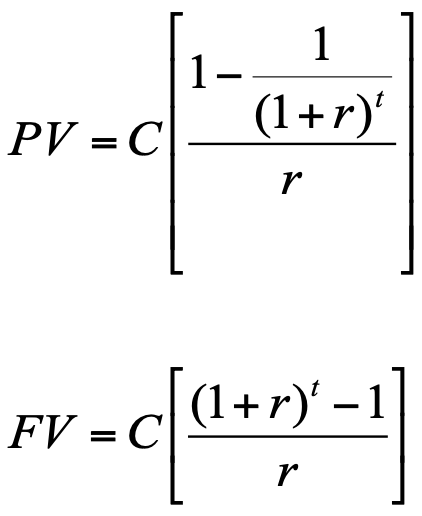
What Is the present value formula?
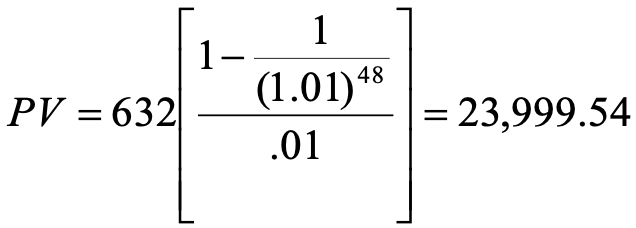
What is EAR formula?

What is APR example?

What is capital budgeting?
The process of planning for purchases of assets whose returns are expected to continue beyond a year
What is capital expenditure?
A cash outlay expected to generate a flow of future cash benefits for more than a year
When do you expand output?
Until marginal revenue equals marginal costs
What do you invest in?
The most profitable projects first
When do you continue accepting projects?
As long as the rate of return exceeds the marginal cost of capital (MCC)
What is an independent project?
Acceptance or rejection has no effect on other projects
What are mutually exclusive projects?
Acceptance of one automatically rejects the others
What are contingent projects?
Acceptance is dependent upon the selection of another
What do we need to ask ourselves when evaluating decision criteria?
Does the decision rule adjust for the time value of money?
Does the decision rule adjust for risk?
Does the decision rule provide information whether we are creating value for the firm?
What is net present value?
The difference between the market value of a project and its costs
How much value is created from undertaking an investment?
Estimate the expected future cash flows
Estimate the required return for projects of this risk level
Find the present value of the cash flows and subtract the initial investment
If the NPV is greater than zero, then what?
We accept the project
What does a positive NPV mean?
That the project is expected to add value to the firm and will increase the wealth of the owners
Since our goal is to increase owner wealth, then what is NPV?
A direct measure of how well this project will meet our goal
What is NPV formula?

What is the decision criteria test for NPV?
Does the NPV rule account for time value of money?
Does the NPV rule account for the risk of cash flows?
Does the NPV rule provide an indication about the increase in value?
Should we consider the NPV rule for or primary decision criteria?
What is payback period?
How long it takes to get the initial cost back in a nominal sense
What is payback period computation?
Estimate the cash flows
Subtract the future cash flows from the initial cost until the initial investment has been recovered
What is the decision rule?
Accept if the payback period is less than some present limit
What are advantages of payback?
Easy to understand
adjusts for uncertainty of later cash flows
Biased towards liquidity
What are disadvantages of payback?
Ignores the time value of money
Requires an arbitrary cutoff point
Ignores cash flows beyond the cutoff date
Biased against long term projects, such as research and development, and new projects
What is the most important alternative to NPV?
Internal rate of return
When is internal rate of return often used?
In practice and is intuitively appealing
What is based entirely on the estimated cash flows and is independent of interest rates found elsewhere?
Internal rate of return