PLSC400 Fejio Exam 1
 Call Kai
 Learn
Learn Practice Test
 Spaced Repetition
 Match
Match Flashcards
 Knowt Play
1/92

There's no tags or description
Looks like no tags are added yet.
Name | Mastery | Learn | Test | Matching | Spaced | Call with Kai | Chat |
|---|
No analytics yet
Send a link to your students to track their progress
93 Terms
List 3 ground tissue cell types and how they differ in wall structure and fxn
parenchyma
thin, flexible primary walls, living, multifunctional
collenchyma
unevenly thickend, living, flexible mechanical support
sclerenchyma
thick, lignified secondary walls, dead, rigid structural support
list 3 tissue systems in plants & purpsoe
dermal
epidermis, periderm (controls gas exchange and water loss)
ground
paranechyma, collenchyma, sclerenchyma (site of photosynthesis and storage)
vascular
xylem and phloem (network from roots to leaves)
Describe major cell types in xylem and phloem
Xylem: tracheids (long, tapered, pits, dead), vessel elements (short, dead, wide, perforation plates)
Phloem: sieve tube elements (living sieve plates) and companion cells (metabollaically active, connected to SE via plasmadesmata)
∆ primary and secondary growth
primary: elongation from apical meristems to make primary body
secondary: lateral meristems to increase girth (vascular cambium → secondary vascular bundle; cork cambium → periderm)
describe structure of chloroplast
bounded by outer and inner envelop membranes
stroma (interior): calvin cycle happens, has ribosomes, DNA, enzymes
thylakoids: internal flattened memebrane sacs with photosyntehsis macheriny (PSII, cyt v6f, PSI, ATP synthase, antenna complexes)
grana: stacks of thylakoids with proton gradient across membrane for additional ATP syntehsis
list the flower plant life stages
seed germination (metabolism activaited by water)
development of plant body (organs expand & biomass inc as it grows)
development of reproductive organs (most genes expressed to make reprod tissue and structures than photosynthesis)
seed formation (embryogeneiss to complete life cyle)
How do plants develop organs & cells types?
Permanent Organogenesis (apical meristems and indefinite growth)
cell division
enlargement or elongation
differentiation of cell types
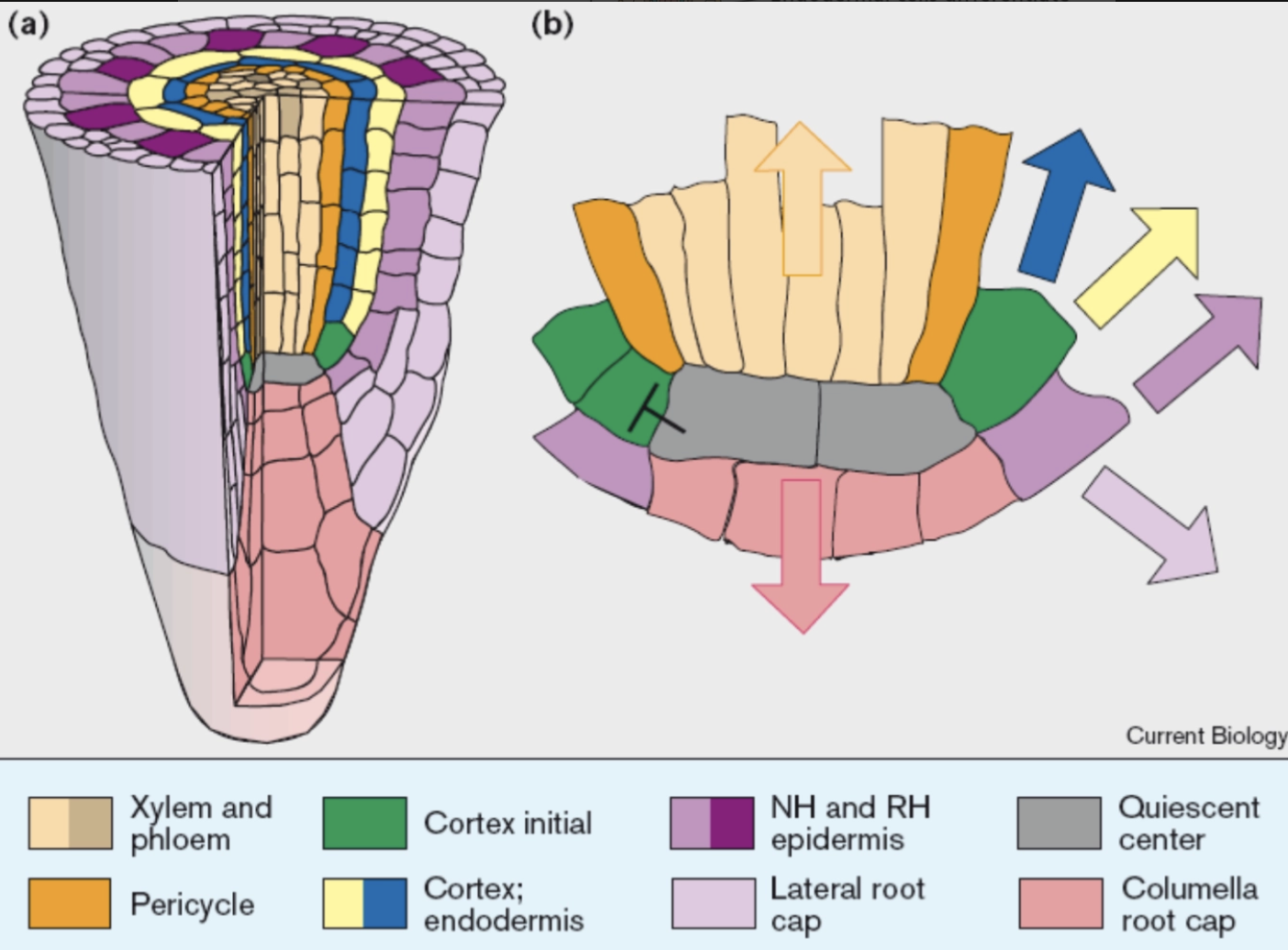
What is the pericycle?
in roots, it is the genetic program area in root to prime cells to active gene expression to create secondary roots or lateral roots
what does the central vacuole play in plant cells?
turgor: accumulates ions → lower osmotic potential → drives water via diffusion → turgor pressure of vac
storage: stores water, ions, sugars, proteins, secondary metabolites
degradation: lytic vac contain hydrolyses
defense: stores toxic compounds
what are plastids and the main types
plastids: double membrane organelle
chloroplast
amyloplasts
chromoplasts
describe molecular structure and assembly of cellulose microfibrils
Celluolose: unbranched polymer of glucose units
chains H-bond in paralell to form microfibrils
Synthesis:
cellulose synthase CesA complexes (resettes) in plasma membrane
move along microtubule tracks
What is xyloglucan and how does it function in the primary cell wall
Xyloglucan: abundant hemicellulose in primary walls
coats and cross links cellulose microfibrils, controlling wall extensibility
what is pectin and list main types
Pectin: acidic polysaccharides ; controls wall porosity and pH
HG: Ca2+ cross links between HG chains to stiffen wall
RG-I: flexible backbone with galactan side chains
RG-II: complex, reserved cross linked by borate
what is lignin, how is it made and why important?
lignin: hydrophobic polymer
made in cytoplasm → exported to wall → oxidative polymerization
deposited in secondary walls of xylem vessles, fibers, casparian strip, etc
FXN: structure reigidty, waterproofing of xylem
what is middle lamella and how are cells glued together
pectin layer bt walls made in gogi vesicles make cell to cell adhesion
What is polyploidy, allopolyploidy, and autopolyploidy
polyploidy: 2+ complete chromo sets
allopolyploidy: duplication of same genome
autopolyploidy: hybridzation between species and chromosome doubling
Write full water potential equaiton and define every term
Ψ = Ψs+ Ψp+ Ψg + Ψm
Ψs = solute potential (-iCRT)
Ψp = pressure potential (+=turgor, -=tension)
g for gravity, only big trees
m for matric potential, for soil and root
Define osmosis
net movement of water across membrane from lower to higher solute concentration (high to low potential)
Describe aquaporin structure
channel proteins
what is pressure bomb and what does it measure
chamber with a lot of postiive pressure on cut leaf to balance negative pressure in xylem to access water status of plant
what is plasmolysis and what does it tell us about cell osmotic potential
protoplast shrinks away from cell wall when solute potential is lower than the cell → water leaves the cell and shrinks within teh cell wall
what is symplastic vs apoplastic
apoplastic: water moves through cell walls and intercellular spaces (non selective, fast, endodermis and casparian strip blocks)
symplastic: water moves through cytoplasm and plasmadesmatas (slower, selective, transcellular, required at endodermis)
what is the casparian strip
band of suberin and ligin walls of root endodermal walls (makes a the impermeable stele)
blocks apoplastic water movement and soltutes → transport via transporters only for fine control of ion selectivity into xylem
How do plants repair xylem embolism
prevention:
small tracheid diameter, pit membrane anatomy with valves to shut the cell via drying and shrinking like contact lenses
describe stomatal opening in response to light
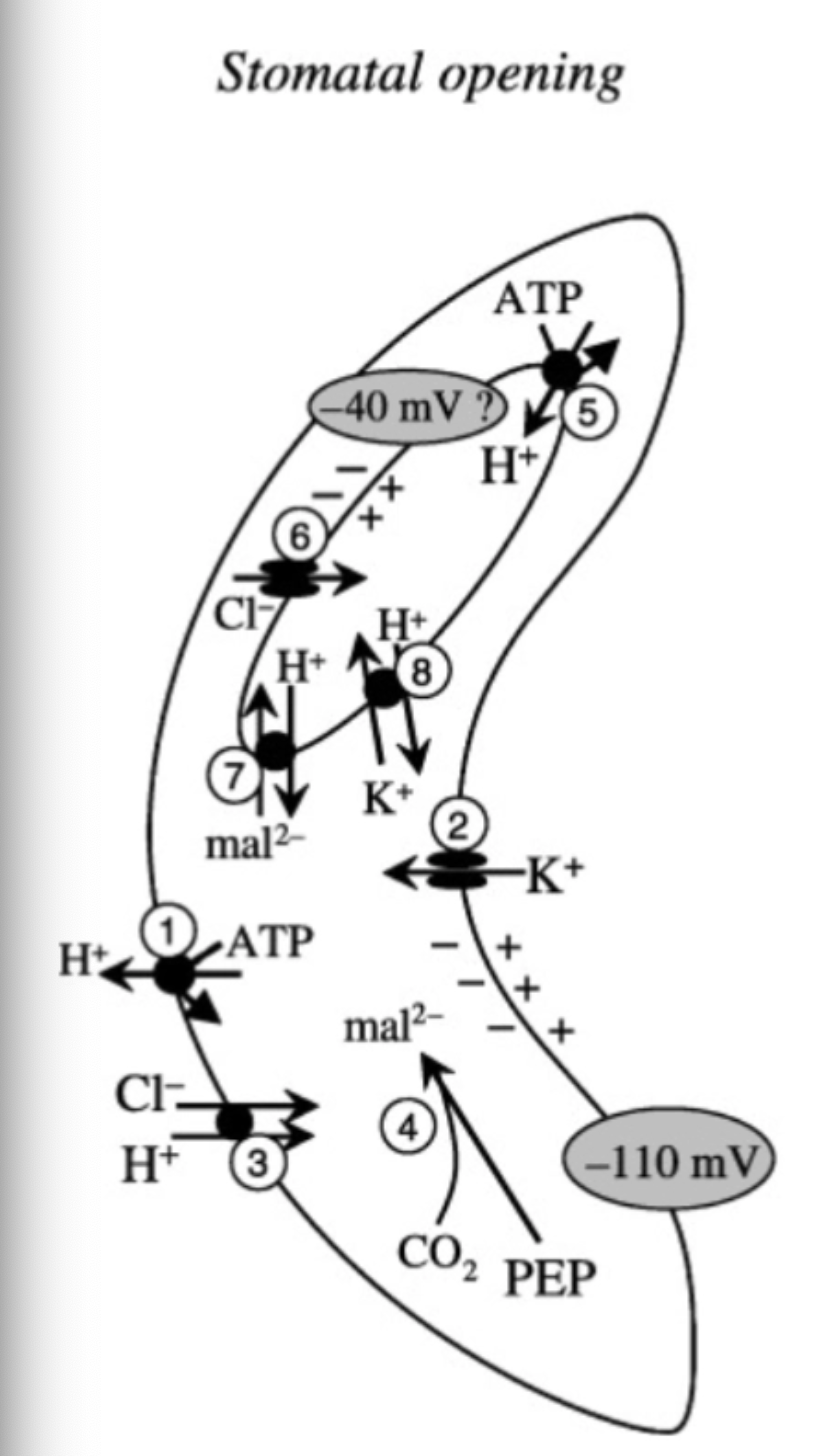
phototrophins in GC PM starts autophosorylation → H ATPase pumps H out of GC → K+ channels allow K+ enter & malate forms → Cl acculumate in vac (dec solute potential) → water enters and guard cell swell & open stomate
explain pathway of the soil-plant-atmosphere continuum
soil water → root → xylem → leaf mesophyll → stomata → atmosphere
water potential gradient is the moving force
soil: -0.1
root to leaf: -1
atmophere: -100
Crietera to essential elements/nutrition
needs it to complete life cycle
cannot be substituted with toehr element
element has a direct effect to metabolism of plant
Describe nitrogen cycle to plant nutrition
N2 from air from bacteria → NH3+ to plant
NH3 or NH4+ direct taken up by nitrogen fixing bacteria
describe rhizobium & legume symbiosis
legume w/ flavonoids → rhizo node gene expresion → NOd factors to get root hair to curl → express nitrogenase and fix N2 to NH4+ to plant for malate and sucrose for rhizo
define waht the nernst equation is
an equation to predict passive equilibrium potential for an ion
if measured ion potential is negative: cation must be actively accumulated
Nernst: Uncharged molecule movement
(diffusion)
- passive transport is DOWN concentration gradient
- active is AGAINST concentration gradient
Nernst: Charged molecule movement
- passive is DOWN electrochemical gradient
- active is AGAINST an electrochemical gradient
Difference bt primary and secondary active transport
primary: uses ATP to move ions AGAINST electrochem gradient (H+ ATPase in PM and vacuole, Ca2+ into vacuole)
secondary: uses gradient created by primary pumps (symporters and antiporters)
What is the fxn of chlorophyll a vs b
A: absrobes blue adn red with reaction centers P680 and P700
B: absorbs shifted light and is only in antenna complexes to broaden aborption spectrum
Describe 3 phases of Calvin Cycle
carboxulation: RuBisCo catalyzes CO2 + RuPB (5C) → 2 3-PGA
Reduction: 3-PGA + ATP → G3P
Regeneration: 5/6 G3P dedicated to make more RuBP, but one G3P gain
3CO2 fixed, 9ATP + NADPH consumed
Photosynthesis path and stages
endgoal: make ATP and NADPH and convert to sugars
light dependent reactions on thylakoid membranes to split water and get electron
light independent reaction in stroma: calvin cycle
What is the antenna complex
the light harvesting comples that has pigment molecules to absorb light, pass energy, and funnel electron to reaction center
what is the z-scheme
diagram to show the path electrons take to travel through light reactions
note that the y axis is in reverse order (more negative as you go up meaning more potential for energy)
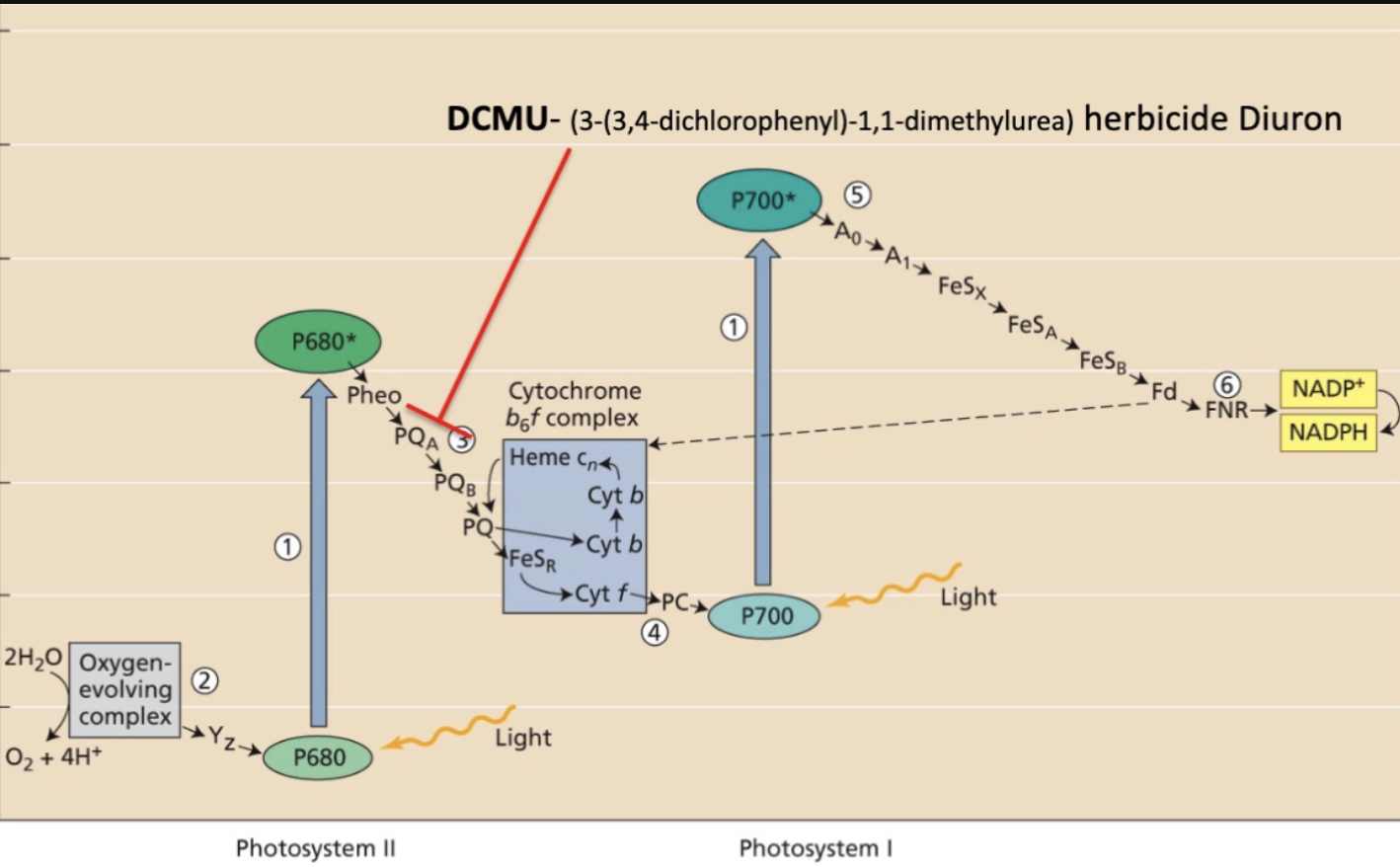
what odes PSI do diff than PSII
PSI picks up electron from the chain from PSII to give second energy boot with P700 to move electron to convert NADP+ to NADPH
What is NPQ
non photochemical quenching: excess energy from sun dumped bc lumen acidicty lowers a lot to make Zeaxanthin to make heat instead of damage
safe a reversible
what is photoinhibition
when npq isnt enough = damage to tissue (D1 protein)
sunburn damage and D1 protein hurting is the reason why photosynthesis delays are seen days after high temps
calvin cycle description and end goal
end goal: use CO2 to build sugar with ATP and NADPH
stroma of thylakoid
CO2 → ATP and NADPH to reduce CO2 → rengeneration of G3P to make more RuBP and G3P for glucose
phases of calvin cycle
carbon fixation (Rubisco to RuBP)
Reduction (use energy from light, 3-PGA → G3P)
Regeneration (G3P for 5 RuBP, 1 G3P for sugar)
What is ribisco and what is it imperfect
grabs CO2 and attaches to sugar backbone
Rubisco can’t tell CO2 from O2 => photorespiration that costs plant carbon and energy
What is Calvin Cycle turned on and off depending on whether day or night
Thioredoxin system protein switch prevent running cycle when light is off
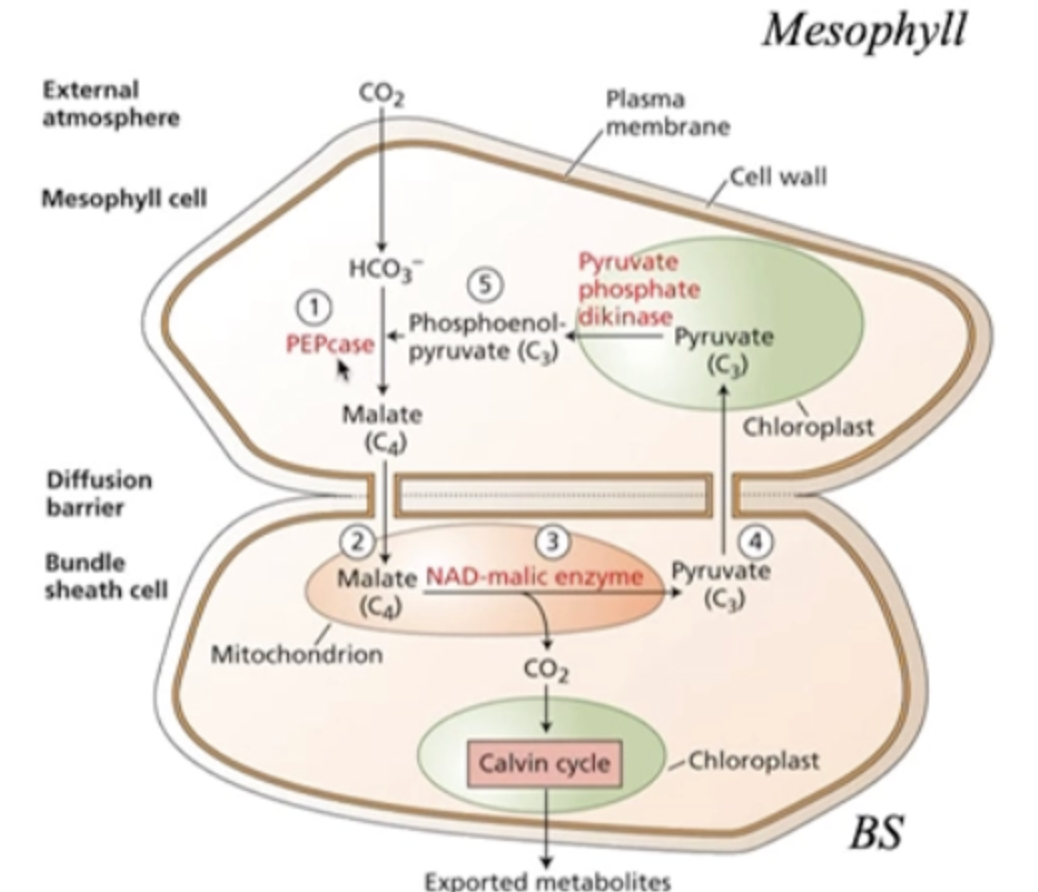
How C4 plants work
mesophyll cells with PEP Carboxylase grabs CO2 (C4)
Bundle sheath cells bring C4 and release CO2 around Rubisco
rubisco works with high CO2 environments and has less chance for photorespiration
What is the first electron acceptor in photosynthesis
Pheophytin
What are the 4 steps to C4 photosynthesis
carboxyloation (CO2 → HCO3- and PEPcase → Malate)
Decarboxylation (Malate with NAD-malic enzyme to make CO2 for calvin cycle & Pyruvate)
C3 reduction (Pyruvate moved to chloroplast)
Regeneration of PEP (Pyruvate turned into PEPcase)
5 main functions of plant cell wall
cell shape and support
protection
cell ot cell adhesion
conductance (water and ions penetration)
gas diffusion
What links cellulose microfibrils together
xyloglucans and the wall matrix
What is the movement of photosynthesis in the thylakoid
stroma: sugar and proton gradient to get H-ATPase working
membrane: light and electron movement
lumen: water splitting and highly acidic
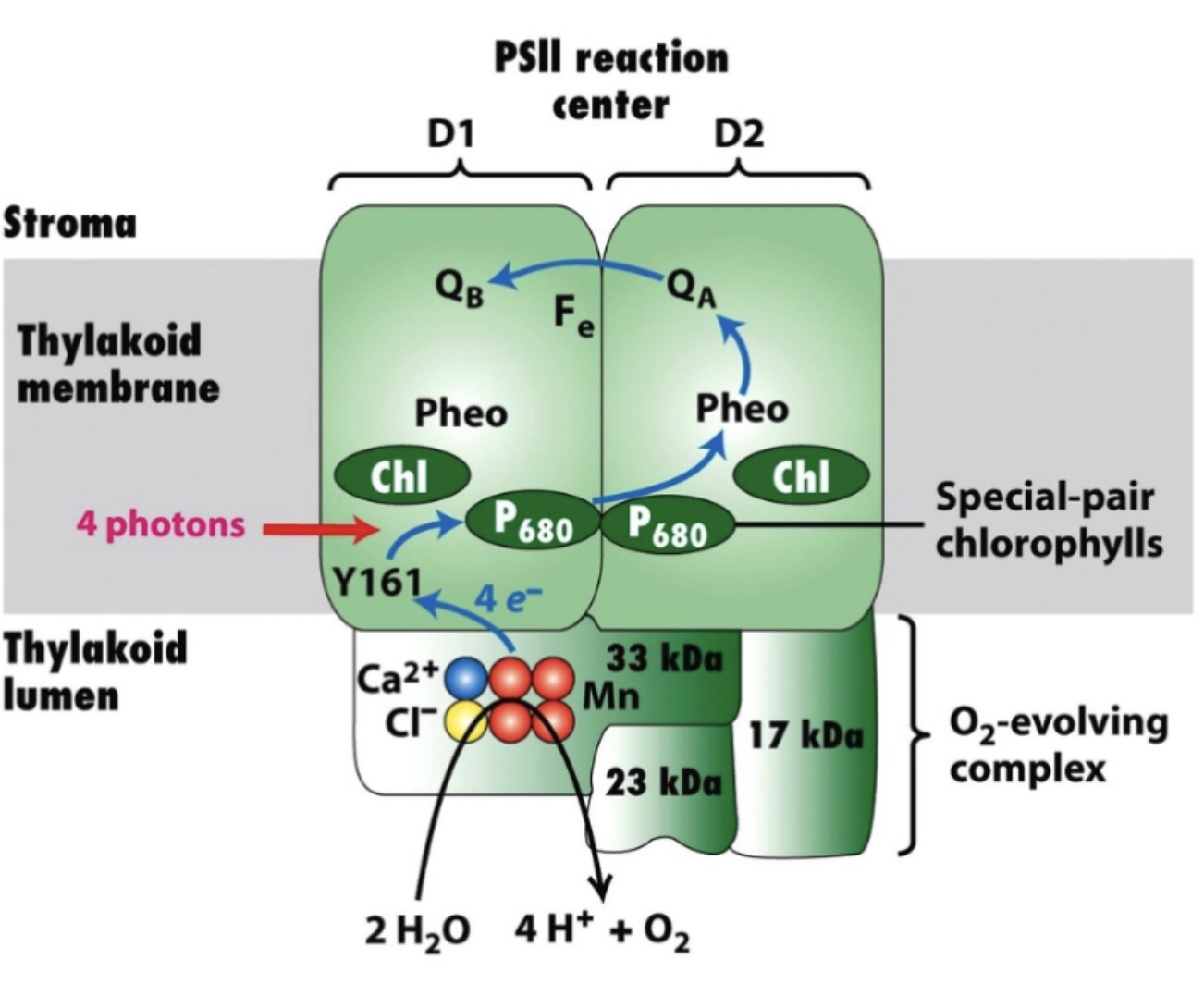
How do electrons go from excited to fundamental state (neutral)
releasing heat or by fluorescing
List teh protein complexes for thylakoid membrane
PSII → PQ → Cytochrome → PC → PSI
H-ATPase
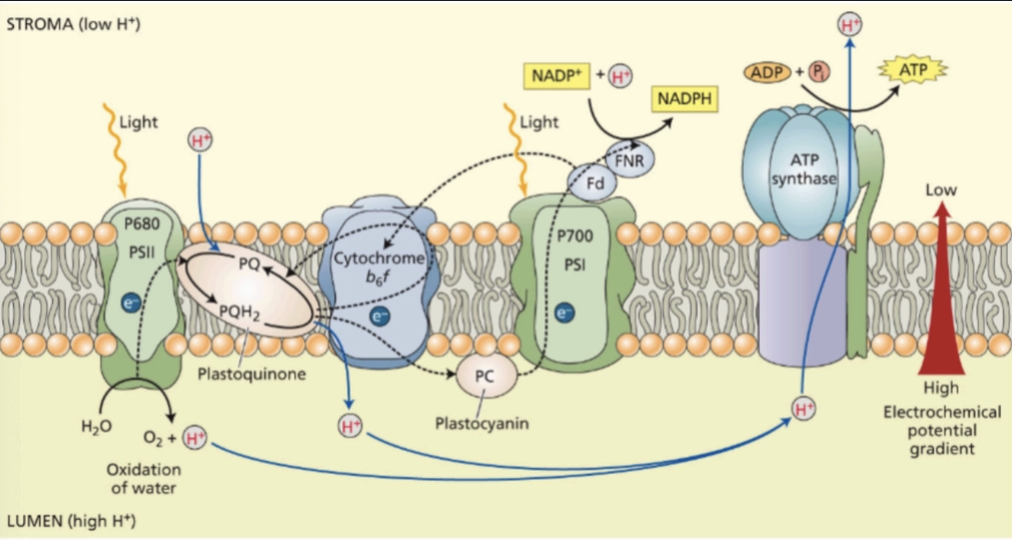
how does a biosynthesis of glucose made in plants?
reducing power of NADPH to oxidize precursors and ATP to combine and form ATP
Name main driving forces of water movement and where located in plant
Pressure gradient (root/soil) (-0.5)
Water potential (across the root) (-1)
Pressure potential (up the xylem and out the leaf) (-100)
In the roots, what are the main ions used that drag water into root
Cl- and K+
hydration shell and membrane potential to be driven into cells (concentration gradient water movement)
What can go through the phosphlipid bilayer of the membrane?
apolar things and gasses (aquaporins bring water tho)
polar ions are transported through the membrane, not through difussion through phospholipid bilayer
Describe the mode of action for channels, pumps, and transporters
Channels: passive (simple diffusion)
Pump: primary active and burns ATP
Transporters: facilitated transport (driven by gradients and whether or not they are going with or against it)
Describe how the H+ ATPase pump works step by step
ATP binds and phosphorylates binding center of protein → conformational change
Proton is grabbed from cytosol and moved outside (AGAINST GRADIENT MOVEMENT)
Phosphate group releated → return to normal conformation
creates negative charge inside, low pH outside cell
What are symporters and anitporters
Symporters: 2 binding sites for protons and ion
H flows DOWN gradient → conformation change to pull ion AGAINST gradient
Antiporter: H moves in DOWN gradient → ion pushed OUT against gradient
How does secondary active transport work and what is the energy source
uses proton gradient as energy source (HATPase)
What are the two cell types in phloem and how do they work together
Sieve cells and companion cells (joined via plasmadesmatas, which CC only have with the sieve cell)
together is called the sieve tube elements
CC is like casparian strip → symplastic movement from parychyma to CC then funnel to SCWhat
What is source-sink concept
Source: organ that produces sugar into pholem
Sink: organ that consumes sugar
Source has negative Ws bc of sugars → water enters by osmosis → high turgor pressure
Sink unloads sugar and makes Ws more postive → lowers turgor pressure
once solute pressure drops, water moves into sieve and sucrose moves throughout the plant
Write out steps of how stomata opens
phototropin senses blue light and activates H ATPase
H ATPase burns ATP to pump H+ outside (H+ AGAINST)
Channel allows K+ in (ion WITH)
Symport Cl- & H+ in (ion AGAINST)
CO2 and PEP make Mal2-
H ATP burns atp to pump H+ into vac (H+ against)
Channel lets Cl- into vacuole (ion WITH)
Antiporter to let Mal2- into vac (H+ and ion WITH)
Antiporter to let K+ into vac (ion AGAINST)
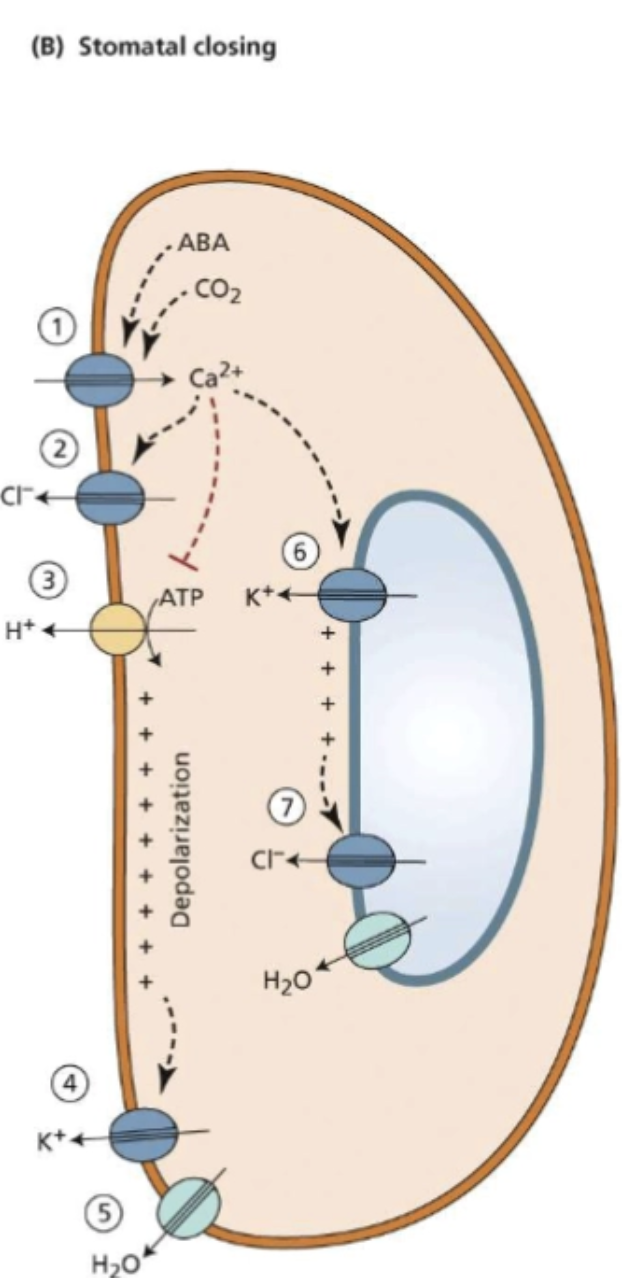
Write out steps on how stomata closes
Ca2+ channel into cell (ion AGAINST) to stop ATPase
Cl- channel out cell (ion AGAINST)
K+ channel out cell (ion AGAINST)
H2O out the cell bc Ws inc
drives K+ and H20 channels out of vac (ion against)
Cl- leaves vac (ion WITH)
much faster process bc the cell is returning to og state from Ws differences
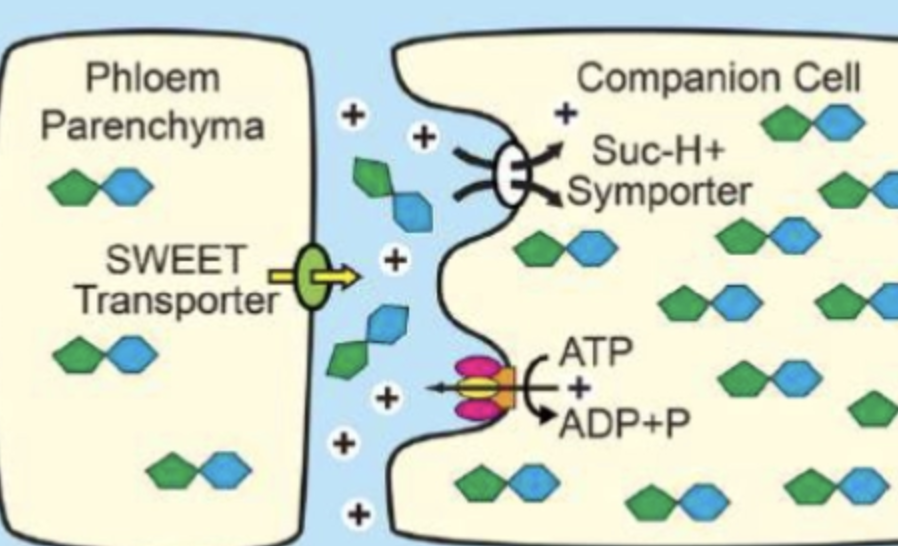
How does the parychyma deposit sugars into the phloem
sucrose symplastically move towards phloem bc veins and gradients
Phloem loading is when acidic apoplastic move it into companion cell
PP use SWEET protein to push sugar into apoplast and H+ ATPase pushes protons out to make symporter drive WITH proton gradient
Connect proton pump to different processse
stomatal opening: acidify apoplast to make Cl- symporter work better to make osmotic potential drop
Phloem loading: acidivy apoplast to get SUC symporter to use acid gradient to pull in sucrose into companion cell
Secondary active ion transport : creates proton gradient for secondary active transporters to use
How does pH affect nutrient availability
protons precipiates positivly charged ions that are attached to soil (silica is negatively charged naturally)
nutrient availability is tied with concentration of protons
List some micro nutrients and their roles in plant phys
Fe: electron carriers and chlorophyll synthesis
B: cell wall with pectin and membrane function
Cl: PSII oxygen evolution, stomatal guard cells
List some macro nutrients and their roles in plant phys
N: amino acids, proteins, chlorophyll
P: ATP and phospholipids
K: stomata regulation
Ca; Cell wall and pectins
Why do plants have to assimilate nutrients and not use raw minerals directly?
plants have to convert inorganic molecules into organic via processing
N: convert NO3- → NH4- → glutamine → amino acids
S: SO4-3 → S-2 → cysteine
P: H2PO4+ used directly in ATP, DNA< phospholipids
How convert nitrogen in soil into amino acid in plant
Uptake in roots: NO3- in soil to root via NRT transporters
Reduction: cytoplasm convert NO3- to NO2- via nitrate reductase Reduction in chloroplast: NO2- → NH4+ via nitrite reductase
Incorporation: NH4+ and glutamate = glutamine via glutamine synthase and ATP
What is biological nitrogen fixation
making N2 into NH3+ from nitrogen fixing bacteria
Nitrogenase reaction: N2 + 8H+ + 8 e- + 16 ATP
what is ABA and why is it the stress hormone
Abscisic acid made in vascilar tissue when leaf starts to lose water.
stomata closes if ABA builds up and reaches stomates (PYR recognize on GC and turns on downstream effect to open gates to make Cl- and malate flow out of cell)
genes turn on: protect molecules
seed dormancy: wait for conditions to be favorable
wants to shift plant in conservation mode
How many proteins are in Cellulose synthase complexes?
3 proteins per unit (previously thought the rosette had 6)
Name organs and a key function of each
Leaf: site of photosynthesis & evaporation
Stem: leaf and root transport & mechanical support
Root: water uptake & anchoring
Name tissue systems found in plants
Dermal
Ground
Vascular
Meristem (root apical and shoot apical)
what is the difference btween a B-1,4 and B1,3 glycosidic linkage? Name the polysaccharide made by each
1,4 → side groups alternate on glucose (linear molecule = cellulose)
1.3 → side groups attached on same side (curved & flexible molecule = callose)
What role does Calcium play in wall rigidity? What component do they interact with?
Ca works with PECTIN in middle lamella and primary wall
Ionic bridges with pectin chains to make stiff lattice structure
Name two main components of the secondary wall
Cellulose and ligin
List layer of root cross section from outer to innermost
Epidermis → Cortex (parenchyma) → endodermis (casparian strip) → Pericycle → Vascular bundle
name 3 types of ATPase
V: vacuole (acidify vacuole)
P: plasma (electrochemical gradient)
F: thylakoid membrane (acidify lumen)
Explain how proton gradient in thylakod is connected to ATP synthesis.
lumen is filled with H+ from water splitting and H+ pumping from process of electron chain. Since [H+ lumen] > [H+ stroma], the H+ wants to diffuse through the only exit, ATPase. movement of H+ provides mechanical energy with ATP ring spinning, which phosphorylates ADP to ATP
How/what forms are P and N taken up in plants?
P: PO4-
N: NH3 and NO4-
What are the mutual benefits of symbiosis
Plant gets WATER and PO4-
Fungi gets carbon via SUGARS and other amino acids
What process fixed the most nitrogen in the history of world/
Haber Bosch process to capture N2 to usable forms like NH3 and NO4-
nitrogen cycle and its form in the environ to plant
through decaying OM → ammonification (NH4+ → Nitrite NO2- → Nitrate NO3- → N2 gas for symbiotic bactera fix for plant)
How do plants regulate how much mineral and ions takes up?
mainly through root epidermal proton pumps for cation exchange with surrounding soil
How do plants get rid of excess nutrients?
storing them in vacuoles, shedding old leaves
Plants can sense nutrient level and respond to it. E.g. lateral roots induced under low Pi. How?
auxin sensitivity via enhanced TIR1 expression and auxin/IAA degradation, alongside root-derived signals
local sensing, ROS signaling, and phosphorus starvation-induced genes (PSRs)
How do plants perceive these messages (regarding nutrient) and respond to it?
root-microbiome interactions (rhizomicrobiome)
Explain the pressure flow aka Munch hypothesis of phloem transport. what creates the pressure gradient from source to sink
source: sucrose laded in sieve tubes → Ws drops → water flows in from xylem via osmosis → POSITIVE TURGOR PRESSURE
sink: sucrose unloaded for consumption → Ws climbs → water exits → low turgor pressure
pressure diff of high source, low sink makes BULK FLOW of pholem sap