Ecosystems and Adaptations Review
 Call Kai
 Learn
Learn Practice Test
 Spaced Repetition
 Match
Match Flashcards
1/22

Earn XP
Description and Tags
A set of flashcards covering ecosystems, food webs, population changes, biomes, adaptations, inheritance, and natural selection based on the lecture notes.
Name | Mastery | Learn | Test | Matching | Spaced | Call with Kai |
|---|
No analytics yet
Send a link to your students to track their progress
23 Terms
What is an ecosystem made up of?
Living organisms and their environment.
What do the arrows in a food chain or food web represent?
The direction of energy transfer from one organism to another.
Why are plants referred to as producers in an ecosystem?
They make their own food using photosynthesis and sunlight.
In the food chain: Plant → Deer → Lion, what is the role of the deer?
The deer is a primary consumer because it eats the producer.
What is the role of decomposers in an ecosystem?
They break down dead organisms and return nutrients to the soil for plants.
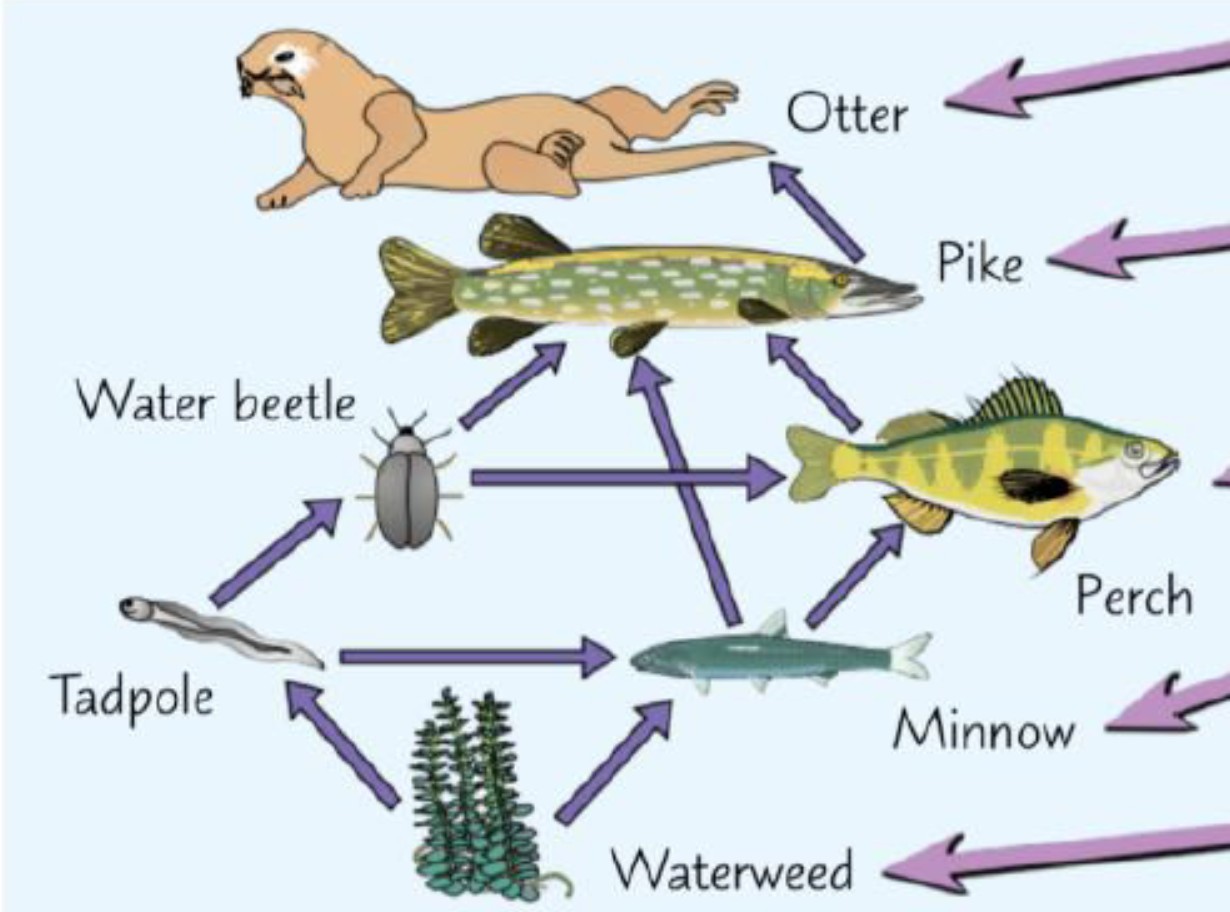
How does the removal of minnows affect tadpoles and water beetles in the provided food web example?
Tadpoles get eaten less and water beetles get eaten more.
What is the definition of bioaccumulation?
The build-up of harmful chemicals in organisms as they move higher up the food chain.
In terms of ecosystems, what is a niche?
The role of an organism in an ecosystem, including what it eats, where it lives, when it is active, and how it survives.
What resources do plants specifically compete for?
Sunlight, water, minerals from soil, and space to grow.
What is the purpose of a camel's hump structural adaptation?
It stores fat for energy to help the camel survive without water for days.
What behavioural adaptation do birds use to avoid the cold and find food in winter?
Migration to warmer places.
How do drip-tip leaves help rainforest plants survive?
The tips help remove excess water from heavy rain.
What is the definition of a species?
A group of similar organisms that can breed with one another to produce fertile offspring.
How does continuous variation differ from discontinuous variation?
Continuous variation shows a range of values measured on a scale, while discontinuous variation consists of fixed categories.
What is a gene?
A section of DNA that contains instructions for making proteins, which control characteristics.
How many chromosomes do humans have in almost every cell?
46 chromosomes (23 pairs).
What is the shape of a DNA molecule?
A twisted ladder, also known as a double helix.
In the strawberry DNA extraction practical, what is the purpose of the extraction solution made of water, washing up liquid, and salt?
It breaks open the cells and releases the DNA.
What is natural selection?
The process where organisms with useful adaptations are more likely to survive, reproduce, and pass on helpful characteristics to offspring.
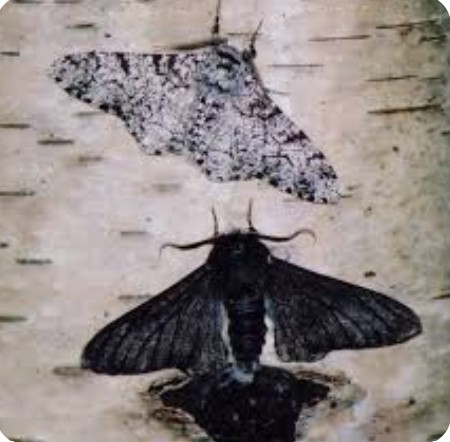
How did soot pollution in the Peppered Moth example lead to natural selection?
Tree trunks became darker, making dark moths better camouflaged from birds, allowing more dark moths to survive and reproduce.
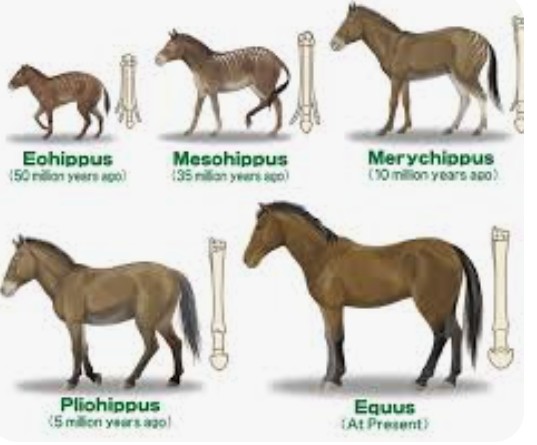
How have body features of horses changed over millions of years according to fossil evidence?
Horses evolved larger bodies, longer legs, and fewer toes.
What happens if a primary producer, like grass, increases in a food chain?
An increase in primary producers can lead to a higher population of primary consumers (herbivores) as there is more food available.
What is the effect of decreasing the population of a top predator, like a lion, in a food web?
If the population of a top predator decreases, the population of primary consumers (e.g., deer) may increase, which can lead to overgrazing of plants and decrease in vegetation.