POPHLTH 111- Module 3
 Call Kai
 Learn
Learn Practice Test
 Spaced Repetition
 Match
Match Flashcards
 Knowt Play
1/75

There's no tags or description
Looks like no tags are added yet.
Name | Mastery | Learn | Test | Matching | Spaced | Call with Kai |
|---|
No analytics yet
Send a link to your students to track their progress
76 Terms
Three population health actions
Health promotion, disease prevention, health protection
Population Health actions can be ____ or ____
Population (mass) based strategy, High risk (individual) based strategy
Population based (mass) strategy
Focuses on the whole population, aims to reduce risk for whole population, useful for widespread diseases (immunisation, legislated use of seatbelts, low salt foods at store)
High risk (individual) strategy
Focuses on high risk individuals, intervention is well matched to individuals concerns (interventions targeting obese adults, drug users)
NZ needle program
decriminalised the sale of needles and syringes to Injecting Drug Users (IDUs), meaning HIV levels from IDU dropped
Advantages of a high risk (individual) strategy
Appropriate to individuals, individual motivation, cost effective use of resources, favourable benefit-to-risk ratio
Disadvantages of a high risk (individual) strategy
Cost of screening, need to identify individuals, temporary effect, limited potential, behaviourally innapropriate
Advantages of a populations- based (mass) strategy
addresses underlying causes, large potential benefit for whole population, Behaviourally appropriate
Disadvantages of a populations- based (mass) strategy
Small benefit to individuals, poor motivation of individuals, whole population is exposed to
downside of strategy (less favorable benefit-risk ratio)
Health promotion
Acts on determinants of wellbeing, health/wellbeing focus, enables/empowers people to increase control over, and improve, their health, involves whole population in everyday contexts (5 fruit a day)
Alma Ata 1978: Declaration for primary health care
Protect and promote health of all, advocated a health promotion approach to primary care
The Ottawa Charter for health promotion (WHO)
Mobilise action for community development
The Ottawa charter acknowledges that health is:
Fundamental right, requires both individual and collective responsibility, opportunity for good health should be equally available, good health is an essential element of social and economic development
3 basic core strategies of Ottawa charter
Enable, Advocate, Mediate
core strategies of Ottawa charter- ENABLE
provide opportunities for all individuals to make healthy choices through access to information, life skills and supportive environments (individual level strategy)
core strategies of Ottawa charter- ADVOCATE
create favourable political, economic, social, cultural and physical environments by promoting/ advocating for health and focusing on achieving equity in health (Systems level strategy)
core strategies of Ottawa charter- MEDIATE
facilitate/ bring together individuals, groups and parties with opposing interests to work together/ come to a compromise for the promotion of health (A strategy that joins up individuals, groups and systems)
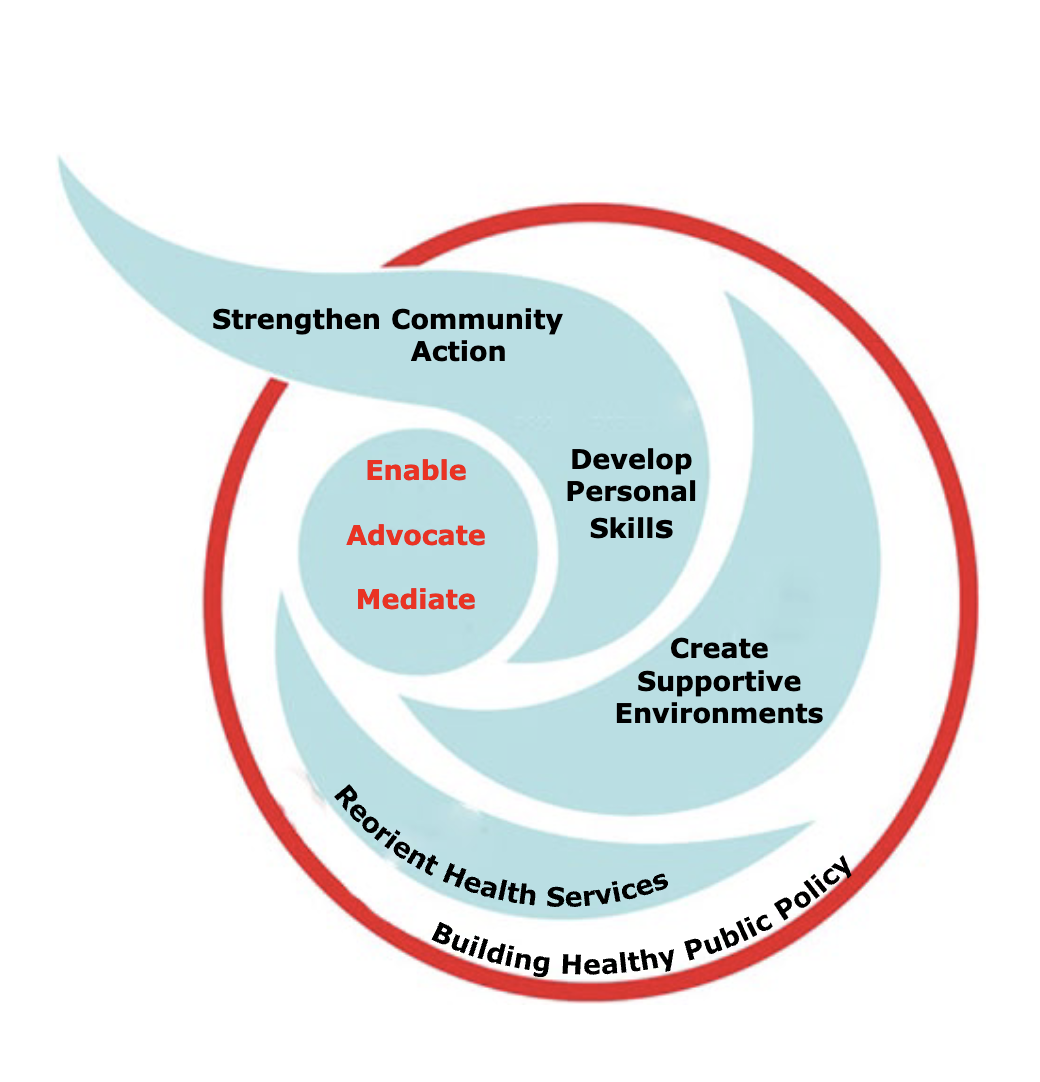
Ottawa charter
5 priority action areas for ottawa charter
Develop personal skills, Strengthen community action, Create supportive environments, Reorient health services towards primary health care, Build healthy public policy
Disease prevention
Looks at particular diseases (or injuries) and ways of preventing them e.g. the incidence, the prevalence, risk factors, or impacts (primary, secondary, tertiary care)
What does intervention at primary stage reduce?
Incidence
What does intervention at secondary care reduce?
Prevalence
What does intervention at tertiary care reduce?
Complications from disease
Health protection
Predominantly environmental hazard focused, Risk/Hazard assessment, Occupational health & Monitoring, Risk communication
Examples of Risk communication
relating environmental risks to the public
Examples of Occupational health & Monitoring
safety regulations on work sites, biomarkers of exposure to hazardous substances
Examples of Risk/Hazard assessment
Environmental epidemiology, Safe air and water, biosecurity
Focus of health promotion, disease prevention and health protection?
Health wellbeing, disease, environmental hazards
A right
an entitlement to do something or be in a certain state. Creates claims for right holder and duties for others.
Liberty
freedom
Liberty right
a protected sphere in which one can decide how to act for oneself, without interference from others.
Coercion
use force or threats of force
Autonomy
self-determination. The capacity to make decisions for oneself, according to one’s own values.
Respect for autonomy
recognition of the capacity and entitlement of others to make decisions concerning their own lives.
principle of necessity
use of coercion must be: Necessary to protect welfare
principle of proportionality
use of coercion must be: proportionate to the harm that might otherwise occur
BUT: use of coercion must be
Necessary to protect welfare (principle of necessity), proportionate to the harm that might otherwise occur (principle of proportionality)
Harm Principle
That the only purpose for which power can be rightfully exercised over any member of a civilized community, against his will, is to prevent harm to others.
An act of Kotahitanga
unity, togetherness, collective action
an expression of solidarity
a commitment to engage in mutual support
Important examples of ethic within health?
Vaccination for smallpox in Boston (Pastor henning jacobson), Rod jacksons lunches, Vaccination rates in NZ vs US (30% higher)
How is vaccination in the US different to NZ?
NZ requires vaccination status to be declared when they begin school, while US requires children to be vaccinated to go to school. suggests that coercion is not necessary to improve public health
Primary, secondary and Tertiary in disease prevention?
susceptible, vaccination. Asymptomatic, eg cancer screenings. Symptomatic, treatment.
What is the Ottawa Charter Action Area that focuses on people?
Develop personal skills
What is the Ottawa Charter Action Area that focuses on community?
Strengthen community action
What is the Ottawa Charter Action Area that focuses on Environment?
Create supportive environments
What is the Ottawa Charter Action Area that focuses on health services?
Reorientate health services towards primary health care
What is the Ottawa Charter Action Area that focuses on policy?
Build health public policy
What are the four screening criteria?
Suitable disease, suitable screening test, suitable treatment, suitable screening program
What is the objective screening initiative?
To improve health outcome (morbidity, mortality, disability)
What is meant by suitable disease?
A disease that is best for screening will be an important public health problem, either common or uncommon. Detectable at early stages, relationship between risk factors and condition is known
Examples of a suitable disease
cancer, diabetes
What is meant by a suitable test?
A test that is reliable, safe, simple, affordable, and acceptable. It must be accurate enough to distinguish betwene positive and negative individuals. Sensitivity and specifity
The gold standard (diagnostic test)
The best / most accurate test available, often expensive
Screening test
Less expensive test that is often less accurate / thorough
True positive
Someone that tests postitive and is actually positive
True negative
someone that tests negative and is actually negative
Sensitivity
The likelihood of a psoitive test in those with the disease
How to calculate sensitivity
(True positives / all with disease ) x100 = %
Specifity
The likelihood of a negative test in those without the disease
How to calculate specifity
(True negatives / all without the disease) x 100 = %
The sensitivity of a screening test is high if:
the proportion of true positives is high
The specifity of a screening test is high if :
the proportion of true negatives is high
Sensitivity and specifity are a
fixed characteristic of the test (shows accuracy of test so will always be the same)
PPV (Positive Prediction Value)
The proportion who have the disease out of all people who test positive
NPV (Negative prediction value)
The proportion who dont have the disease out of all the people who tested negative
How to calculate PPV?
(True positives / all who test positive ) x100 = %
(a / a+b) x100
How to calculate NPV?
(true negative / all who test negative ) x100 =%
(d/c+d)x100
NPV and PPV are
Not fixed characteristics, reflect both test accuracy and prevalence of the disease
What does it mean if a population has a low PPV?
The screening program may not be right for that population, as it gives many false positives which is stressful
How does prevalence affect test results of screenings?
High prevalence means higher false negative test results and low false positive results
Why is treatment such an important screening criteria?
It is morally wrong to test someone for a disease you are unable to treat.
What does suitable treatment mean?
Evidence of early treatment WILL lead to better outcomes, effective, acceptable and accessible, evidence based policies covering who is eligible and which treatment is best for each patient
What is meant by a suitable screening program?
Benefits must outweigh the harm, RCT evidence that screening will result in reduced mortality and increased survival time
What does a suitable screening program include?
Adequate resourcing and sgreed policy for diagnosis, treatment and programme management, cost effective, healthcare system must be able to support all elements, needs to reach those most likely to benefit (high risk)