chapter 5
 Call Kai
 Learn
Learn Practice Test
 Spaced Repetition
 Match
Match Flashcards
 Knowt Play
1/162

There's no tags or description
Looks like no tags are added yet.
Name | Mastery | Learn | Test | Matching | Spaced | Call with Kai |
|---|
No analytics yet
Send a link to your students to track their progress
163 Terms
- Epithelial tissue
- Connective tissue
- Nervous tissue
- Muscular tissue
what are the four broad categories of tissues
Organ
structure with discrete boundaries that is composed of two or more tissue types
Histology
the study of tissues and how they are arranged into organs
Tissues
- groups of similar cells that perform a specific function in an organism
- they also come from the same region of an embryo
muscle and epithelium tissues
what tissues are so close together that you can scarcely see the matrix
- Fibrous proteins
- ground substance which ar
- tissue fluid
- extracellular fluid
the matrix is made out of?
epithelial tissue
Tissue composed of layers of closely spaced cells that cover organ surfaces, form glands, and serve for protection, secretion, and absorption
- epidermis
- inner lining of the digestive tract
- liver and other glands
the epithelial tissue's locations are
A single cell, fertilized egg
Human development begins as a
- Ectoderm (outer)
- Endoderm (inner)
- Mesoderm (middle)
what are the three primary germ layers?
Ectoderm (outer)
Gives rise to epidermis and nervous system
Endoderm (inner)
Gives rise to mucous membrane lining digestive and respiratory tracts, digestive glands, among other things
mesenchyme
Mesoderm (middle) becomes gelatinous tissue called
Mesoderm (middle)
Wispy collagen fibers and fibroblasts in gel matrix and gives rise to muscle, bone, blood
control and communication
nervous tissues provide
movement
muscle tissues provide
cover and protect the body
epithelial tissues provide
support
connective tissues provide
Epithelia
allow no room for blood vessels
epithithelial tissue
Extracellular material is so thin it is not visible with a light microscope
epithelial tissue
Lie on a layer of loose connective tissue and depend on its blood vessels for nourishment and waste removal5-10
Basement membrane
layer between an epithelium and the underlying connective tissue
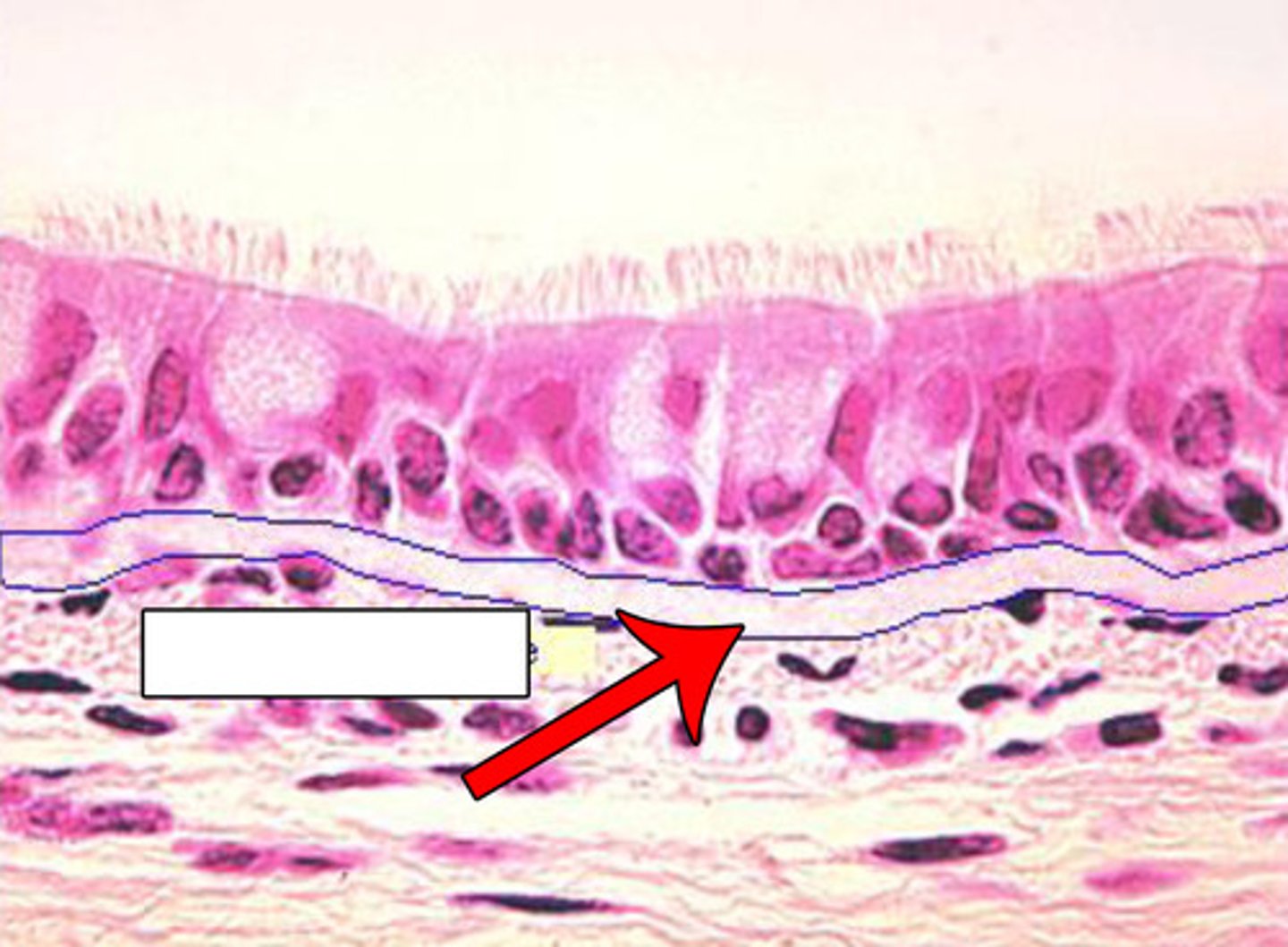
Basement membrane
what anchors the epithelium to the connective tissue below it
Collagen
Laminin
Heparin sulfate
glycoproteins
what is the basement layer made up of?
Basal surface
surface of an epithelial cell that faces the basement membrane
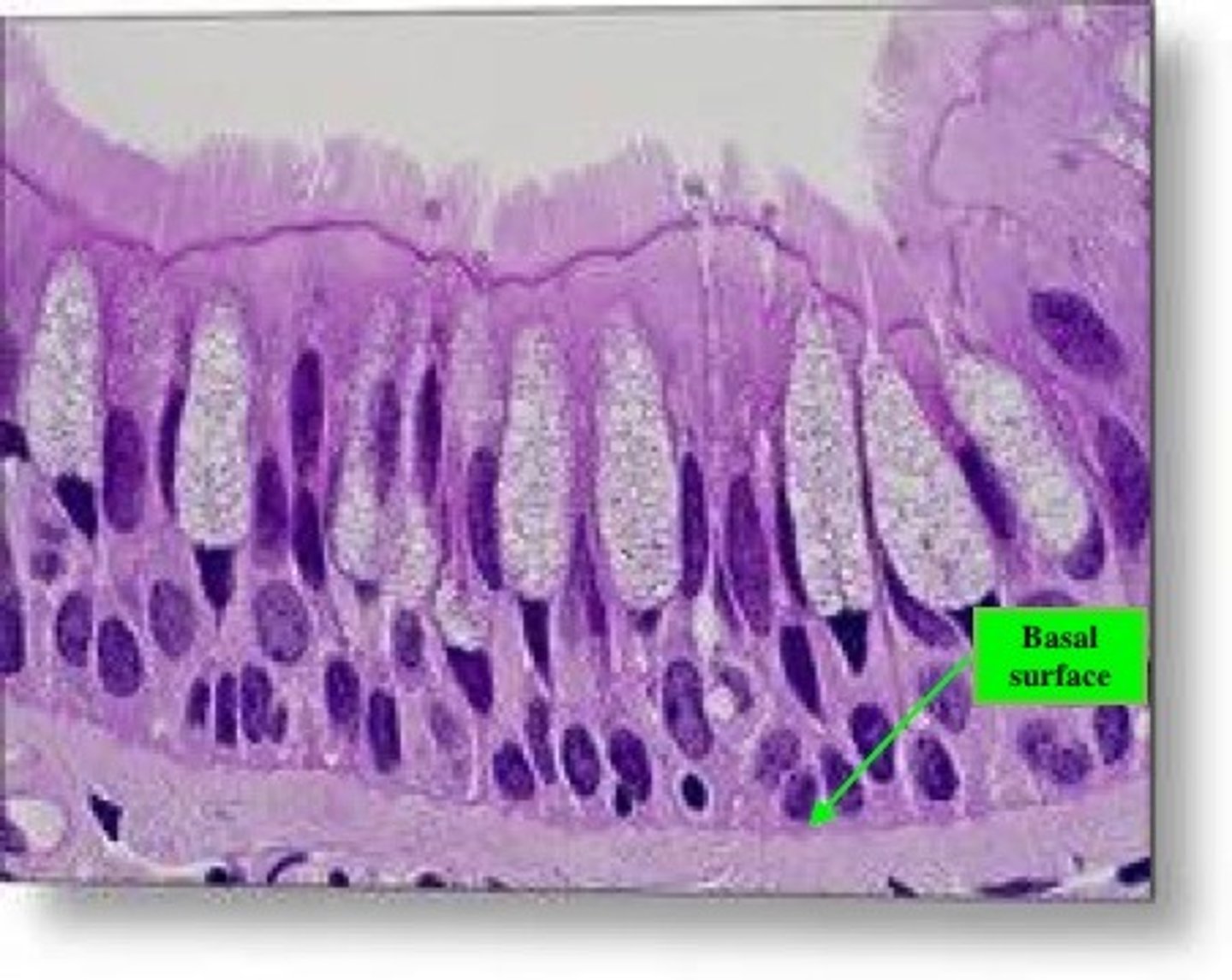
Apical surface
surface of an epithelial cell that faces away from the basement membrane
one layer of cells
named by shape of cells
All cells touch the basement membrane
what factors make up a simple epithelium
Contains more than one layer
Named by shape of apical cells
Some cells rest on top of others and do not touch basement membrane
what factors make up a stratified epithelium
Simple squamous
Simple cuboidal
Simple columnar
Pseudostratified columnar
what are the four types of simple epithelia?
Simple squamous
Simple cuboidal
Simple columnar
what simple epithelia is named for their shape?
not all cells reach the apical surface
Shorter cells are covered over by taller ones
Looks stratified
Every cell reaches the basement membrane
what are some characteristics of pseudostratified columnar epithelia?
Goblet cells
wineglass-shaped mucus-secreting cells in simple columnar and pseudostratified epithelia
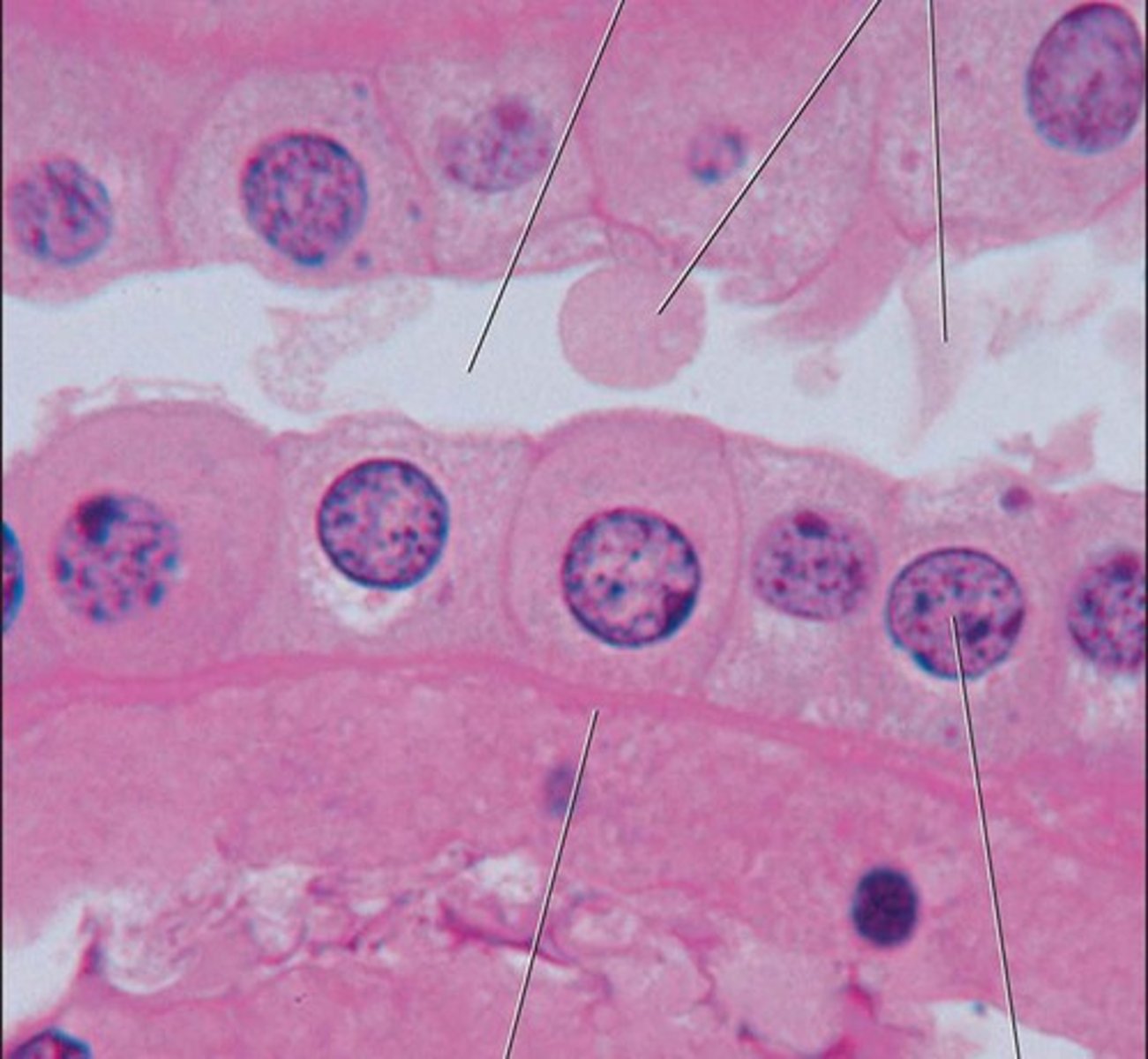
cuboidal cells
square or round cells
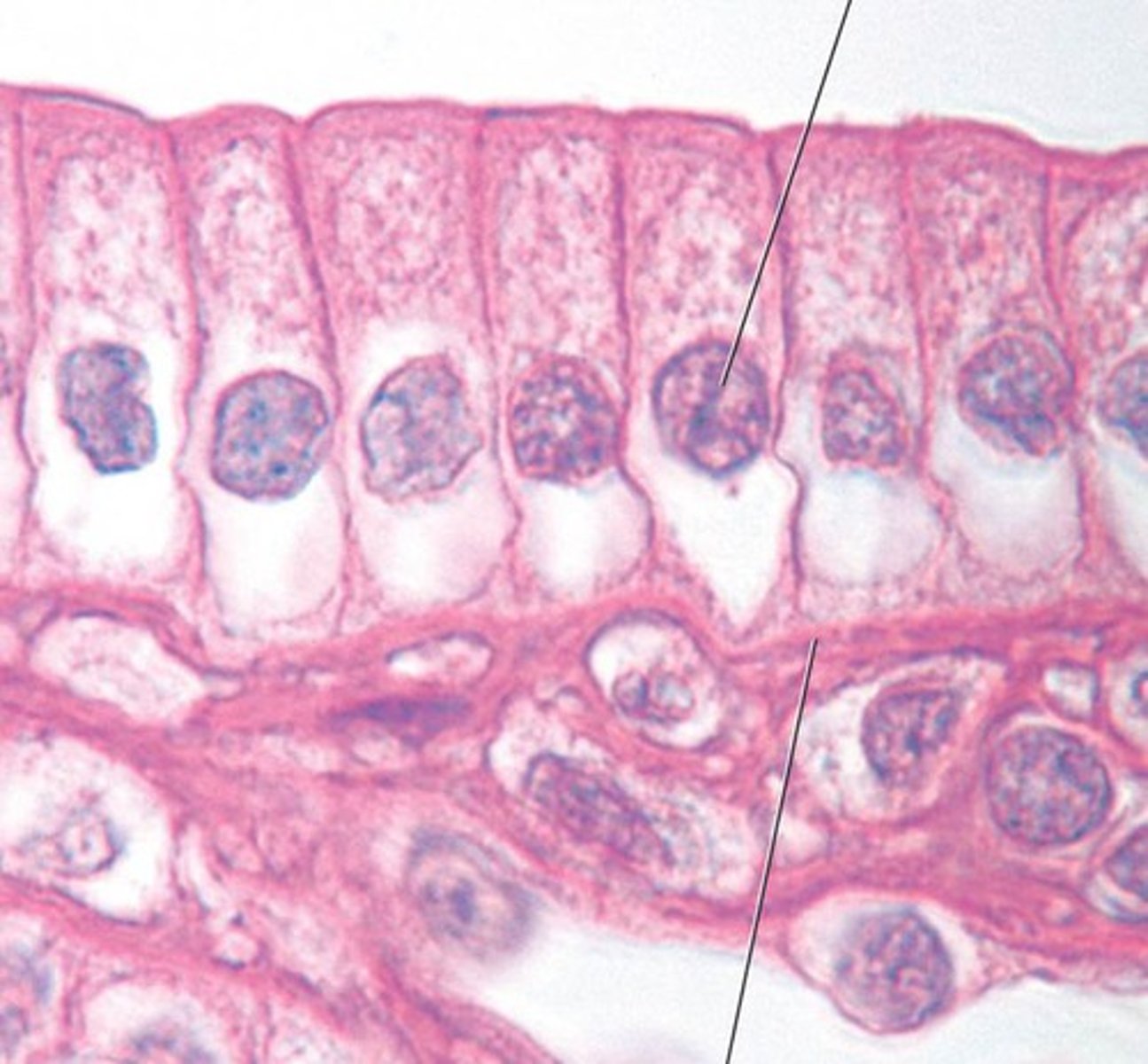
columnar cells
tall, narrow cells
squamous cells
thin, scaly cells
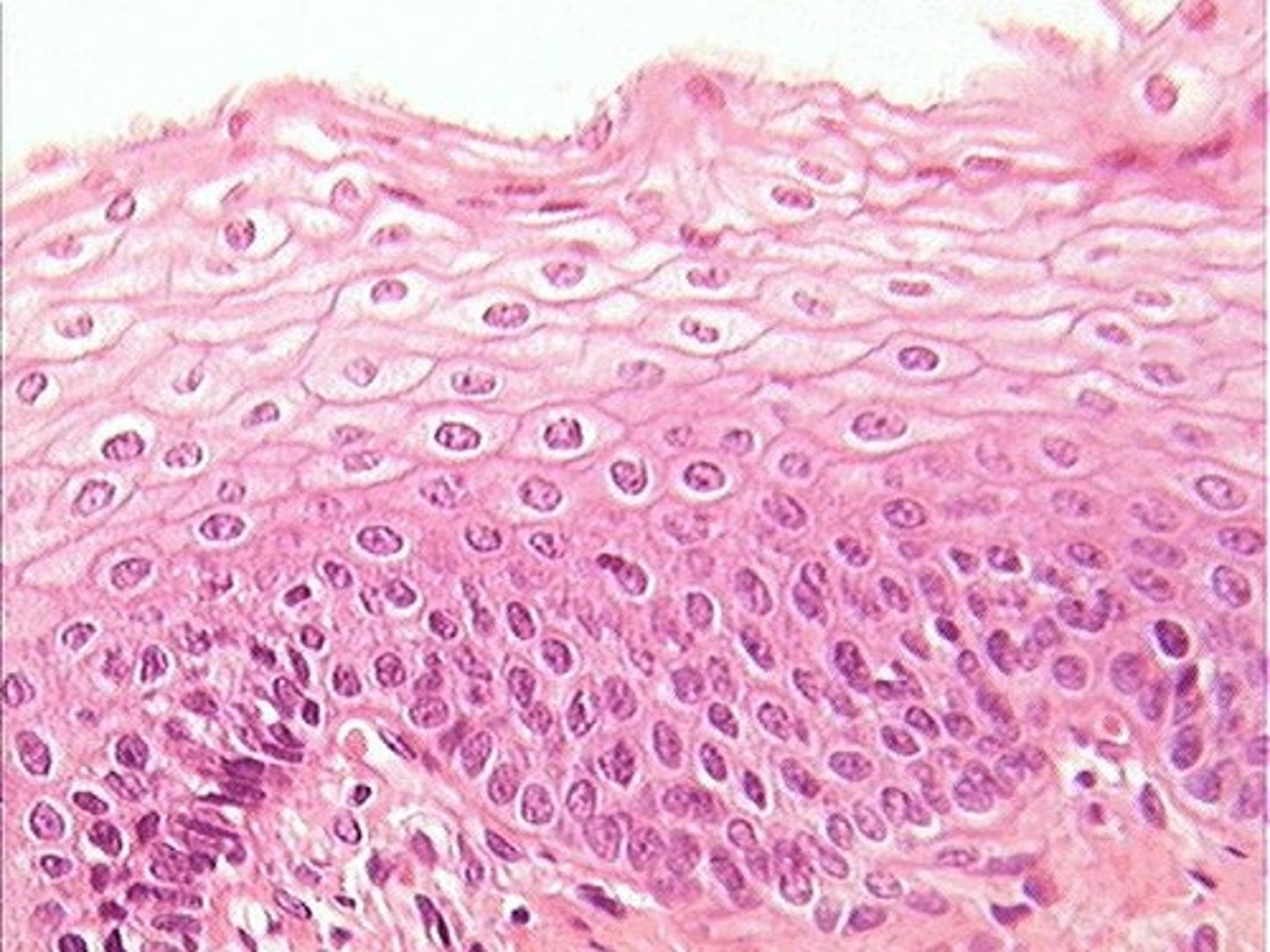
Permits rapid diffusion /transport of substances
Secretes serous fluid
what do simple squamous epithelium do
Absorption and secretion, mucus production and movement
what do simple cuboidal epithelium do
Liver, thyroid, mammary and salivary glands, and kidneys tubules
Where is simple cuboidal epithelium found?
Simple columnar epithelium
Oval nuclei in basal half of cell and Absorption and secretion; secretion of mucus
Simple columnar epithelium
Brush border of microvilli, ciliated in some organs, may possess goblet cells
Simple columnar epithelium
Lining of GI tract, uterus, kidney, and uterine tubes
Pseudostratified epithelium
- With cilia and goblet cells
- Secretes and propels mucus
- Respiratory tract and portions of male urethra
Range from 2 to 20 or more layers of cells
Some cells resting directly on others and not all touch basement membrane
what are some characteristics of Stratified Epithelia?
Stratified squamous
Stratified cuboidal
Stratified columnar (rare)
Transitional epithelium
what are the four names of stratified epithelia?
Stratified Epithelium
what is the most widespread epithelium in the body?
Mitosis
Deepest layers of epithelium tissue undergoes continuous
flatter
upward
exfoliation
Deepest layers undergo continuous mitosis. Their daughter cells push toward the surface and become ______as they migrate farther ______Finally die and flake off called _____
Keratinized
Nonkeratinized
Two kinds of stratified squamous epithelia
Keratinized
found on skin surface, abrasion resistant (has a waterproof protein)
Nonkeratinized
lacks surface layer of dead cells (inside of mouth)
Keratinized stratified squamous
Multiple cell layers with cells becoming flat and scaly toward surface
Epidermis; palms and soles heavily keratinized
Resists abrasion; retards (holds back) water loss through skin; resists penetration by pathogenic organisms
what does Keratinized stratified squamous epithelium do?
Nonkeratinized stratified squamous
Same as keratinized epithelium without the surface layer of dead cells
Tongue, oral mucosa, esophagus, and vagina
Nonkeratinized stratified squamous are found where
Resists abrasion and penetration of pathogens
both Keratinized and Nonkeratinized stratified squamous do what
Secretes sweat, sperm production and ovarian hormone production
found: Sweat gland ducts; ovarian follicles and seminiferous tubules
Stratified cuboidal epithelium does what and is found where?
Transitional epithelium
Multilayered epithelium surface cells that change from round to flat when stretched
Allows for filling of urinary tract
Ureter and bladder
stratified cuboidal epithelium
Sweat gland ducts; egg-producing vesicles (follicles) of ovaries; sperm-producing ducts (seminiferous tubules) of testis
simple columnar epithelium
Inner lining of stomach, intestines, gallbladder, uterus, and uterine tubes; some kidney tubules
Stratified Squamous Epithelium—Nonkeratinized
"Tongue, oral mucosa, esophagus, anal canal, vagina"
Stratified Squamous Epithelium—Keratinized
Epidermis; palms and soles are especially heavily keratinized
pseudostratified columnar epithelium
Respiratory tract from nasal cavity to bronchi;
simple cuboidal epithelium
Liver, thyroid, mammary, salivary, and other glands; most kidney tubules; bronchioles
simple squamous epithelium
"Air sacs (alveoli) of lungs; glomerular capsules of kidneys; some kidney tubules; inner lining (endothelium) of heart and blood vessels; serous membranes of stomach, intestines, and some other viscera; surface mesothelium of pleura, pericardium, peritoneum, and mesenteries"
Connective tissue
a type of tissue in which cells usually occupy less space than the extracellular material
Connective tissue
Binds organs to each other, supports and protects organs
in direct contact
Most cells of connective tissue are not _________ with each other
extracellular material
Most cells of connective tissue
are Separated by
Highly vascular
connective tissues are
richly supplied with blood vessels
what does highly vascular mean
Connective tissue
Most abundant, widely distributed, and histologically variable of the primary tissues
Binding of organs
Support
Physical protection
Immune protection
Movement
Storage
Heat production
Transport
what do connective tissues do?
Binding of organs
tendons and ligaments
Support
bones and cartilage
Physical protection
cranium, ribs, sternum
Immune protection
white blood cells attack foreign invaders
Movement
bones provide lever system
Storage
fat, calcium, phosphorus
Heat production
metabolism of brown fat in infants
Transport
blood
fibers and ground substance
Fibroblasts produce what
Macrophages
Amoeboid cells that roam connective tissue and engulf foreign particles and debris of dead cells.
Macrophages
Arise from white blood cells called monocytes
Leukocytes
white blood cells
Neutrophils attacking bacteria
react against bacteria, toxins, and other foreign material
What do Leukocytes, or white blood cells mainly
synthesize disease-fighting antibodies
come from lymphocytes
Plasma cells do what and come from what
blood vessels
Mast cells are found alongside
mast cells
Cells that release chemicals (such as histamine) that promote inflammation and inhibit clotting
Adipocytes
what stores triglycerides (fat molecules)
collagenous, reticular, and elastic fibers
what are the 3 different types of fibers?
Collogin
what are all three fibers made up of?
collagenous
thick collagen fibers
Most abundant of the body's proteins—25%
Tough, flexible, and resist stretching
Less visible in matrix of cartilage and bone
collagen and Collagenous fibers
Tendons, ligaments, and deep layer of the skin are mostly
Reticular fibers
•Thin collagen fibers coated with glycoprotein (not made for strength)
• made for filtration
• Form framework of such organs as spleen and lymph nodes
Elastic fibers
• Thinner than collagenous fibers
• Branch and rejoin each other
• Made of protein called elastin
• Allows stretch and recoil
• Yellow fibers—fresh elastic fibers
elastin
Elastic fibers are made out of proteins called
Ground substance
Usually a gelatinous to rubbery consistency resulting from three classes of large molecules
fibrous conective tissue
tissue that has fibers
loose connective tissue
much of the space is occupied by ground substance
• Areolar
• Reticular
what are the two types of loose connective tissues?