2.1-2.8 Alkali metals and Halogens
 Call Kai
 Learn
Learn Practice Test
 Spaced Repetition
 Match
Match Flashcards
 Knowt Play
1/23

There's no tags or description
Looks like no tags are added yet.
Name | Mastery | Learn | Test | Matching | Spaced | Call with Kai |
|---|
No analytics yet
Send a link to your students to track their progress
24 Terms
Name the first 5 elements in Group 1
Lithium, sodium, potassium, rubidium, caesium
Which three elements are unusually soft and more reactive than calcium?
Lithium, sodium and potassium
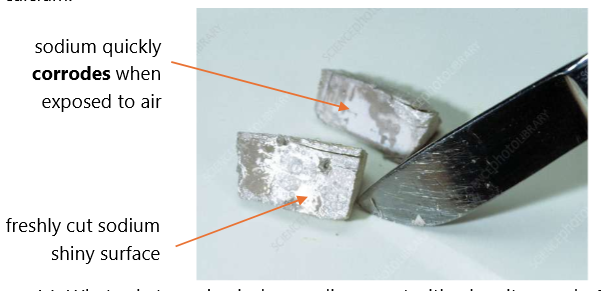
What happens when sodium is cut open?
Sodium corrodes quickly when exposed to air
The freshly cut surface of sodium is shiny
Why are lithium, sodium and potassium all stored in paraffin oil?
To prevent reaction with oxygen in the air
What are the products of metal and water reacting together?
Metal + water → metal hydroxide solution + hydrogen
What pH are metal hydroxide solutions?
They are STRONGLY ALKALINE
What can we observe when lithium reacts with water?
Fizzing/effervescence
Metal floats and moves on the surface
Metal gets smaller and eventually disappears
What can we observe when sodium reacts with water?
Fizzing/effervescence
Metal floats and moves on the surface
Metal gets smaller and eventually disappears
It also MELTS into a ball
And forms a WHITE TRAIL on the surface
What can we observe when potassium reacts with water?
Fizzing/effervescence
Metal floats and moves on the surface
Metal gets smaller and eventually disappears
It also MELTS into a ball
And forms a WHITE TRAIL on the surface
AND it produces a lilac flame
Describe the trend in the reactivity of the metals in group 1
Reactivity increases as you go down Group 1
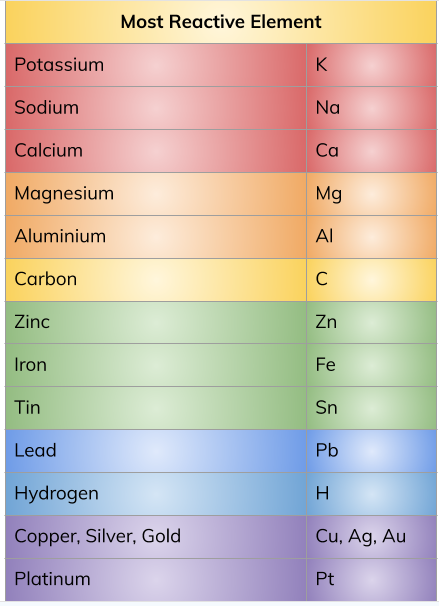
What is the reactivity series of metals (most reactive to least)
Potassium
Sodium
LIthium
Calcium
Magnesium
Aluminium
Zinc
Iron
Copper
Silver
Gold
Why is sodium more reactive than lithium?
Outer shell electrons are further away from the nucleus
Weaker force of attraction between the nucleus and the outermost electrons
Lost more easily
Why can a demonstration of caesium with water not be carried out in school?
Caesium is much more reactive than potassium, so it reacts explosively
What are the first 4 elements in Group 7?
Fluorine, chlorine, bromine and iodine
Which halogens are gases at room temperature?
Fluorine and chlorine
Which halogen(s) are liquid at room temp?
Bromine
Which halogen(s) are solid at room temp?
Iodine
Describe the trend of melting and boiling points in the halogens
Melting and boiling points increase down the group
Explain the trend of melting and boiling points in the halogens
Molecules get bigger, contain more electrons
Forces of attraction between molecules gets stronger
More energy is needed to overcome them
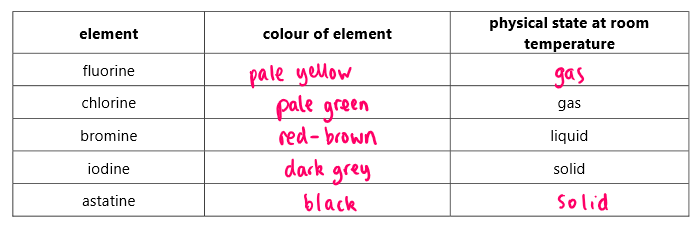
Describe what fluorine looks like at room temperature
Pale yellow gas
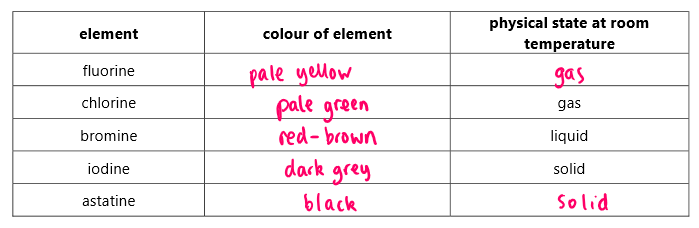
Describe what chlorine looks like a room temperature
Pale green gas
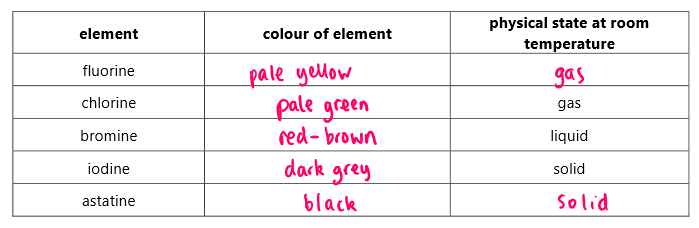
Describe what bromine looks like a room temperature
Red-brown liquid
Describe what iodine looks like at room temperature
Dark grey solid
Describe what astatine looks like at room temperature
Black solid