Acoustics, monitoring, leads and signals
 Call Kai
 Learn
Learn Practice Test
 Spaced Repetition
 Match
Match Flashcards
 Knowt Play
1/21

There's no tags or description
Looks like no tags are added yet.
Name | Mastery | Learn | Test | Matching | Spaced | Call with Kai |
|---|
No analytics yet
Send a link to your students to track their progress
22 Terms
ACOUSTICS: What do surfaces in a room do?
Absorb, reflect and diffuse sound.
What will a room with lots of hard surfaces (eg glass, painted concrete) sound like?
This room will be very reflective.
Therefore there is a long reverb time (RT60).
What will a room with lots of soft surfaces (eg carpets, curtains, sofas) sound like?
Will be less reflective so not much reverb.
What’s the difference between a small room and a big room in terms of sound?
Small room - short pre-delay
Large room - long pre-delay
What can acoustic treatment do?
Control reverberations and reflections of sound to ensure accurate capture and monitoring of audio without unwanted colouration from the room.
What are the two main types of room treatment?
Absorption
Diffusion
Explain absorption
The surface soaks up (absorbs) sound energy.
This reduces reverb.
Examples - acoustic foam, acoustic panels, ceiling clouds, acoustic curtains
Explain diffusion
Diffusers scatter sound energy in multiple directions - creating a more ‘lively’ feel (they don’t increase reverb).
Examples - Quadratic residue diffusers, skyline diffusers
What issues can these forms of acoustic treatment solve?
Flutter echoes
Standing waves
Comb filtering
What are standing waves?
Wave patterns that appear to stay in one position, rather than traveling.
They’re formed by the interference of two waves with identical frequency and amplitude traveling in opposite directions.
What two problems can standing waves cause?
Phase cancellation
Increase in amplitude for a sound wave at a specific frequency
What are isolation booths?
Rooms within a room that isolate performers.
These stop spill of other instruments and spill from the musician in the isolation booth.
These are normally acoustically treated and insulated.
What are two uses of isolation booths?
Recording drums - because their loud volume can spill onto other tracks
Recording vocals - need the most isolation to completely avoid spill
What type of response do studio monitor speakers have?
A relatively flat frequency response.
This means that they don’t emphasise certain frequencies.
What’s the problem with mixing on speakers that aren’t completely accurate?
Some frequencies will be louder or quieter than they should be.
When played on good speakers, the problem frequencies will either be lacking or over-emphasised.
What is this issue referred to as?
‘Translation’
What are the two seperate speakers that studio monitors usually have?
A tweeter
A woofer
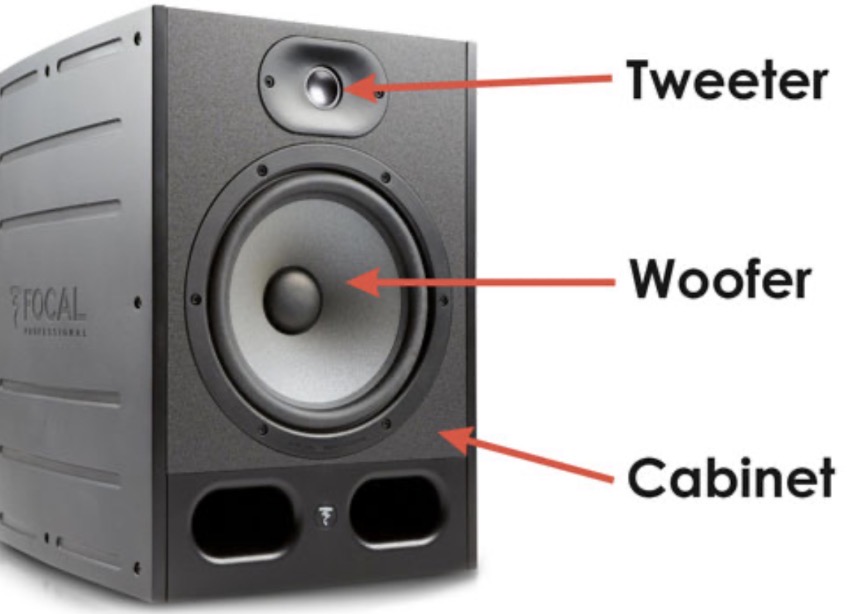
What is the function of these?
The tweeter handles high frequencies (2kHz-20kHz).
The woofer handles everything below this.
What’s another part that some studio monitors may use?
A sub-woofer - handles very low frequencies (below 100Hz).
What is the function of a crossover?
It separates out the signals from the speakers so that the tweeter doesn’t get any of the signal meant for the woofer.
It works as a series of filters - HPF for the tweeter and LPF for the subwoofer.
What can speakers be described as?
Transducers (similar to mics).
Explain how speakers are able to generate sound.
They go through the process of electromagnetic induction:
An electrical signal hits the coil.
The coil makes the magnet (that it’s attached to) vibrate.
This makes the cone v