Version 2- Public Policy
 Call Kai
 Learn
Learn Practice Test
 Spaced Repetition
 Match
Match Flashcards
 Knowt Play
1/73

There's no tags or description
Looks like no tags are added yet.
Name | Mastery | Learn | Test | Matching | Spaced | Call with Kai |
|---|
No analytics yet
Send a link to your students to track their progress
74 Terms
Public Policy (def)
“A statement by government-at whatever level-of what it intends to do about a policy problem”
-public problem
-in the "public interest"
-goal oreinted
-made by the government
Features of Public Policy
-addresses a public problem
-is done in the "public interest".
-goal-oriented
-made by the government
Inferred/Implied Policy
-Policy is doing something other than what is explicitly stated
ex: Redlining (gov outlines majority Black neighborhoods as hazardous for investment & denies mortgages. Policy docs do not explicitly mention race, but what the policy does is racially target minorities)
-Policy is what the government has said it will not do
ex: 2nd Amendment (gov will not infringe on the right to bear arms)
-Policy is what the government does not say it will do
ex: paid maternity leave (gov has not stated there’s a right to paid maternity leave —> the policy is that you don’t have a right to paid maternity leave)
Symbolic Policy
Policy is designed to send a signal/message, but results in no real government action.
ex law in Kennesaw GA requiring every head-of-household to own a gun
(not enforced, sends a message that the town is safe & the people are armed/will protect themselves)
Negative Policy
NEED TO FIND
Law of Unintended Consequences
Policy sometimes has effects that policy makers do not expect
EX seatbelt laws —> people drive riskier when they feel safer —> more crashes
Policy as Allocation of Goods
policy = a tool to distribute resources
*concerns markets, supply, fairness etc.
-distributive
-regulatory
-redistributive
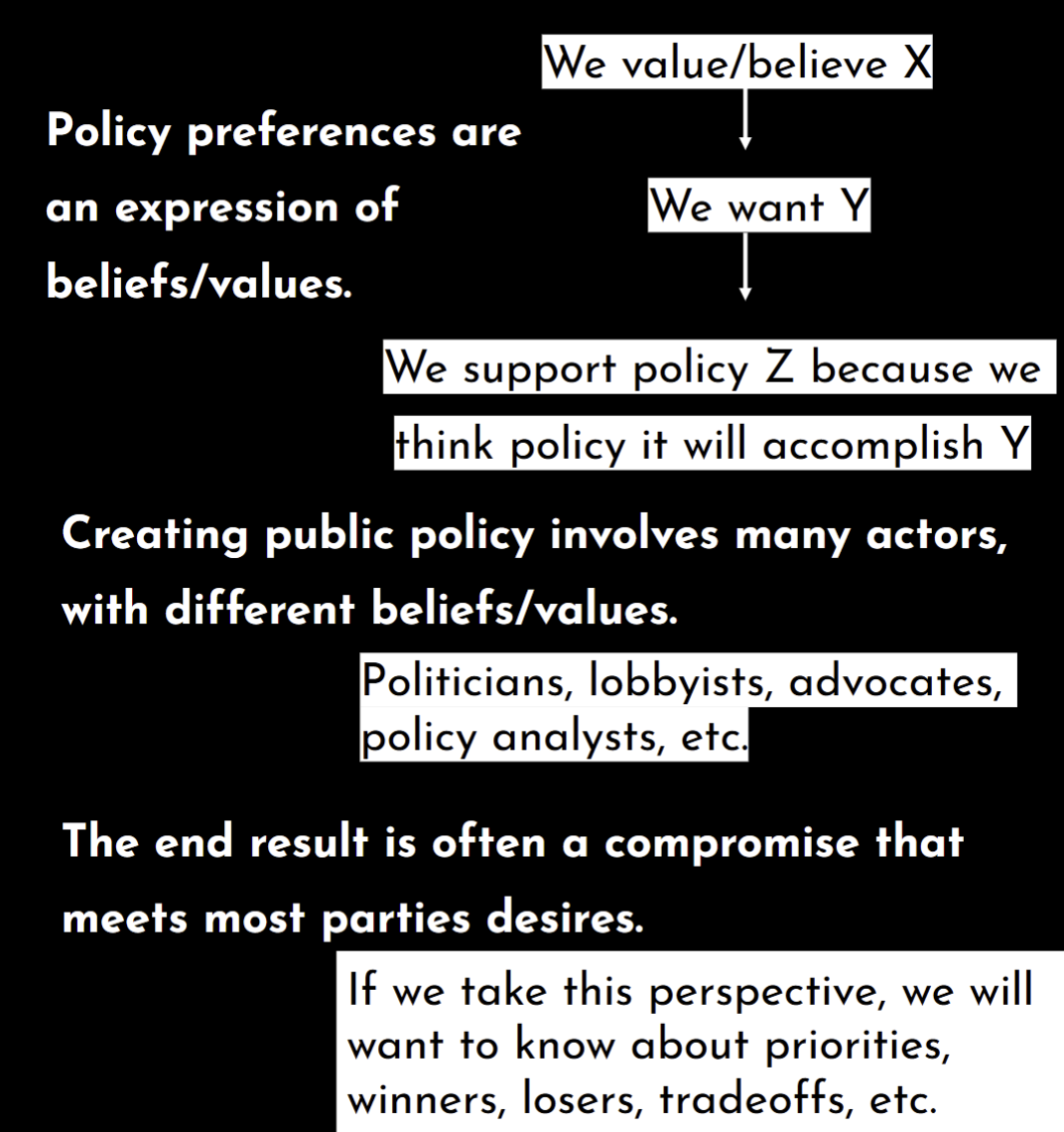
Policy as the Result of Political Process
policy = political change??
expression of values —> goal —> compromise
Policy as Behavior Change
policy = getting people to behave in desired ways
Policy as Outcome
policy = what we want to happen, how we want something to look, policy goal focused
Public Problems vs Policy Problems
a problem affecting the public (a significant portion of the population)
vs
a problem existing in the world analyzed & defined through a policy lens
Public Policy Problem
-unrealized needs, values, or oppurtunities for improvement
-negatively affects (a lot of) people
-usually can’t solve on our own
-something the government should take action on
3 Categories of Rationales for Policy Intervention
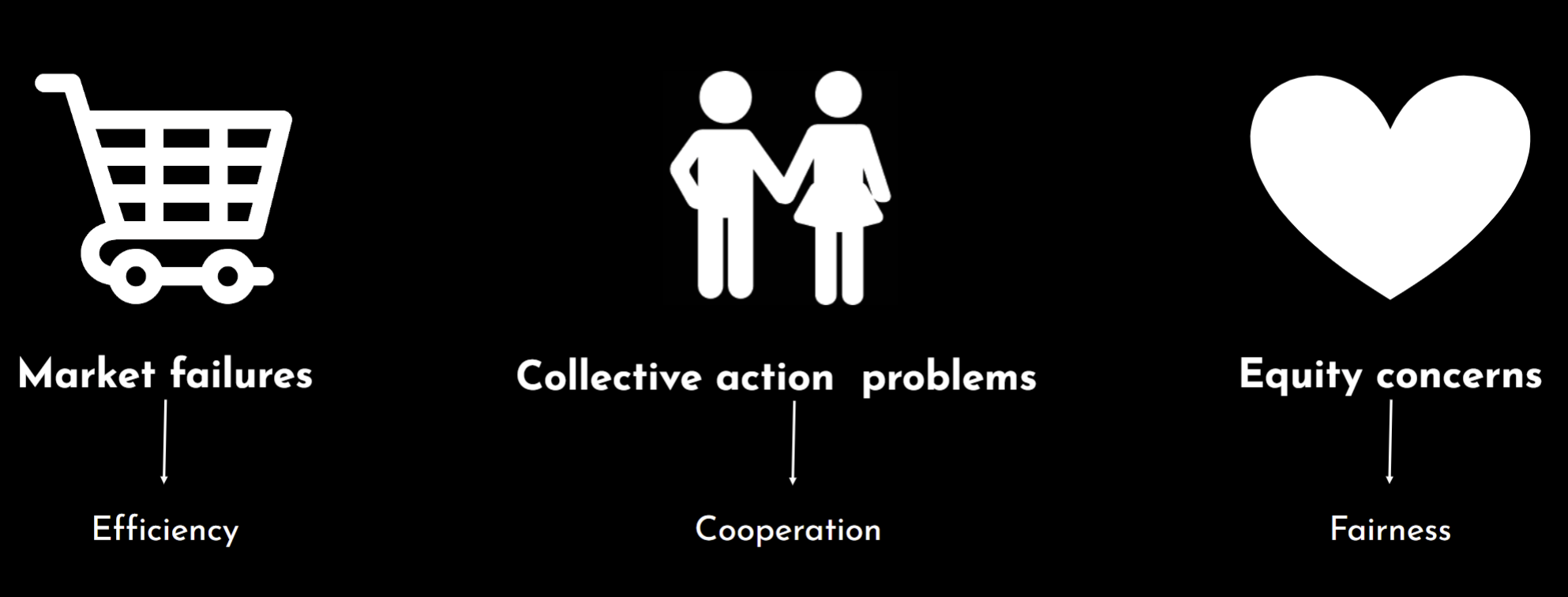
Market Failure
Efficiency Problems
when markets do not allocate goods efficiently.
—> happens when the assumptions of the market are not met
*one of the 3 rationales for policy intervention
types of Market Failure
-externalities
-information asymmetry
-imperfect competition
assumptions of the market
-all parties have complete & perfect information
-all costs & benefits are reflected in prices
-terms of the exchange & property rights to the good are specified
-preferences are sincere (people pursue their self-interest)
-perfect competition (large # of buyers & sellers)
-no party has too much power over the other
Types of Goods
-common pool goods
-public goods
-private goods
-toll goods
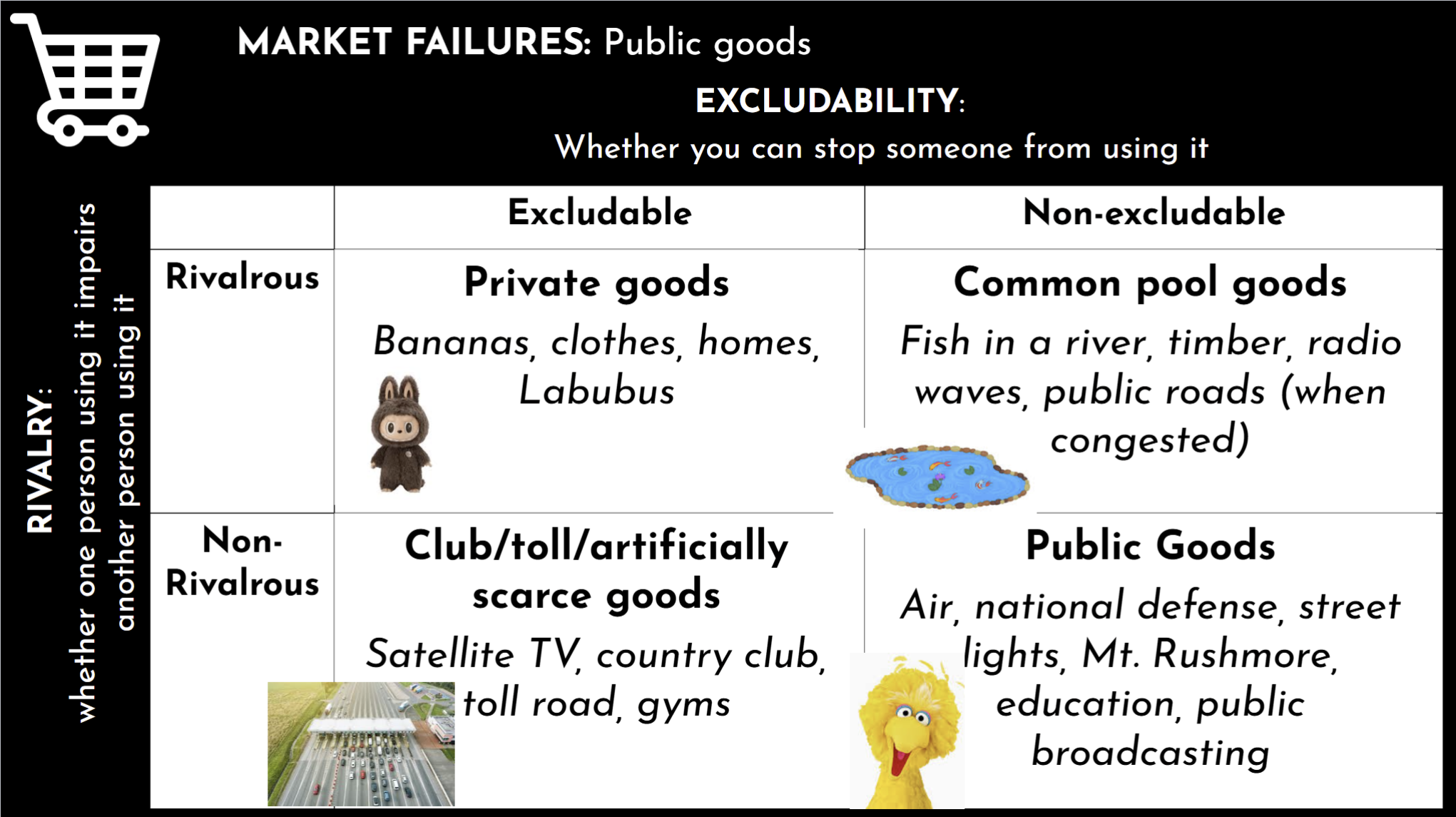
Rivalrous (goods)
use by one party stops or impairs another person from using it.
Excludable (goods)
you can stop someone from using it.
*don’t think too hard about this one… stay away from extreme scenarios
Private Goods
left to market regulation (mostly)
information assymetry, imperfect competition—>intervention
excludable & rivalrous… can stop me from using it, my use impairs others from using it
examples: store bananas, clothes, homes,
Common Pool Goods
sometimes require policy intervention.
tragedy of the commons —> intervention
non-excludable & rivalrous… can’t stop me from using it, my use impairs others using it
examples: fish in a river, timber, radio waves, congested public roads
Club/Toll/Artificially Scarce Goods
externalities, imperfect competition (monopolies)—> intervention
excludable & non-rivalrous… can stop me from using it, my use doesn’t impair others from using it
examples: Satellite TV, gym, toll roads
*can become rivalrous (—> private good) through congestion
Public Goods
automatic market failure —> rationale for policy intervention
-benefits are not captured by the price
-market undersupplies —> gov must supply
-non-excludable —> free rider problem
non-excludable & non-rivalrous… can’t stop me from using it, my use doesn’t impair others from using it
examples: wild tree banana, air, national defense, street lights, education, public broadcasting, trafficless roads,
*can become rivalrous (—> common pool good) through congestion
Externalities
A market failure where the price of a good fails to reflect all of the costs and benefits to society. Parties outside of an exchange are affected by the exchange.
-positive: getting vaccinated, a beekeeper sells honey & his bees are pollinating plants in the neighborhood to make that honey, pulling weeds in your yard prevents them from spreading to others’,
-negative: second-hand smoke, pollution, antibiotic resistance,
Information Asymmetry
buyers and/or sellers (mainly buyers) do not have enough accurate information to maximize their self-interest in an exchange.
-people lack the time and ability to gather information
-people may withhold information as a strategy
…a market failure —> rationale for policy intervention
Imperfect Competition
There are not enough sellers for proper competition. Markets require large numbers of buyers & sellers.
-Entrance to the market is rarely free
-Existing firms resist competition
-Skills and training are needed to truly compete
-Existence of natural monopolies
Market Failure —> Rationale for Policy Intervention
Collective Action Problems
Cooperation Problems
when individuals fail to work together for the common good or when self-interested action produces outcomes that are not good for the collective.
*one of the 3 rationales for policy intervention
types of Collective Action Problems
-tragedy of the commons
-free rider problem
-coordination
-prisoner’s dilemma
Free Rider Problem
People will not pay because they can benefit from the public good without paying for it.
collective action problem —> reason for policy intervention
example: public television, public parks, fare dodging on public transit,
Tragedy of the Commons
Individuals acting in their own self interest will overuse and deplete a common resource because they cannot be excluded from it.
collective action problem —> reason for policy intervention
example: “please take one” Halloween candy, lumber in a forest, fish in a pond/river,
Coordination
People can’t coordinate on their own
collective action problem —> reason for policy intervention
example: painted lanes on roads
Prisoner’s Dilemma
It would be beneficial for individuals to cooperate, but they don’t because of how they expect others to behave.
collective action problem —> reason for policy intervention
examples: international arms race, global climate change,
Equity Concerns (reason for policy intervention)
Fairness Problems
We care about fairness and the well-being of people, but benefits and burdens are not equally distributed.
*one of the 3 rationales for policy intervention
types of Equity Concerns (reason for policy intervention)
-Redistribution
-Public welfare/public health
-Protecting vulnerable populations
-Equality of opportunity
-Paternalism
-Values
Redistribution (reason for policy intervention)
Public policy is needed because markets may be efficient, but not always fair
example: federal income tax
equity concern —> rationale for policy intervention
Social Welfare/Health (reason for policy intervention)
Public policy is needed because we need to maintain a minimum level of human thriving
example: unemployment & disability payments
equity concern—> rationale for policy intervention
Protecting Vulnerable Populations (reason for policy intervention)
example: policy protecting pregnant women, children, decisionally impaired people, prisoners, ex-seats for pregnant women & people with disabilities on public transportation, disability parking,
equity concern—> rationale for policy intervention
Equality of Oppurtunity (reason for policy intervention)
example: laws against employment discrimination, the Civil Rights Act, ADA,
equity concern—> rationale for policy intervention
Paternalism (reason for policy intervention)
Public policy is needed because people do not always
behave in ways that maximize their own self-interest
example: seatbelt laws, soda tax,
equity concern—> rationale for policy intervention
Values (reason for policy intervention)
Public policy is needed to protect and express our _____.
example: right to protest, free speech,
equity concern—> rationale for policy intervention
goals that shape public policy
-equity
-efficiency
-liberty
-welfare
-security
-effectiveness
-feasibility
equity (policy goal)
fairness or justice in the distribution of the policy’s costs, benefits, and risks across population subgroups.
*all sides want fair distribution, but differ in their understanding of what fair looks like
Methods:
-Equality (of opportunity or outcomes)
-Need
-Merit
-Proximity or Availability
-Voting
-Random
-Maximal benefits
efficiency (policy goal)
achieving an objective for the lowest cost
*involves eliminating waste or repetition & streamlining
liberty (policy goal)
protecting personal freedom, and balancing it with the need to prevent harm…
community goals vs individual choice
Paradox: “sometimes curtailing individual liberty may be necessary to preserve a community in which all citizens can be free.”
welfare (policy goal)
meeting peoples needs (especially those in the most need)
debate: objective vs subjective
—>bare minimum needs vs thriving, pursuing happiness, ex cake
security (policy goal)
being and feeling safe from harm.
Managing risks vs giving up stuff like liberty
effectiveness (policy goal)
ability of the policy that is created to meaningfully address the problem it was designed to solve.”
feasibility (policy goal)
whether it is realistically possible to adopt a particular policy solution
*asks if there is…
-political will
-existing infrastructure
-technology
-knowledge, capacity, skill
-trust
trade offs common examples (4/13)
target population (def)
the group of people whose behavior you wish to change with a policy
target population (chart)
4 target populations
advantaged
dependents
contenders
deviants
advantaged (target population)
high power, positive/deserving social construction
the military, businesses/corporations, scientists,
dependents (target population)
low power, positive/deserving social construction
children, refugees, the poor, people with disabilities,
deviants (target population)
low power, negative/undeserving social construction
criminals, fraudsters,
contenders (target population)
high power, negative/undeserving social construction
big unions, the 1%
social construction
beliefs about groups of people that are formed and contested by…
-Personal experiences
-Media
-Art
-Popular culture
-Religion
-Public figures
-Science
The Policy Process (chart)
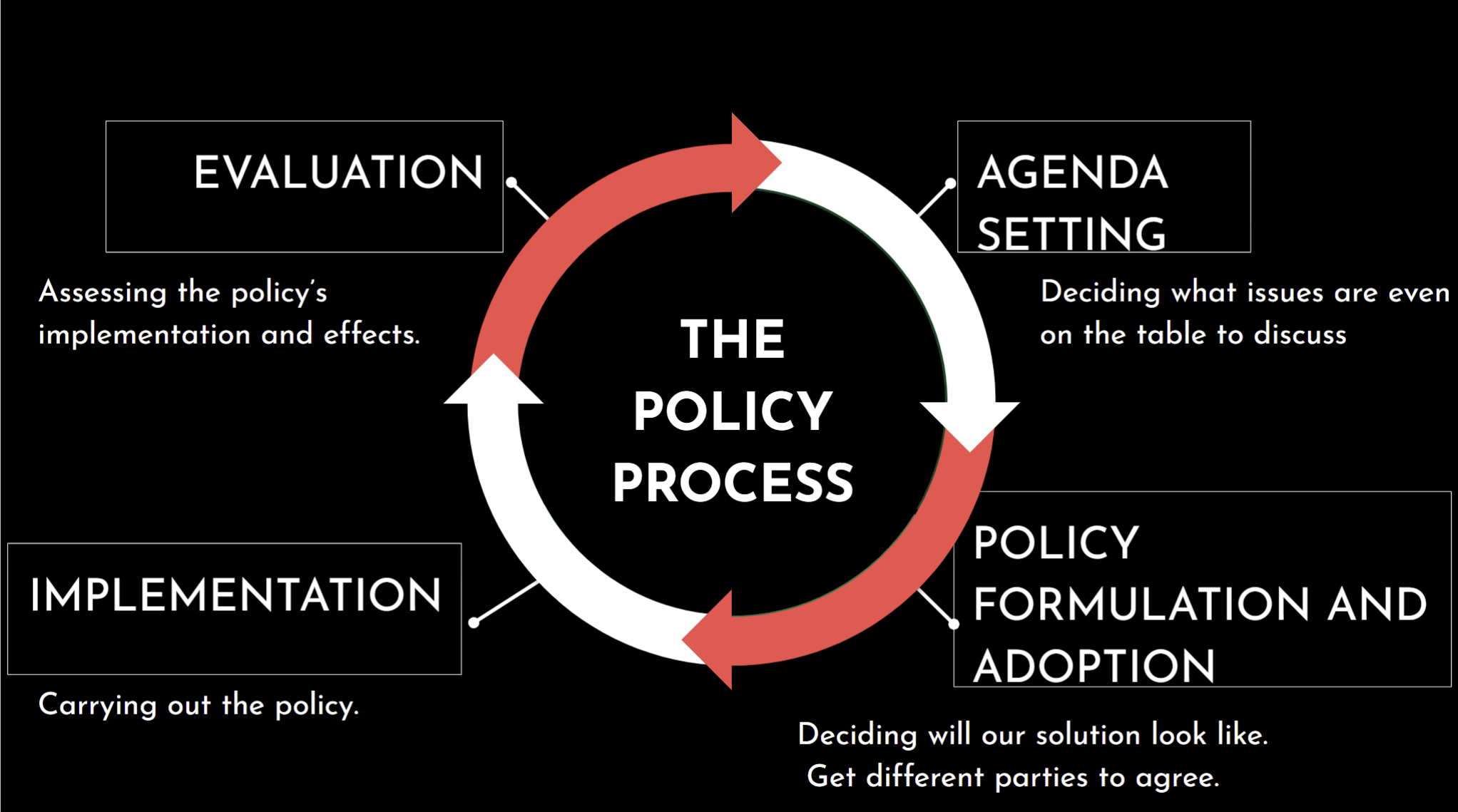
policy actors
-elected officials
-agency leaders
-corporate representatives
-interest groups & advocacy coalitions
-the general public
interest groups
-Organized groups of individuals/organizations coming together to advocate for a common cause.
-Often specialize in a specific domain, advocacy method, or policy issue
—> lobbying, public opinion, education, research
-Multiple interest groups or other policy actors join together to form advocacy coalitions: looser networks of actors working towards a common cause
EX AARP, NRA, MADD,
*pretty powerful as a policy actor
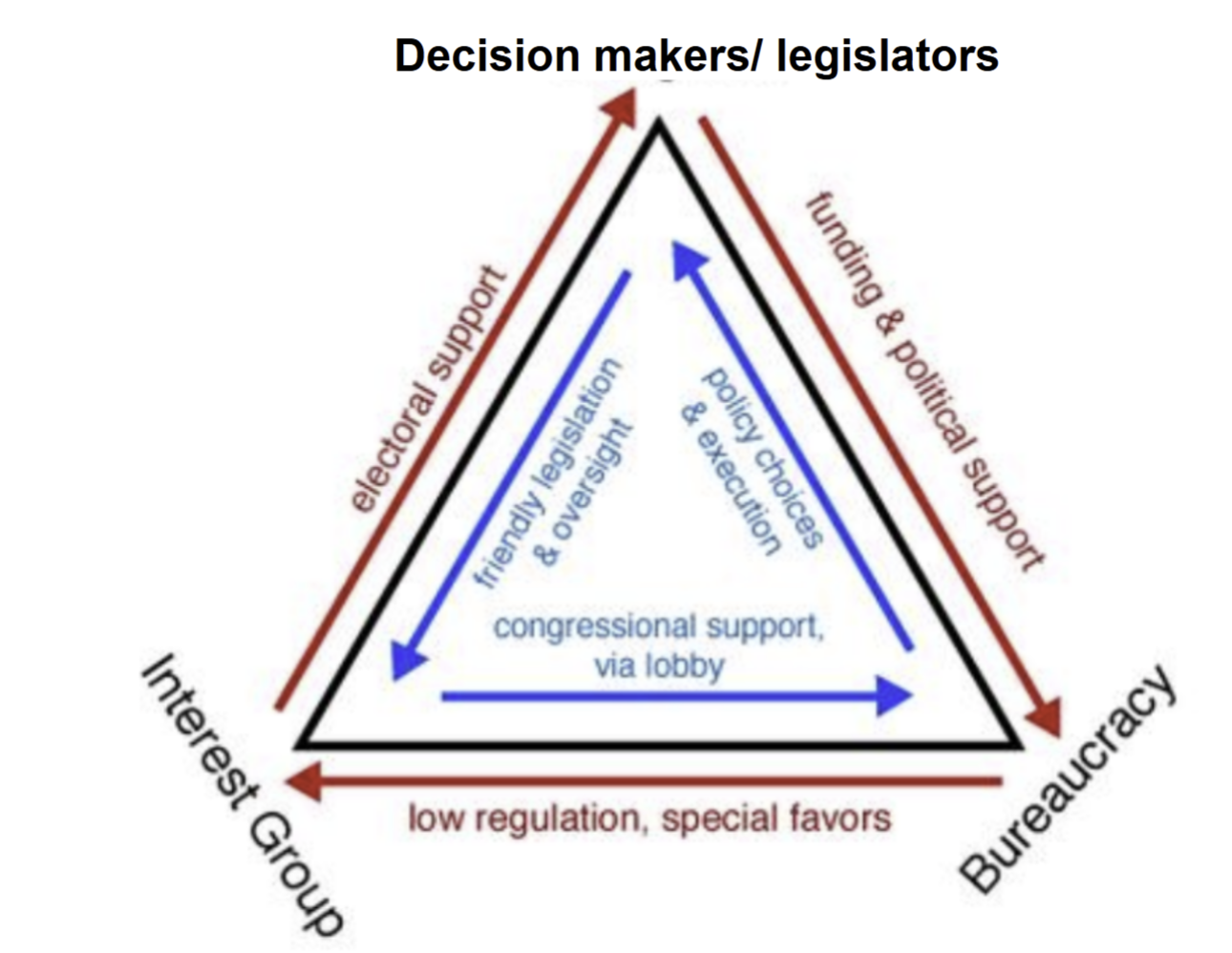
Policy Monopoly / Iron Triangle
a stable arrangement where both decision-makers, bureaucracy, and interest groups are satisfied with the current state of affairs/negotiation.
→ becomes a status quo, and policy change is very difficult to make happen
examples:
-FDA, pharma companies, legislators, (commerce, science, health)
-Defense, defense contractors, legislators, (defense, veterans)
-U.S. Dept. of Energy, energy companies, legislators (energy)
Policy Monopoly / Iron Triangle (diagram)
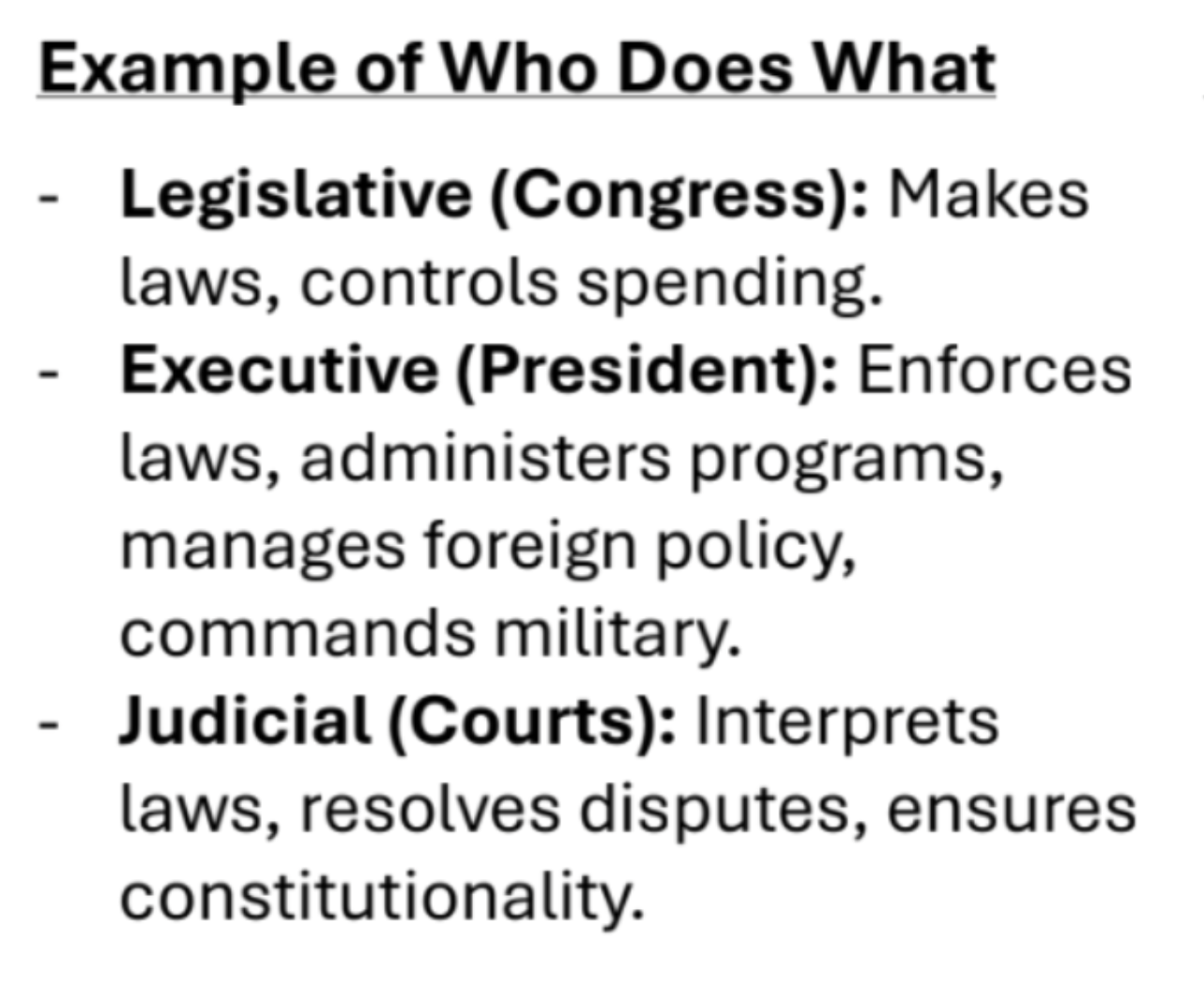
3 branches of government and their functions
Legislative- makes laws, passes regulations, and handles appropriations
Executive- administers and enforces laws
Judicial- interprets laws, applies them to cases, and exercises judicial review
the historical debate between state power and federal power in US political thought
Jefferson (limited powers of the federal government, limited power of the executive branch, limited government intervention, state control)
Hamilton (strong federal government, state control with cooperation, stronger power in the executive branch, more tolerance for government intervention)
separation of powers
division of government into three distinct branches with separate powers and responsibilities
—> prevents the concentration of powers into one branch
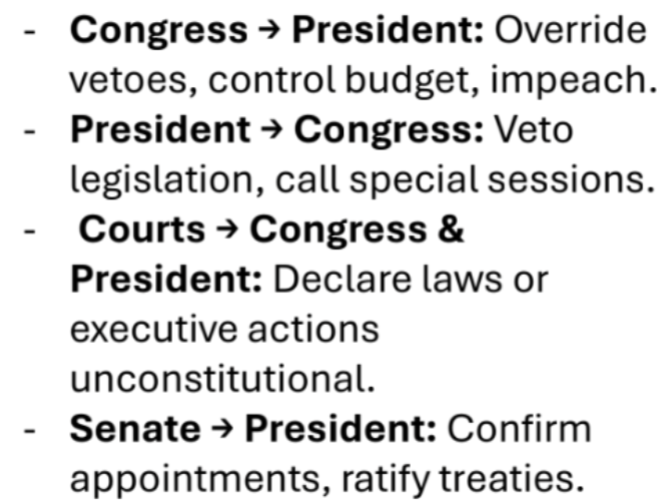
checks and balances
each branch has a too to limit or influence the others, preventing the abuse of power
—>ensures cooporation and accountability across branches
3 levels of government
federal
state
local
shared sovereignty / dual sovereignty / federalism
An organization of government where power is shared between state and federal
enumerated powers
specific authorities granted to the federal government by the U.S. constitution
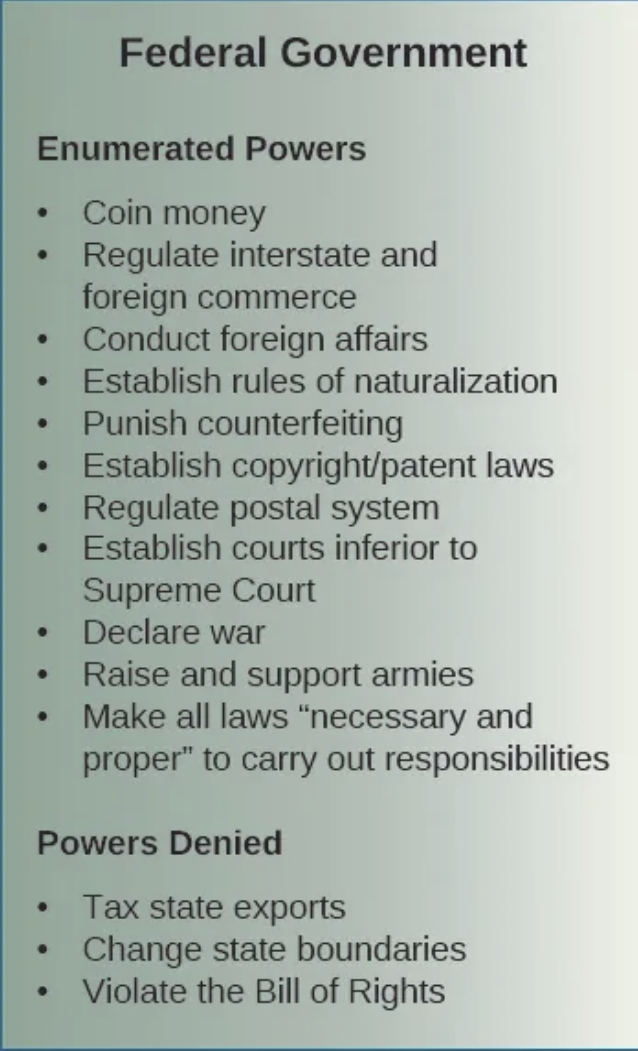
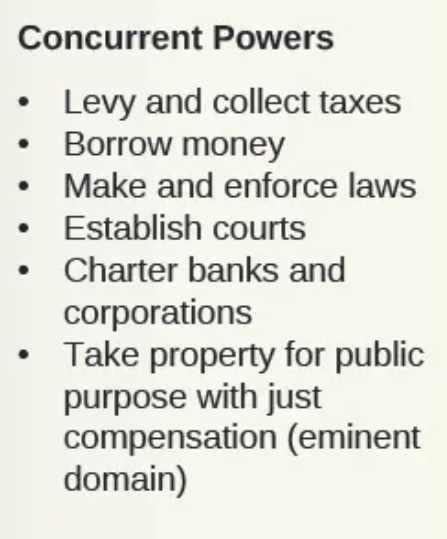
concurrent powers
powers shared by both federal and state governments
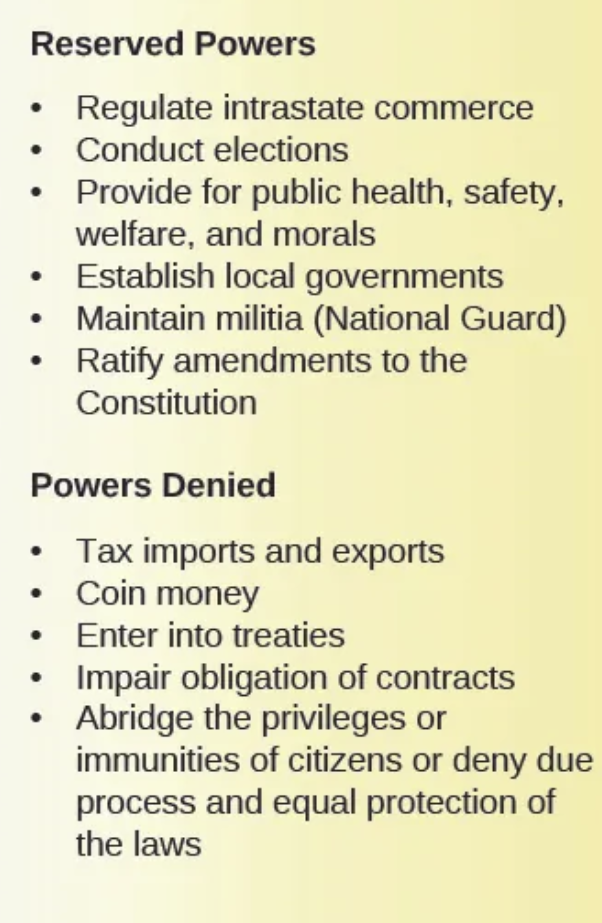
reserved powers
powers reserved to the state governments
■ Explain what state primacy is
■ Explain what federal supremacy is
How do states and local governments share power?
■ Explain the general difference between Dillon’s rule vs. home rule in shaping local
government power
● What are the three models of federalism?
○ Dual federalism, cooperative federalism, new federalism
○ Explain the
● Define fiscal federalism
○ What is an unfunded mandate?
state primacy
• Protects against federal overreach
• States govern the bulk of our lives
• Enables innovation
• Federal government allows latitude
federal supremacy
-If conflict, federal law is supreme
• Doctrine of preemption –superiority of higher authorities
• Intent to preempt must be clear